Keep ahead of the pack
Join our mailing list and be the first to hear our latest news and biggest announcements.
By signing up you agree to our privacy policy. You can unsubscribe at any time.
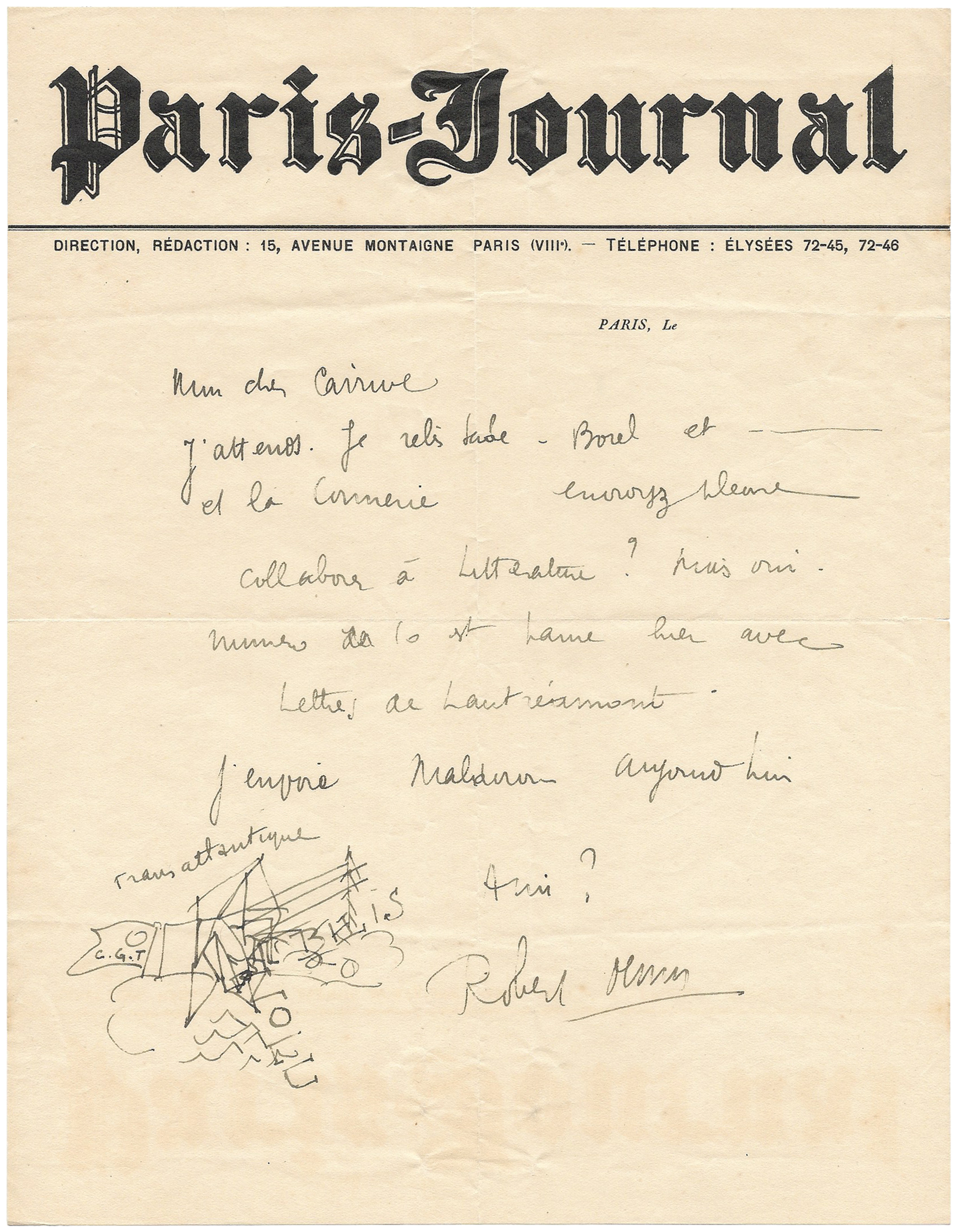
Autograph letter signed « Robert Desnos » to Jean Carrive
N.p.n.d. [Paris, 15 May 1923], 1 p. in-4°
« I’m rereading Sade — Borel and… and stupidity »
Autograph letter signed « Robert Desnos » to Jean Carrive
N.p.n.d. [Paris, 15 May 1923], 1 p. in-4° in black ink
Paris-Journal letterhead
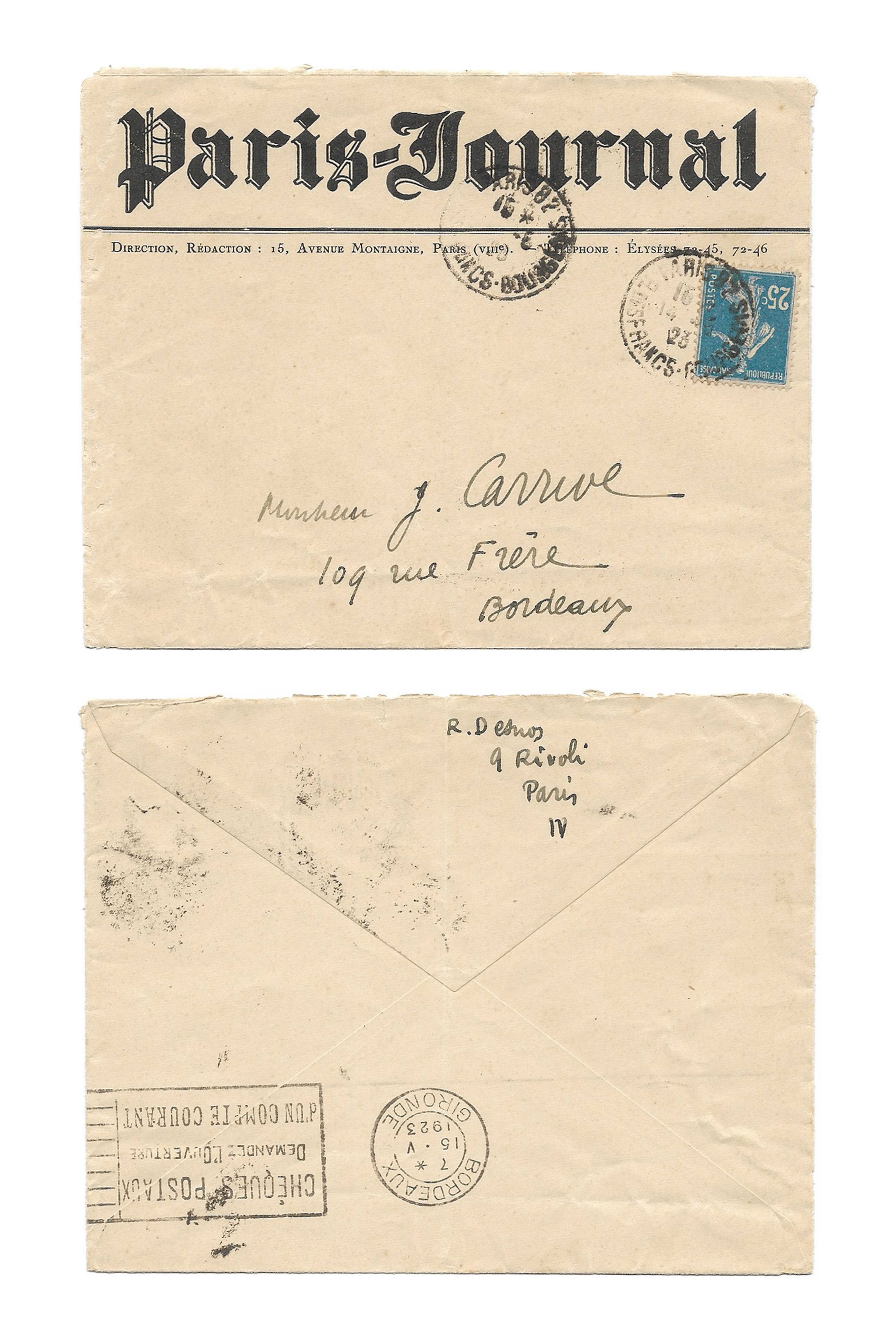
Included: Autograph envelope, stamped and postmarked
Slight tear on fold, one word crossed out by Desnos
Desnos’s Readings and His Contribution to the Journal Littérature
A LETTER ENRICHED WITH A SIBYLLINE DRAWING BY THE POET
« Mon cher Carrive,
J’attends. Je relis Sade – Borel et… et la connerie.
Envoyez please.
Collaborer à Littérature ? [edited by Breton] mais oui.
Numéro de 10 est parue hier avec lettres de Lautréamont.
J’envoie Maldoror aujourd’hui.
Ami ?
Robert Desnos »
An essential medium of the avant-garde founded in 1919, the journal Littérature marked the first bold strokes of the Dadaist trio Aragon-Breton-Soupault. At the height of the Dada movement between 1920 and 1921, the journal benefited from contributions by emerging figures such as Ernst, Picabia, and Tzara. After a one-year hiatus, a second series was launched in the spring of 1922, this time under the direction of the Breton-Soupault duo. It swiftly signaled its definitive break with Dada and welcomed new contributors, including Desnos. The tenth issue, dedicated to Lautréamont, features an introduction by Éluard to the latter’s letters, along with contributions from Aragon, Desnos (with two poems), Picabia, and Breton.
In a letter sent just four days earlier to Pierre Picon, Desnos expressed his admiration for Sade in these terms: “Is it true that you do not like Sade? Surely you do not know him? He is the finest type of all times and all countries.”
Desnos enriched his letter with an original drawing: Titled “Transatlantique”, the drawing connects a ship at sea with a telegraph pole. The ship’s flag bears the initials C.G.T. (Compagnie générale transatlantique), while the word “Volubilis” appears fragmented into two parts, placed both beneath the telegraph wires and on the surface of the waves. This reference alludes to a famous phrase by Desnos—“Le volubilis et je sais l’hypoténuse”—uttered in the presence of André Breton during a hypnotic sleep session on September 28, 1922. Breton had announced, in Littérature, new series, no. 8 (January 1923), the forthcoming publication of a collection titled Poèmes, including an excerpt from Le Volubilis et je sais l’hypoténuse, intended for a very limited print run (five copies) in Barcelona. The work was ultimately published in November 1923, in Clair de terre. The drawing thus symbolically suggests the hoped-for articulation between social commitment and the inherently surrealist dynamic (Cahiers Desnos, ns no. 9, p. 80).
A rebellious Bordeaux student isolated from his family’s conventions, Carrive discovered the journal Littérature at the age of 18 and sought, through André Breton, to join the Parisian avant-garde circle. Wary of this prolific correspondent, Breton often delegated the task of responding to him to Desnos. Between the two young men, an exchange of singular freedom and virulence emerged, where provocation and a taste for literary subversion served as an implicit manifesto. Carrive is listed among the nineteen names in the Manifesto of Surrealism (1924) as having “engaged in absolute surrealism.” He contributed to the twelfth and final issue of La Révolution surréaliste in 1929 before gradually distancing himself from the movement by the late 1920s. André Breton ultimately settled accounts with him, among others, in the Second Manifesto of Surrealism (1930): “Mr. Carrive, incapable of addressing political or sexual issues except through the lens of Gascon terrorism, a poor apologist in the end for Mr. Malraux’s Garine.”
Provenance:
Jean Carrive
Then Charlotte Behrendt-Carrive (1909-2002)
Bibliothèque surréaliste de Jean Carrive, Tajan, 17 nov. 2016, n°416, (Charlotte Carrive’s estate)
Bibliography:
L’Étoile de mer, Cahiers Robert Desnos – 1923, ns n°9, 2020, p.79-80 (Faulty transcription on two words)
Join our mailing list and be the first to hear our latest news and biggest announcements.
By signing up you agree to our privacy policy. You can unsubscribe at any time.