Keep ahead of the pack
Join our mailing list and be the first to hear our latest news and biggest announcements.
By signing up you agree to our privacy policy. You can unsubscribe at any time.
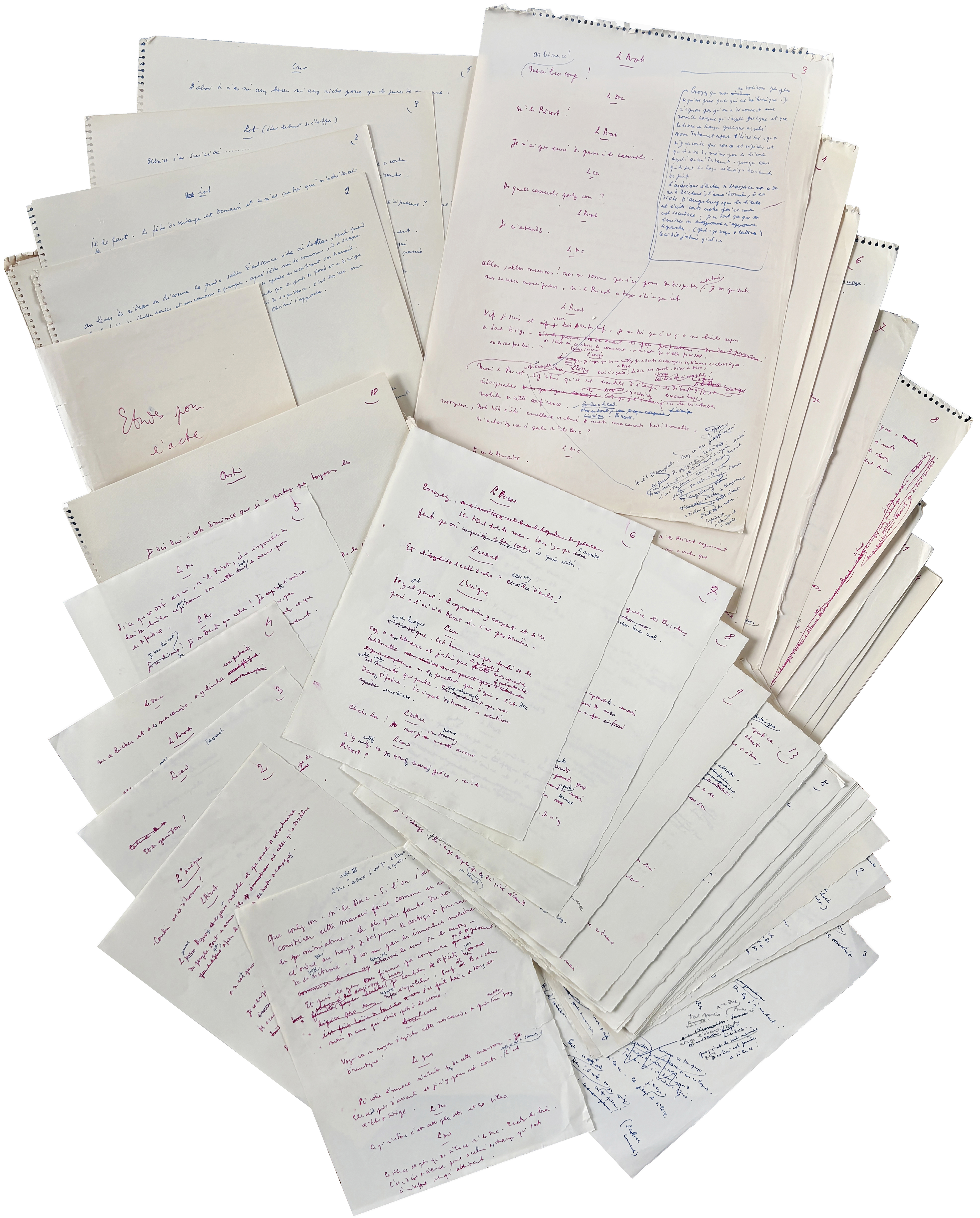
Autograph manuscript signed for Bacchus
[Saint-Jean-Cap-Ferrat, c. 1951], 167 p. in-folio and in-4°
First draft manuscript for Bacchus, Cocteau’s most ambitious play, which caused a scandal
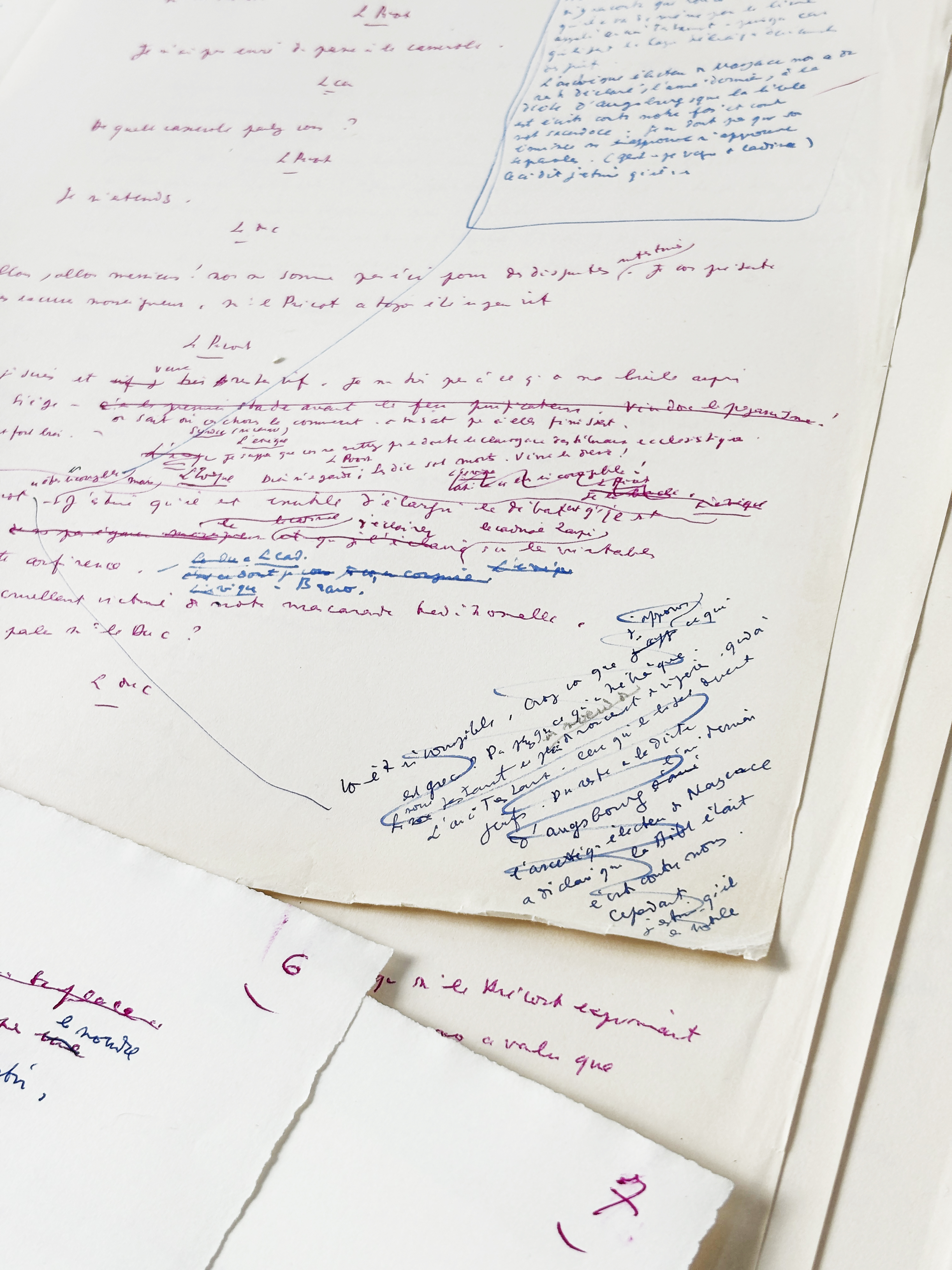
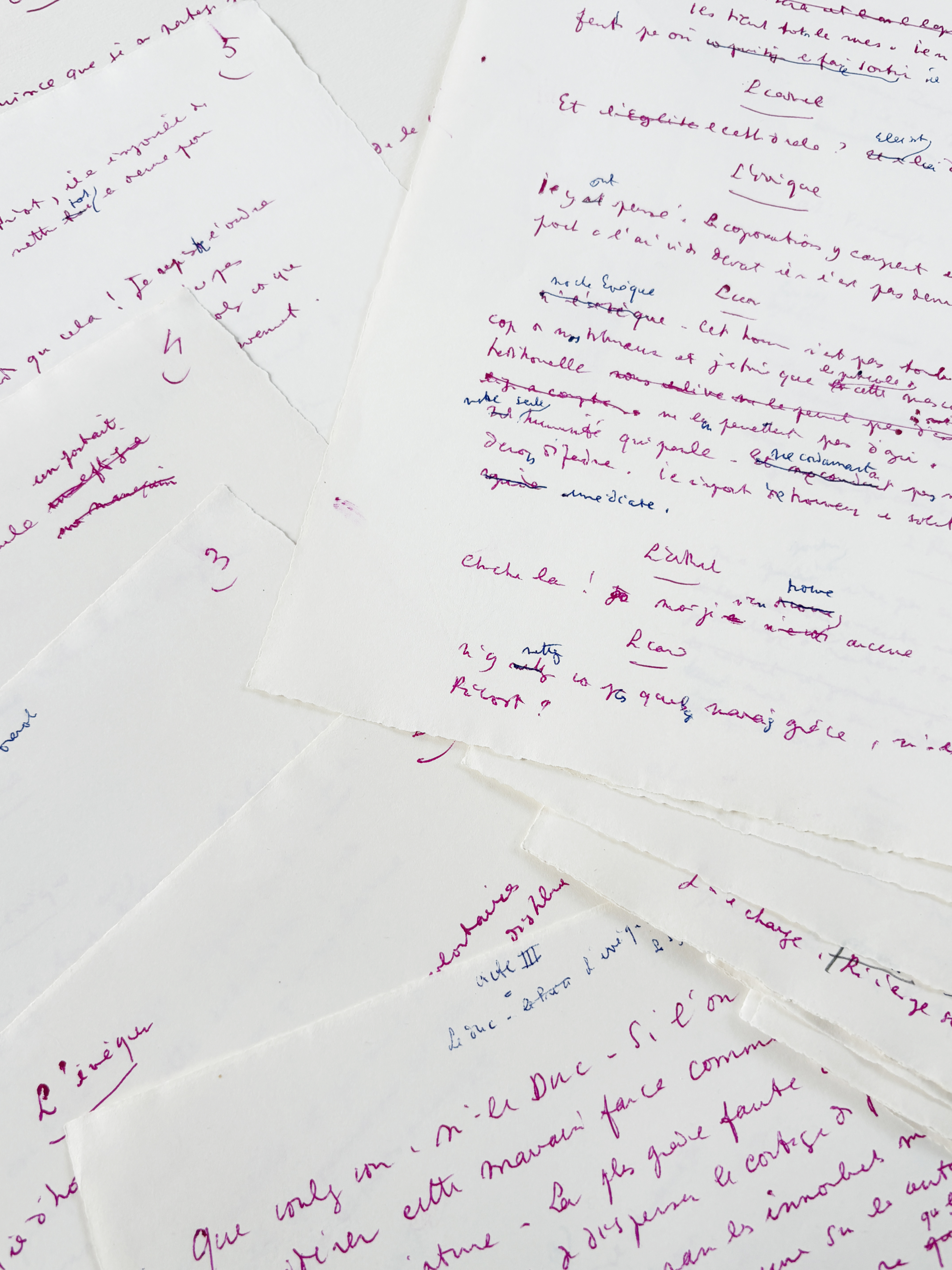
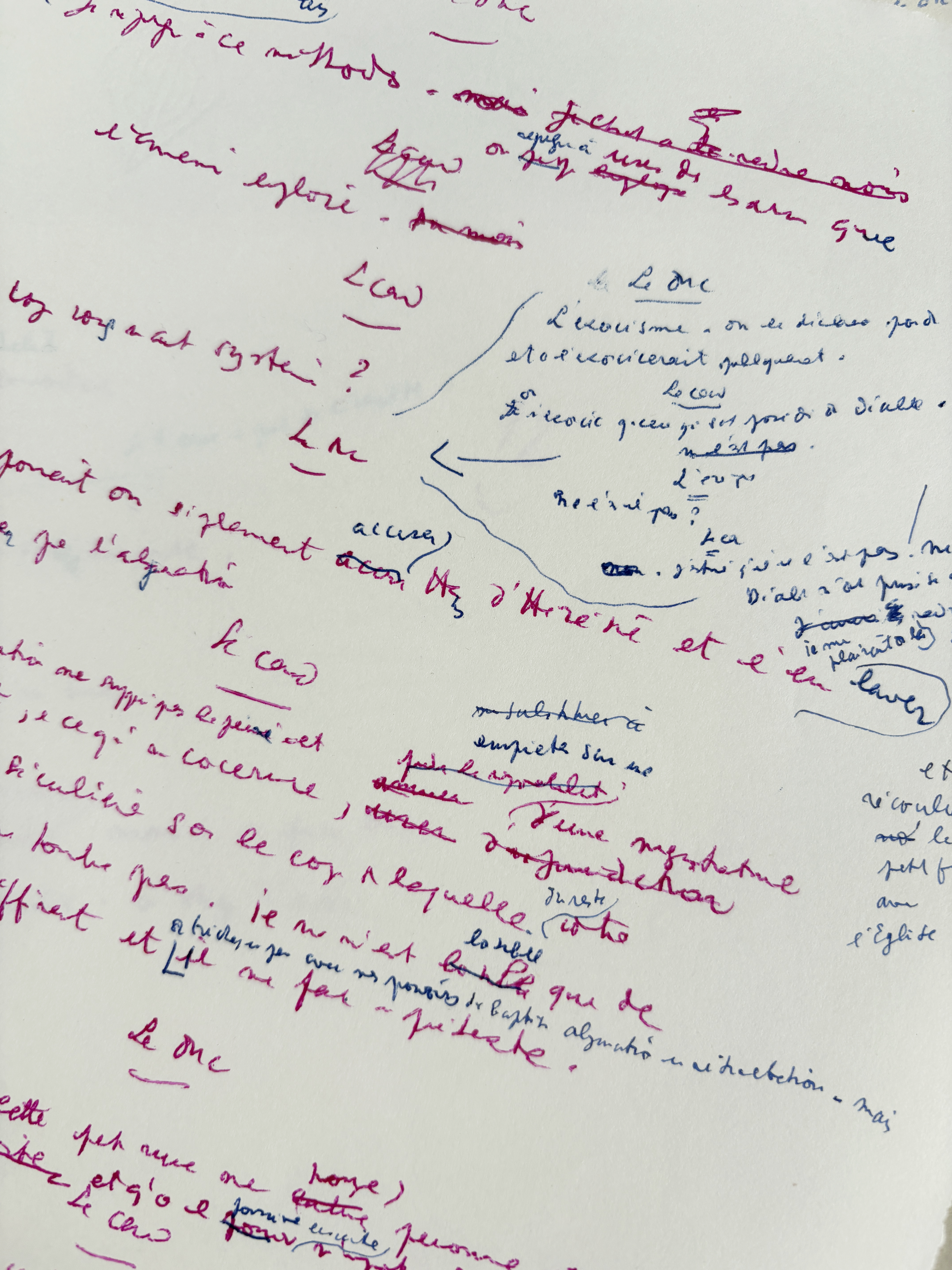
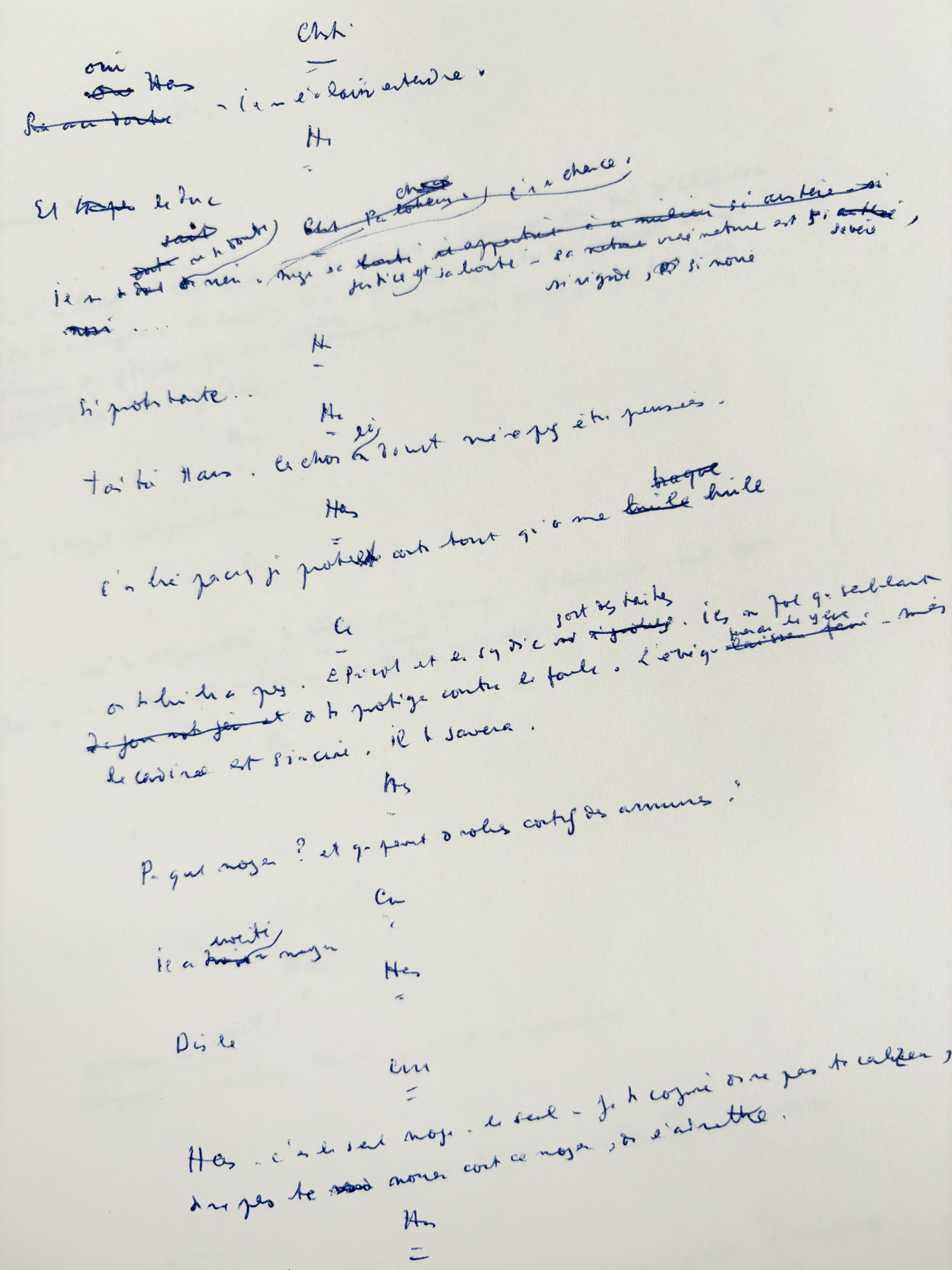
Autograph manuscript signed for Bacchus
[Saint-Jean-Cap-Ferrat, c. 1951], 167 p. in-folio and in-4°
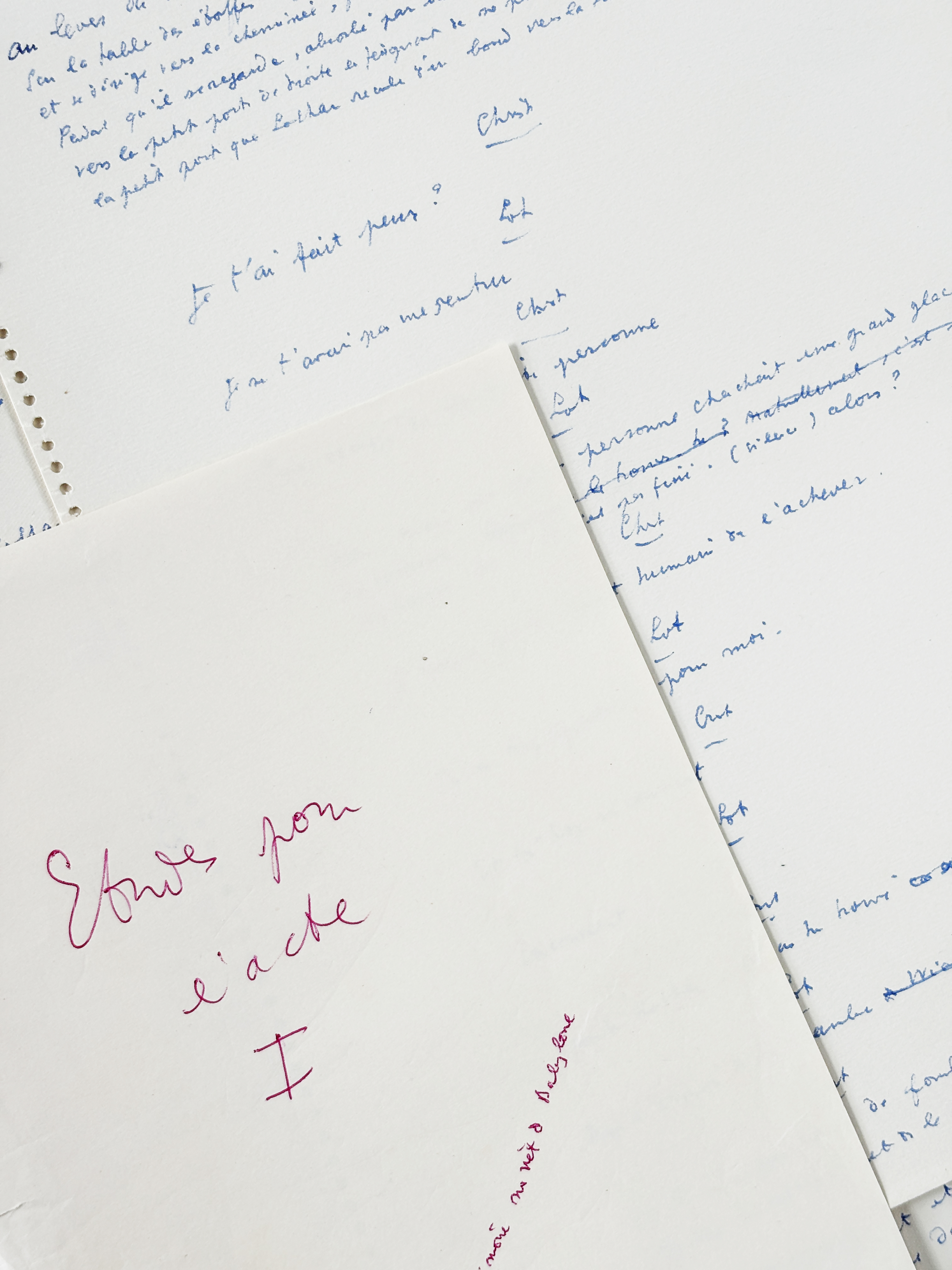
Written predominantly in blue and red ink, with a few leaves in graphite.
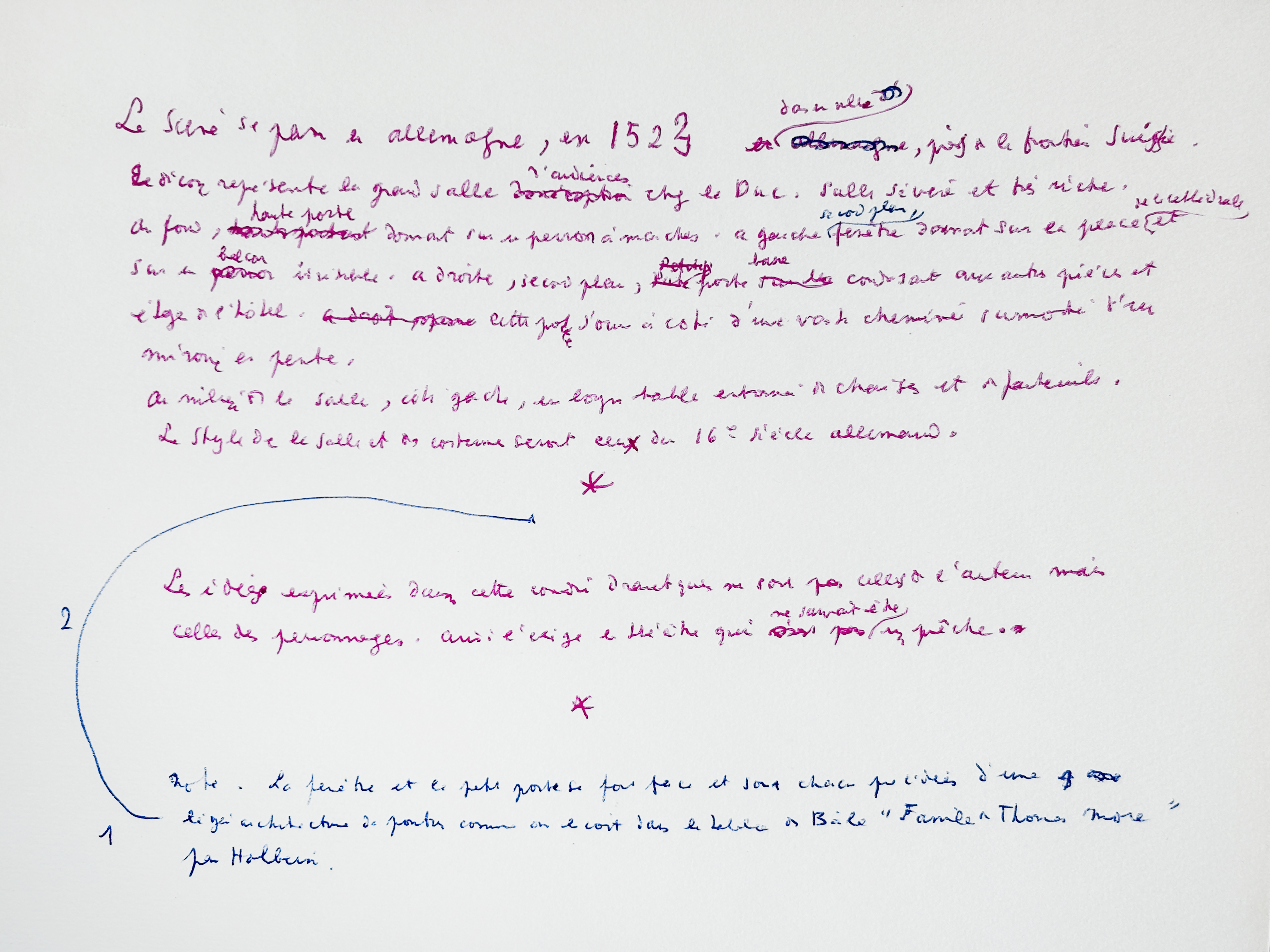
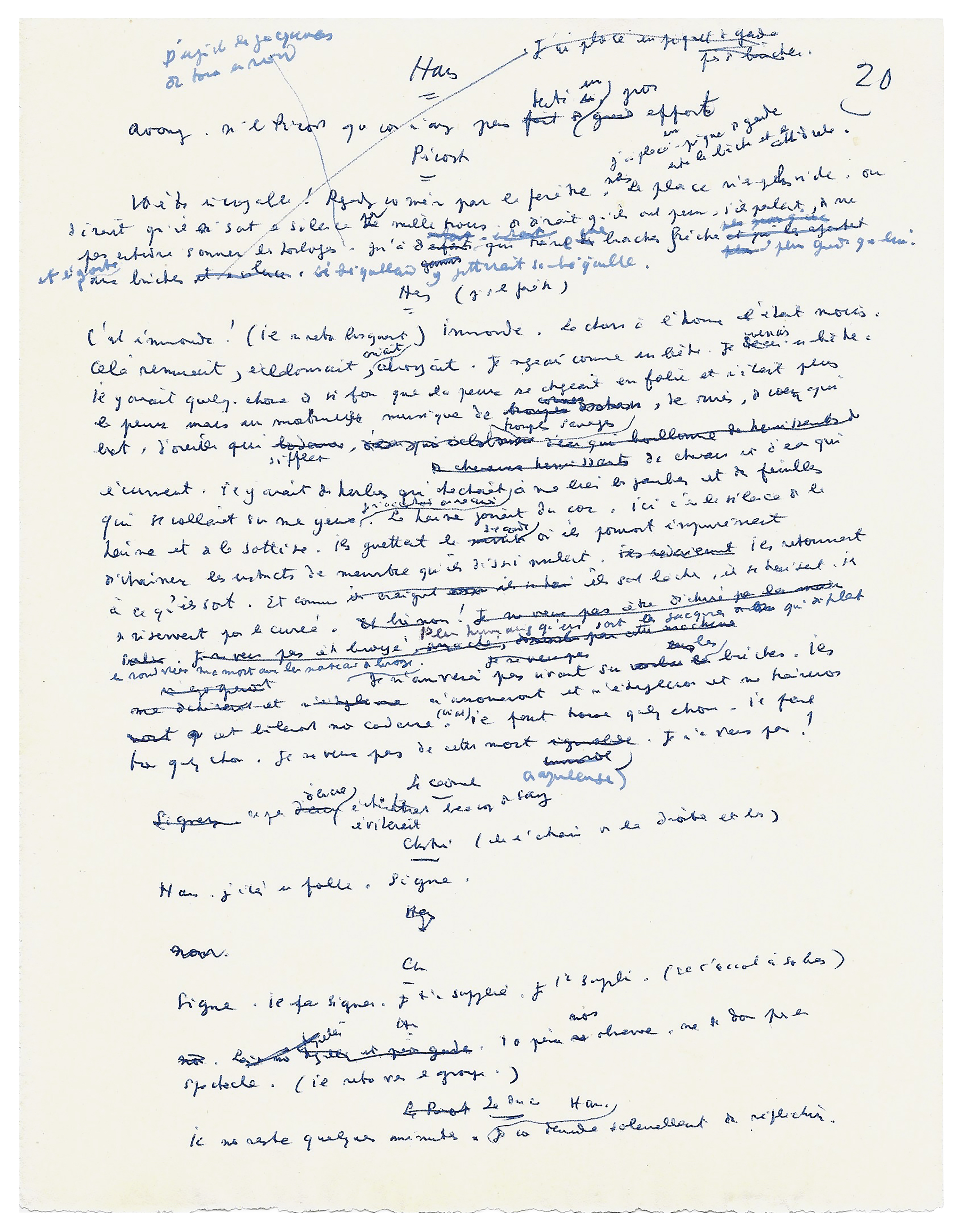
Very numerous erasures, obliterations, corrections, additions, and overwritings, all in Cocteau’s hand.
FIRST DRAFT MANUSCRIPT OF BACCHUS, THE POET’S MOST AMBITIOUS PLAY, WHICH CAUSED A SCANDAL
A MANUSCRIPT OF MAJOR IMPORTANCE, AT THE VERY HEART OF COCTEAU’S CREATIVE PROCESS
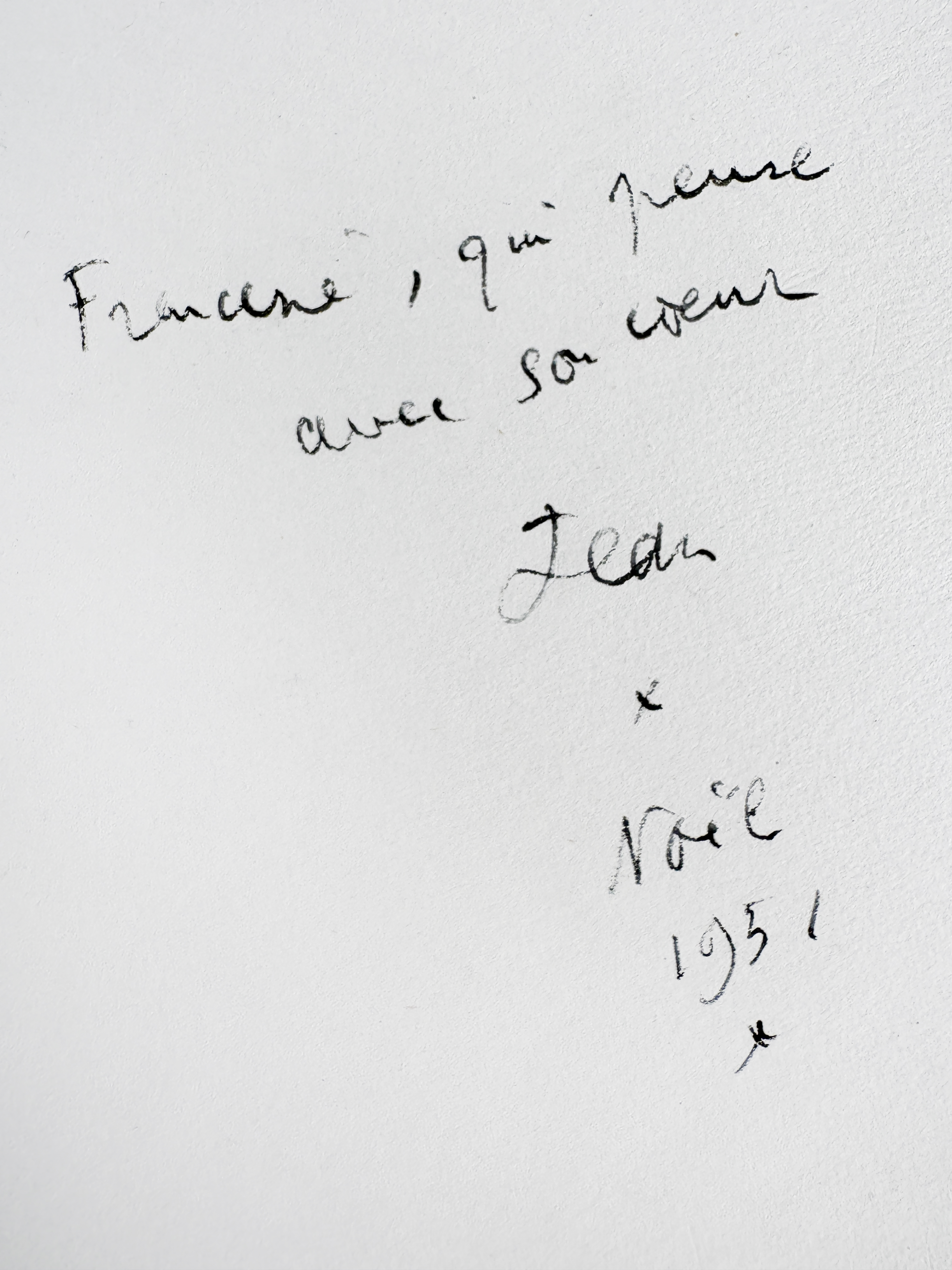
Preceded by three unfoliated leaves, the title leaf is enriched with a double dedication to Francine Weisweiller: “À Francine, À bord de l’Orphée II [Francine Weisweiller’s yacht],” followed by “À Francine, who thinks with her heart. Jean. Noël 1951.”
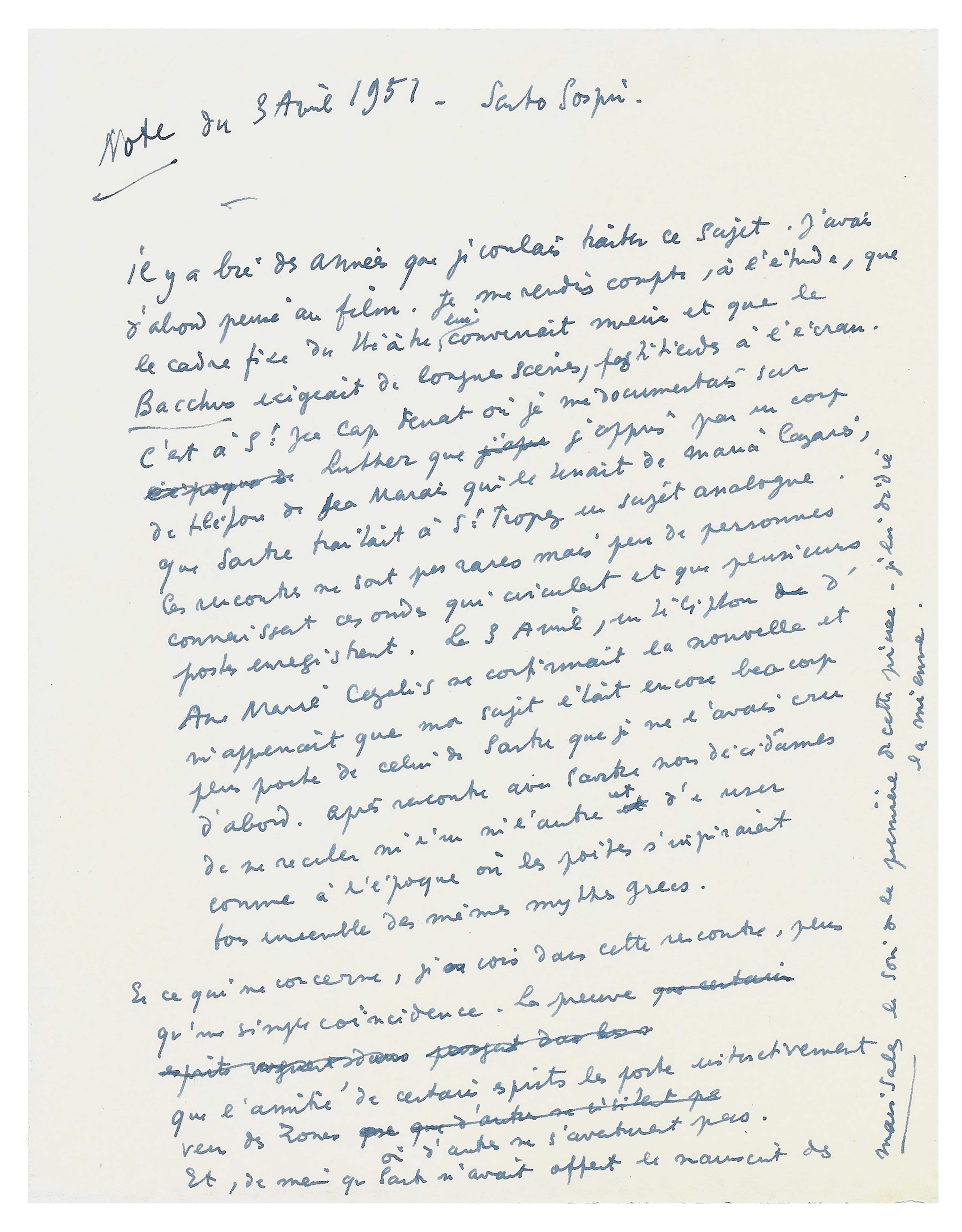
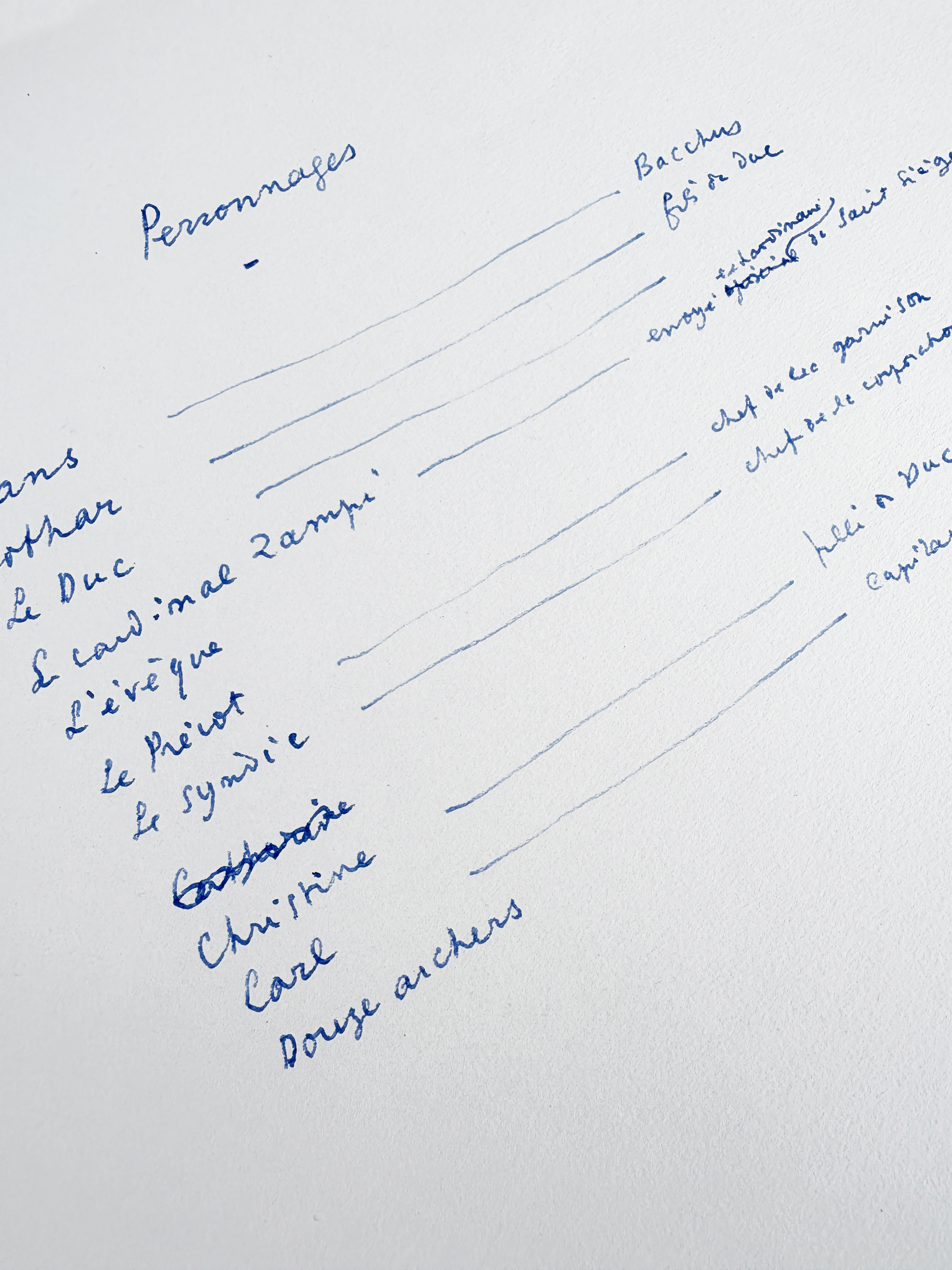
This is followed by the list of characters, together with an introductory notice situating the opening scene. Added to this is a particularly interesting autograph note by the author, dated and written at his home in his Santo Sospir villa on 3 April 1951. Having learned that Jean-Paul Sartre was working on a similar subject, Cocteau grew concerned and took the initiative to arrange a meeting. The two writers lunched together in Antibes in early April 1951. Cocteau emerged reassured as to the originality both of his theme and of his plot: “For many years I had wanted to treat this subject. I first thought of a film. On closer study, I realized that the fixed framework of the theatre was better suited, and that Bacchus required long scenes […]. It was in St-Jean-Cap-Ferrat, where I was researching Luther, that I learned through a telephone call from Jean Marais—who had it from Maria Casarès—that Sartre was dealing in St-Tropez with a similar subject. Such coincidences are not rare, but few people are aware of these waves that circulate and that several individuals register. On 3 April, a telephone call from Anne-Marie Cazalis confirmed the news and informed me that my subject was even closer to Sartre’s than I had at first believed. After meeting Sartre, we decided that neither of us would withdraw, and to proceed as in the days when poets all drew inspiration together from the same Greek myths […] And just as Sartre had offered me the manuscript of Les Mains sales on the opening night of that play, I dedicate mine to him.”
Another preparatory manuscript of the play is known, enriched with several drawings, likewise originating from Francine Weisweiller.
Collation:
Act I: 16 leaves [scenes 1 and 2], in folio format, detached from a spiral-bound notebook
Act I: 42 leaves [scenes 3 to 8], in folio format, detached from a spiral-bound notebook
Act II: 45 leaves, in folio and quarto formats; discontinuous pagination
Act III: 48 leaves, in quarto format, discontinuous pagination, with title folder
“This play is undoubtedly one of my finest theatrical works” (Jean Cocteau)
The plot is set in Germany in the year 1523, where the political and religious struggle forces the individual to make an exclusive choice between the nascent Protestant Reformation, led by Martin Luther, and the powerful Catholic Church, unsettled by Luther’s tangible successes. When the play premiered on 20 December at the Théâtre Marigny by the Renaud-Barrault company, critics did not hesitate to insinuate that Cocteau had drawn inspiration from Sartre’s play, disregarding the chronology, as evidenced by the title registered in 1946. Furthermore, Barrault did not include Bacchus in his national tour, limiting it to the capital. The play was a partial success on the French stage, from which Cocteau seems never to have fully recovered. In total, there were thirty-two performances of a text that had demanded such erudite study and exacted so much effort from him—writing, costumes, set design, and direction all undertaken by Cocteau himself.
Heavily revised, this manuscript presents countless variants from the printed version:
For example, in Act I, one finds an anachronism that Cocteau ultimately chose to suppress: “Alas, events are not so simple. Workers’ demands become unacceptable.” In Act II, scene 6, a long exchange between Hans and the cardinal on happiness, chastity, and war was omitted in the printed version, replaced by the simple annotation: “Short silence.” In Act III, scene 5, Cocteau tempered the play’s anticlericalism, redacting part of the line: “The cause of free men may one day overcome the Devil, who disguises himself as a good God, as pope, or as a rebellious monk,” leaving only “as a rebellious monk.”
Finally, the very last scene, following Hans’s death, was particularly reworked by Cocteau; among other deleted lines, the bishop’s threat to Christine—“We have convents to pacify wild virgins”—was cut, along with her reply: “I am neither virgin nor mad.”
The scandalous play:
“The Bacchus Affair” represents a peak of hostility in the relationship between Mauriac and Cocteau. The performance on 28 December at the Théâtre Marigny was particularly tumultuous. Leaving before the end of the performance, the deeply Catholic Mauriac, shocked by a few lines he deemed blasphemous, published a scathing review the very next day in Le Figaro littéraire. He accused Cocteau of attempting to ridicule in his play a Catholic Church whose representatives he had known and respected at the time of his conversion in 1925, recognizing that it also bore admirable fruit: “You wanted the Catholic Church to be embodied in a buffoonish bishop, in a political cardinal, worse in my eyes than the buffoon. Your mockery, through them, strikes the Church in its very soul.”
Mauriac reduced Cocteau’s talent to mere mimicry: Bacchus became yet another turn of Cocteau’s “act” he had witnessed for “nearly half a century.” Stunned but defiant, Cocteau responded in the press with an article in France-Soir entitled “I Accuse,” written as a litany of accusations: “I accuse you, by striking on the adversary’s ground, of being a judge with secret tenderness for the accused. One is either one or the other. And I accuse you of wanting to be one in your articles and the others in your novels […] I accuse you of respecting only a single tradition of France. The one that consists of killing its poets.”
Provenance:
Francine Weisweiller, one of his closest and most devoted friends, who often stayed at the poet’s villa in Saint-Jean-Cap-Ferrat.
Join our mailing list and be the first to hear our latest news and biggest announcements.
By signing up you agree to our privacy policy. You can unsubscribe at any time.