Keep ahead of the pack
Join our mailing list and be the first to hear our latest news and biggest announcements.
By signing up you agree to our privacy policy. You can unsubscribe at any time.
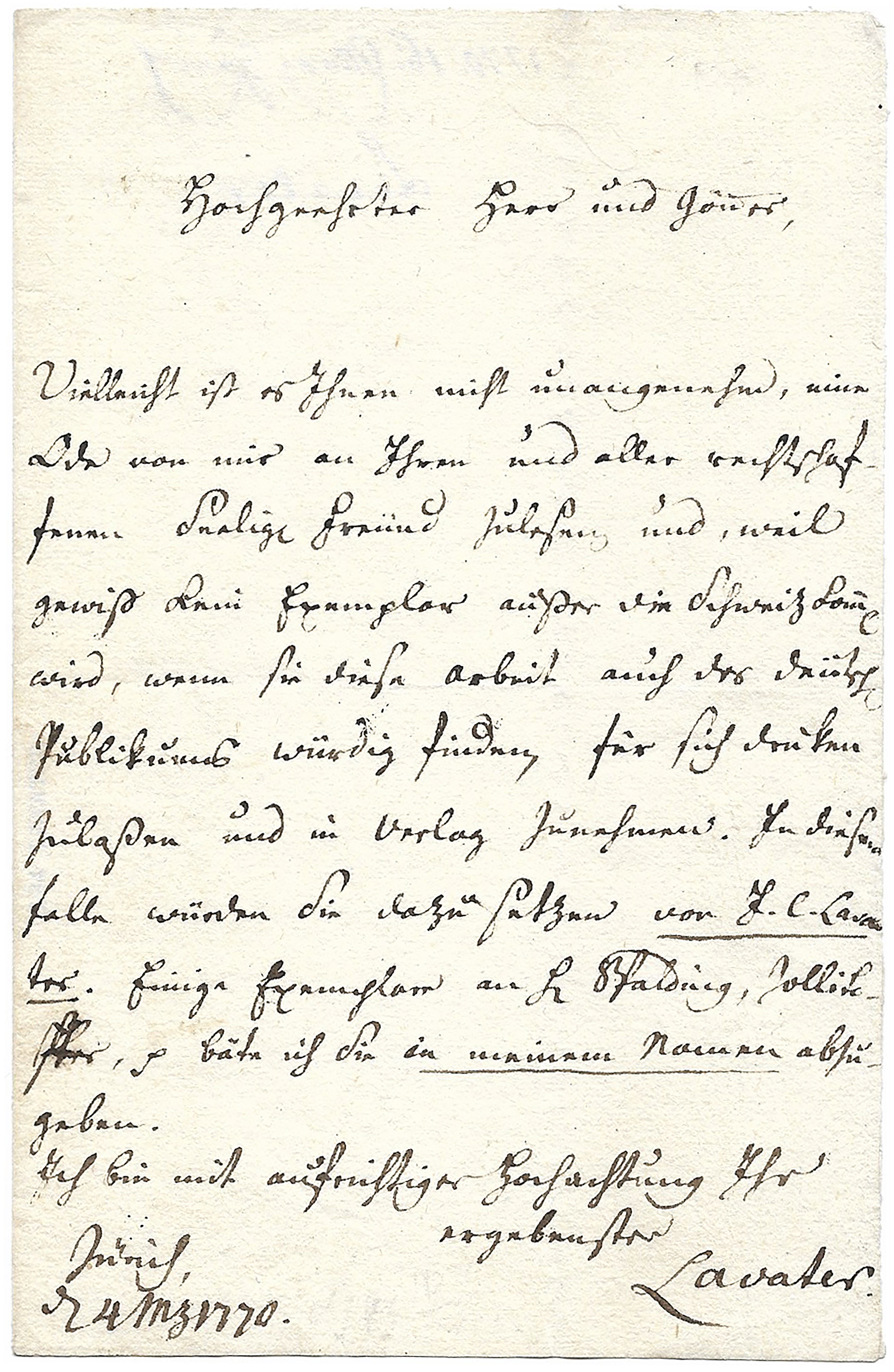
Autograph letter signed « Lavater » to a benefactor
Zurich, 4 March 1770, 1 p. in-12° on laid paper
« Perhaps you will not mind reading an ode of mine »
Autograph letter signed « Lavater » to a benefactor
Zurich, 4 March 1770, 1 p. in-12° on laid paper, black ink
Watermark: “SW” initials
In fine condition throughout
Scarce letter by the Swiss poet and theologian concerning one of his odes
Translation:
« Most esteemed Sir and Benefactor,
Perhaps you will not mind reading an ode of mine dedicated to you and all righteous and blessed friends, and, since certainly no copy will go beyond Switzerland, if you deem this work worthy of the German public, to allow it to be printed for yourself and included in publication. In that case, the copies would bear the name of J. C. Lavater. I would ask you to deliver a few copies to H. Spalding, Zollikofer, etc., on my behalf.
With sincere respect, I remain
Yours devotedly,
Lavater »
Original version:
« Hochgeehrter Herr und Gönner,
Vielleicht ist es Ihnen nicht unangenehm, eine
Ode von mir an Ihren und aller rechtschaffenen Seeligl Freund zulesen, und, weil gewiß kein Exemplar außer die Schweiz kommen wird, wenn sie diese Arbeit auch des deutschen Publikums würdig finden, für sich drüken zulaßen und in Verlag zunehmen. In diesem falle würden die dazu setzen von J. C. Lavater. Einige Exemplare an H. Spalding, Zollikofer, p bäte ich Sie in meinem Nomen abzugeben.
Ich bin mit aufrichtiger Hochachtung Ihr ergebenster
Lavater. »
L’année 1770 marque un tournant dans la vie et la carrière de Lavater. Devenu diacre l’année précédente, il rédige parallèlement la traduction d’un essai, Idées sur l’état futur des êtres vivants, ou Palingénésie philosophique, du naturaliste genevois Charles Bonnet, qu’il dédie à Moses Mendelssohn avec lequel il entame une correspondance dans laquelle il est question de la réfutation ou non de certains aspects du christianisme, et qui, publiée la même année, connaît une certaine renommée à travers l’Europe des Lumières.
Provenance:
M-E.S coll.
Join our mailing list and be the first to hear our latest news and biggest announcements.
By signing up you agree to our privacy policy. You can unsubscribe at any time.