Keep ahead of the pack
Join our mailing list and be the first to hear our latest news and biggest announcements.
By signing up you agree to our privacy policy. You can unsubscribe at any time.
Two autograph letters signed enriched with original drawings
Paris, December 1881 and 1888, 11 pp. in total, small in-8°
« You will do me the favor of burning these sketches »
Two autograph letters signed enriched with original drawings to Etienne Martin
Paris, December 1881 and 1888, 11 pp. in total, small in-8°
On laid paper, crowned watermark: “Paris Louvre Note Paper.”
Very good condition, apart from a few discreet repairs, old mounting traces, and slight show-through in places.
Interesting unpublished corpus of letters and sketches by the young Alexis Vollon, aged only sixteen
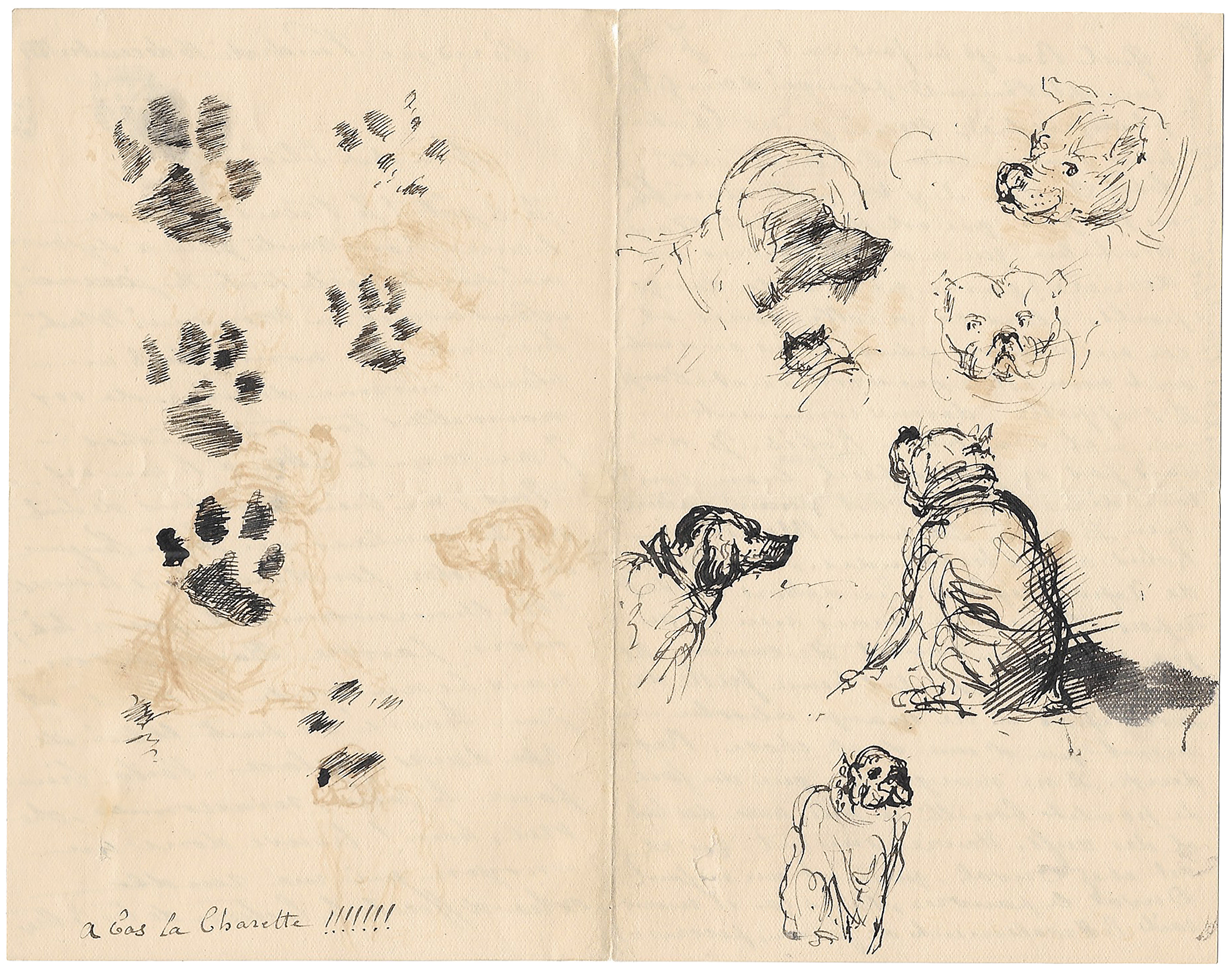
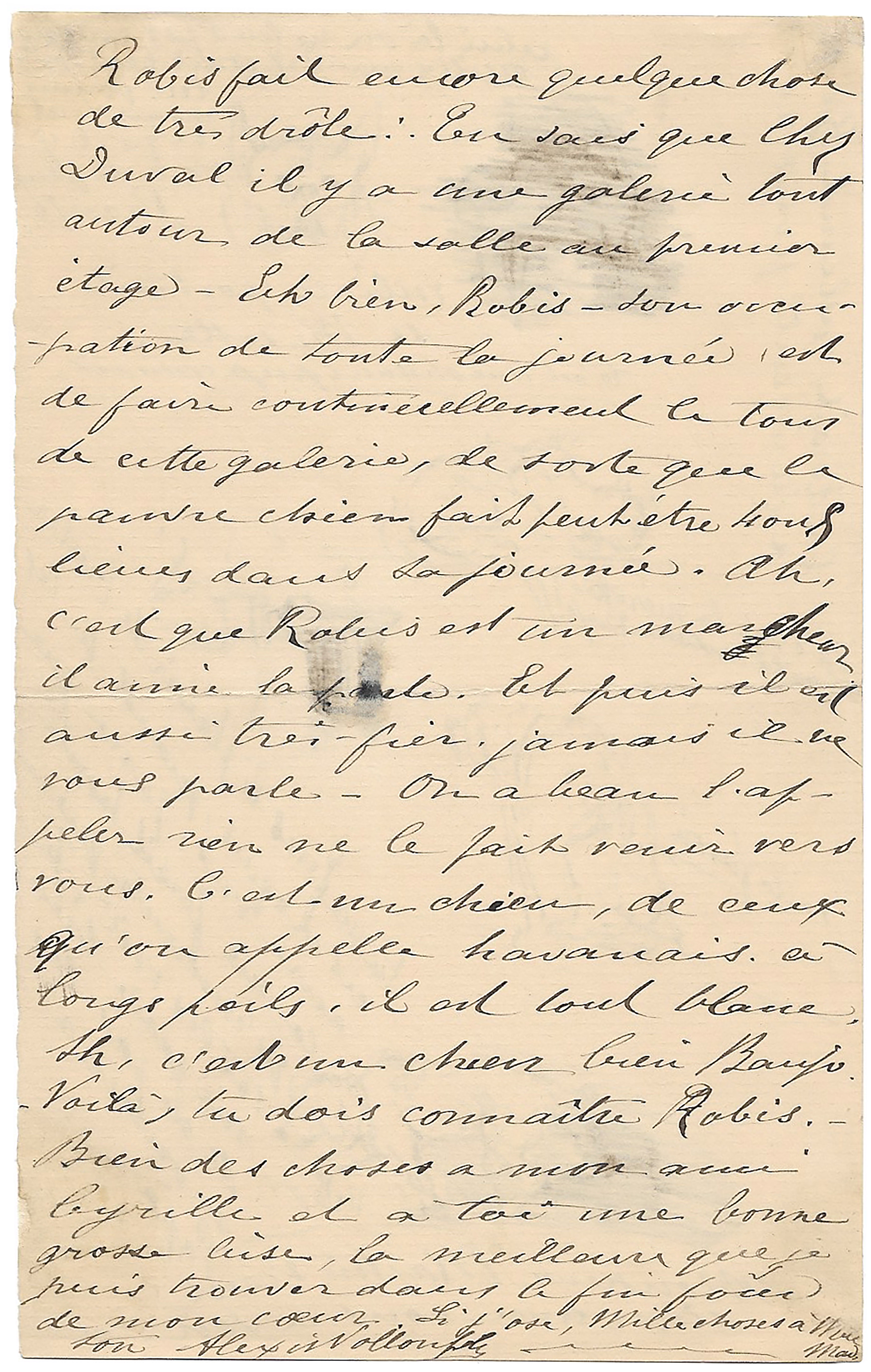
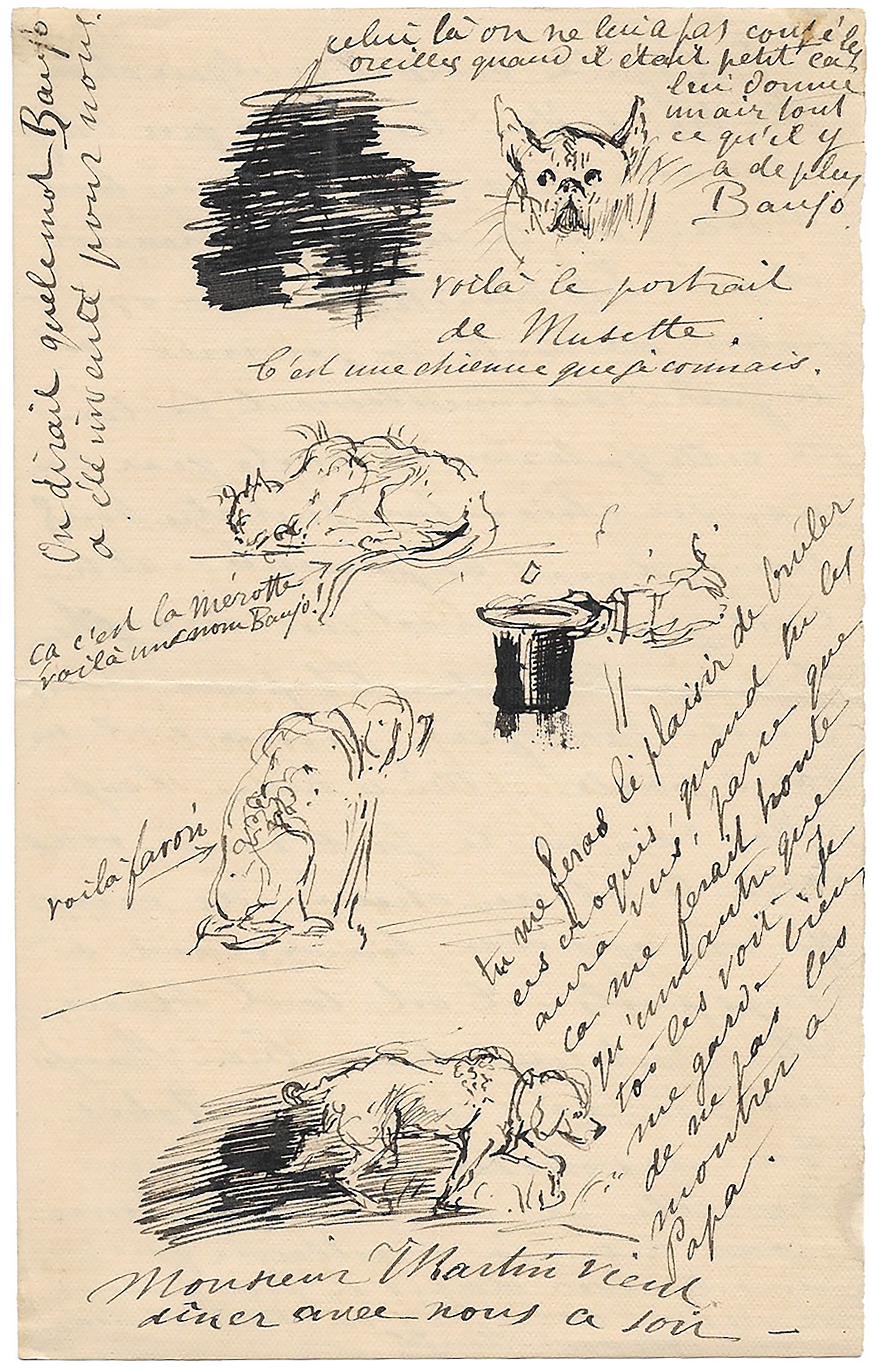
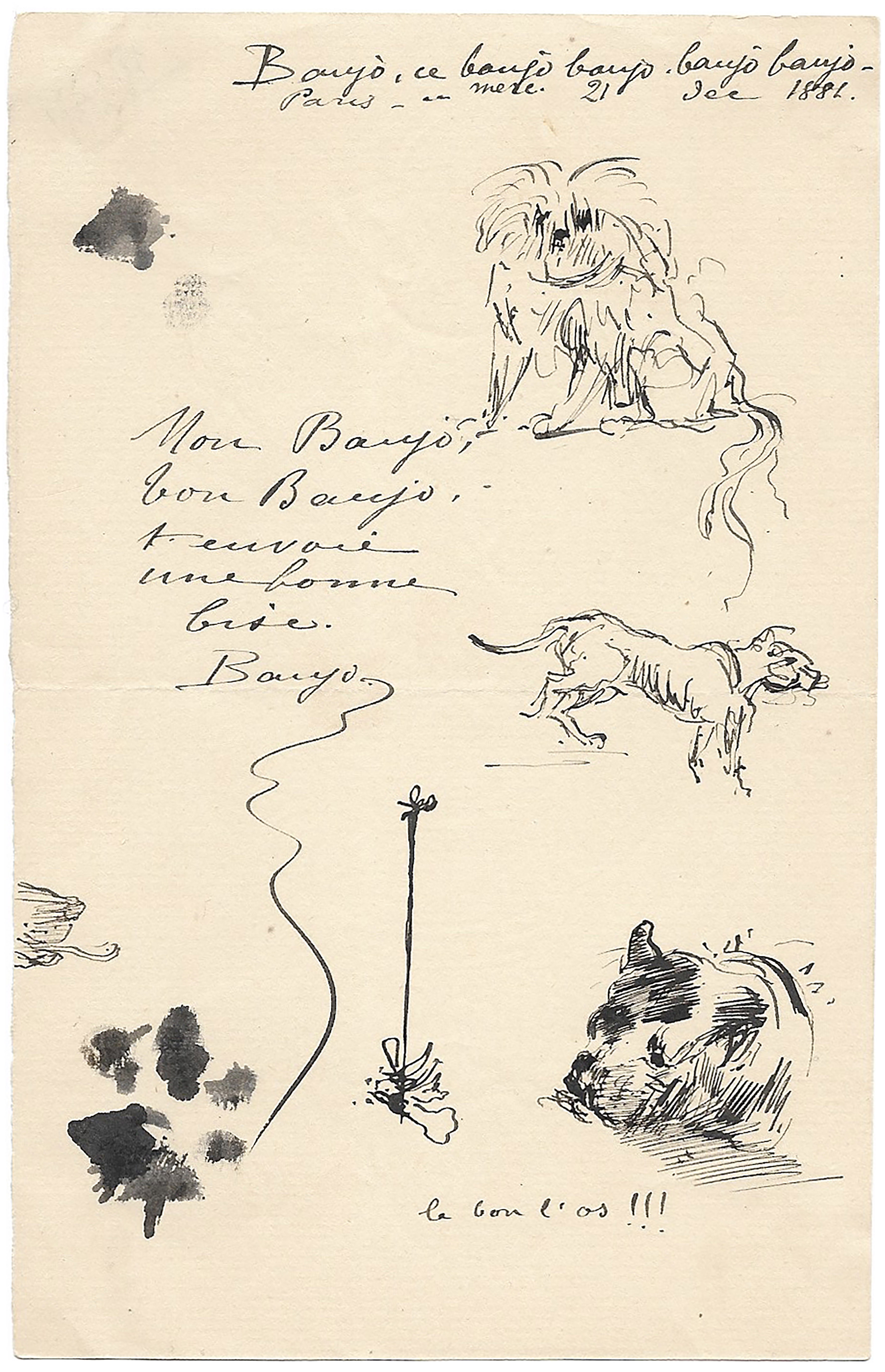
In the first letter, addressed to his friend Étienne Martin, Alexis Vollon enriches his text with numerous finely executed animal drawings:
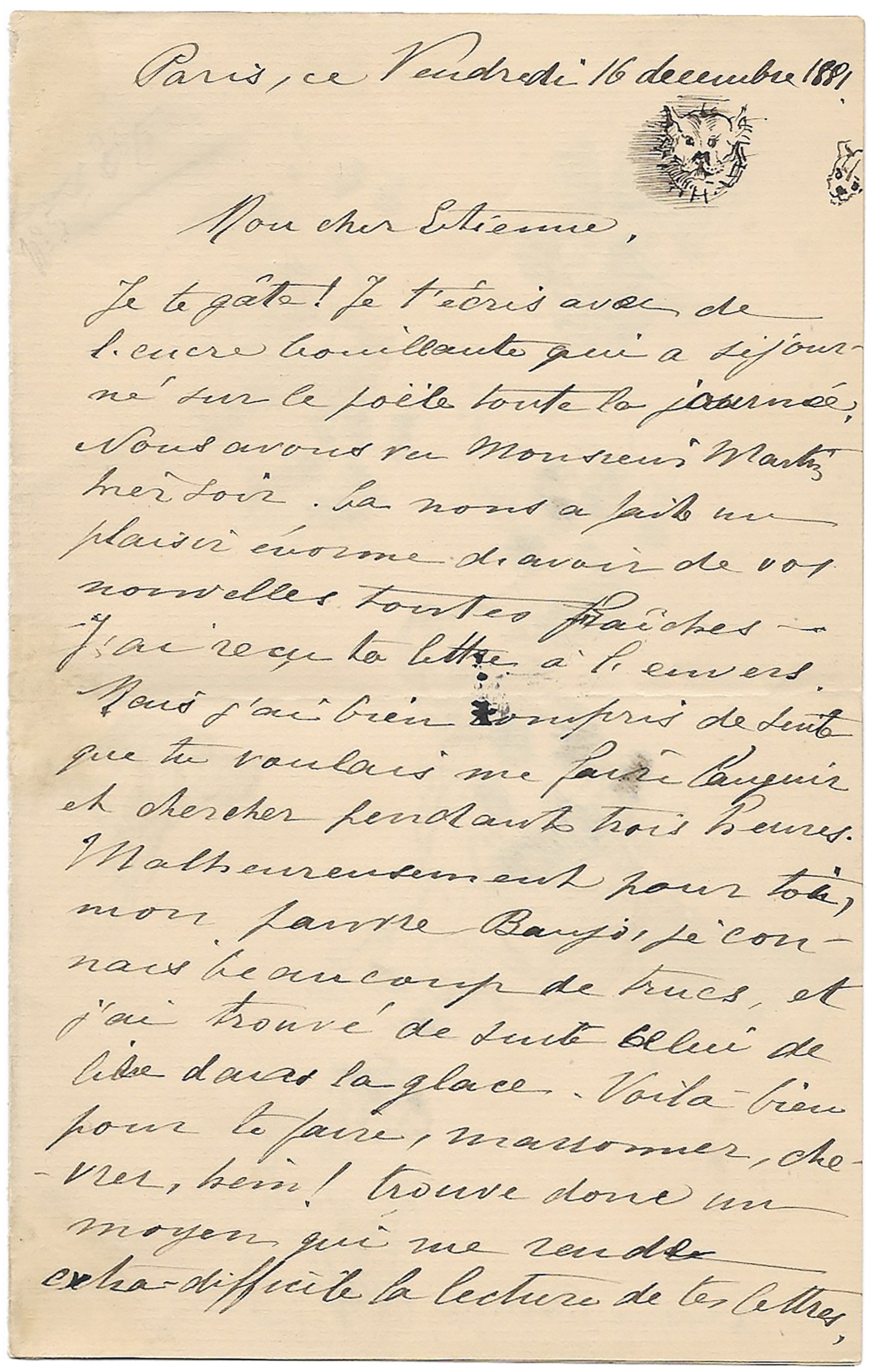
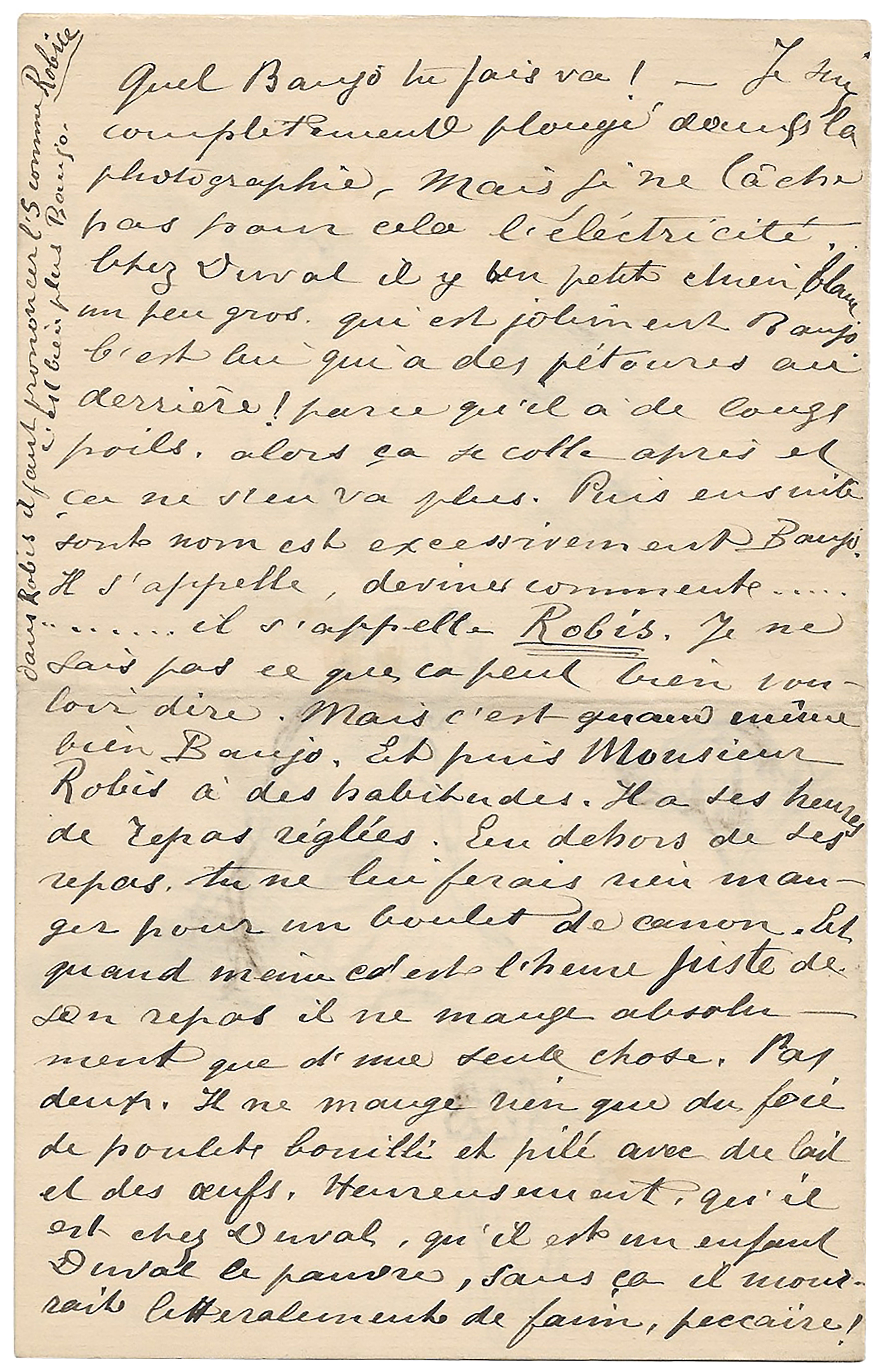
Paris, 16 Dec. 1881: « Mon cher Etienne, Je te gâte ! Je t’écris avec de l’encre bouillante qui a séjourné sur le poële toute la journée. Nous avons vu Monsieur Martin hier soir [le père du correspondant]. Ça nous a fait un plaisir énorme d’avoir de vos nouvelles toutes fraîches » He amuses himself at having deciphered his friend’s letter too easily [the latter had written it backwards] Vollon saying he knows « beaucoup de trucs, et j’ai trouvé de suite de lire dans la glace ». He repeatedly bestows upon him the nickname « Banjo » and says he is « plongé dans la photographie, mais je ne lâche pas pour cela l’électricité. Chez Duval il y a un petit chien blanc, un peu gros, qui est joliment Banjo […] Il s’appelle, devine comment… il s’appelle Robis. » He then describes the dog’s habits and quirks in detail, portraying him at length, and sketches him several times across various pages of the letter. On the verso of the final page, richly embellished with drawings, Vollon concludes: « tu me feras le plaisir de brûler ces croquis, quand tu les auras vus, parce que ça me ferait honte qu’un autre que toi les voit. Je me garde bien de ne pas les montrer à papa. »
From the ensemble of drawings and sketches there emerges an undeniable talent in a young man of sixteen, a future artist recognized in his time. These are in all likelihood among the very earliest known studies by Vollon.
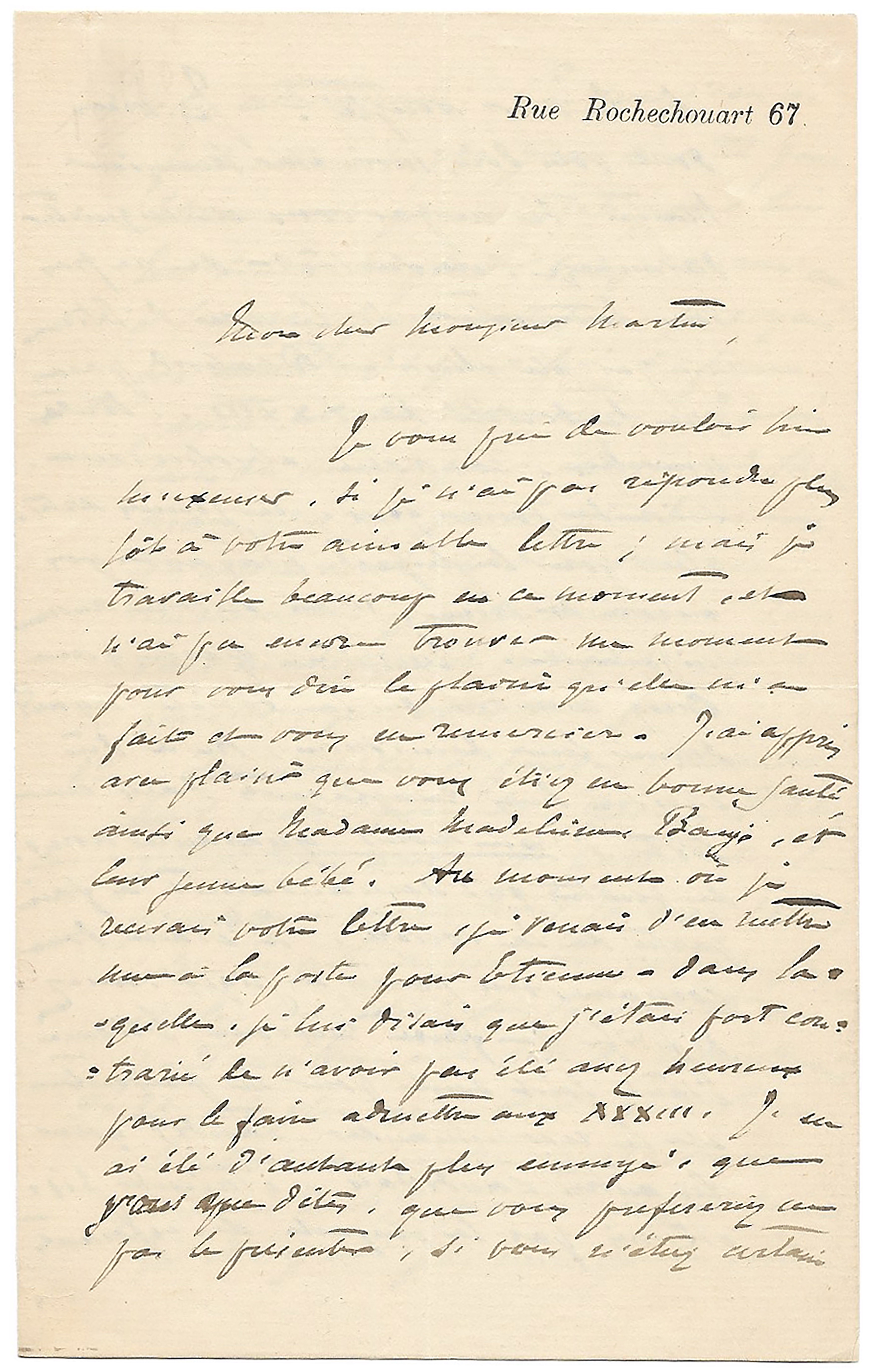
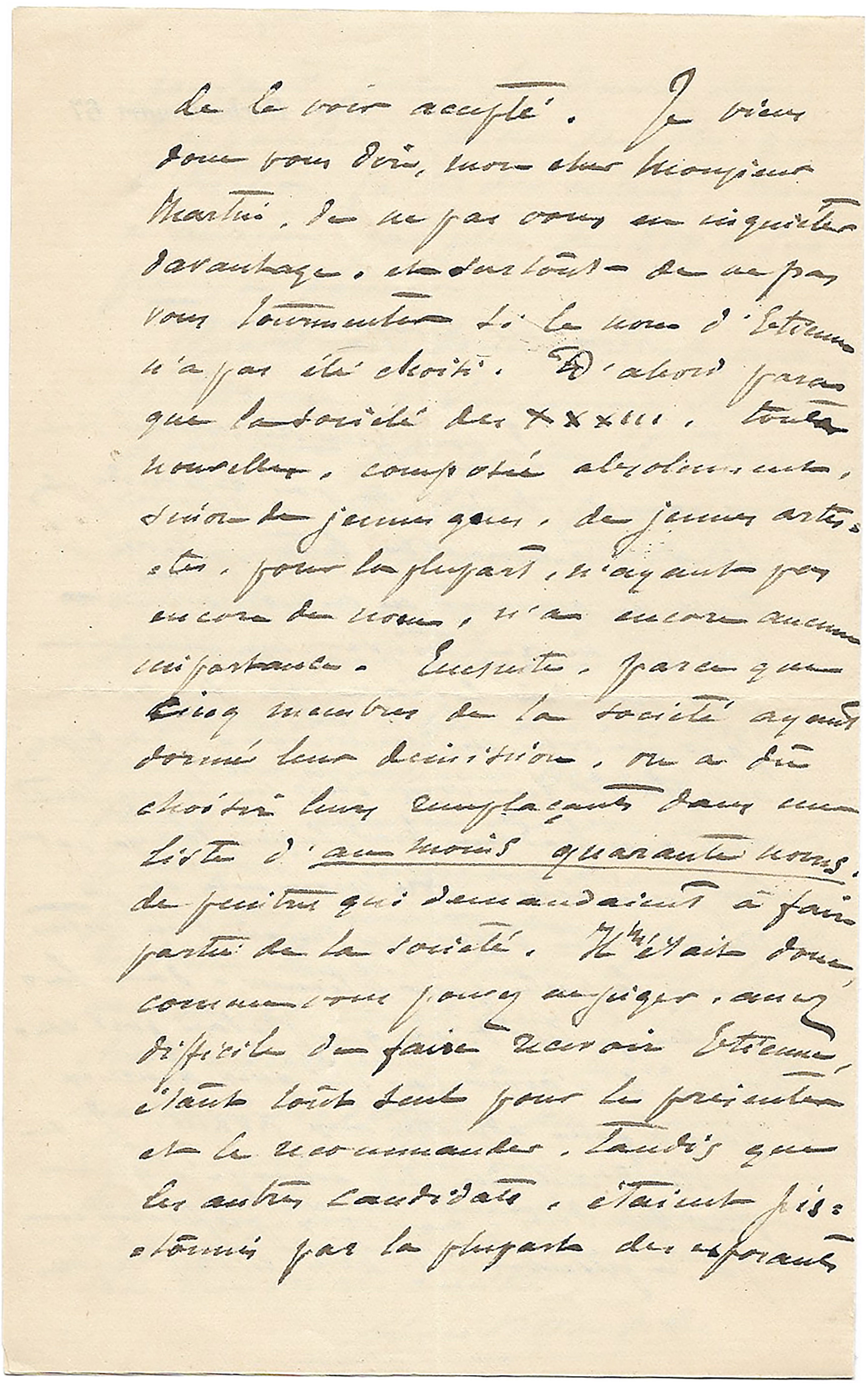
In a second, lengthy letter, most likely dating from the end of 1888, Vollon addresses the watercolorist Paul Martin with the deference that is fitting.
[Paris], 67 rue Rochechouart, 4 pp., 8vo, in black ink:
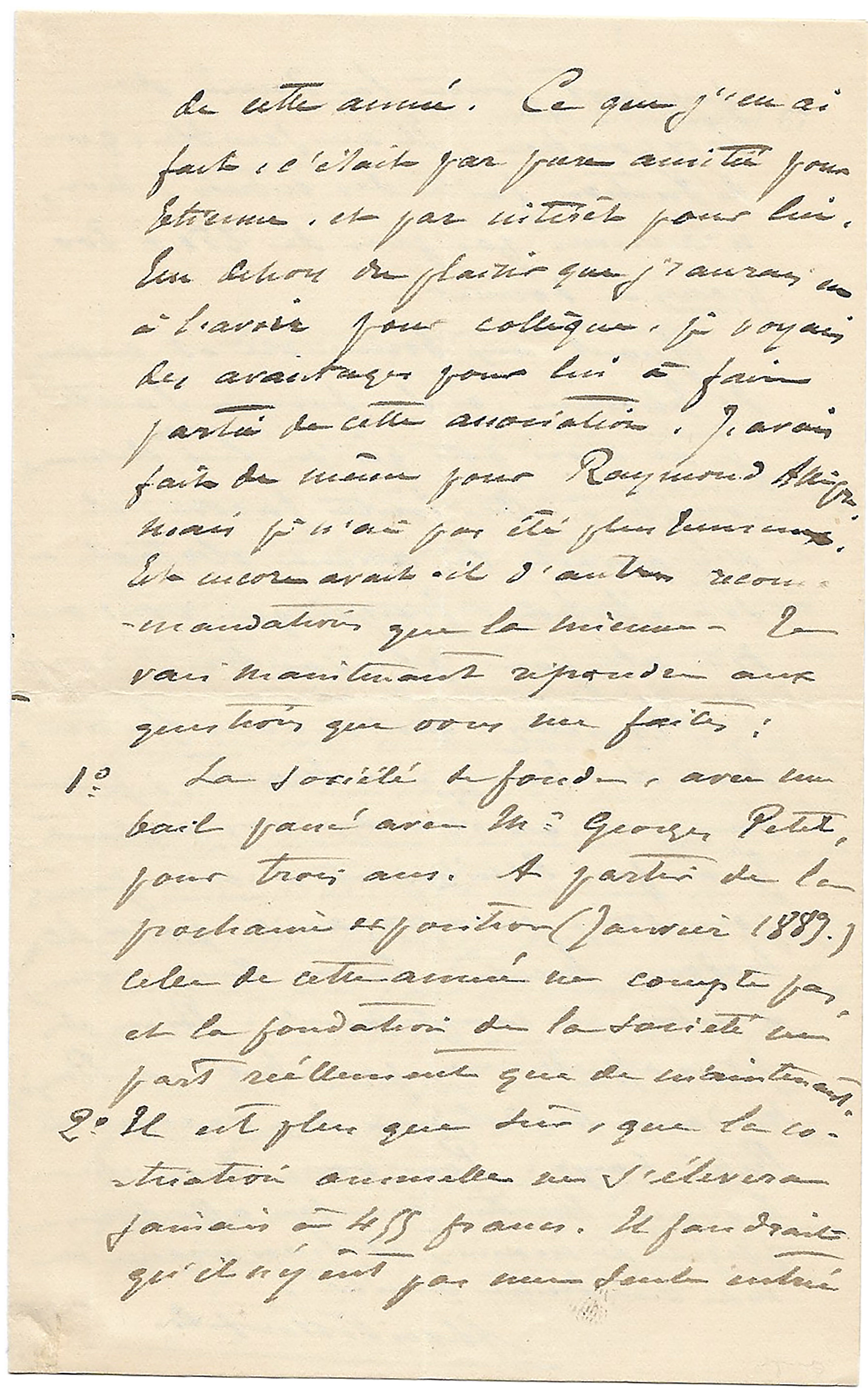
He attempts to play down Étienne’s failure to gain admission to the Société des XXXIII, an inner circle of newly established young artists. Doubtless a member himself, Vollon finds himself in an awkward position vis-à-vis his friend’s father: « Je viens donc vous dire, mon cher Monsieur Martin, de ne pas vous inquiéter davantage, et surtout de ne pas vous tourmenter si le nom d’Étienne n’a pas été choisi. D’abord parce que la société des XXXIII, toute nouvelle, composée absolument, sinon de jeunes gens, de jeunes artistes, pour la plupart, n’ayant pas encore de nom, n’a encore aucune importance. Ensuite, parce que cinq membres de la société ayant donné leur démission, on a dû choisir leurs remplaçants dans une liste d’au moins quarante noms de peintres qui demandaient à faire partie de la société. Il m’était donc, comme vous pouvez le voir, assez difficile d’en faire recevoir Étienne, étant tout seul pour le présenter et le recommander. Tandis que les autres candidats étaient pistonnés par la plupart des exposants de cette année […] Je vais maintenant répondre aux questions que vous me faites :
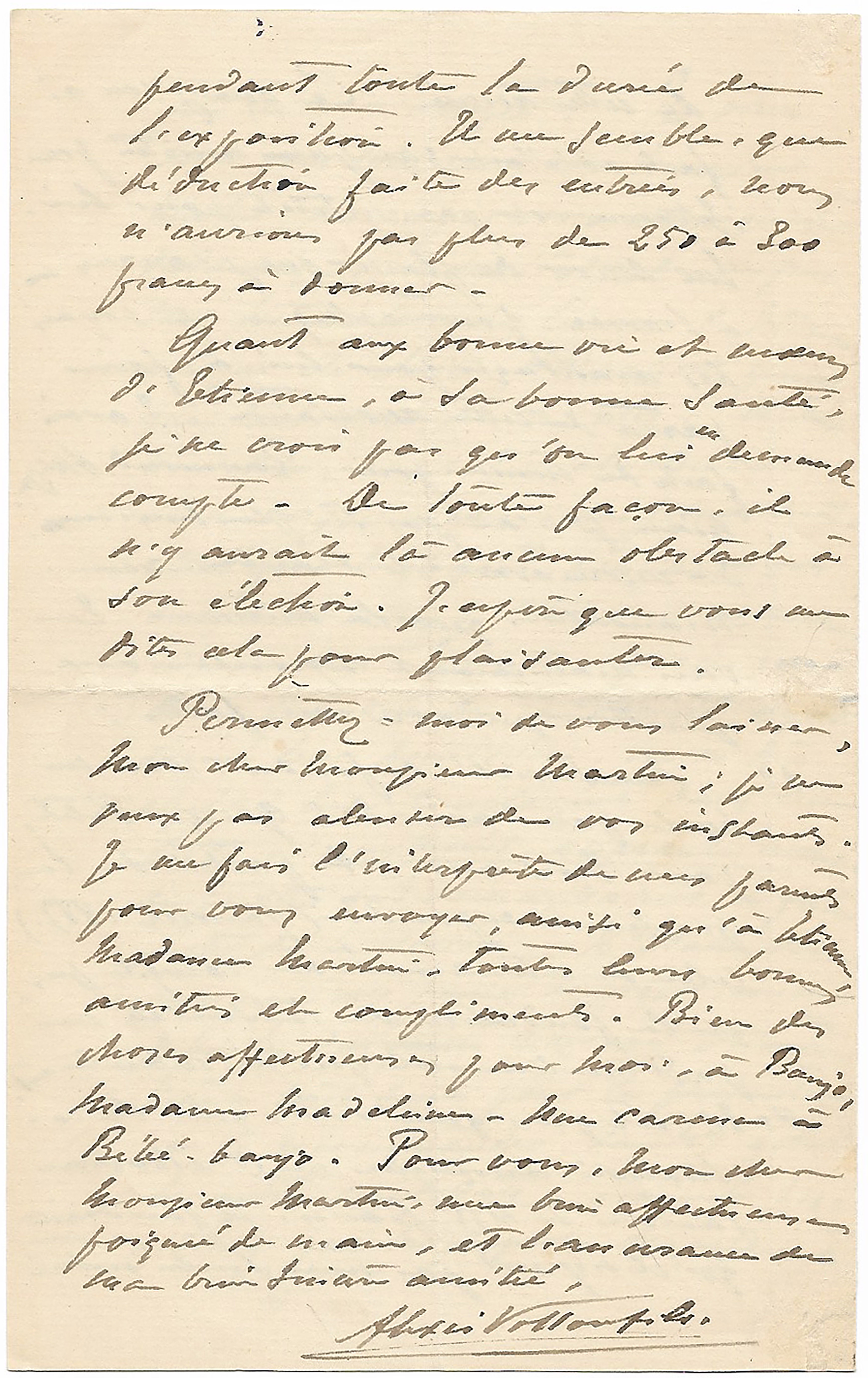
La société se fonde avec un bail passé avec Mr Georges Petit pour trois ans […] Bien des choses affectueuses pour moi, à Banjo, Madame Madeleine…
Alexis Vollon »
Alexis Vollon trained under his father, Antoine Vollon, inheriting a taste for richly colored painting. Emerging during the era of the Impressionists, he shared some of their subjects while carefully preserving the coloristic qualities imparted by his master. Over the course of his career, he explored a variety of genres: genre scenes, episodes inspired by the Comédie Italienne, portraits, landscapes, and seascapes. He also practiced printmaking, with a particular preference for etching. Portraiture, however, held a central place in his oeuvre, especially through pastel, a medium in which he developed a distinctive and recognized approach. Between 1880 and 1901, he regularly exhibited at the Salon des Artistes Français maritime views depicting Mers-les-Bains or the port of Le Tréport. His first solo exhibition took place in 1884 at the Galerie des Artistes Modernes in Paris. The following year, he debuted at the Salon des Artistes Français, where he received an honorable mention. The only son of the watercolorist Paul Martin, Étienne Martin first studied under his father before turning to oil painting. He later trained with Antoine Vollon, a major figure in Provençal painting, through whom he met Alexis Vollon, about ten years his junior. Throughout his career, he remained faithful to the artistic principles of this master, whom he considered his teacher, even dedicating a biography to him to preserve and transmit his legacy.
We include:
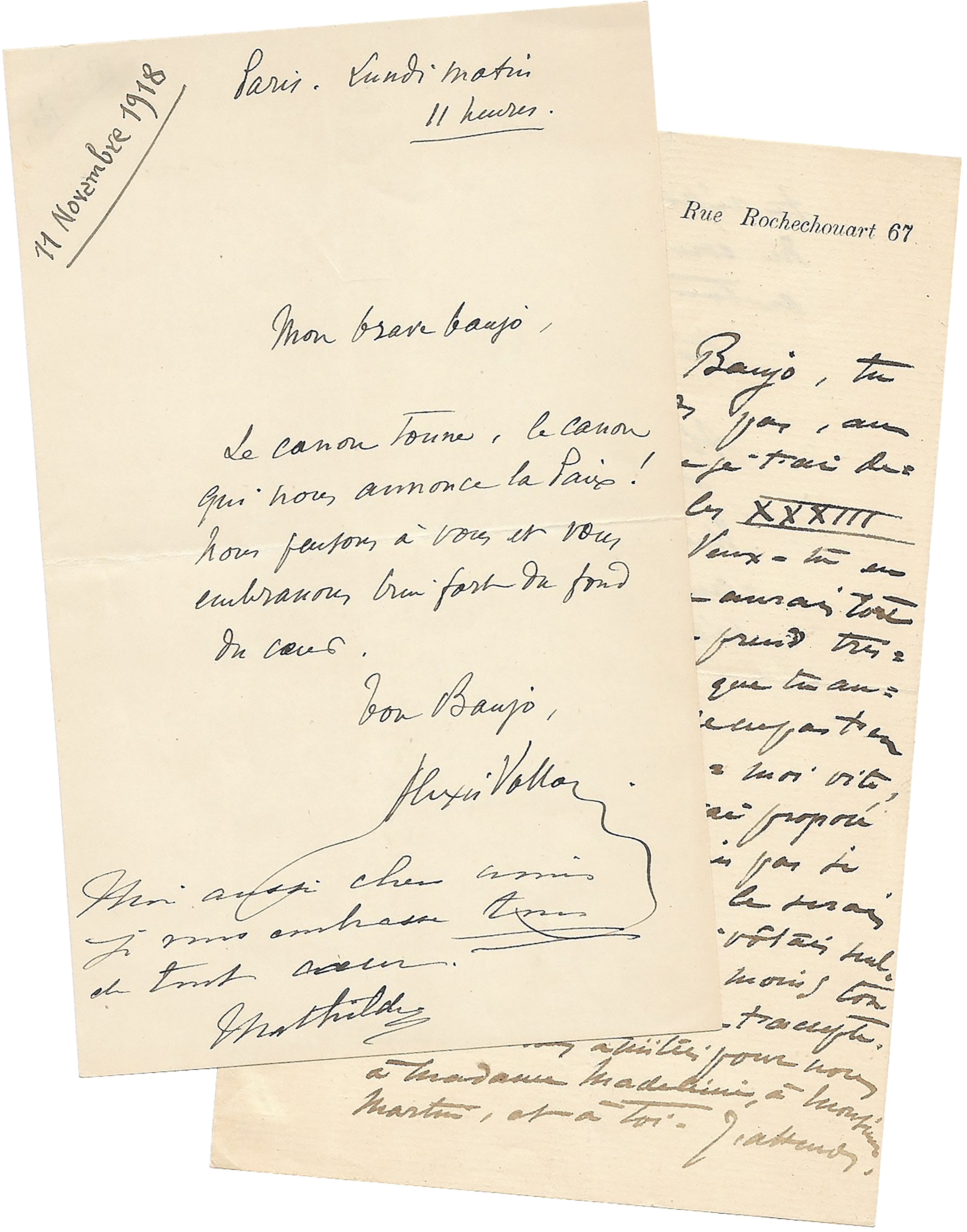
Two other autograph letters (3 pp. in-8° in total) from Vollon to Martin, alias “Banjo”; one concerning the Société des XXXIII, the other written on the day of the Armistice, November 11, 1918.
Provenance:
Private collection
Join our mailing list and be the first to hear our latest news and biggest announcements.
By signing up you agree to our privacy policy. You can unsubscribe at any time.