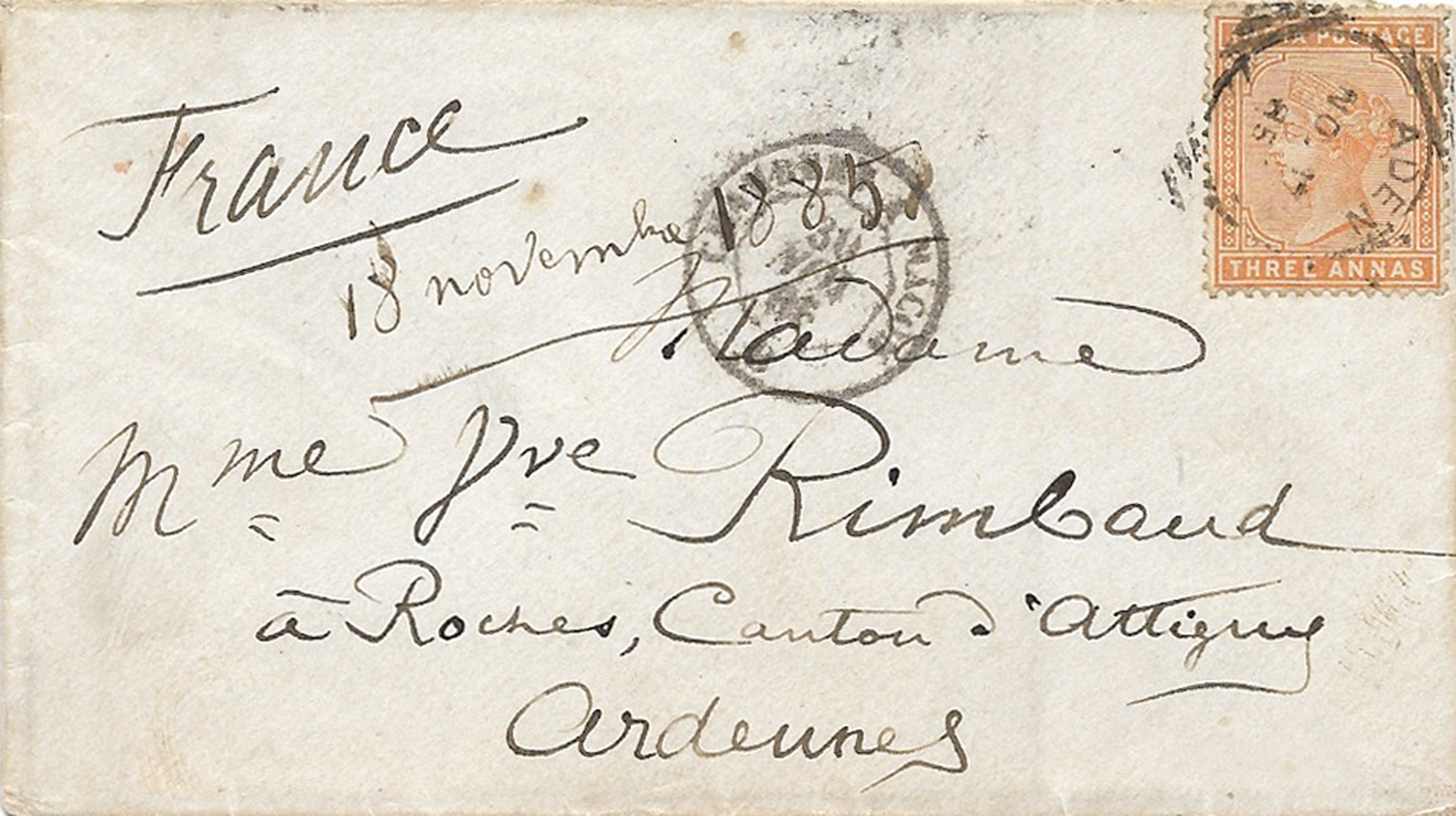
BRASSENS, Georges (1921-1981)

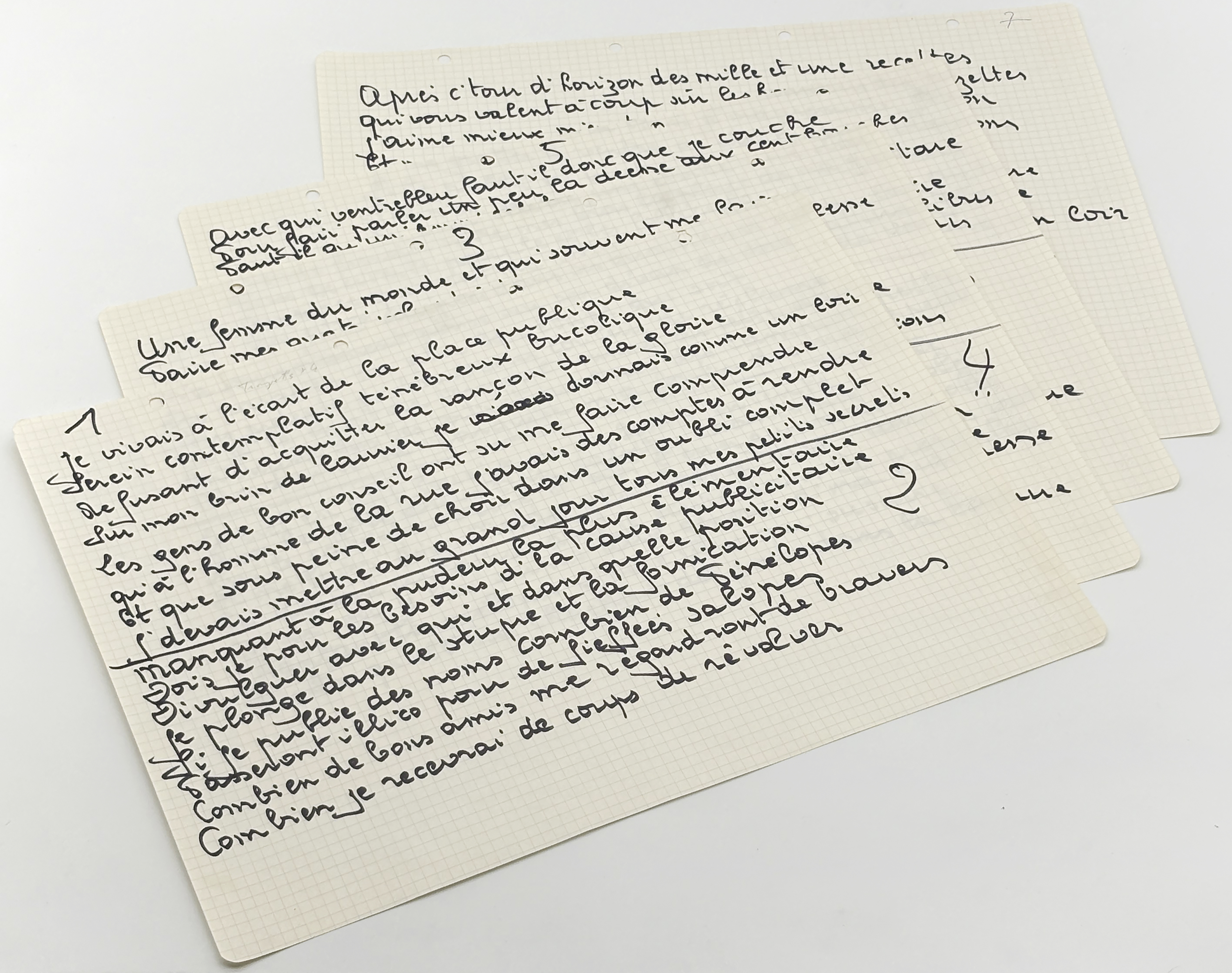
Autograph manuscript for Les Trompettes de la renommée
s.l.n.d. [c. 1976], 4 oblong folio leaves (30 × 40 cm) on small-ruled paper

« Si je publie des noms combien de Pénélopes / Passeront illico pour de fieffées salopes… »
EUR 25.000,-
Fact sheet

BRASSENS, Georges (1921-1981)

Autograph manuscript for Les Trompettes de la renommée
s.l.n.d. [c. 1976], 4 oblong folio leaves (30 × 40 cm) on small-ruled paper, black felt-tip pen.
Foliation in Georges Brassens’s hand for each verse, except for the seventh, in another hand. One correction by Brassens on a word in the first verse.
The third verse is missing; the refrains were not copied by the author either.

Les Trompettes de la renommée, or a satire of the mechanisms of fame, by Georges Brassens

Precious manuscript of the title song from the album released in 1962

One of his most accomplished texts, emblematic of the golden age of French chanson, reportedly censored from radio broadcasts by the Maison de la Radio upon its release


Les Trompettes de la renommée was released by Philips in December 1962 on the album of the same name. With guitar in hand, Georges Brassens was accompanied during the studio recording by Barthélémy Rosso on lead guitar and Pierre Nicolas on double bass.

The present manuscript consists of an almost complete clean copy, single-sided, of the song. It may have served as a teleprompter for Brassens (accompanied by guitarist Joël Favreau) during the television programme Numéro Un, hosted by his friend Marcel Amont on 10 January 1976. Filmed in close-up, his gaze occasionally playful in keeping with the lyrics, Brassens fixes an immobile point, suggesting the presence of a prompter removing the sheets as the performance unfolds. This hypothesis is further supported by a form of self-censorship by Brassens himself (or was it imposed upon him?) regarding the third verse, which he does not perform during the broadcast.

The contemporary resonance of this text reflects an era already marked by a gradual loosening of decorum and increasing self-exposure. Beneath its humorous surface, the song in fact develops a serious critique of celebrity culture. Brassens stages an artist refusing to submit to promotional logic, at the risk of falling into obscurity, while contemporary media society elevates indecency and the exposure of intimacy into norms.
« Si je publie des noms combien de Pénélopes / Passeront illico pour de fieffées salopes… »
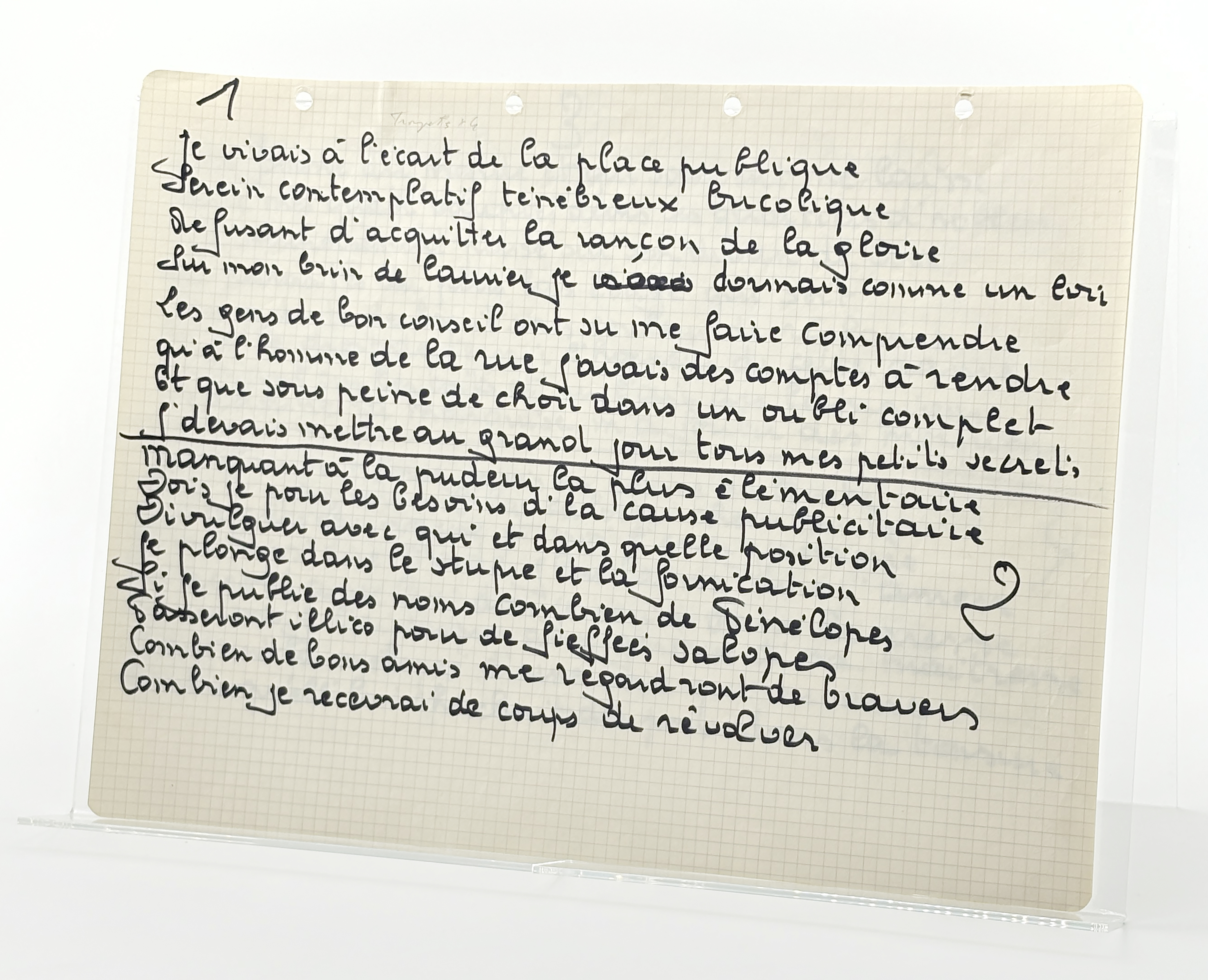
By invoking the possibility of “publishing names,” the speaker highlights the destructive power of public speech, capable of transforming figures of fidelity—symbolised by “Pénélope”—into objects of moral discredit. Brassens thus criticises a media logic in which the exposure of private life becomes an instrument of notoriety, often at the expense of talent itself.
A particularly vivid verse, belonging to the tradition of bawdy song, evokes “morpions” in association with a lady of high nobility, thereby intensifying the effect of social transgression and contrast.

The penultimate verse, which could understandably have offended the censorship board of the Maison de la Radio in a context where, at the turn of the 1960s, General Charles de Gaulle conceived public broadcasting as “the voice of France,” reads:
« Sonneraient-ell’s plus fort, ces divines trompettes, / Si, comm’ tout un chacun, j’étais un peu tapette »

This provocation nonetheless belongs to Brassens’s characteristic satirical register, which he extended to all social categories: police, military, clergy, prostitutes, journalists, bourgeois, students, and others. The anecdote that he refrained from performing this verse in the presence of Charles Trenet also reflects a degree of personal tact.

A true masterpiece of his repertoire, Les Trompettes de la renommée condenses the essential features of Brassens’s artistic aesthetic.

Census: No manuscript of this song is held in the archives of the city of Sète. Jérôme Arnoult records only one other known manuscript of this work.

Provenance: Estate of Sophie Duvernoy (1930–2025)
A discreet yet essential figure within Georges Brassens’s inner circle, Sophie Duvernoy entered his service in 1969 after having worked for the illustrator Raymond Peynet. She referred to Brassens as “the good master” (le bon maître), a nickname he himself had mischievously suggested when they first met. Born in Poland and nine years younger than the singer-songwriter, she was recruited almost by chance when Peynet moved to the South of France. At the time, Brassens was living in the Le Méridien building on Rue Émile-Dubois, alongside neighbours and friends such as Jacques Brel. Sophie subsequently accompanied Brassens when he moved to Rue Santos-Dumont, quickly becoming a stable presence within an environment shaped by the constant visits of friends and figures from the artistic world. A relationship grounded in trust and mutual understanding gradually emerged between these two reserved personalities. At the heart of this domestic space, which had become a place of artistic creation, Sophie Duvernoy assumed a central role, ensuring the conditions necessary for the work of the poet from Sète. Guardian of silence, manager of household affairs, and intermediary with the outside world, she moved in close proximity to Brassens’s creative process without ever disturbing its equilibrium. Her closeness to the artist also found expression in a limited direct participation in his work. She joined the chœur des copains alongside, among others, Claudine Caillart, Fred Mella, Joël Favreau, Pierre Nicolas, and André Tavernier, contributing backing vocals to two songs: “Tempête dans un bénitier” and “Le Roi.” Following the death of her “good master,” she lived in an apartment purchased by Brassens, who had guaranteed her lifetime use of it — a testament to the singular place she occupied both in his daily life and in the immediate orbit of his artistic creation.

Keep ahead of the pack

Join our mailing list and be the first to hear our latest news and biggest announcements.

By signing up you agree to our privacy policy. You can unsubscribe at any time.