Keep ahead of the pack
Join our mailing list and be the first to hear our latest news and biggest announcements.
By signing up you agree to our privacy policy. You can unsubscribe at any time.
Two autograph manuscripts: Fernande and Le Roi
s.l.n.d., 2 pp., large quarto on small-ruled paper, recto and verso, green ink.
« Il y a peu de chances qu’on / Détrône le roi des cons »
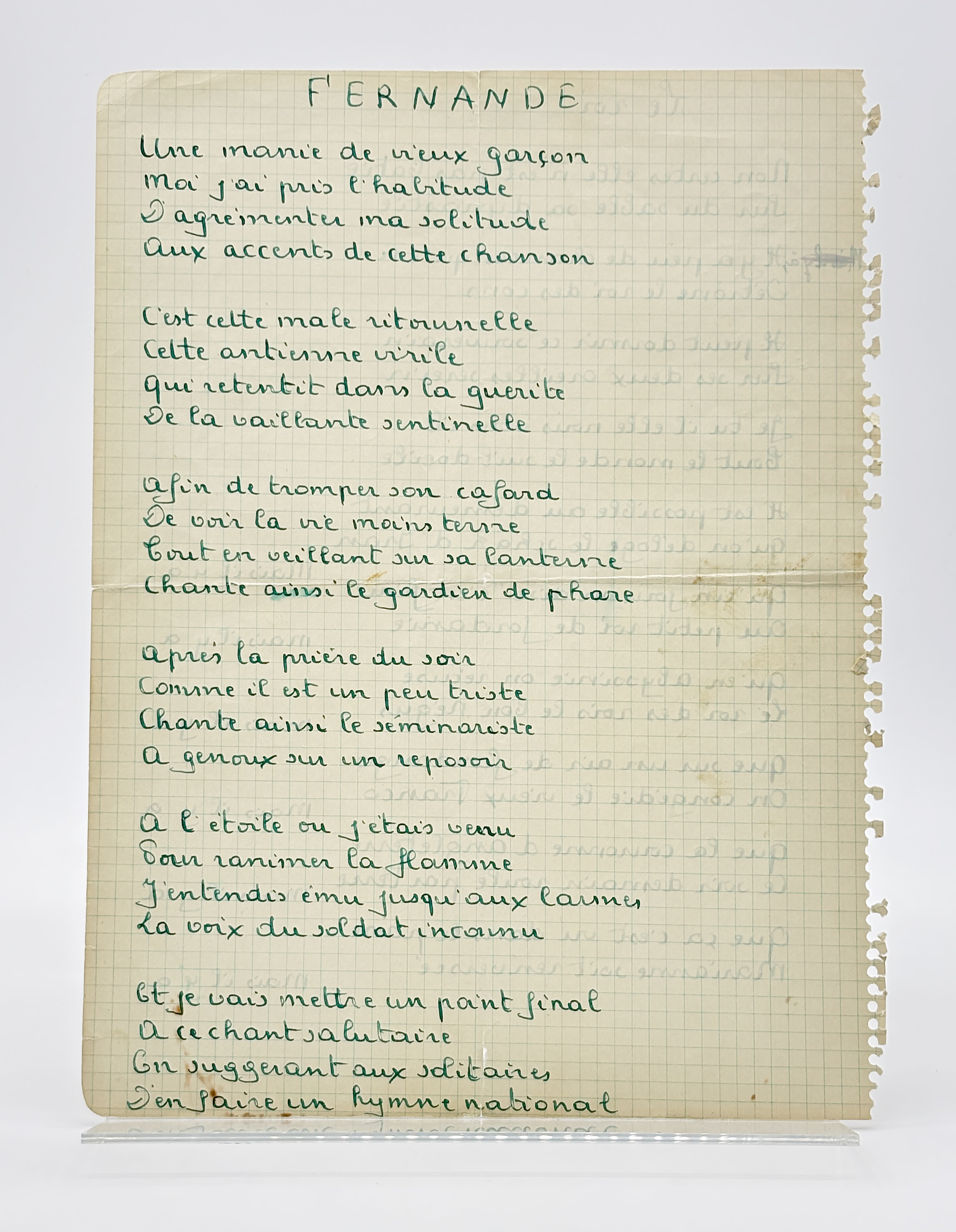
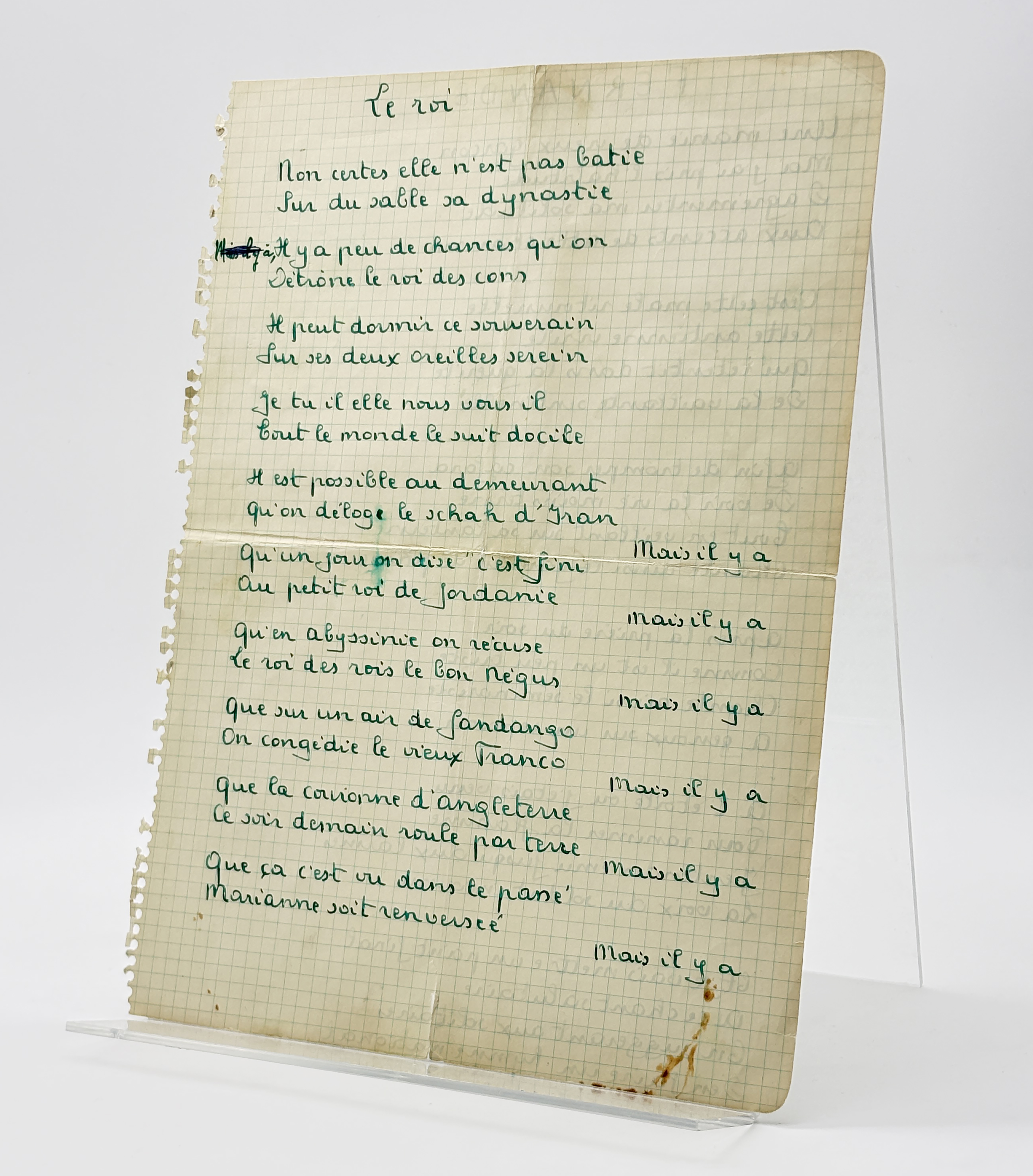
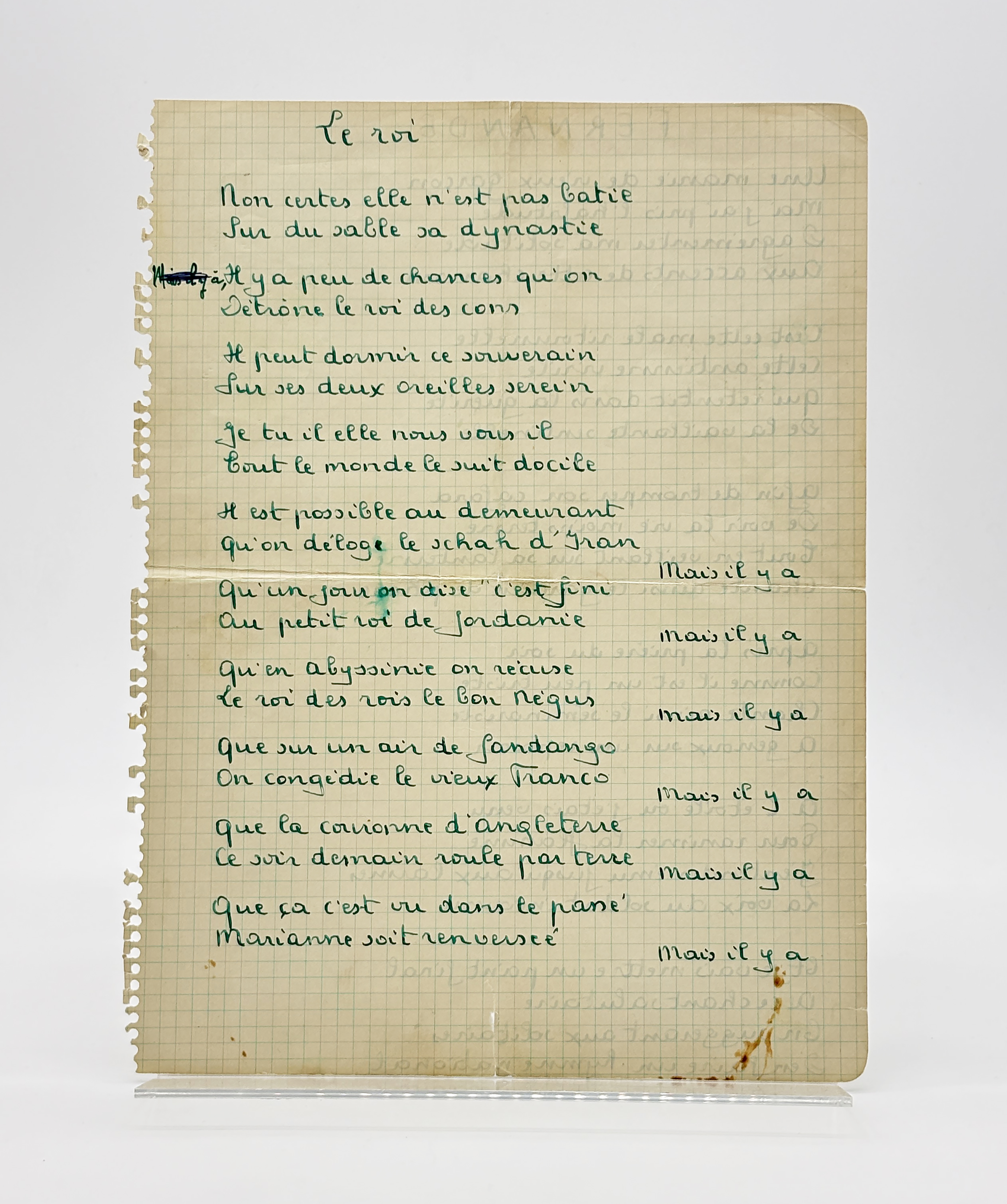
Fernande and Le Roi: precious manuscript of two major works from Georges Brassens’s repertoire, carefully prepared in clean copy form.
« C’est cette mâle ritournelle / Cette antienne virile / Qui retentit dans la guérite / De la vaillante sentinelle »
Fernande, genesis of a mythical text
While staying at his holiday home in Lézardrieux, Georges Brassens travelled to Paimpol to visit his old friend Michel Le Bonniec (nephew of Jeanne Le Bonniec-Planche, herself a figure celebrated in his work). It was on this occasion that Brassens conceived the refrain of Fernande, which he immediately improvised, delighted by his own discovery. Upon arriving at his friend’s shop, he entered singing the refrain, even offering—according to legend—the first hearing of this new creation to a customer trying on shoes.
The song is built on a series of figures and staged situations (lighthouse keeper, seminarian, sentry, Unknown Soldier), combining masculine universes, symbolic verticality, and possible phallic connotations, while playing on ironic contrasts between the sacred and the carnal. In a cyclical structure, Brassens articulates humour, provocation, and an implicit reflection on representations of male desire.
Le Roi
Faithful to his semantic register based on biting irony, Georges Brassens employs hyperbole without restraint, at times bordering on insult. Through the metaphor of monarchy, the poet constructs a narrative whose stability rests not on political legitimacy, but on the permanence of human “stupidity.” Thus, when the text asserts that this dynasty “is not built on sand,” it presents the “king of fools” not as the most foolish of men, but as the beneficiary of a lasting collective order ensured by universal docility: “everyone follows him, obediently.” He further reinforces his point by suggesting possible political upheavals: “let us depose the Shah of Iran,” “dismiss old Franco,” “let the Crown of England… fall to the ground.”
Brassens offers a disenchanted satire of politics: behind the diversity of regimes and authority figures lies the continuity of collective folly, which silently ensures the persistence of all forms of domination.
Fernande remains today the quintessential bawdy song in Brassens’s repertoire. Along with Le Roi, it appears on the eponymous album released in 1972 under the Philips label. The album was certified gold in 1976 (100,000 copies sold), and platinum in 1980 (400,000 copies).
In this manuscript, Brassens presents a carefully calligraphed clean copy of both songs in green ink. It may have served as a working sheet during studio recording sessions, given that he omits the refrain for Fernande while writing the incipit of Le Roi: “Mais il y a”.
According to Jérôme Arnoult’s census, up to five autograph manuscripts are known for each song. Two versions of Fernande (inv. M004-01 and M004-02) and one of Le Roi (inv. M064) are currently held at the Espace Brassens in Sète.
Provenance: Estate of Sophie Duvernoy (1930–2025)
A discreet yet essential figure within Georges Brassens’s inner circle, Sophie Duvernoy entered his service in 1969 after having worked for the illustrator Raymond Peynet. She referred to Brassens as “the good master” (le bon maître), a nickname he himself had mischievously suggested when they first met. Born in Poland and nine years younger than the singer-songwriter, she was recruited almost by chance when Peynet moved to the South of France. At the time, Brassens was living in the Le Méridien building on Rue Émile-Dubois, alongside neighbours and friends such as Jacques Brel. Sophie subsequently accompanied Brassens when he moved to Rue Santos-Dumont, quickly becoming a stable presence within an environment shaped by the constant visits of friends and figures from the artistic world. A relationship grounded in trust and mutual understanding gradually emerged between these two reserved personalities. At the heart of this domestic space, which had become a place of artistic creation, Sophie Duvernoy assumed a central role, ensuring the conditions necessary for the work of the poet from Sète. Guardian of silence, manager of household affairs, and intermediary with the outside world, she moved in close proximity to Brassens’s creative process without ever disturbing its equilibrium. Her closeness to the artist also found expression in a limited direct participation in his work. She joined the chœur des copains alongside, among others, Claudine Caillart, Fred Mella, Joël Favreau, Pierre Nicolas, and André Tavernier, contributing backing vocals to two songs: “Tempête dans un bénitier” and “Le Roi.” Following the death of her “good master,” she lived in an apartment purchased by Brassens, who had guaranteed her lifetime use of it — a testament to the singular place she occupied both in his daily life and in the immediate orbit of his artistic creation.
Join our mailing list and be the first to hear our latest news and biggest announcements.
By signing up you agree to our privacy policy. You can unsubscribe at any time.