Keep ahead of the pack
Join our mailing list and be the first to hear our latest news and biggest announcements.
By signing up you agree to our privacy policy. You can unsubscribe at any time.
Autograph card signed « GHuÿsmans » to André Godard
Paris, 16 Feb. 1899, 1 p. ½ in-12° oblong, in black ink
« In art, as in life, Suffering is the most powerful lever and the true springboard of Beauty »
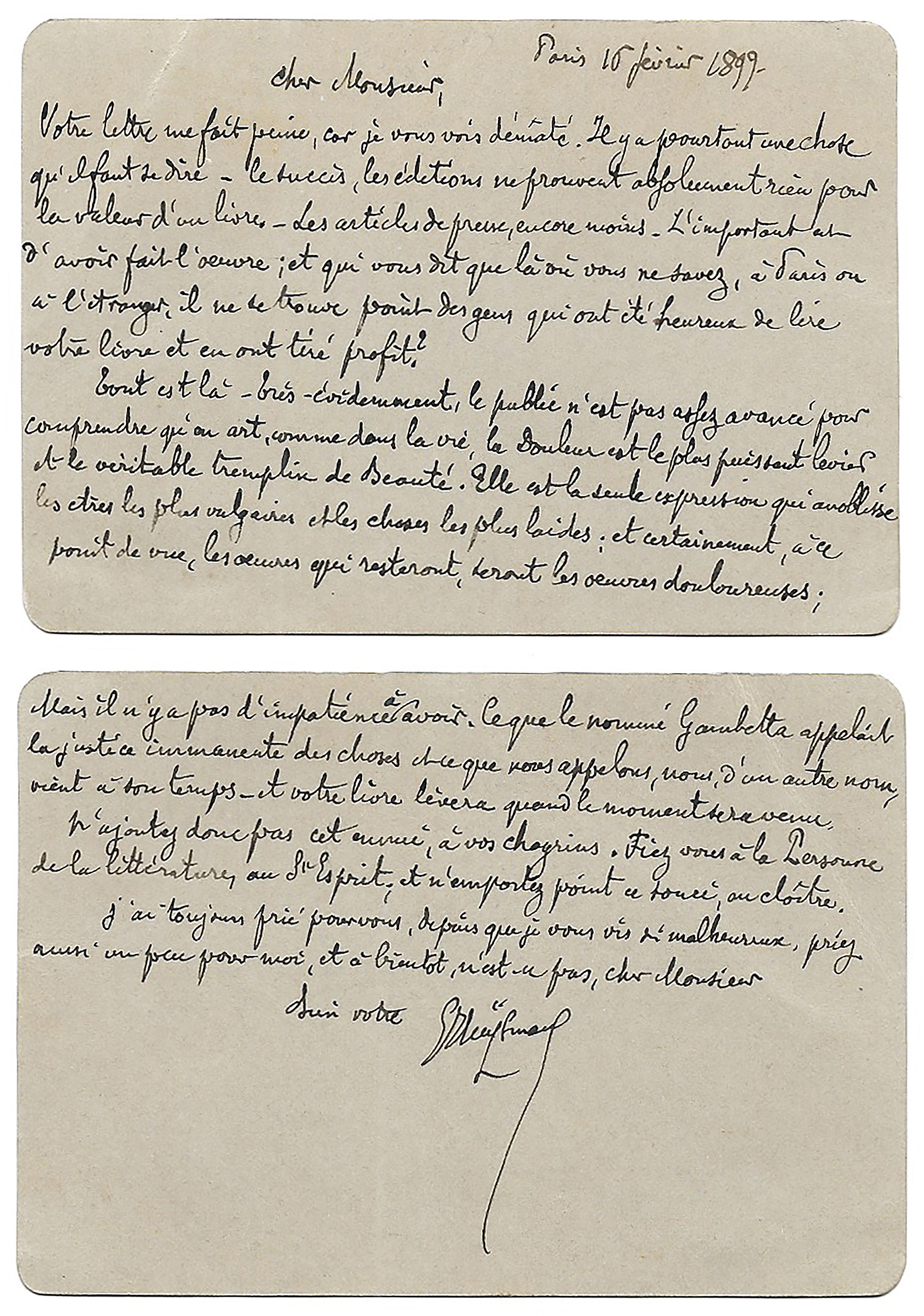
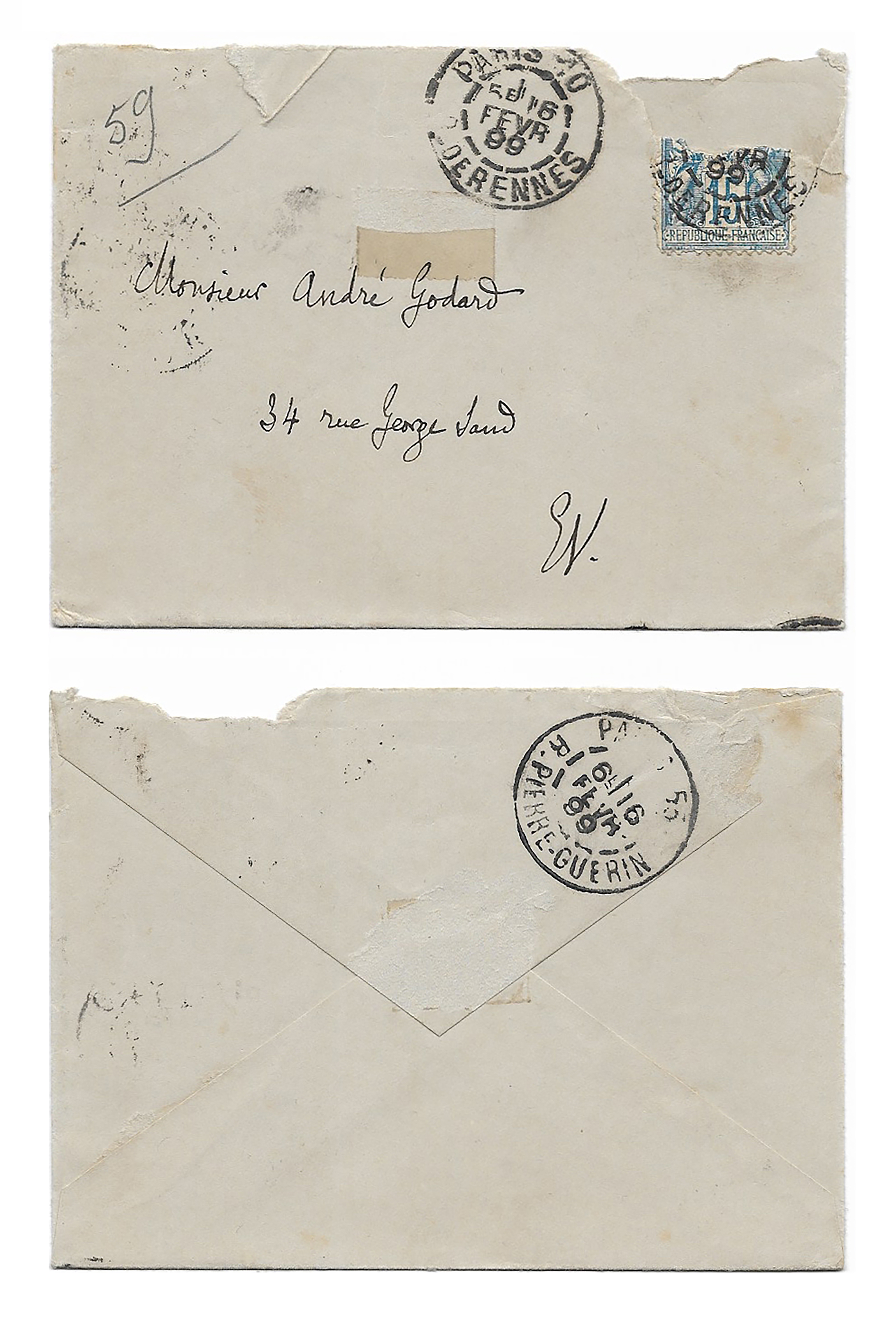
Autograph card signed « GHuÿsmans » to André Godard
Paris, 16 Feb. 1899, 1 p. ½ in-12° oblong, in black ink
Autograph envelope, stamped and postmarked (tears)
A remarkable unpublished statement by the writer, encapsulating on its own the Huysmansian aesthetic
« Votre lettre me fait peine, car je vous vois démâté. Il y a pourtant une chose qu’il faut se dire – le succès, les éditions ne prouvent absolument rien pour la valeur d’un livre – Les articles de presse, encore moins. L’important est d’avoir fait l’œuvre ; et qui vous dit que là où vous ne savez, à Paris ou à l’étranger, il ne se trouve point des gens qui ont été heureux de lire votre livre et en ont tiré profit ?
Tout est là – très évidemment, le public n’est pas assez avancé pour comprendre qu’en art, comme dans la vie, la Douleur est le plus puissant levier et le véritable tremplin de Beauté. Elle est la seule expression qui anoblisse les êtres les plus vulgaires et les choses les plus laides ; et certainement, à ce point de vue, les œuvres qui resteront, seront les œuvres douloureuses ;
Mais il n’y a pas d’impatience à avoir. Ce que le nommé Gambetta appelait la justice immanente des choses et ce que nous appelons, nous, d’un autre nom, vient à son temps – et votre livre lèvera quand le moment sera venu.
N’ajoutez donc pas cet ennui, à vos chagrins. Fiez-vous à la Personne de la littérature, au St Esprit, et n’emportez point ce souci, au cloître.
J’ai toujours prié pour vous, depuis que je vous vis si malheureux, priez aussi un peu pour moi, et à bientôt, n’est-ce pas, cher Monsieur
Bien votre
GHuÿsmans »
Suffering as a mystical path:
Following his conversion to Catholicism, dated to May 1891 (after his visit to Abbé Mugnier in the sacristy of Saint-Thomas-d’Aquin), Huysmans’s aesthetic came to value a spiritual beauty grounded in asceticism, suffering, and bodily affliction. This undertaking formed part of the writer’s spiritual quest, exploring Christian mysticism. During the same period, he explored the treasures of Paris’s religious architecture and composed several monographs and historical studies on various monuments.
In Sainte Lydwine de Schiedam (1901), Huysmans transposes onto the hagiographic body what Grünewald depicted on canvas. Émilie Sermadiras further notes that the saint’s mutilated body draws on an imaginary situated at the crossroads of scientific analysis and doloristic Catholic spirituality, where content and form unite in a “poetics of the fragment” centered on the suffering body.
Here seeking to comfort his correspondent after what appears to have been an editorial setback, Huysmans is likely alluding to Ysabelle, a novel by André Godard (1865-1941) published the previous year.
Provenance :
Private collection
Literature:
Émilie Sermadiras, La poétique du fragment dans Sainte Lydwine de Schiedam de J.-K. Huysmans, ou comment donner forme à « un amas répugnant de bribes », in Véronique Cnockaert et Marie-Ange Fougère (dir.), La chair aperçue. Imaginaire du corps par fragments (1800-1918), coll. « Cahiers ReMix », Observatoire de l’imaginaire contemporain (UQAM), 2018)
Join our mailing list and be the first to hear our latest news and biggest announcements.
By signing up you agree to our privacy policy. You can unsubscribe at any time.