Keep ahead of the pack
Join our mailing list and be the first to hear our latest news and biggest announcements.
By signing up you agree to our privacy policy. You can unsubscribe at any time.
Autograph letter signed « Mathieu Dreyfus » to Ferdinand Buisson
[Paris], 14 Nov. 1898, 1 p. in-12° on «petit bleu»
« What happened there that made him decide not to write to us anymore? »
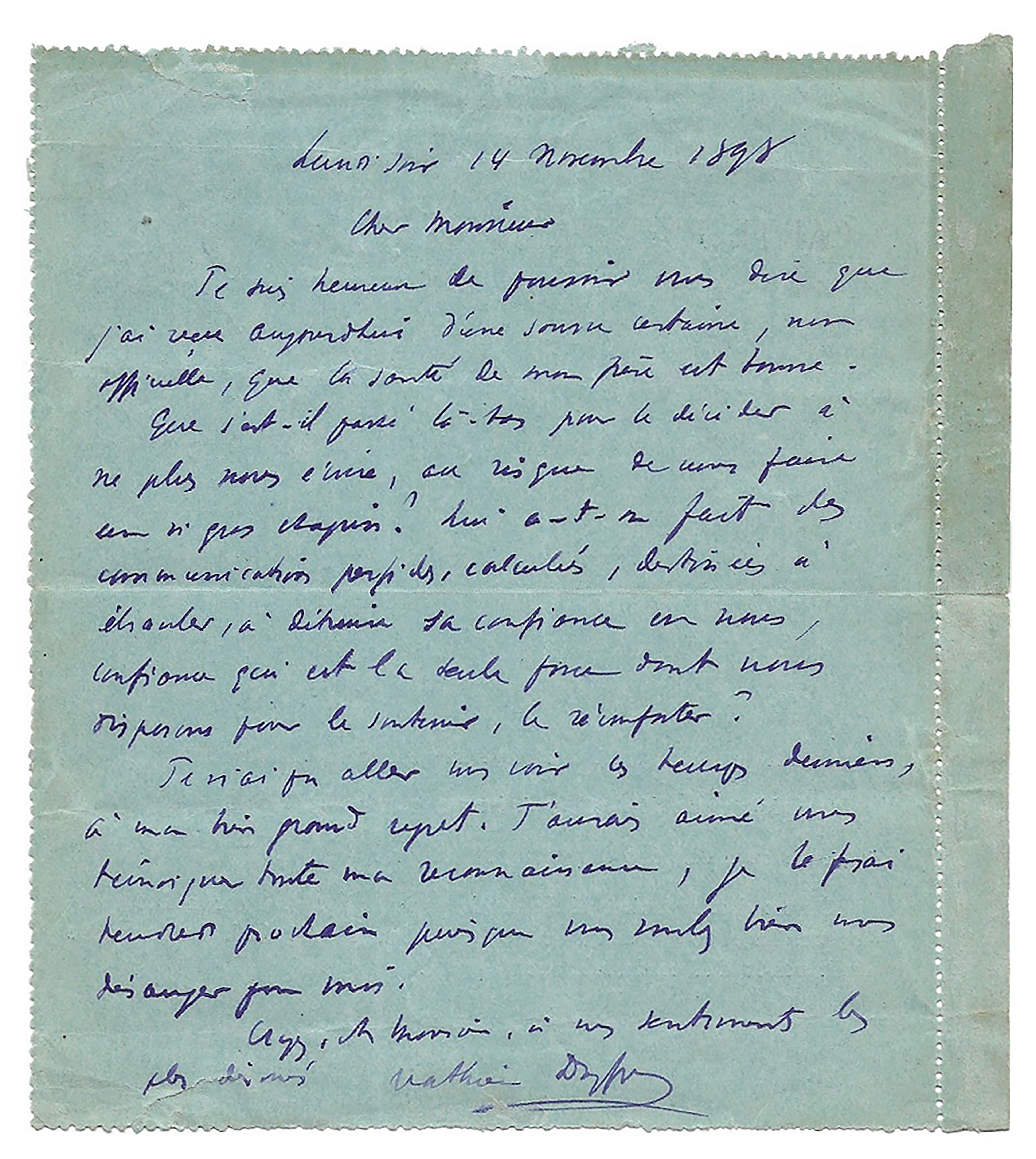
Autograph letter signed « Mathieu Dreyfus » to Ferdinand Buisson
[Paris], 14 Nov. 1898, 1 p. in-12° on «petit bleu»
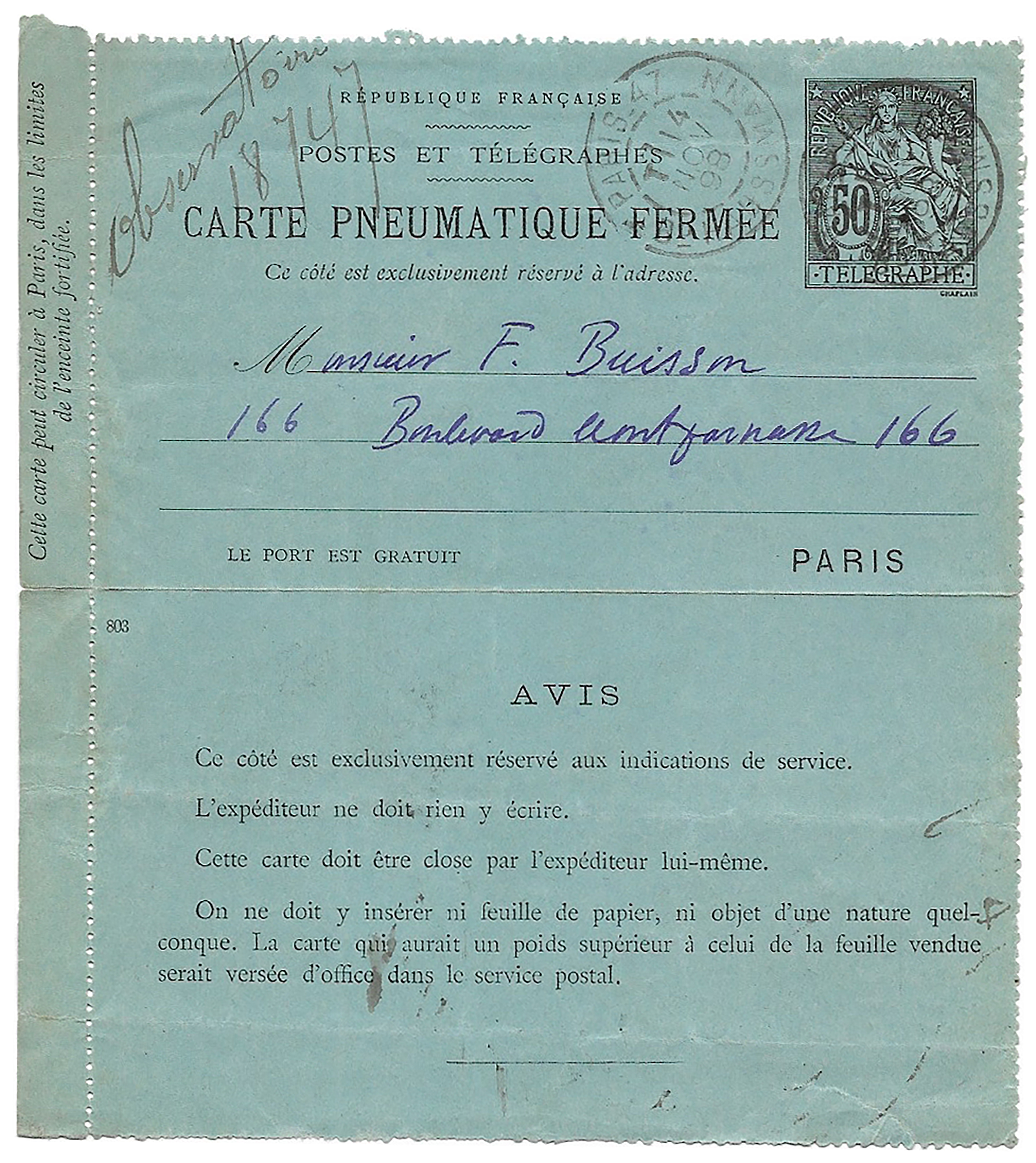
Autograph address on the verso: : « [M]onsieur F. Buisson / 166 Boulevard Montparnasse 166 [Paris] »
A small tear along the lower edge, with no missing material and no impact on readability
Rare letter from Mathieu Dreyfus conveying news of his brother Alfred, who was going through a critical phase of his imprisonment on Devil’s Island
« Cher Monsieur,
Je suis heureux de pouvoir vous dire que j’ai reçu aujourd’hui d’une source certaine, non officielle, que la santé de mon frère est bonne. Que s’est-il passé là-bas [Alfred Dreyfus était incarcéré sur l’île du Diable depuis mars 1895] pour le décider à ne plus nous écrire, au risque de nous faire un si gros chagrin ? Lui a-t-on fait des communications perfides, calculées, destinées à ébranler, à détruire sa confiance en nous, confiance qui est la seule force dont nous disposons pour le soutenir, le réconforter ? Je n’ai pu aller vous voir les temps derniers, à mon très grand regret. J’aurais aimé vous témoigner toute ma reconnaissance, je le ferai vendredi prochain puisque vous voulez bien vous déranger pour moi.
Croyez, cher Monsieur, à mes sentiments les plus dévoués.
Mathieu Dreyfus »
Autumn 1898: A Critical Episode in the Prison Life of Captain Alfred Dreyfus
Imprisoned on Devil’s Island since March 1895, Dreyfus repeatedly appealed to the President of the Republic and to General Boisdeffre for a retrial. His attempts proved fruitless, each of his letters remaining unanswered. Dreyfus then decided, on September 24, to “bring his correspondence to an end,” as he announced to the Governor of French Guiana: “For I can do no more, nor anything further, than I have done for Madame Dreyfus, for my children, for whom I have lived.”
In the course of October, during one of his visits, he confided to Jean-Baptiste-Ferdinand Deniel that he was “firmly resolved to end his life.” Determined to stop writing and prepared to go to any extreme, he alarmed Deniel, who took his threat very seriously and informed Vérignon, director of the prison administration, of the prisoner’s state of mind.
Dreyfus obtained from the latter a promise that a response from Boisdeffre would reach him before the end of the year. It was probably through the intervention of Joseph Reinach, who himself approached Charles Dupuy, the newly appointed President of the Council of Ministers and a fervent anti-Dreyfusard, that Mathieu managed to obtain information about his brother.
The First Dreyfusard
Mathieu Dreyfus’s tireless campaign on behalf of his brother began as soon as he learned from his sister-in-law, Lucie, on November 1, 1894, that Alfred had been arrested for treason. While the family’s quest for the truth had only just begun, the Affair was still far from attracting public attention. From that point onward, Mathieu would use every means at his disposal and mobilize his network of contacts to bring to light the conspiracy orchestrated against his brother by the General Staff.
A professor at the Sorbonne, educator, and co-founder of the League of Human Rights, Ferdinand Buisson met Mathieu Dreyfus in the spring of 1898, four months after the Affair had been revived and taken on an international dimension, following Émile Zola’s open letter to President Félix Faure. Until then, Buisson had remained reserved on account of his official position, but in this pivotal year he took a stand in support of the captain; his commitment alongside Mathieu Dreyfus became wholehearted.
Unpublished letter
Join our mailing list and be the first to hear our latest news and biggest announcements.
By signing up you agree to our privacy policy. You can unsubscribe at any time.