Keep ahead of the pack
Join our mailing list and be the first to hear our latest news and biggest announcements.
By signing up you agree to our privacy policy. You can unsubscribe at any time.
Letter signed « Chateaubriand » to John Wilson Croker
Paris, 29 March 1844, 3 p. in-8°
« I am dying piece by piece »
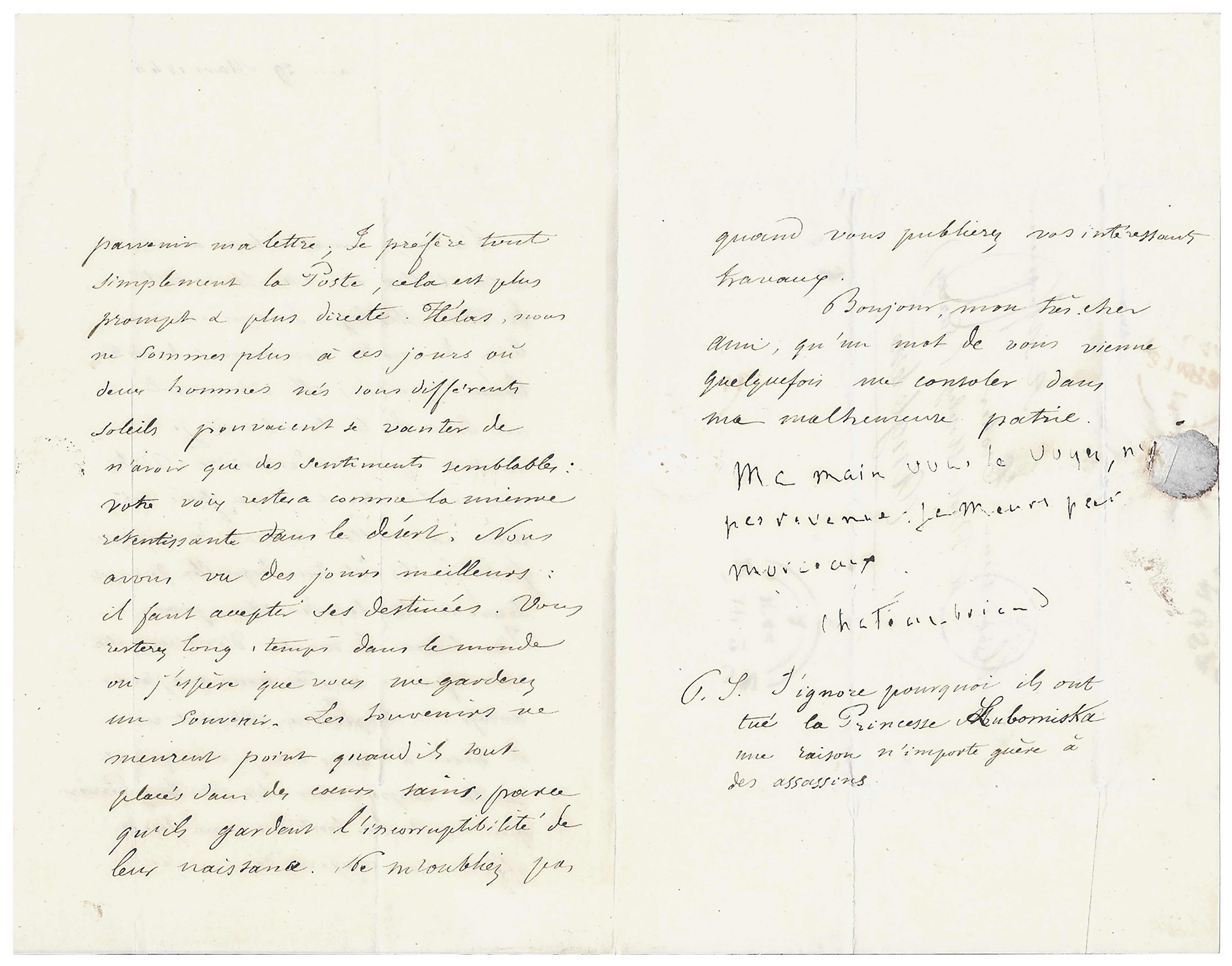
Letter signed « Chateaubriand » (with three autograph lines) to John Wilson Croker
Paris, 29 March 1844, 3 p. in-8°
The letter was probably dictated by Chateaubriand to his secretary of the time, Julien Danielo.
Address on the fourth page: to West Molesey (Surrey), postal marks
Superb twilight letter to one of his English literary admirations
“Memories do not die when they are placed in holy hearts, because they keep the incorruptibility of their birth.”
He thanks his friend for his « bonne amitié ; elle me console au bord de la tombe où je ne tarderai pas à descendre. Votre erreur touchant mon frère est bien naturelle [Jean-Baptiste de Chateaubriand, guillotined in 1794 along with part of the rest of the family], ce sont des méprises fort faciles et dans lesquelles doivent souvent tomber les étrangers. J’ai trouvé le moyen d’insérer votre nom [in his Mémoires d’outre-tombe, an allusion to Book IX of Volume II, devoted to the literary glories across the Channel] parmi ceux des amis que j’avais autrefois en Angleterre. N’ayant rien de secret à vous dire je n’ai point voulu importuner Sir Anthony Perrier qui avait la bonté de me faire offrir un moyen de vous faire parvenir ma lettre […] Hélas, nous ne sommes plus à ces jours où deux hommes nés sous différents soleils pouvaient se vanter de n’avoir que des sentiments semblables : votre voix restera comme la mienne retentissante dans le désert. Nous avons vu des jours meilleurs : il faut accepter ses destinées. Vous resterez long temps dans le monde où j’espère que vous me garderez un souvenir. Les souvenirs ne meurent point quand ils sont placés dans des cœurs saints, parce qu’ils gardent l’incorruptibilité de leur naissance. Ne m’oubliez pas quand vous publierez vos intéressants travaux.
Bonjour à mon très cher ami, qu’un mot de vous vienne quelquefois me consoler dans ma malheureuse patrie.
[Although suffering, Chateaubriand finds a renewed strength to add these few lines in his own trembling hand:]
Ma main vous le voyez, n’est pas revenue. Je meurs par morceaux.
Chateaubriand
P.S. J’ignore pourquoi ils sont tué la Princesse Lubomirska, une raison n’importe guère des assassins. [an allusion to the execution of Rosalie Lubomirska during the Great Terror, on 30 June 1794]
Chateaubriand first came to know England during an initial stay in London in 1793, when he was living in considerable poverty. His appointment as ambassador to the English capital at the turn of the 1820s opened the doors of Britain’s literary circles to him. He never concealed his admiration for English literature, and devoted an entire chapter of his Mémoires to it. The name of John Wilson Croker appears there for the first time alongside those of Thomas Moore, Campbell, Rogers, Crabbe, Wordsworth, Southey, Hunt, Knowles, Lord Holland and Canning (vol. II, book IX, p. 199, Garnier, 1910).
Chateaubriand later returns to his relationship with Croker: “Mr. Croker, a member of the Admiralty, celebrated as both an orator and a writer, belonged to the school of Mr. Pitt, as did Mr. Canning; but he was more disillusioned than the latter. He occupied at Whitehall one of those gloomy apartments from which Charles I had stepped out of a window onto the scaffold. […] Mr. Croker came, two years ago [1822], to visit me at the Marie-Thérèse Infirmary. He remarked on the similarity of our opinions and our destinies. Events set us apart from the world; politics makes solitaries, just as religion makes anchorites. When a man dwells in the wilderness, he finds within himself some distant image of the infinite Being who, living alone in immensity, watches the revolutions of the worlds unfold.” (ibid., vol. IV, book IX, p. 263)
A politician like Canning and Lord Holland, a Member of Parliament and a member of a Tory cabinet, John Wilson Croker (1780-1857) pursued his literary tastes with zeal. He produced numerous historical works and occasional writings, and was a tireless critic and, on occasion, a poet who celebrated English victories.
Provenance:
Private collection
Unpublished letter
Join our mailing list and be the first to hear our latest news and biggest announcements.
By signing up you agree to our privacy policy. You can unsubscribe at any time.