Keep ahead of the pack
Join our mailing list and be the first to hear our latest news and biggest announcements.
By signing up you agree to our privacy policy. You can unsubscribe at any time.
Ten autograph poems
N.p.n.d. [c. 1920], 1 p. in-8°
« La dentelle accidentelle / Du rose ouvre la mer »
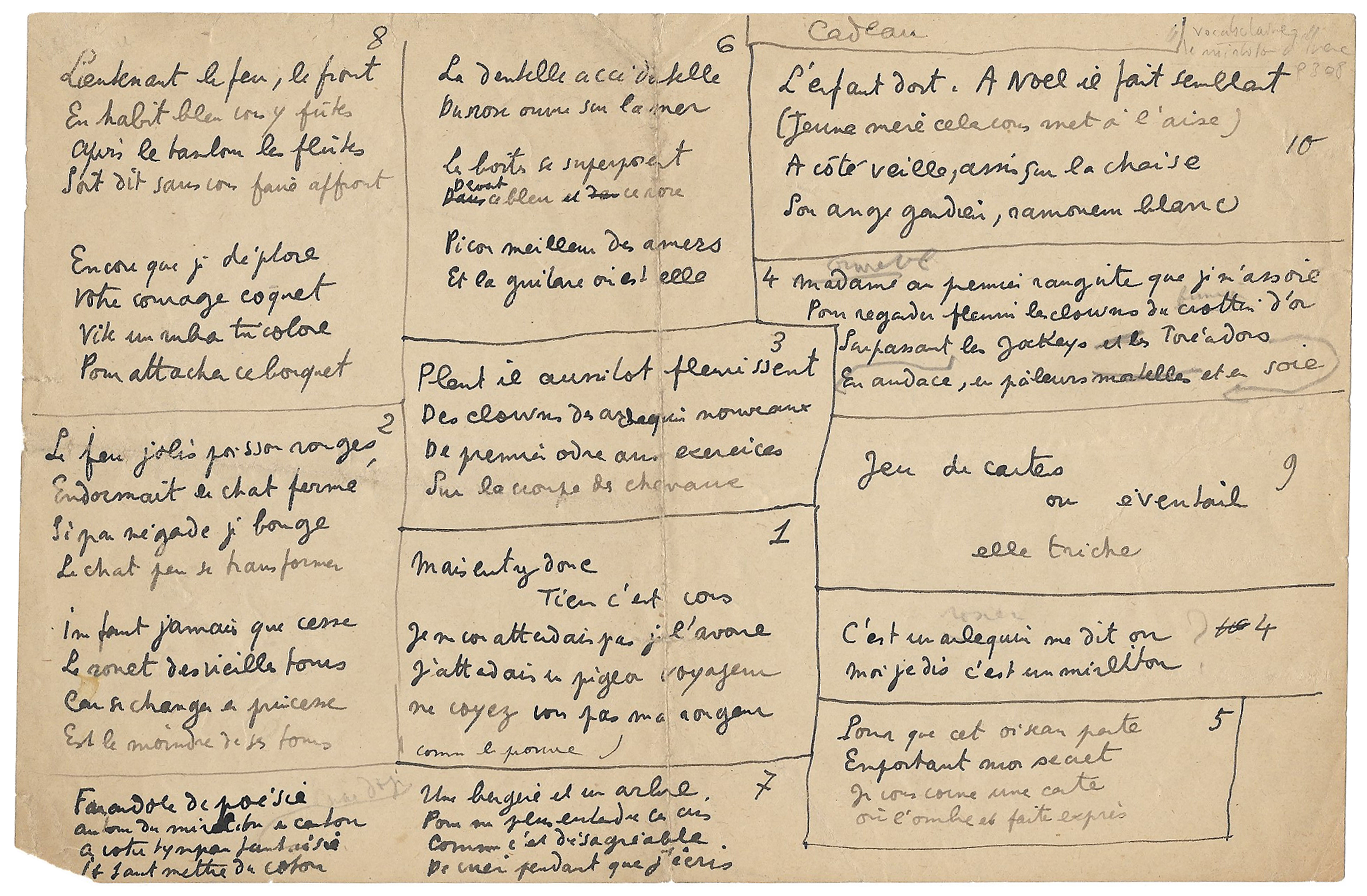
Ten preparatory autograph poems: Cadeau [Le Mirliton d’Irène]
N.p.n.d. [c. 1919-1921], 1 p., large oblong 8vo
Each poem enclosed in a box drawn by Cocteau himself
Slight loss to lower right corner (no loss of text), fold marks, a small ink offset and one obliteration, a few pencil overwritings, all in Cocteau’s hand
[Verso:] A reproduction of Pablo Picasso’s 1916 portrait of Jean Cocteau, with autograph pencil annotation by Cocteau
A set of ten poems, most of them unpublished, for Le Mirliton d’Irène, which appeared in his collection Vocabulary
“Le Mirliton d’Irène” is an allusion to Irène Lagut, painter and pupil of Picasso, as confirmed by this extract from a letter from Cocteau to her dated 8 October 1919: « Me voilà couché, Irène, avec une extinction de voix ridicule. “Je suis un mirliton entouré de vers tristes”, dirait le poète » (Bulletin d’information, Société des amis de Jean Cocteau, April 1922). In keeping with Cocteau’s wish to restore value to the commonplace in poetry, he may have drawn his inspiration from the bad verses comparable to those printed on the paper bands wrapped around pastries. Another hypothesis, as Michel Décaudin points out, may be that of occasional verse, such as the « madrigals » composed by Mallarmé and published in 1919 by Éditions de la Sirène. Finally, Cocteau himself attributes to these Mallarmean verses the « grace of a Japanese era, of fans, albums, candy bags […] » (Le Rappel à l’ordre, Stock, p. 80).
Of this section of the collection, here titled « Cadeau », Cocteau would retain only three poems. Box « 2 » would become Chat; box « 9 », Prise sur le fait; and finally box « 10 », Minuit. All three are here in their definitive version, if one disregards the indentation of the second line of Minuit, present in the published collection. The writing of Vocabulaire extended from the end of 1919 to the autumn of 1921. The composition of this set may therefore safely be placed in that period. The bulk of this project of ten poems was extensively reworked by Cocteau before publication.
Vocabulaire marks, in Cocteau’s work, the transition between a form of poetry inherited from the avant-garde and one of a more classical manner, prefiguring Plain-Chant or Le Requiem.
Provenance:
Bernard Loliée
Bibliography:
Œuvres poétiques complètes, éd. Michel Décaudin, Pléiade, 1999, p. 308-310
Join our mailing list and be the first to hear our latest news and biggest announcements.
By signing up you agree to our privacy policy. You can unsubscribe at any time.