Keep ahead of the pack
Join our mailing list and be the first to hear our latest news and biggest announcements.
By signing up you agree to our privacy policy. You can unsubscribe at any time.
Autograph letter signed « Renoir » to Paul Bérard
[Algiers, March 1881], 2 p. in-8°
« So far the women are unapproachable, and I can’t understand their gibberish »
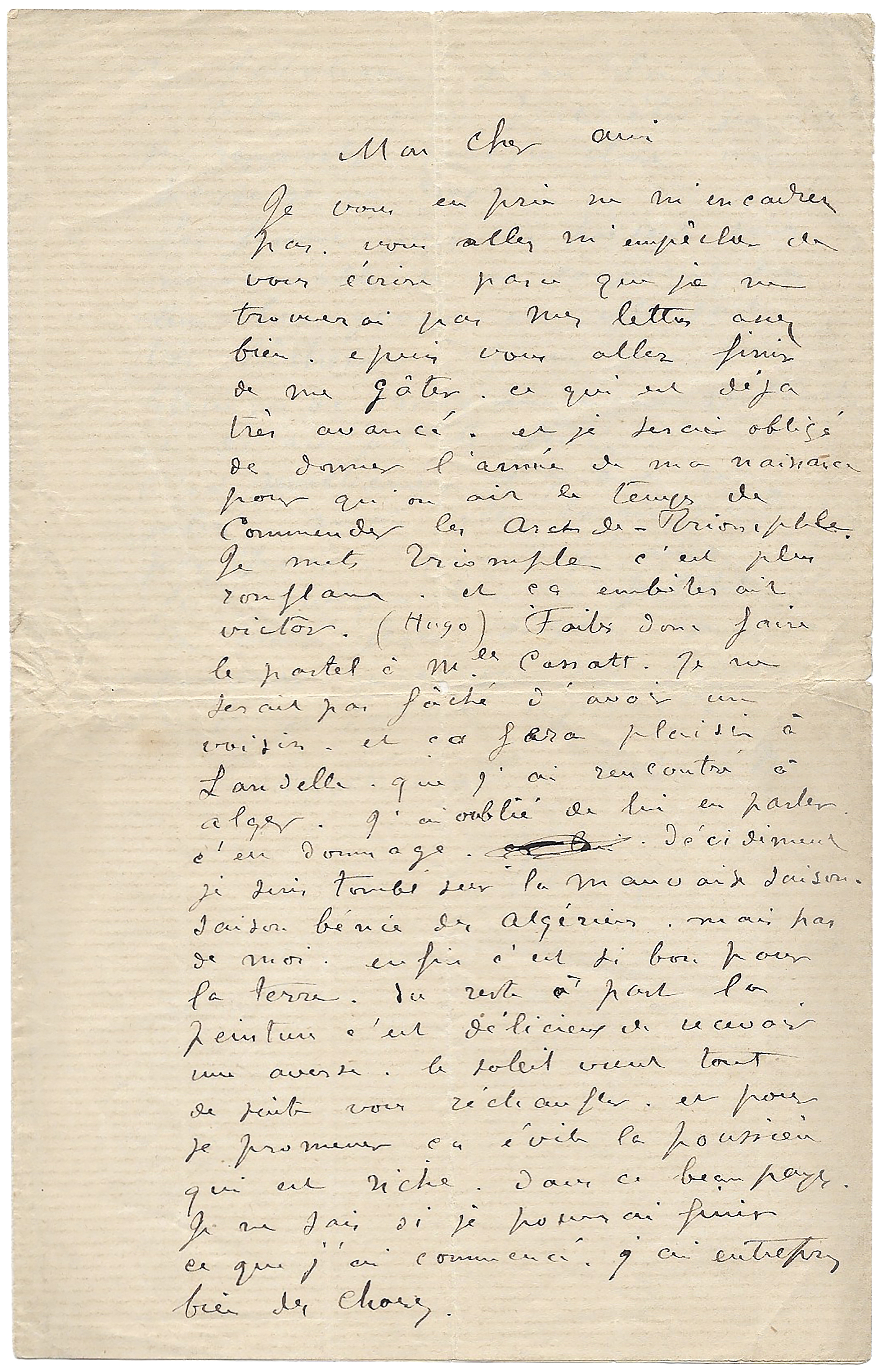
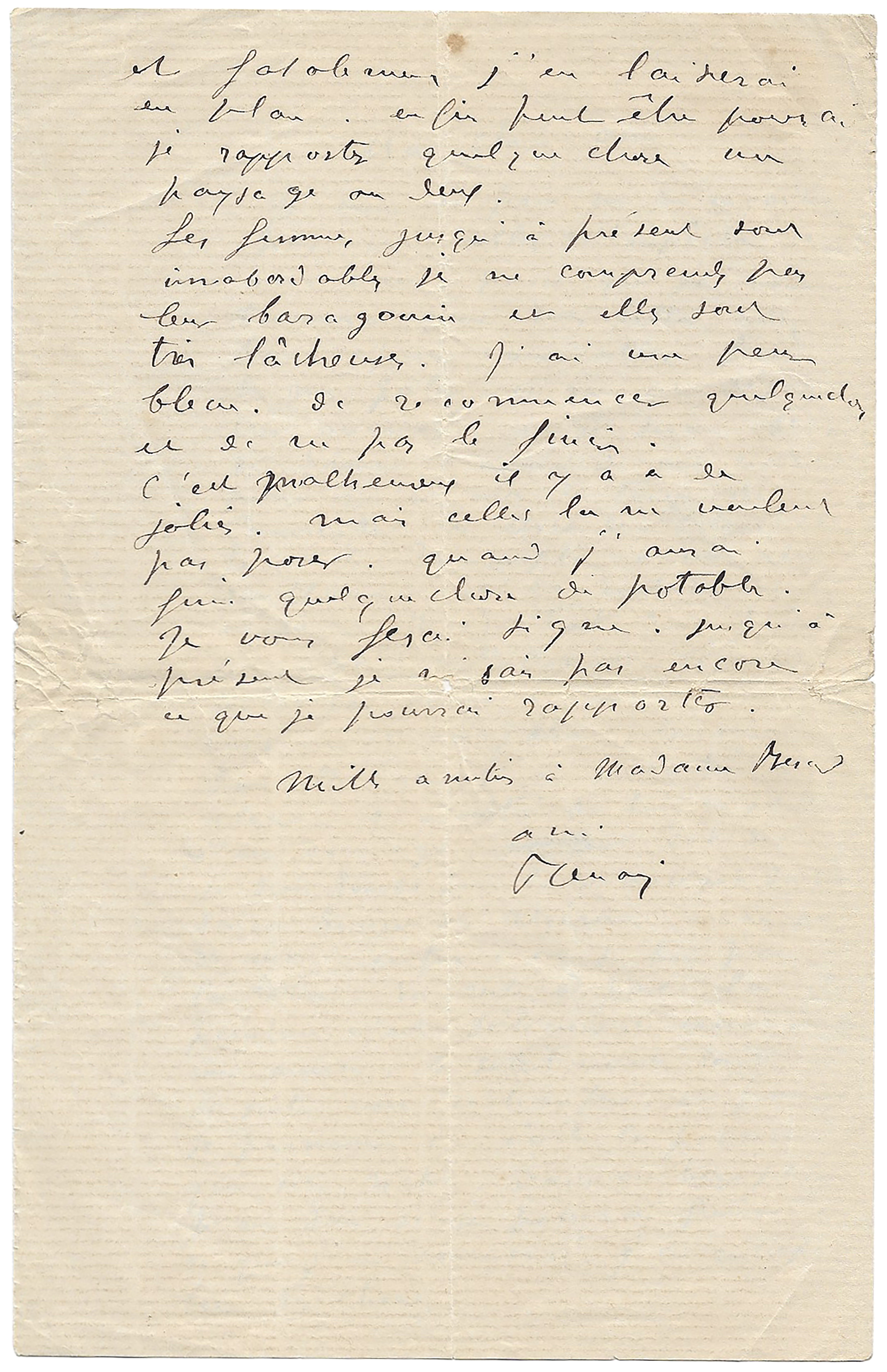
Autograph letter signed « Renoir » to Paul Bérard
[Algiers, March 1881], 2 p. in-8° in black ink, on laid paper
Two words struck through by Renoir; small splits and perforations along the folds, of no consequence
Renoir in Algeria: « Perhaps I can bring something back, a landscape or two »
Scarce travel letter from the master, charmed by this « beautiful country » but faced with a language barrier with the women he wishes to pose for him
« Mon cher ami,
Je vous en prie de m’encadrez pas, vous allez m’empêcher de vous écrire parce que je ne trouverai pas mes lettres assez bien. Et puis vous allez finir de me gâter, ce qui est déjà très avancé, et je serai obligé de donner l’année de ma naissance pour qu’on ait le temps de commander les Arcs de Triomphle. Je mets Triomphle, c’est plus ronflant, et ça embêterait Victor (Hugo)¹. Faites donc faire le pastel à Mlle Cassatt². Je ne serais pas fâché d’avoir un voisin, et ça ferait plaisir à Landelle [Charles Landelle (1821-1908), peintre orientaliste apprécié du public, faisait de fréquents séjours en Afrique du nord], que j’ai rencontré à Alger. J’ai oublié de lui en parler, c’est dommage. Décidément je suis tombé sur la mauvaise saison, saison bénie des Algériens, mais pas de moi. Enfin c’est si bon pour la terre. Du reste, à part la peinture, c’est délicieux de recevoir une averse, le soleil vient tout de suite vous réchauffer, et pour se promener ça évite la poussière qui est riche dans ce beau pays. Je ne sais si je pourrai fini ce que j’ai commencé, j’ai entrepris bien des choses, et fatalement j’en laisserai en plan. Enfin peut-être pourrai-je rapporter quelque chose, un paysage ou deux.
Les femmes jusqu’à présent sont inabordables, je ne comprends pas leur baragouin et elles sont très lâcheuses. J’ai une peur bleue de recommencer quelque chose et de ne pas le finir.
C’est malheureux, il y en a de jolies, mais celles-là ne veulent pas poser. Quand j’aurai fini quelque chose de potable, je vous ferai signe. Jusqu’à présent je ne sais pas encore ce que je pourrai rapporter.
Mes amitiés à Madame Berard.
Ami
Renoir »
The turn of the 1880s marks a decisive shift in Renoir’s painting. Having reached the end of an Impressionist phase that he now judges exhausted, the painter sets out, in the footsteps of Delacroix, on a first journey to Algeria in March 1881, in search of a style of his own. His so-called Ingresque period begins from this point, and will culminate in Les Grandes baigneuses (1884-1887).
Fifty years after Delacroix, whom Renoir so admired, he is one of the few Impressionists to have turned to Orientalism. It is worth recalling that in the early 1870s, during his bohemian years alongside Monet and Bazille, he was already copying works by Delacroix while studying new colour effects, as seen in Intérieur de harem à Montmartre (1872), a pendant to Delacroix’s famous canvas Les Femmes algériennes (1834), now in the Louvre.
Despite the artistic disappointments evoked here, Renoir nonetheless manages to express his own vision of Algeria, at once luminous and full of striking contrasts, in both the architecture and the portraits. The artist is enchanted by the golden light, intimate and warm, a reflection of local culture and of the craft of its textiles. His portrait Jeune fille algérienne (held in the Museum of Fine Arts, Boston), painted during his stay in March 1881, is the most illustrious example. The following year, Renoir undertakes a second journey to Algiers in the company of Aline Charigot, in order to complete what he had begun in 1881.
It was through Charles Deudon that Renoir met Paul-Antoine Bérard, a banker and wealthy heir, who commissioned paintings and portraits from him as early as 1879 and soon became his patron.
1- The French and Algerian press had echoed Victor Hugo’s 79th birthday on 26 February. The anniversary gave rise to various celebrations, in France as in Algiers. Years later, the dealer Ambroise Vollard would report this very harsh judgment from the elderly Renoir: “One would have to be mad to say that Hugo has no genius; but his art, such as it is, makes my skin crawl: and above all, the hatred I have for that man stems from the fact that it was he who got the French out of the habit of speaking simply.” (Vollard 1994, p. 140)
2- Close to Degas since 1877, Mary Cassatt had taken part in the Impressionist exhibitions of 1879 and 1880, which had propelled her to the ranks of the movement’s leading figures. The artist was about to take part in the exhibition running from 2 April to 1 May 1881. Her portrait of Lucie Bérard, the daughter of his correspondent, born in 1880, to whom Renoir alludes here, dates from that same year. The pastel is now held in the Philadelphia Museum of Art.
Provenance:
Paul Bérard ; Maurice Bérard (by descent) ; private coll.
Bibliography:
Auguste Renoir – Lettres choisies, éd. Augustin de Butler et Anne Distel, Flammarion – Musée d’Orsay, n°38
Join our mailing list and be the first to hear our latest news and biggest announcements.
By signing up you agree to our privacy policy. You can unsubscribe at any time.