Keep ahead of the pack
Join our mailing list and be the first to hear our latest news and biggest announcements.
By signing up you agree to our privacy policy. You can unsubscribe at any time.
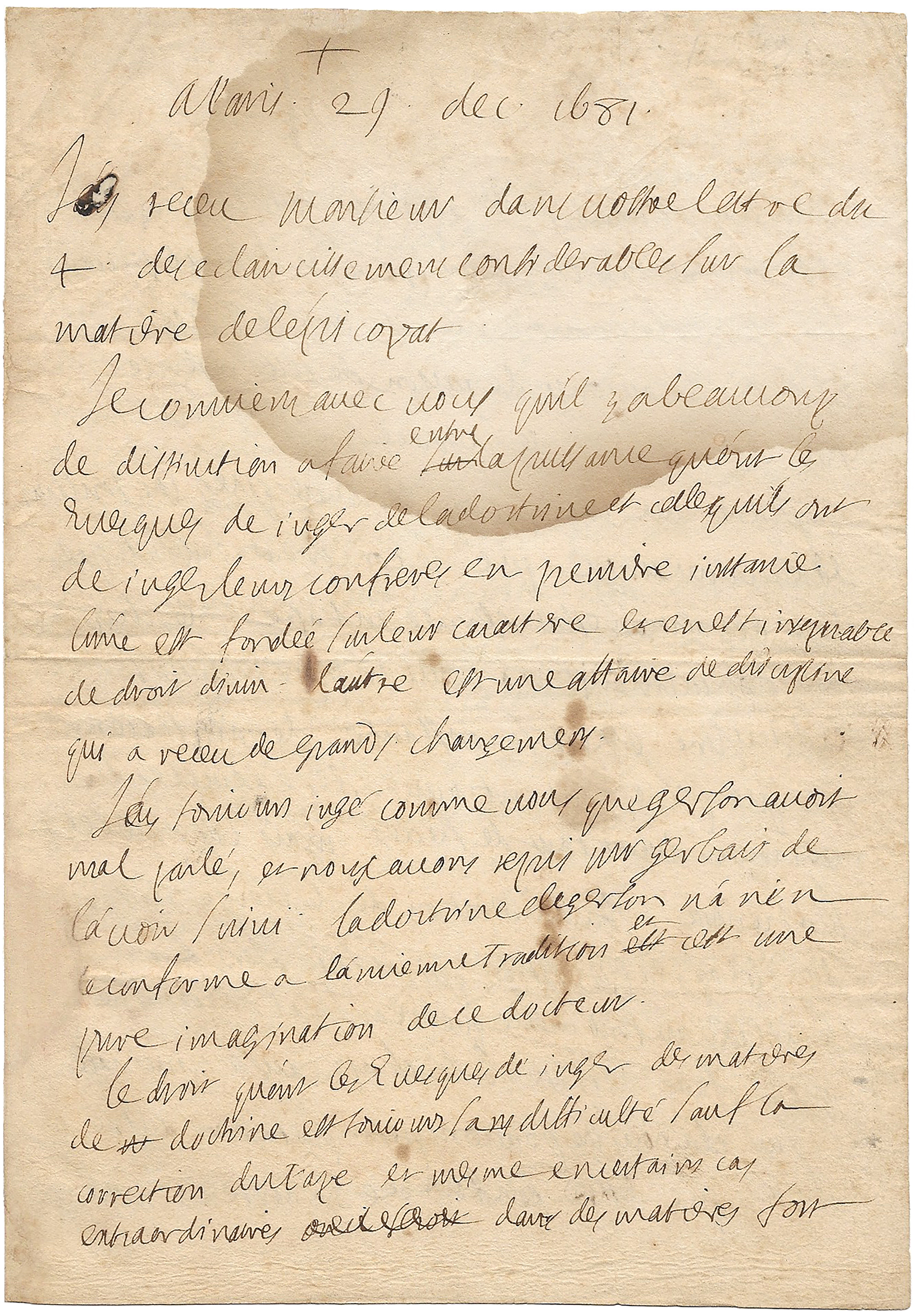
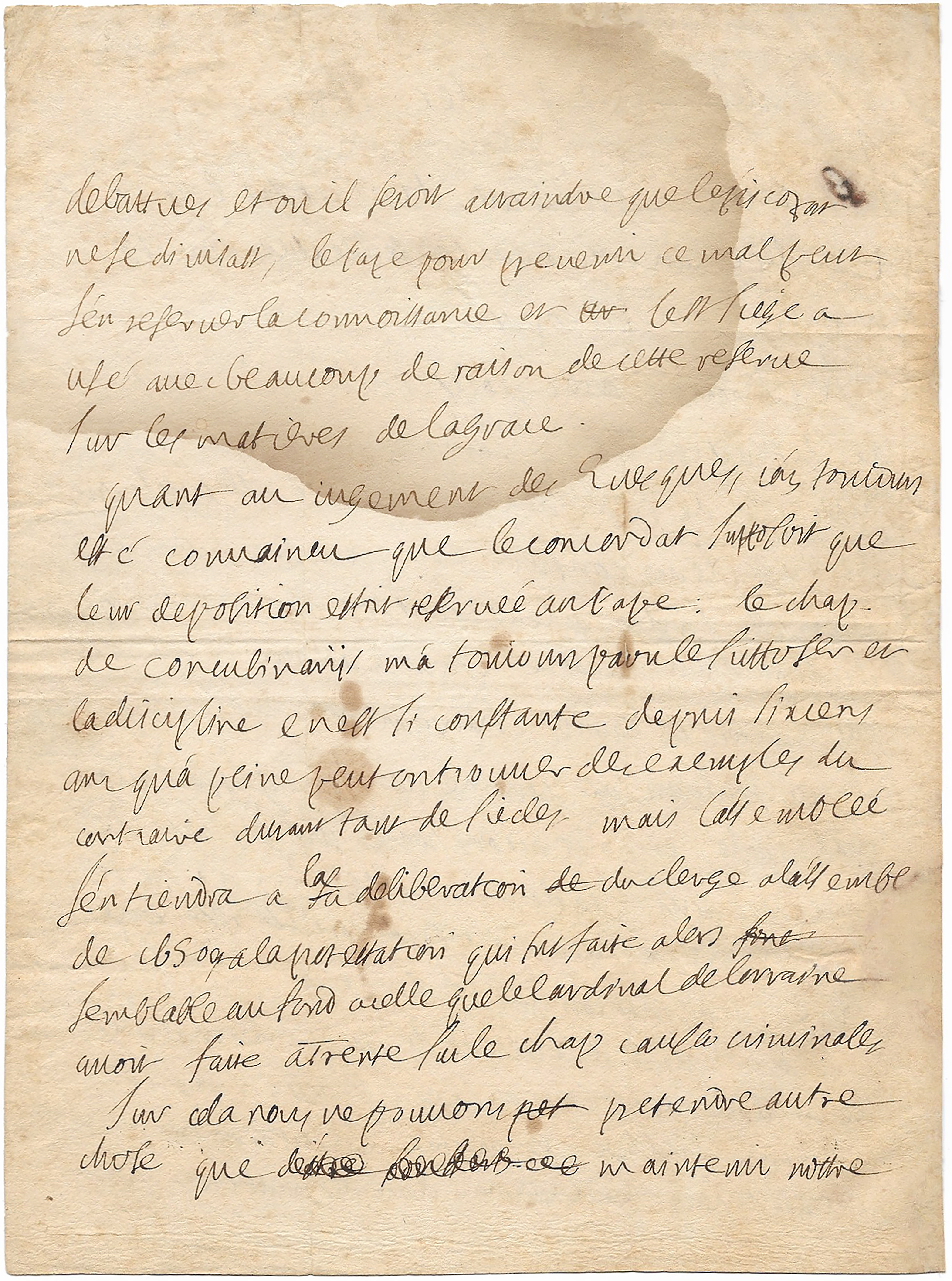
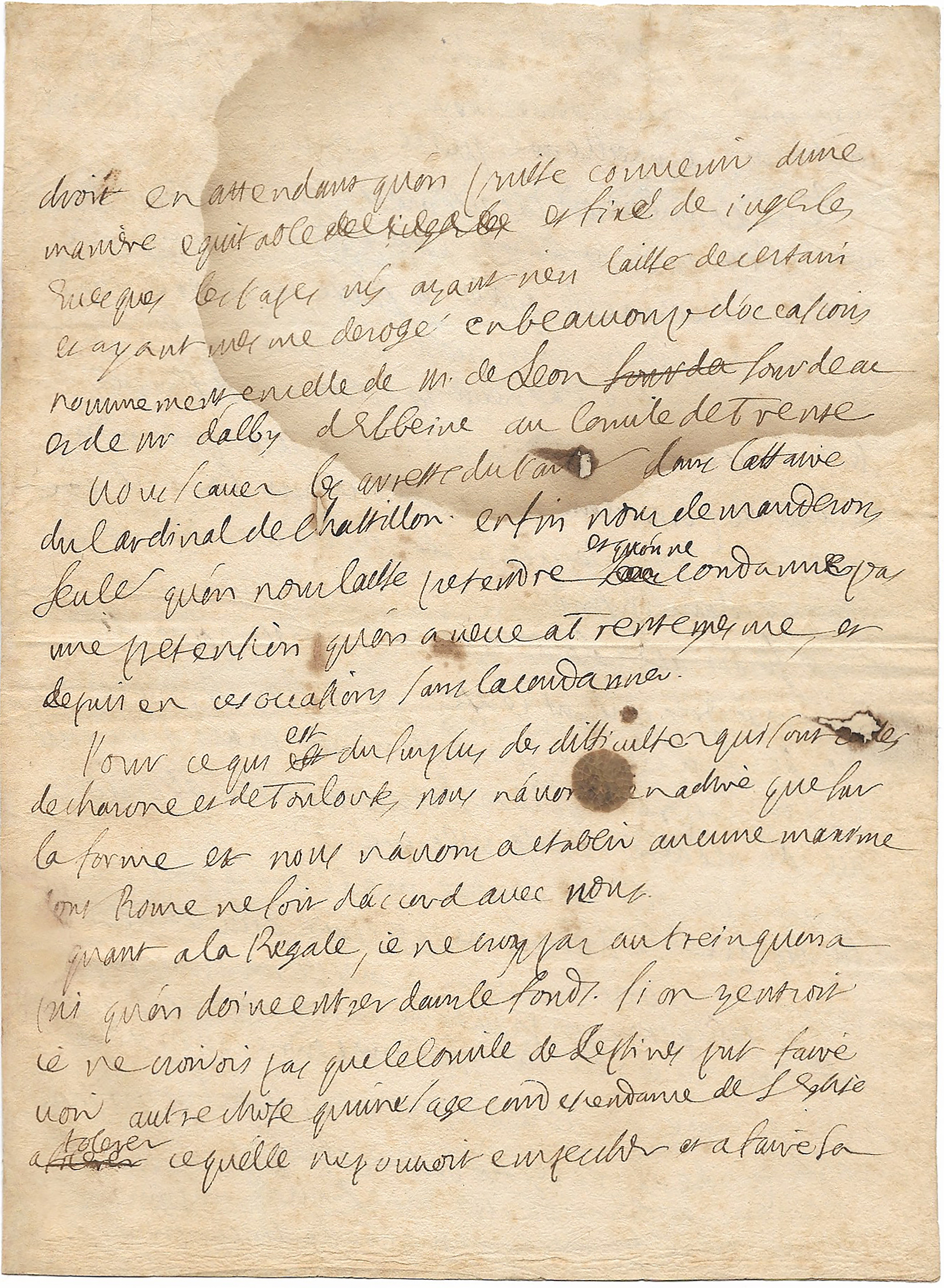
Autograph letter signed « J-Bénigne de Meaux » to François Diroys
Paris, 29th Dec. 1681, 4 p. small in-4°, brown ink
« The right of bishops to judge matters of doctrine is always without difficulty »
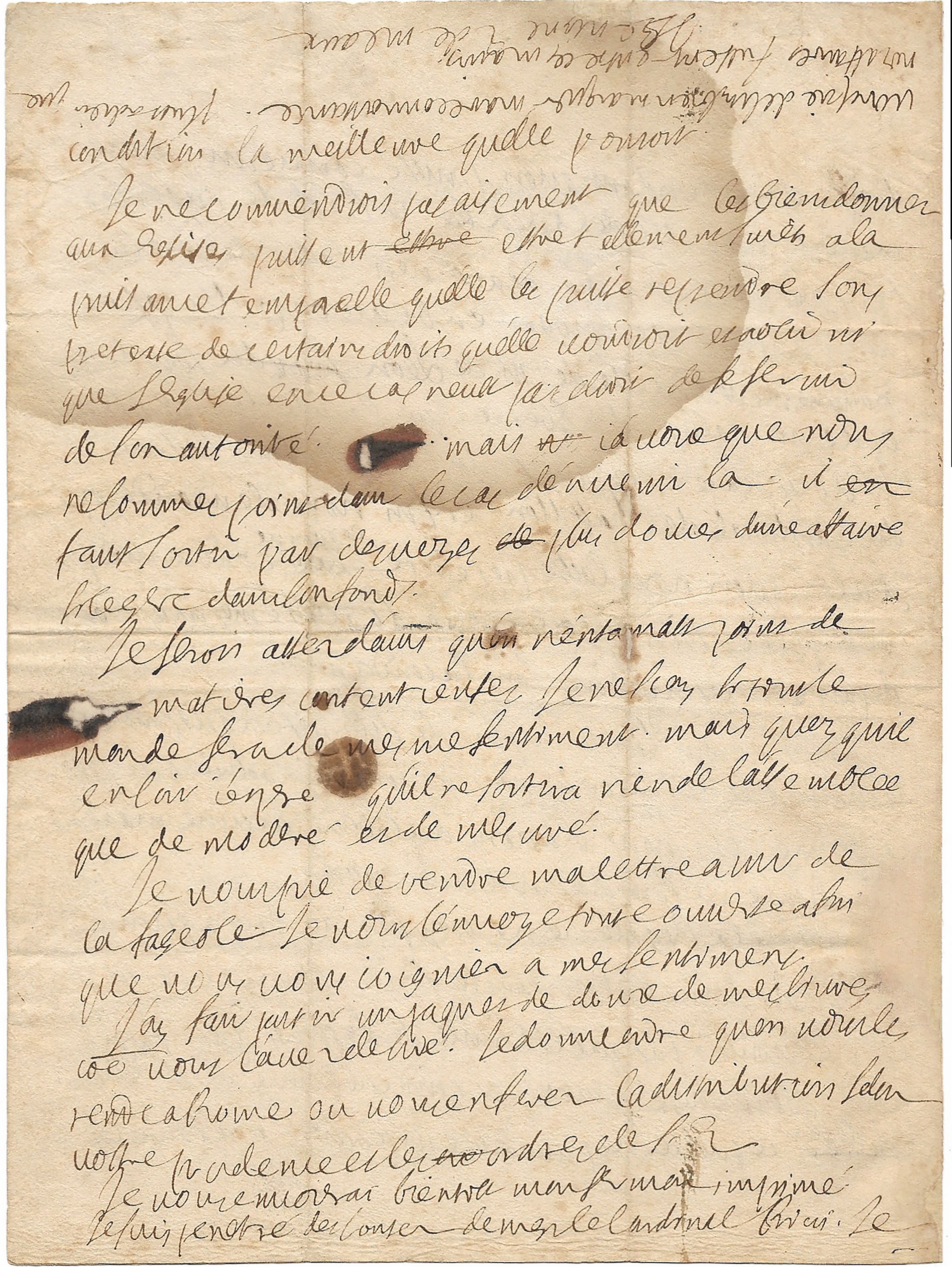
Autograph letter signed « J-Bénigne de Meaux » to François Diroys
Paris, 29th Dec. 1681, 4 p. small in-4°, brown ink
On laid paper with watermark
Old stain without affecting readability
Restored ink perforations, a few ink smudges from Bossuet’s hand
A major and fully autograph letter of Bossuet regarding the doctrinal and disciplinary issues of the 1682 assembly of the clergy
« J’ai reçu, Monsieur, dans votre lettre du 4 des éclaircissemens considérables sur la matière de l’épiscopat¹.
Je conviens avec vous qu’il y a beaucoup de distinction à faire entre la puissance qu’ont les évêques de juger sur la doctrine et celle qu’ils ont de juger leurs confrères en première instance : l’une est fondée sur leur caractère et en est inséparable de droit divin, l’autre est une affaire de discipline qui a reçu de grands changemens.
J’ai souvent jugé comme vous que Gerson² avait mal parlé et nous avons repris Mr Gerbais³ de l’avoir suivi⁴. La doctrine de Gerson n’a rien de conforme à l’ancienne tradition et c’est une pure imagination de ce docteur.
Le droit qu’ont les évêques de juger des matières de doctrine est toujours sans difficulté sauf la correction du pape et même en certains cas extraordinaires dans des matières fort débattues et où il serait à craindre que l’épiscopat ne se divisât, le pape pour prévenir ce mal peut s’en réserver la connaissance et le St Siège a usé avec beaucoup de raison de cette réserve sur les matières de la grâce.
Quant au jugement des évêques, j’ai toujours été convaincu que le concordat [Le concordat de 1516, conclu entre Léon X et François Ier] supposait que leur déposition était réservée au pape. Le chapitre des concubinaires m’a toujours paru le supposer et la discipline en est si constante depuis six cents ans qu’à peine peut-on trouver des exemples du contraire durant tant de siècles. Mais l’assemblée s’en tiendra à la délibération du clergé de l’assemblée de 1650⁵ et à la protestation qui fut faite alors semblable au fond à celle que le cardinal de Lorraine avait faite à Trente sur le chapitre causae criminales. Sur cela nous ne pouvons prétendre autre chose que maintenir notre droit en attendant qu’on puisse convenir d’une manière équitable et fixe de juger les évêques, le pape n’y ayant rien laissé de certain et ayant même dérogé en beaucoup d’occasions nommément en celle de Mr de Leon Sourdeac⁶ et de Mr d’Albi d’Elbene au concile de Trente [Diroys avait lui-même étudié cette matière].
Vous savez les arrêts du Parlement dans l’affaire du cardinal de Châtillon⁷. Enfin nous demanderons seulement qu’on nous laisse prétendre et qu’on ne condamne pas une prétention qu’on a eue à Trente même et depuis en ces occasions sans la condamner⁸.
Pour ce qui est du surplus des difficultés qui sont celles de Charonne et de Toulouse nous n’avons rien à dire que sur la forme et nous n’avons à établir aucune maxime dont Rome ne soit d’accord avec nous.
Quant à la regale [droit dont jouissait le Roi de percevoir les fruits des bénéfices pendant la vacance. En 1673, Louis XIV voulut étendre ce droit à tout le royaume], je ne crois pas au train qu’on a pris qu’on doive entrer dans le fonds. Si on y entrait je ne croirais pas que le concile de Leptines pût faire voir autre chose qu’une sage condescendance de l’Eglise à tolérer ce qu’elle ne pourrait empêcher et à faire sa condition la meilleure qu’elle pouvait.
Je ne conviendrais pas aisément que les biens donnés aux églises puissent être tellement sujet à la puissance temporelle et qu’elle les puisse reprendre sous prétexte de certains droits qu’elle voudrait établir ni que l’Église en ce cas n’eût pas droit de se servir de son autorité [Diroys avait défendu la nature temporelle de la Régale dans un mémoire qu’il rédigea la même année] Mais j’avoue que nous ne sommes point dans le cas d’en venir là. Il faut sortir par des voies plus douces d’une affaire si légère dans son fond.
Je serais assez d’avis qu’on n’entamât point de matières contentieuses. Je ne sais si tout le monde sera de même sentiment mais quoiqu’il en soit j’espère qu’il ne sortira rien de l’assemblée que de modéré et de mesuré. Je vous prie de rendre ma lettre à Mr de la Fageole. Je vous l’envoie toute ouverte afin que vous vous joigniez à mes sentiments.
J’ai fait partir un paquet de douze de mes livres [Discours sur l’histoire universelle] comme vous l’avez désiré. Je donne ordre qu’on vous les rende à Rome où vous en ferez la distribution selon votre prudence et les ordres de S.E.
Je vous enverrai bientôt mon sermon [sur l’Unité de l’Église] imprimé. Je suis pénétré des bontés de Mgr le cardinal Ricci. Je vous prie de lui marquer ma reconnaissance. Plût à Dieu que nos affaires fussent entre ses mains.
J. Bénigne de Meaux »
Recently appointed Bishop of Meaux on 2 May 1681, Bossuet delivered a sermon at the opening of the General Assembly of the Clergy of France on the following 9 November, a discourse that would become famous for its treatment of the Unity of the Church. A regular correspondent of Bossuet, Diroys was highly regarded within diocesan circles for his erudition as a historian. His Preuves et préjugés (1683) would later follow in the line of Bossuet’s Discours sur l’histoire universelle, published in 1681. Bossuet consulted him on several matters, notably on a question of canon law concerning the episcopate: should a bishop be judged by the pope or by his peers? The issue arose in connection with the four French “Jansenist” bishops who refused simply to sign the Formulary. From the clarifications provided by Diroys and from his own historical investigations, Bossuet concluded that the Assembly of the Clergy should uphold the rights of the episcopate, while not excluding the possibility of a reasoned decision by the pope.
On the question of the régale, mentioned later in the letter and the subject of a dispute between the king and the pope, Bossuet found himself torn between loyalty to his sovereign and obedience to the pope. The “Eagle of Meaux” was obliged to walk a ridge line, as in his sermon on the Unity of the Church: to defend the liberties of the Gallican Church without diminishing the legitimate prerogatives of the Holy See. Prudence and moderation were required, he concluded.
Diroys, who had the ear of Cardinal d’Estrées, served as a crucial channel of information for Bossuet in gauging the state of mind of what the Gallicans called the “Court of Rome.” He needed to know the sentiments of the pope and the cardinals in order to avert the risk of crisis and to ease the disputes then underway.
1- One of the difficulties that the Assembly had to examine concerned the right claimed by the Pope to judge bishops in the first instance. By brief of 27 April 1667, Alexander VII, at the King’s request, had appointed nine commissioners charged with acting on behalf of the Holy See against the four bishops who refused to sign the Formulary outright; “and this without the possibility for these four bishops to appeal in any way from their judgment or to challenge any of them.”
2- Jean Gerson (1363–1429), one of the most illustrious doctors of the Gallican Church, had written a treatise De Appellationibus a summo Pontifice, which Gerbais seems to have relied on. It is not precisely known what particular opinion of Gerson is criticized here by Bossuet, except perhaps the definition he gives of major causes that must be brought before the Pope after being examined first in the provinces: they are thus called, he says, non ratione materiæ, sed ambiguæ difficultatis in terminatione (not by reason of the matter, but because of the ambiguous difficulty in their resolution).
3- Jean Gerbais, born around 1629 in Rupoix, in the diocese of Reims, came to study in Paris and received the clerical hat on 5 May 1661. He was a professor of humanities at the Collège des Grassins and rector of the University. In 1662, he was appointed professor of Latin eloquence at the Collège Royal. He attached himself to Le Tellier, the future Archbishop of Reims, whom he even accompanied on a trip to Italy in 1667.
4- Cardinal d’Estrées would not have been displeased to provoke a new conflict between the Roman Curia and the French clergy regarding the brief condemning Gerbais’s book. Therefore, the King ordered the extraordinary Assembly of March 1681 to examine this censure. However, the minutes of this Assembly, signed by Bossuet, do not mention the rebuke referred to here by the bishop of Meaux.
5- When examining the case of the two bishops of Albi and Léon, deposed by commissioners appointed by the Pope, the 1650 Assembly of the clergy declared that the brief “granting authority to four bishops to judge other bishops sovereignly was contrary to the Concordat, in which the Pope reserves the knowledge of major causes in the last instance; that the King, consenting that the bishops be judged by the Pope’s commissioners, had prejudiced the right of said bishops to be judged by their fellow provincials…”
6- René de Rieux de Sourdéac, bishop of Saint-Pol-de-Léon since 1619. He was first excommunicated, and his Church placed under interdict in 1625 by Étienne Louytre, dean of the Church of Nantes, a papal commissioner delegated to enforce a judgment of Pope Urban VIII against the nuns of a monastery in Morlaix, in the diocese of Léon, who, supported by their bishop, refused to submit to Jacques Gallemant, André Duval, and Pierre de Bérulle, appointed by the Pope as superiors of all Carmelite convents in the kingdom.
7- Odet de Coligny, Cardinal of Châtillon, brother of Admiral Coligny, was bishop of Beauvais and holder of numerous benefices when he abjured Catholicism, married, squandered the property of his Church and that of his abbey of Saint-Benoît-sur-Loire, fought with the Protestants at Saint-Denis in 1567, and then went to England, where he would die on 2 March 1571, poisoned by his valet.
8- Meaning: We will only ask that Rome allow us to assert (our rights) and not condemn this claim that we (the French) have made, even at Trent and since, on the occasions I have just mentioned, without it having been condemned.
The general assembly of the high clergy on 19 March 1682, the first under the guidance of Bossuet, was to culminate in the Declaration of the Four Articles
In his Discours sur l’histoire universelle, written in 1681 and which established him as a major figure within the episcopal milieu, Bossuet set out his conception of the history of the world. From Creation to the triumph of the Catholic Church, passing through the fall of the ancient empires, he sought the meaning and cause of events in God’s designs for His Church. That same year, he completed the education of the Dauphin, before being appointed bishop of Meaux on 2 May.
The following year, in the context of the conflict between Louis XIV and Pope Innocent XI over the droit de régale, he played a central role in the drafting and adoption of the Declaration of the Four Articles at the extraordinary assembly of the French clergy.
François Diroys (1620–1691), doctor of the Sorbonne and canon of Avranches, was initially close to the Solitaires of Port-Royal. He had notably been the tutor of Thomas du Fossé’s brother before aligning himself with the Formulary. He defended it in a treatise published in 1705, Dissertatio pro justificanda condemnatione qua S. Sedes V propositiones sub nomine Jansenii…, to which Nicole responded the following year with Examen d’un écrit de M. Dirois (1706). Diroys also wrote several memoranda on the conflict between the Pope and the King, as well as a Treatise on the Régale, which remained unpublished. A theologian attached to Cardinal d’Estrées, who had arrived in Rome in 1672, he corresponded with Le Camus and the Appaméens and frequented the Italian Oratorians of the Chiesa Nuova, where he occasionally met Favoriti.
Included:
Sermon presché a l’ouverture de l’assemblée generale du clergé de France
9 November 1681. Paris: Frédéric Léonard, 1682. 8 x 15 cm. Bound.
First edition. Bound in contemporary full brown calf. Spine with raised bands and decorative tooling. Brown calf title label.
Wear and scuffs on boards. Foxing.
The only sermon published by the author, on the unity of the Church. From the very first words, Bossuet links the Catholic Church to Jewish history
Provenance:
HVT, 14 mars 2014, n°490
Bibliography:
Correspondance, t. II, éd. Charles Urbain et Eugène Levesque, Paris, 1909, n°250
Join our mailing list and be the first to hear our latest news and biggest announcements.
By signing up you agree to our privacy policy. You can unsubscribe at any time.