Keep ahead of the pack
Join our mailing list and be the first to hear our latest news and biggest announcements.
By signing up you agree to our privacy policy. You can unsubscribe at any time.
Autograph letter to Madam Dumans
Meaux, 20 Dec. 1695, 1 p. in-8°
« The order of the Church was formerly to receive confirmation before communion; this remains its spirit even today »
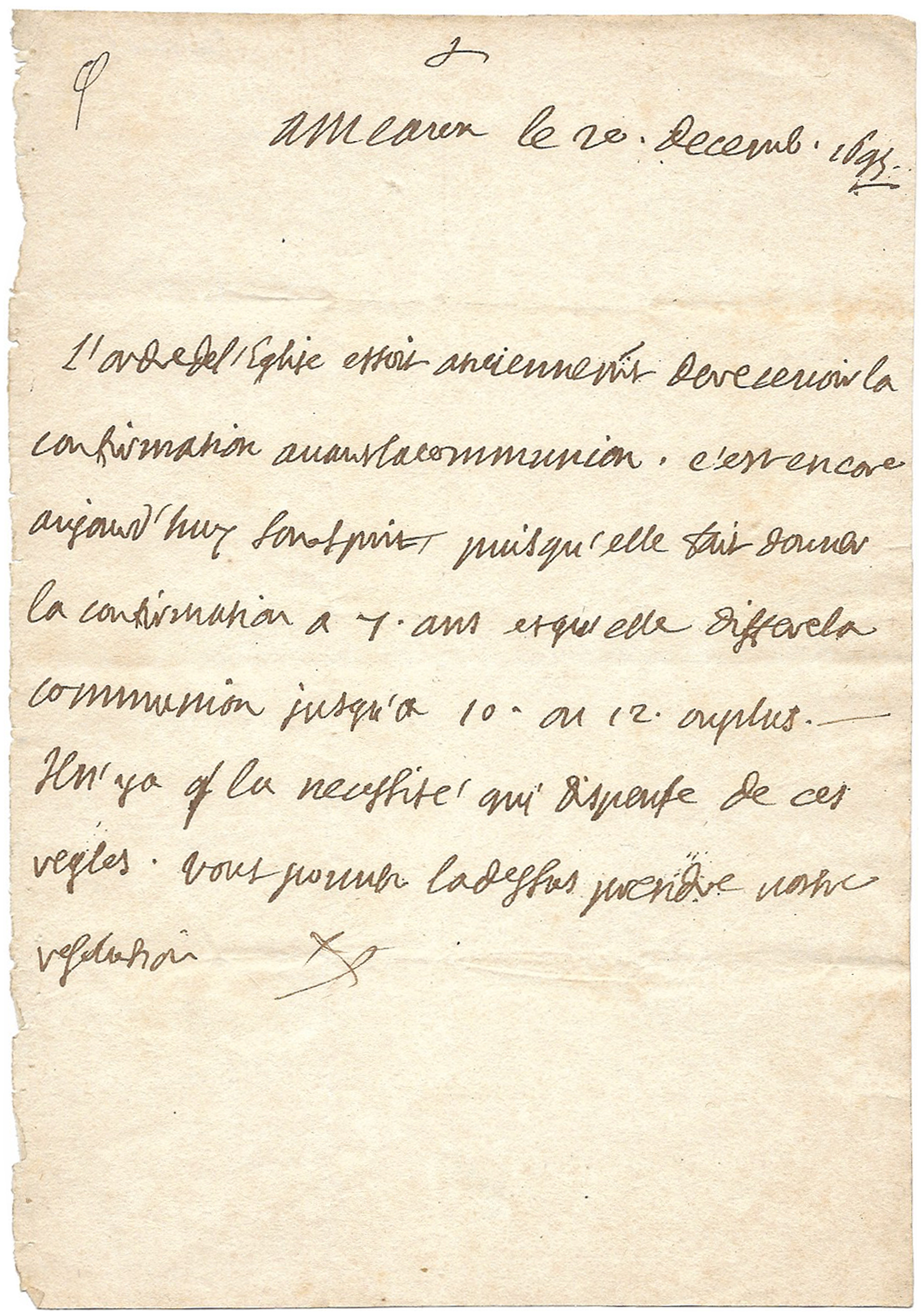
Autograph letter to Madam Dumans
Dictated by Bossuet and written down by his secretary, François Ledieu.
Meaux, 20 Dec. 1695, 1 p. in-8° on laid paper
Left margin slightly frayed; otherwise in very good condition
A fine letter of spiritual direction concerning the sacramental cursus
« L’ordre de l’église estoit anciennement de recevoir la confirmation avant la communion ; c’est encore aujourd’huy son esprit, puisqu’elle fait donner la confirmation a 7 ans et qu’elle diffère la communion jusqu’à 10 ou 12, ou plus. Il n’y a que la nécessité qui dispense ces règles. Vous pouvez là-dessus prendre vostre résolution. »
Seven years is the age required by the Catechism of the Council of Trent for confirmation (part II, De confirmationis sacramento, xv). The Dauphin, a pupil of Bossuet, received his first communion on Christmas Day 1674, at the age of thirteen years and two months; he had been confirmed on 4 October 1673.
Originally from the province of Péronne, Ledieu studied in his hometown before moving to Paris in 1676. He became magister and doctor of theology from 1681, and three years later entered the secretariat of Abbé Bossuet. The latter granted him a priory and appointed him among the canons of the cathedral in 1697. Ledieu subsequently became chancellor and was entrusted with the supervision of the diocesan schools. Closely devoted to supporting Bossuet’s publications, he developed numerous arguments against Jansenism and Quietism. His Journal has since been regarded as a major source for the history of the Church.
Provenance:
Ancienne collection M. Richard
Puis collection H.D.
Bibliography:
Correspondance, t. VII, éd. Ch. Urbain et E. Levesque, Hachette, 1913, n°1316
Join our mailing list and be the first to hear our latest news and biggest announcements.
By signing up you agree to our privacy policy. You can unsubscribe at any time.