Keep ahead of the pack
Join our mailing list and be the first to hear our latest news and biggest announcements.
By signing up you agree to our privacy policy. You can unsubscribe at any time.
Autograph letter signed « Alphonse D. » to Timoléon Ambroy
N.p., [after 16th Oct. 1868], 2 p. in-12° on laid paper
« My first lettre du Moulin… was written partly based on the notes you had sent me »
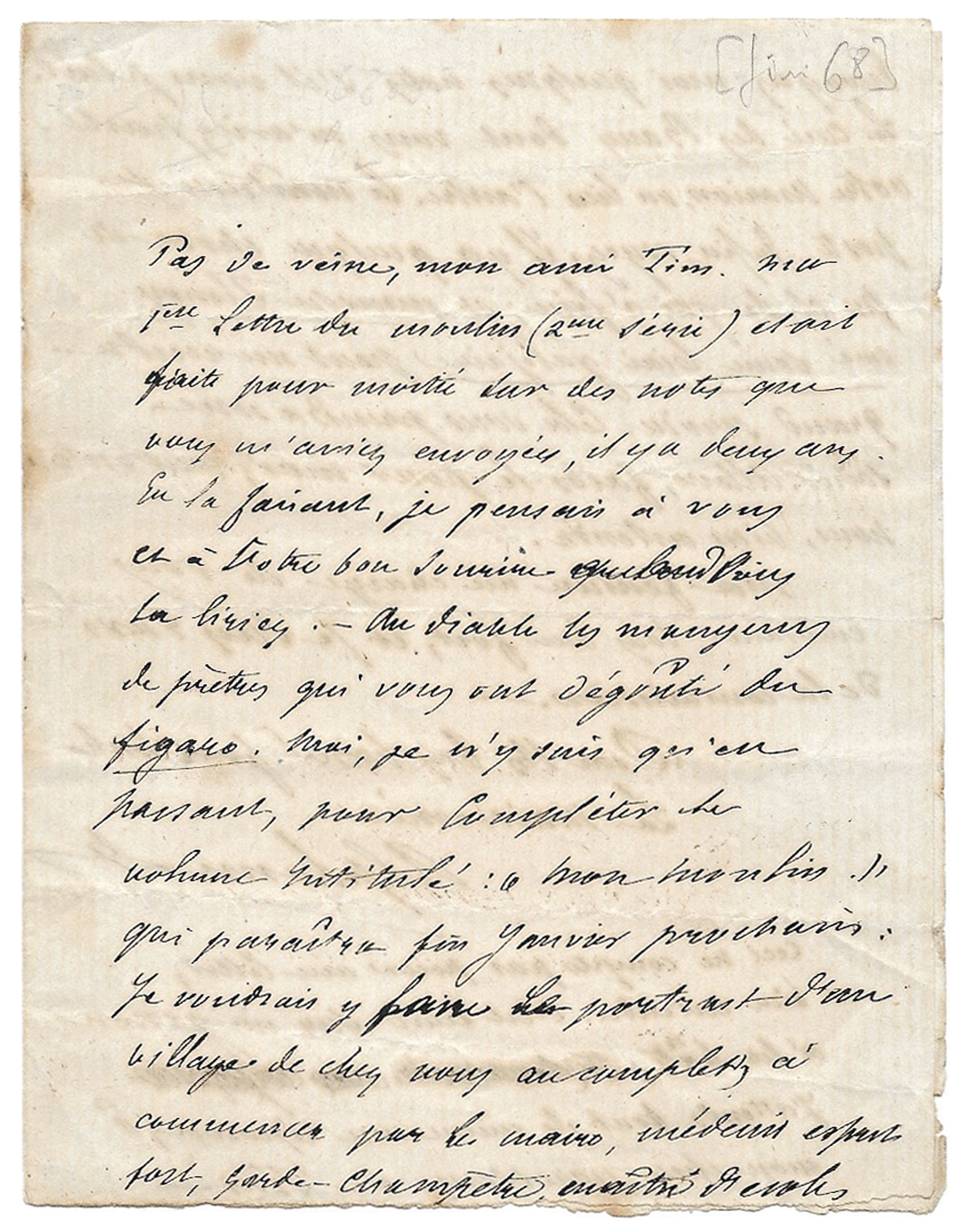
Autograph letter signed « Alphonse D. » to Timoléon Ambroy
N.p., [after 16th Oct. 1868], 2 p. in-12° on laid paper
Three words crossed out by Daudet
Slight browning, fold marks
A nice letter, partly unpublished, about Lettres de mon moulin, providing valuable insight into the way Daudet gathered material for the writing of his collection
« Pas de veine, mon ami Tim, ma première lettre du Moulin (2ème série) [La Diligence de Baucaire] était faite pour moitié sur des notes que vous m’aviez envoyées, il y a deux ans. En la faisant, je pensais à vous et à votre bon sourire quand vous la liriez. – Au diable les mangeurs de prêtres qui vous ont dégoûté du Figaro. Moi, je n’y suis qu’en passant, pour compléter le volume intitulé : ‘Mon Moulin’ [premier titre envisagé par Daudet] qui paraîtra fin janvier [1869] prochain : Je voudrais y faire le portrait d’un village de chez vous au complet [Le poète Mistral ?], à commencer par le maire, médecin esprit fort, garde champêtre, maître d’école. Envoyez moi quelques notes s’il vous plaît. Le curé des Baux dont vous m’aviez parlé. Votre Marion, ou bien l’autre, la maîtresse de poste… Enfin, voyez. Il y a quelque chose de fin et de gai à faire […] cela vous prendra une soirée. Allons, faites-le pour moi ; tout entre nous, bien entendu.
Ma femme me charge de vous embrasser tout bien fort, et je suis ravi de la commission.
Donc, un bon baiser pour toute la maisonnée.
Alphonse D.
Ceci ne compte pas pour une lettre, bien entendu. C’est écrit sur un genoux à la hâte […] »
Although written “hurriedly on one knee,” this letter sheds light on the way Daudet approached the composition of Lettres de mon moulin, which should be viewed within the context of his journalistic activities. Through a concise style, with concentrated effects and a frequent use of the first person, the writer at times blends reality with imagination—a method also found in contemporaries such as Vallès or Zola. In doing so, Daudet aligns himself with the logic of the chronique, conceived to establish a more intimate relationship between the newspaper and its reader.
The “première lettre du Moulin” here refers to La Diligence de Beaucaire, published on October 16, 1868 in Le Figaro. This short story, which originally formed a single text with Installation, was separated from it starting with the first edition published by Hetzel at the beginning of 1869. With Installation introducing the entire book, La Diligence opens the series of Lettres proper.
Daudet and Timoléon Ambroy had known each other since the early 1860s. The latter, who served as a gatherer of information for the writing of the Lettres, was the dedicatee of En Camargue (divided into five sections), the second-to-last story in the collection. Daudet stayed several times with the Ambroy family in Fontvieille during his trips to Provence, where he came to write in order “to reconnect with nature and cure himself of Paris and its fevers.”
Provenance:
Private collection
Bibliography:
Lettres familiales, (dir. Lucien Daudet), Plon, 1944, p. 75-76, n° XXXIV (a largely faulty and incomplete transcription)
Œuvres I, éd. Roger Ripoll, Pléiade, 1986, p. 1282 (one sentence transcribed)
Join our mailing list and be the first to hear our latest news and biggest announcements.
By signing up you agree to our privacy policy. You can unsubscribe at any time.