Extremely rare letter from the mystic Madame Guyon, a key figure in the spread of Quietism in France.
A declaration of submission that did not prevent the relentless Bossuet from having the theologian of the ‘pure love of God’ imprisoned.
Formerly in the collections of Alfred Bovet, Marcel Plantevignes, and Claude de Flers
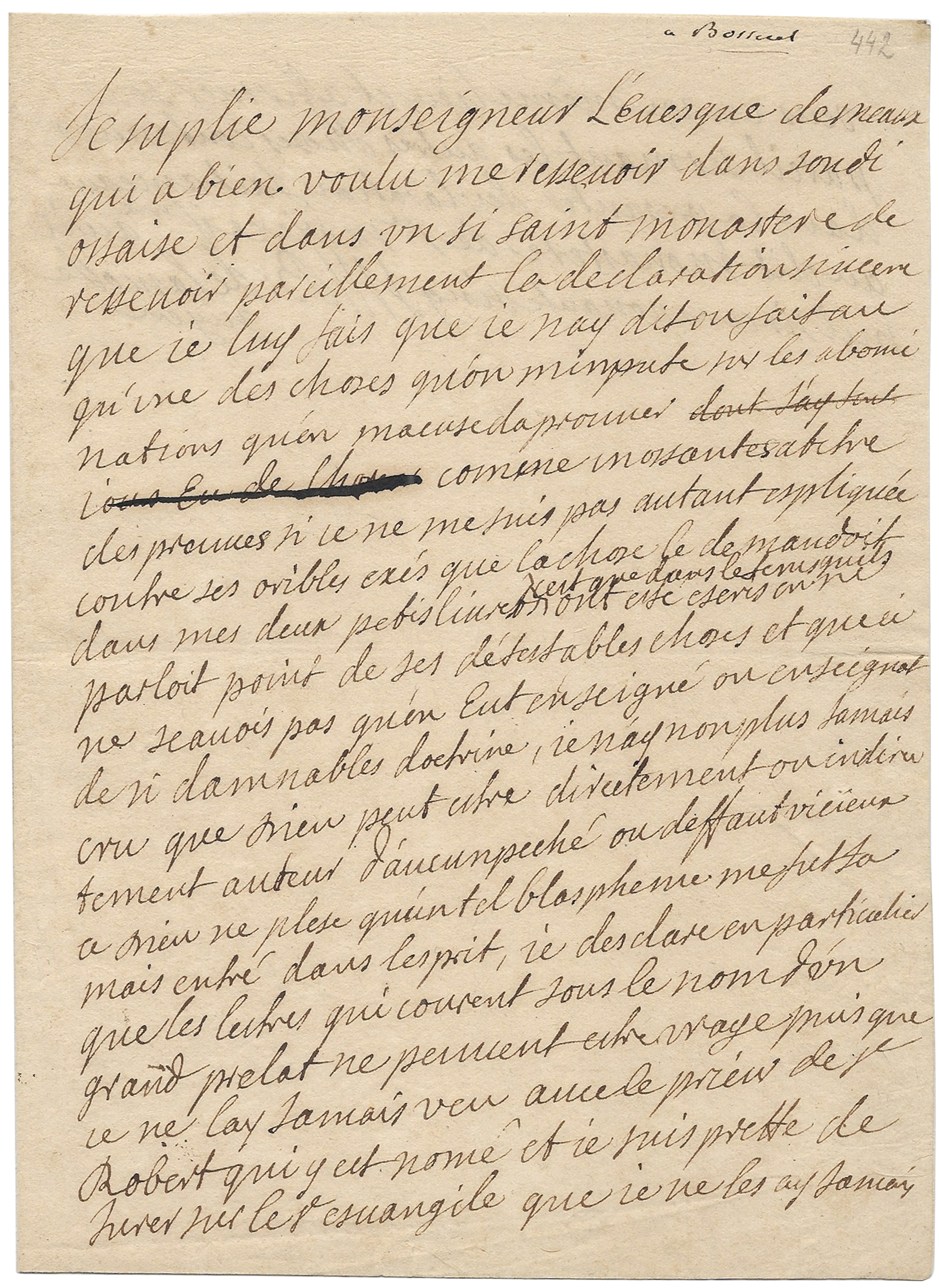
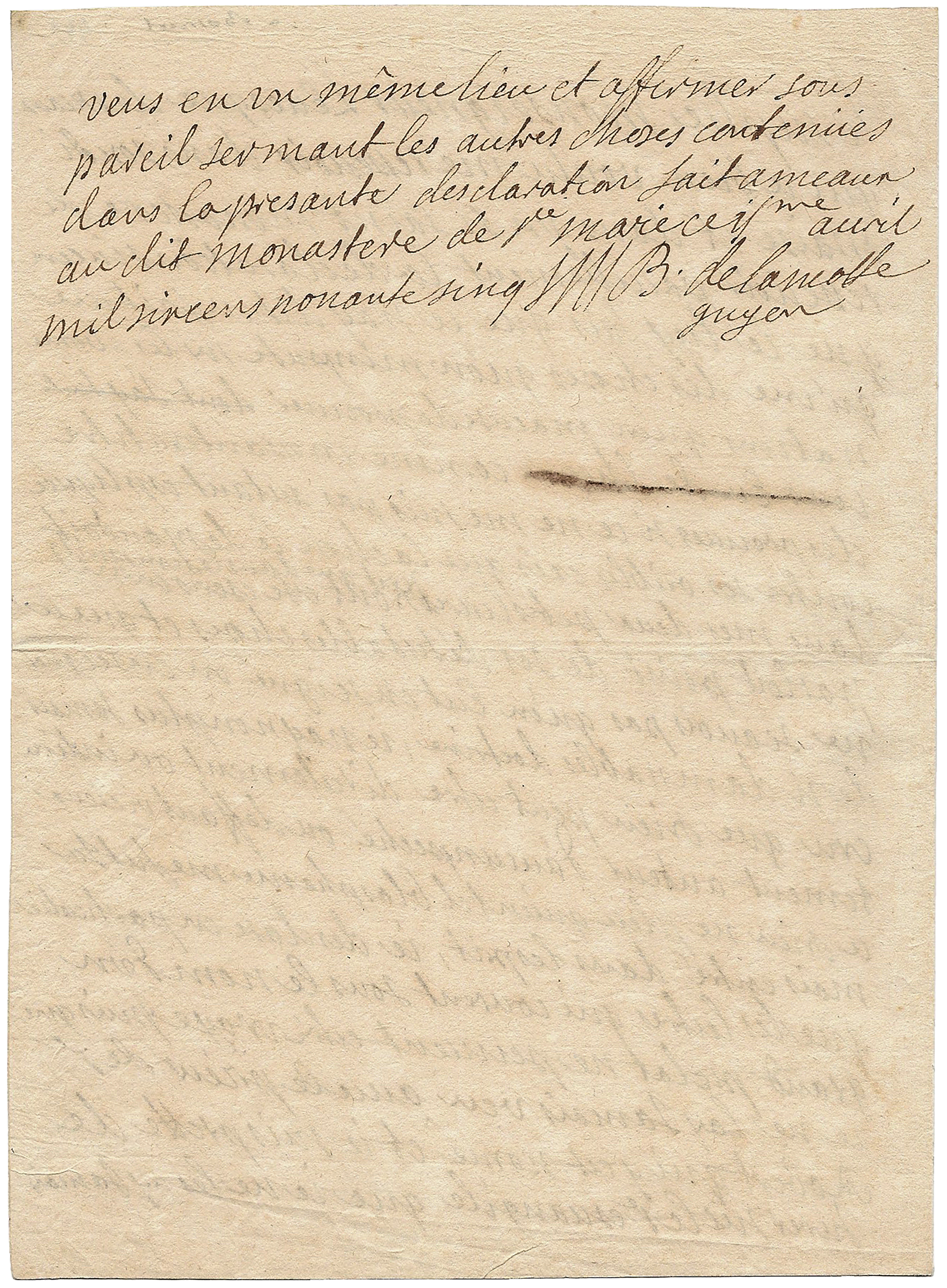
« Je supplie Monseigneur l’évêque de Meaux, qui a bien voulu me recevoir dans son diocèse et dans un si saint monastère, de recevoir pareillement la déclaration sincère que je lui fais, que je n’ai dit ou fait aucune des choses qu’on m’impute sur les abominations qu’on m’accuse d’approuver comme innocentes. Si je ne me suis pas autant expliquée contre ces horribles excès que la chose le demandait dans mes deux petits livres¹, c’est que dans le temps qu’ils ont été écrits, on ne parlait point de ces détestables choses, et que je ne savais pas qu’on eût enseigné ou enseignât de si damnables doctrines. Je n’ai non plus jamais cru que Dieu pût être directement ou indirectement auteur d’aucun péché, ou défaut vicieux. À Dieu ne plaise qu’un tel blasphème me fût jamais entré dans l’esprit. Je déclare en particulier que les lettres qui courent sous le nom d’un grand prélat² ne peuvent être vraies, puisque je ne l’ai jamais vu avec le Prieur de Saint-Robert, qui y est nommé, et je suis prête à jurer sur le saint Évangile que je ne les ay jamais vus en un même lieu, et affirmer sous pareil serment les autres choses contenues dans la présente déclaration.
Fait à Meaux, au dit monastère de Sainte-Marie, ce 15 avril 1695.
MB de la Motte Guyon »
At the Roots of the Quietist Movement
A spiritual current linked to older traditions in Christianity, such as the hesychasm of the 13th and 14th centuries, Quietism took root in Italy at the end of the 17th century. It was later preached by Miguel de Molinos (1628–1696), a Spanish priest and theologian, who set out this doctrine in his Guide spirituel, published in 1675. Interpreted as a disdain for the hierarchical structure of the Catholic Church, Molinos’ theses were accused of undermining ecclesiastical authority and advocating a lax morality. They were firmly condemned by Pope Innocent XI in the bull Caelestis Pastor of 1687, and Molinos was forced to publicly abjure.
Decisive Influence on Fénelon and the French Quietist Controversy
In the wake of the condemnation of the Spanish theologian , Jeanne-Marie Bouvier de la Motte advanced a theory of the “pure love of God” closely aligned with his thought. thus propagated a doctrine marked by anti-intellectualist and anti-activist tendencies, akin to Protestant Pietism, which was developing contemporaneously in the Netherlands and in Germany. Attracted by her ideas, became both their advocate and defender. Her teaching was examined beginning in the summer of 1694 during the Conferences of Issy, convened between , , and M. Tronson. These discussions produced the Thirty-Four Articles, intended to define orthodoxy in matters of spirituality. It was these articles that Bossuet presented to Madame Guyon on 14 April 1695 (the day before the letter discussed here), requesting her formal subscription, which she granted.
The “detestable things” to which Madame Guyon alludes likely refer to the propositions attributed to the Quietists that the Thirty-Four Articles were designed precisely to condemn (Fénelon, Œuvres, vol. I, Pléiade, pp. 1534–1538). She nonetheless maintains that she neither “said nor did any of the things imputed” to her. The term “did” may denote her activity as a spiritual director or teacher; it may also concern her moral conduct, since Quietists were at times accused of indifference toward matters pertaining to salvation, including the struggle against concupiscence (see Articles VII and VIII). In the seventeenth century, heresy was treated with utmost seriousness, and litigious zeal was widespread.
In what would become the defining controversy of his final years, the “Eagle of Meaux,” , deployed his influence at court to oppose the mysticism of the doctrine of “pure love” as professed in France by Madame Guyon. In 1697, published the Explication des maximes des saints sur la vie intérieure, defending the doctrine by appealing to the Greek Fathers and to numerous Western Christian mystics. A controversy ensued between Fénelon and Bossuet, culminating in 1699 with the condemnation of Fénelon’s work by Pope . This decision cast a lasting shadow over Christian mysticism during the following century and, in France, contributed to its decline—an eclipse described by the historian as the “twilight of the mystics.”
This statement did not prevent Madame Guyon from being imprisoned at the Fort de Vincennes, before being transferred the following year to a convent in Vaugirard, and then, on 4 June 1698, being incarcerated in the Bastille. Imprisoned without a specific reason (made possible by a lettre de cachet), she became the target of a brutal campaign of slander, being suspected of immoral behavior, precisely at the moment when the controversy between Bossuet and Fénelon was at its height.
According to Levesque, Bossuet reportedly accepted the present declaration only to later reject it. Madame Guyon states that there is an act “of which I sent a copy in my own hand, and I no longer have it. It is the one in which he makes me declare that I have not seen M. de Grenoble with the Prieur of Saint-Robert. He no longer wants this declaration now” (letter of 2 June 1695).
Madame Guyon was finally released at the age of 55, on 24 March 1703.
Atheist and misogynist, Schopenhauer nonetheless paid tribute to Madame Guyon in his principal work The World as Will and Representation:
“I would especially recommend, as a special and very complete example, and at the same time as a practical illustration of the ideas I have presented, the autobiography of Madame Guyon; it is a beautiful and great soul, whose thought always fills me with respect […] All this will help us understand in what sense Madame Guyon so often repeats at the end of her autobiography: ‘Everything is indifferent to me, I can no longer will anything, it is impossible for me to know whether I exist, or whether I do not exist.’”
1- Sans doute Moyen court et très-facile de faire oraison que tous peuvent pratiquer tres-aisement, Lyon, Briasson, 1686, and Le Cantique des Cantiques de Salomon interprété selon le sens mystique et la vraie représentation des états intérieurs, [by Madame Guyon, according to Antoine-Alexandre Barbier], Lyon, Briasson, 1688.
2- Étienne Le Camus (1632–1707), cardinal and bishop of Grenoble, ardent defender of the papacy. He opposed Madame Guyon’s Quietism with vigor—at a time when she enjoyed the temporary protection of Madame de Maintenon—and led a campaign of slander against her. Madame Guyon makes clear reference to this here.
Autograph letters by Madame Guyon are exceedingly rare on the market. Only two letters in private hands are known, including this one.