Keep ahead of the pack
Join our mailing list and be the first to hear our latest news and biggest announcements.
By signing up you agree to our privacy policy. You can unsubscribe at any time.
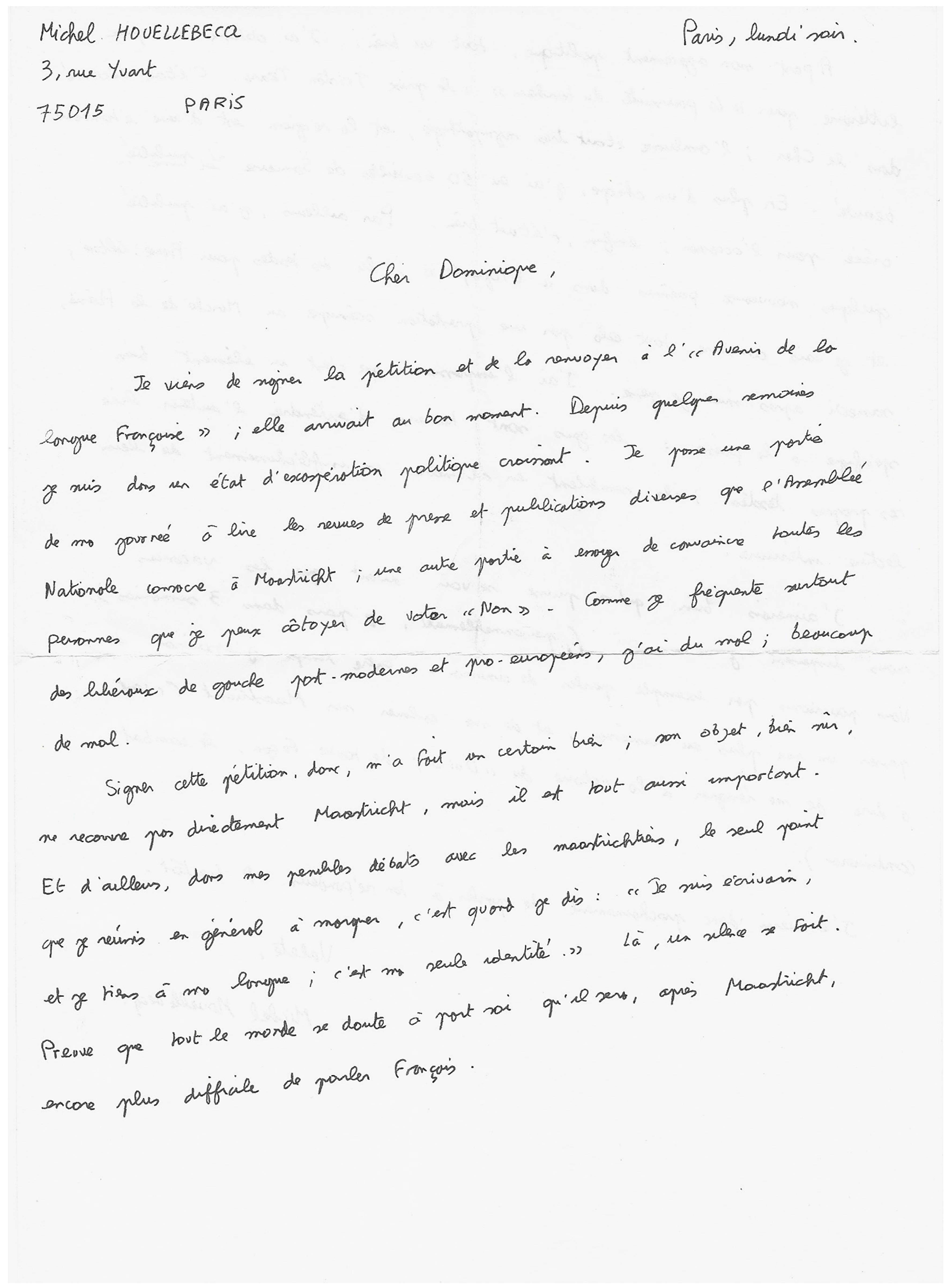
Autograph letter signed « Michel Houellebecq » to Dominique Noguez
Paris « Monday evening » [22 June 1992], 2 p. in-4° in black ink
« I am a writer, and I cherish my language; it is my only identity »
Autograph letter signed « Michel Houellebecq » to writer and film critic Dominique Noguez Dominique Noguez
Paris « Monday evening » [22 June 1992], 2 p. in-4° in black ink
Watermark: ‘Jean Neurf – Extra Strong’
Usual fold marks
Exasperated by the political situation and opposed to the Maastricht Treaty, Houellebecq uses his correspondence to share his thoughts on the referendum and to update on his literary news
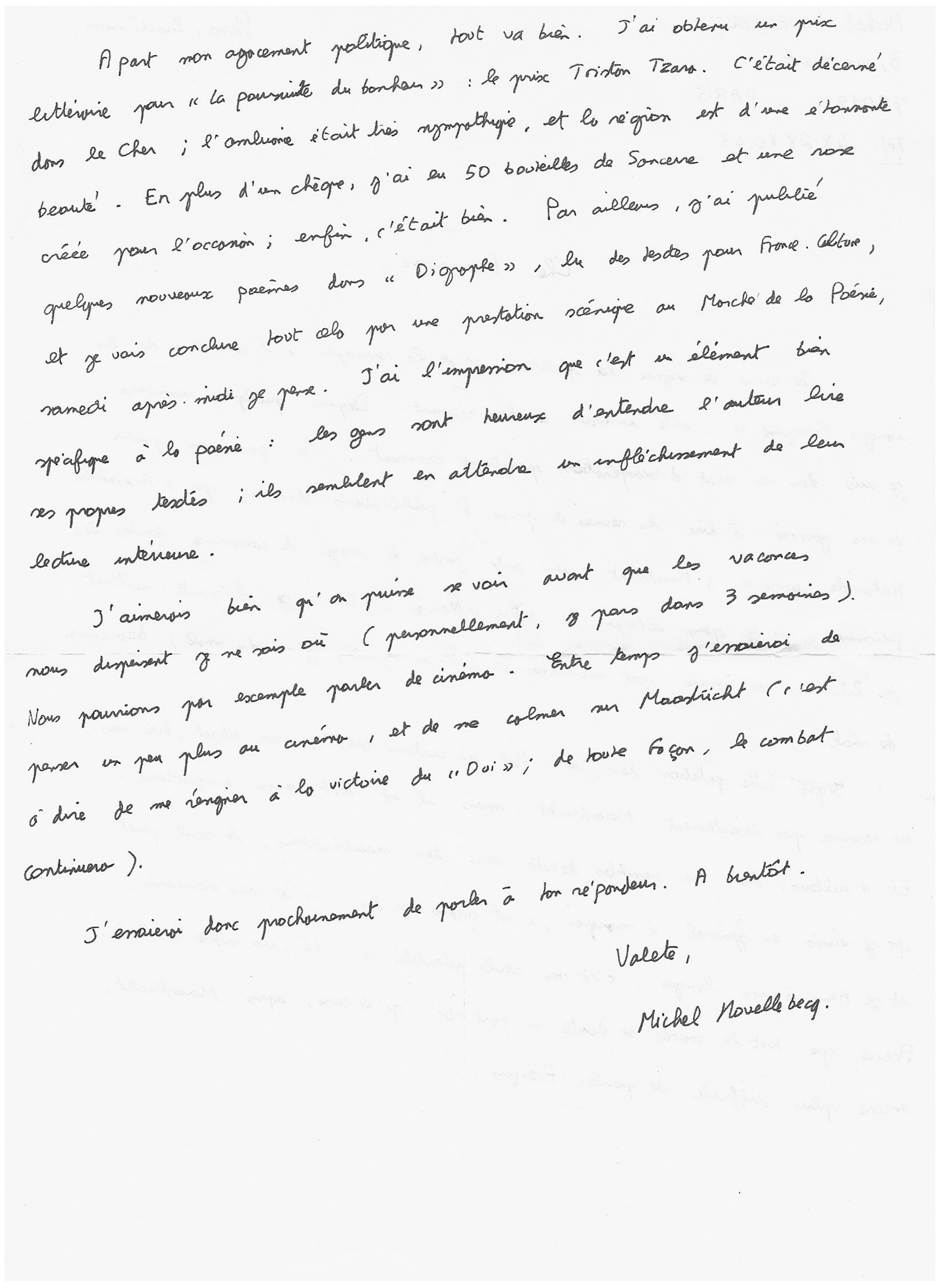
« I received a literary prize for La Poursuite du bonheur […] In addition to a check, I got 50 bottles of Sancerre. »
« Cher Dominique,
Je viens de signer la pétition et de la renvoyer à l’ »Avenir de la langue française » [appel publié dans Le Monde du 11 juillet 1992, cosigné par 300 signataires du monde culturel]; elle arrivait au bon moment. Depuis quelques semaines je suis dans un état d’exaspération politique croissant. Je passe une partie de ma journée à lire les revues de presse et publications diverses que l’Assemblée Nationale consacre à Maastricht ; une autre partie à essayer de convaincre toutes les personnes que je peux côtoyer de voter « non ». Comme je fréquente surtout des libéraux de gauche post-modernes et pro-européens, j’ai du mal ; beaucoup de mal.
Signer cette pétition, donc, m’a fait un certain bien ; son objet, bien sûr, ne recouvre pas directement Maastricht, mais il est tout aussi important. Et d’ailleurs, dans mes pénibles débats avec les Maastrichtiens, le seul point que je réussis en général à marquer, c’est quand je dis : « Je suis écrivain, et je tiens à ma langue ; c’est ma seule identité. » Là, un silence se fait. Preuve que tout le monde se doute à part soi qu’il sera, après Maastricht, encore plus difficile de parler français.
À part mon engagement politique, tout va bien. J’ai obtenu un prix littéraire pour « La Poursuite du bonheur » : le prix Tristan Tzara. C’était décerné dans le Cher ; l’ambiance était très sympathique, et la région est d’une étonnante beauté. En plus d’un chèque, j’ai eu 50 bouteilles de Sancerre et une rose créée pour l’occasion ; enfin, c’était bien. Par ailleurs, j’ai publié quelque nouveaux poèmes dans « Digraphe », lu des textes pour France Culture, et je vais conclure tout cela par une prestation scénique au Marché de la Poésie, samedi après-midi [27 juin] je pense. J’ai l’impression que c’est un élément bien spécifique à la poésie : les gens sont heureux d’entendre l’auteur lire ses propres textes ; ils semblent en attendre un infléchissement de leur lecture intérieure.
J’aimerais bien qu’on puisse se voir avant que les vacances nous dispersent je ne sais où (personnellement, je pars dans 3 semaines). Nous pourrions par exemple parler de cinéma. Entre temps, j’essaierai de penser un peu plus au cinéma, et de me calmer sur Maastricht (c’est à dire de me résigner à la victoire du « oui » ; de toute façon, le combat continuera).
J’essaierai donc prochainement de parler à ton répondeur. À bientôt.
Valete,
Michel Houellebecq »
Houellebecq expresses a fervent—albeit somewhat fatalistic—opposition to the French referendum on the ratification of the Maastricht Treaty, scheduled for September 20, 1992, which was expected to result in a narrow but clear victory for the “yes” vote. The writer’s opposition reveals the anti-European leanings and identity concerns that would later characterize his fictional work. By voicing his fear of an erosion of the French language, he articulates a central theme in his imagination: the idea of a linguistic identity threatened by supranational political and economic processes.
Houellebecq received his very first literary prize for The Pursuit of Happiness, his second collection of poems, published in 1991 by Éditions de la Différence. At that time, he distanced himself from free verse and the contemporary fragmentation of poetic expression to return to the discipline of classical versification. Poet Juliette Darle, who had met the young Houellebecq for the prize ceremony, recalled: “I perceived a singular personality and immediately associated Michel with the great authors of the twentieth century […]. Michel Houellebecq had launched into a diatribe against liberalism. Yves Fromion, the deputy mayor of Aubigny, was astonished and insisted on meeting this curious poet. […] There were no available rooms, so he had to sleep in a caravan. We spent wonderful evenings together. Michel read poems by Louis Aragon, crying and taking swigs of whisky. The next day we took him to Sancerre.”
Poetry holds a central place in Houellebecq’s literary activity, who has consistently published numerous collections alongside his novels.
Passionate about literary life, Dominique Noguez (1942–2019), a prominent film critic, devoted himself to defending those whom the era often labeled as “free thinkers.” He was equally attentive to the promotion of the French language. Houellebecq’s mention of the petition published in Le Monde on July 11, 1992, by the collective L’Avenir de la langue française—which gathered around three hundred signatories from the cultural sphere—attests to their intellectual proximity. For Houellebecq, signing this petition appears as a symbolic act that channels his political exasperation at the time, while above all reaffirming the primacy of language as a core element of identity.
Michel Houellebecq’s autograph letters are very rarely offered on the market, and even more so when they are of such significance.
Join our mailing list and be the first to hear our latest news and biggest announcements.
By signing up you agree to our privacy policy. You can unsubscribe at any time.