Keep ahead of the pack
Join our mailing list and be the first to hear our latest news and biggest announcements.
By signing up you agree to our privacy policy. You can unsubscribe at any time.
Original drawing signed « Max Jacob »
N.p.n.d. [St Benoît sur Loire], 1 p. in-4° in black ink
Nice drawing by the poet depicting an archangel on horseback defeating the Devil
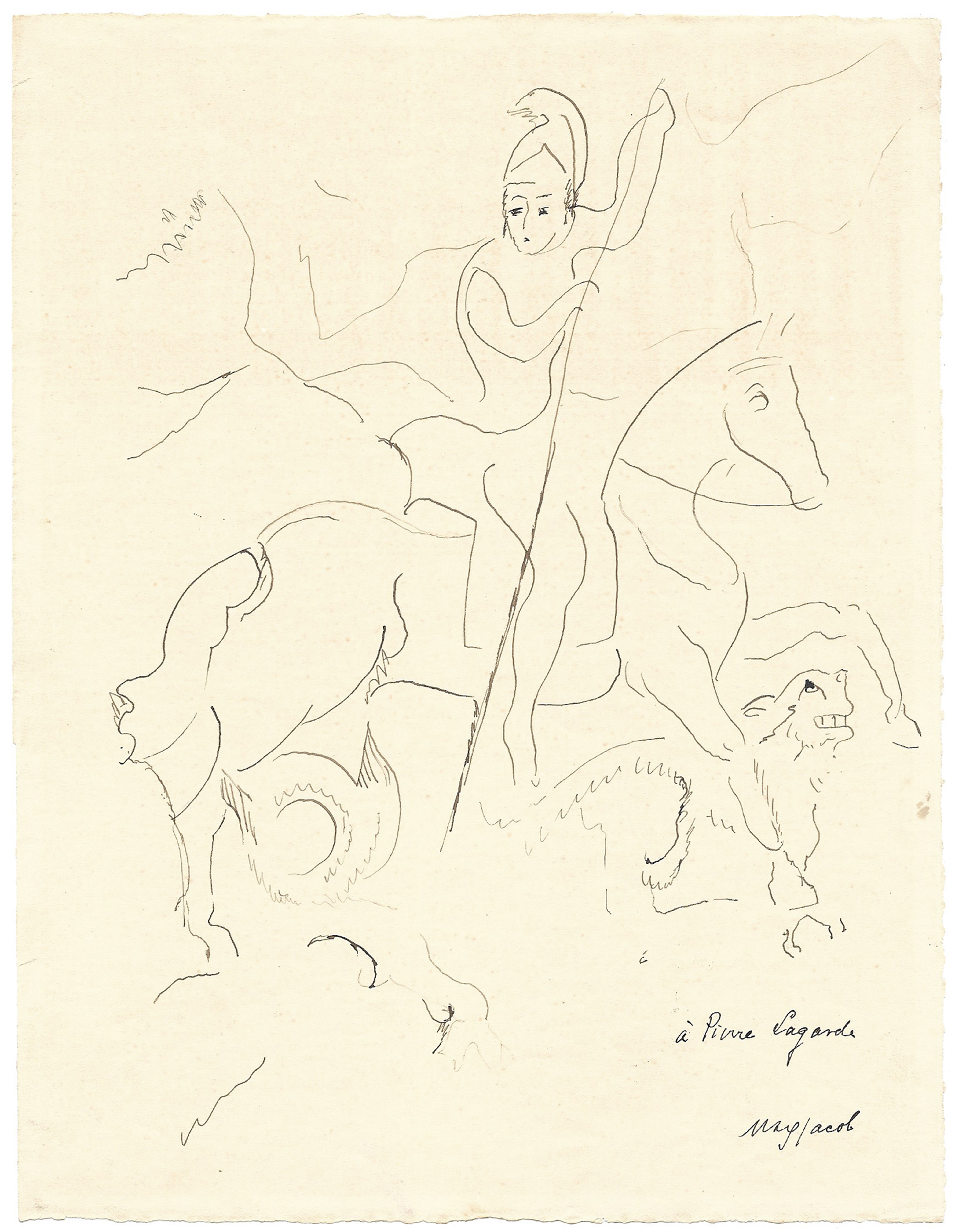
Original drawing signed « Max Jacob »
N.p.n.d. [St Benoît sur Loire], 1 p. in-4° in black ink
Slight browning on right hand margin
Nice drawing by the poet depicting an archangel on horseback defeating the Devil
The figure of the archangel became a recurring theme for the poet after his conversion to Christianity in the early 1910s, and even more so in his “meditations” composed in Saint-Benoît-sur-Loire. He soberly dedicates his drawing to his friend Pierre Lagarde in the lower right corner.
A central character of the Montmartre and Montparnassian avant-garde, who converted to Catholicism in 1915 after having had several visions, Max Jacob left Paris in 1936 to settle in Saint-Benoît-sur-Loire in the Loiret region. He led a monastic life there. His poetic and mediating works, partly taken up by Pierre Lagarde in his admirable work Max Jacob – Mystique et martyr (La Baudinière, 1944), are close to the quietist current. From then on, he assumed his life as a fisherman as a condition of his redemption. Six months before the liberation of Paris, he was arrested by the Gestapo because of his Jewish origins, a fate he accepted as a martyr. He was interned by the French gendarmerie at the Drancy camp and died there five days later, a few hours before his scheduled deportation to Auschwitz.
We include:
Several period engraved proofs of the same design used for printing
Provenance:
Pierre Lagarde’s archives
Then private collection, Christie’s, 14 déc. 2023, n°109
Bibliography:
Max Jacob – Mystique et martyr, Pierre Lagarde, éd. La Baudinière, 1944, p. 33
Join our mailing list and be the first to hear our latest news and biggest announcements.
By signing up you agree to our privacy policy. You can unsubscribe at any time.