Keep ahead of the pack
Join our mailing list and be the first to hear our latest news and biggest announcements.
By signing up you agree to our privacy policy. You can unsubscribe at any time.
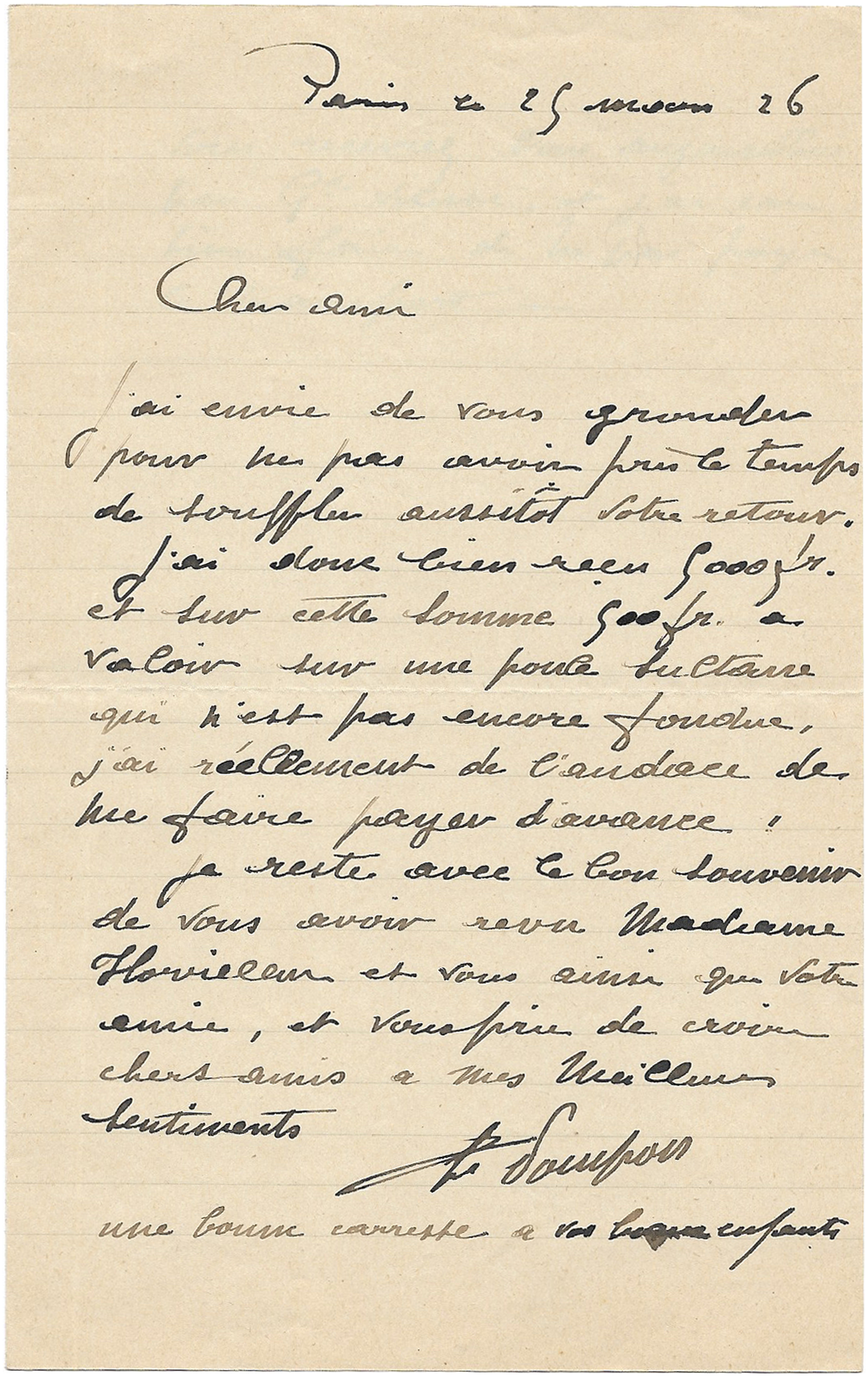
Autograph letter signed « F Pompon » to René Horvilleur
Paris, 25 March [19]26, 1 p. in-8° in black ink on lined paper
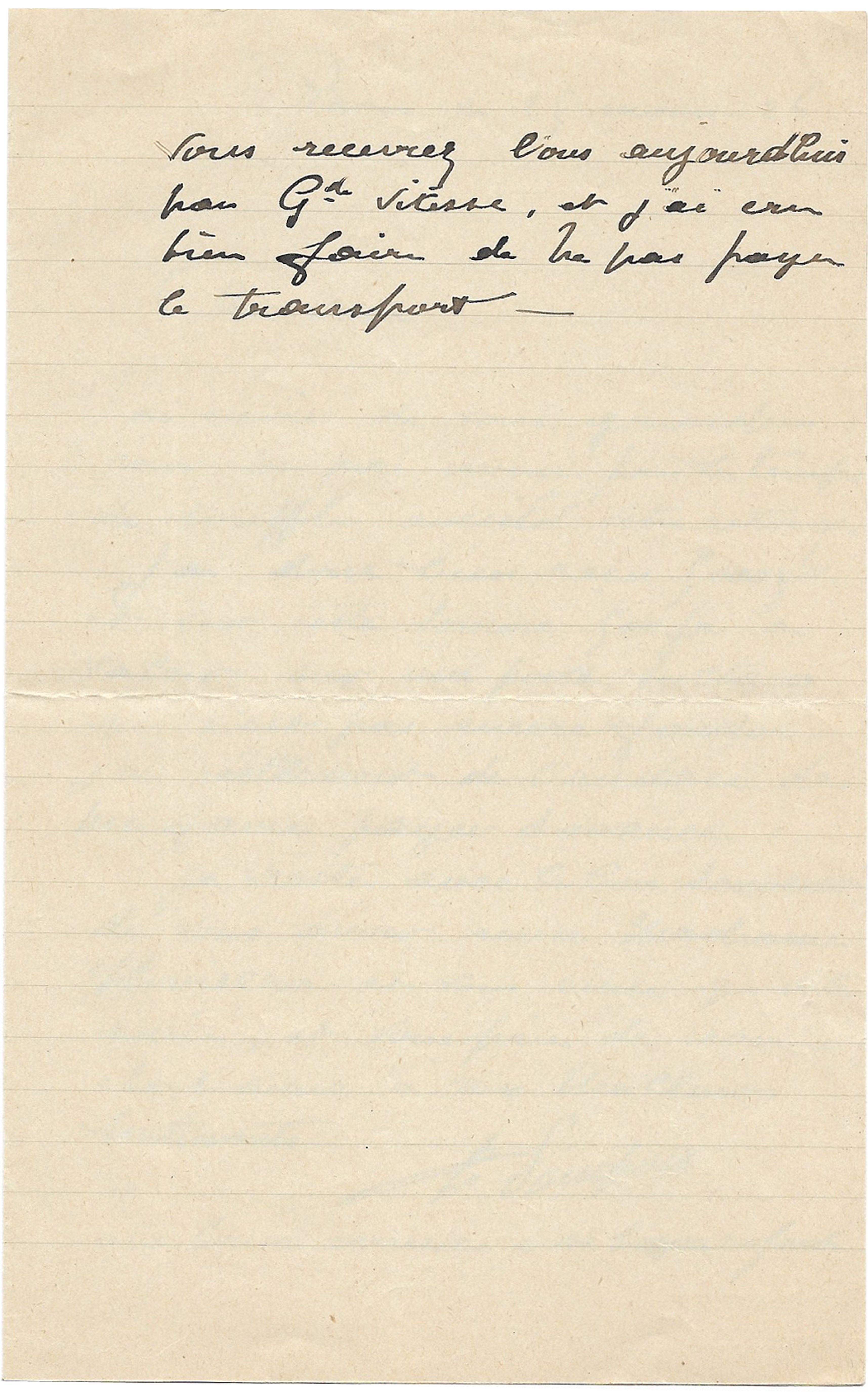
« You will receive the bear today by express delivery »
Autograph letter signed « F Pompon » to painter and collector René Horvilleur
Paris, 25 March [19]26, 1 p. in-8° in black ink on lined paper
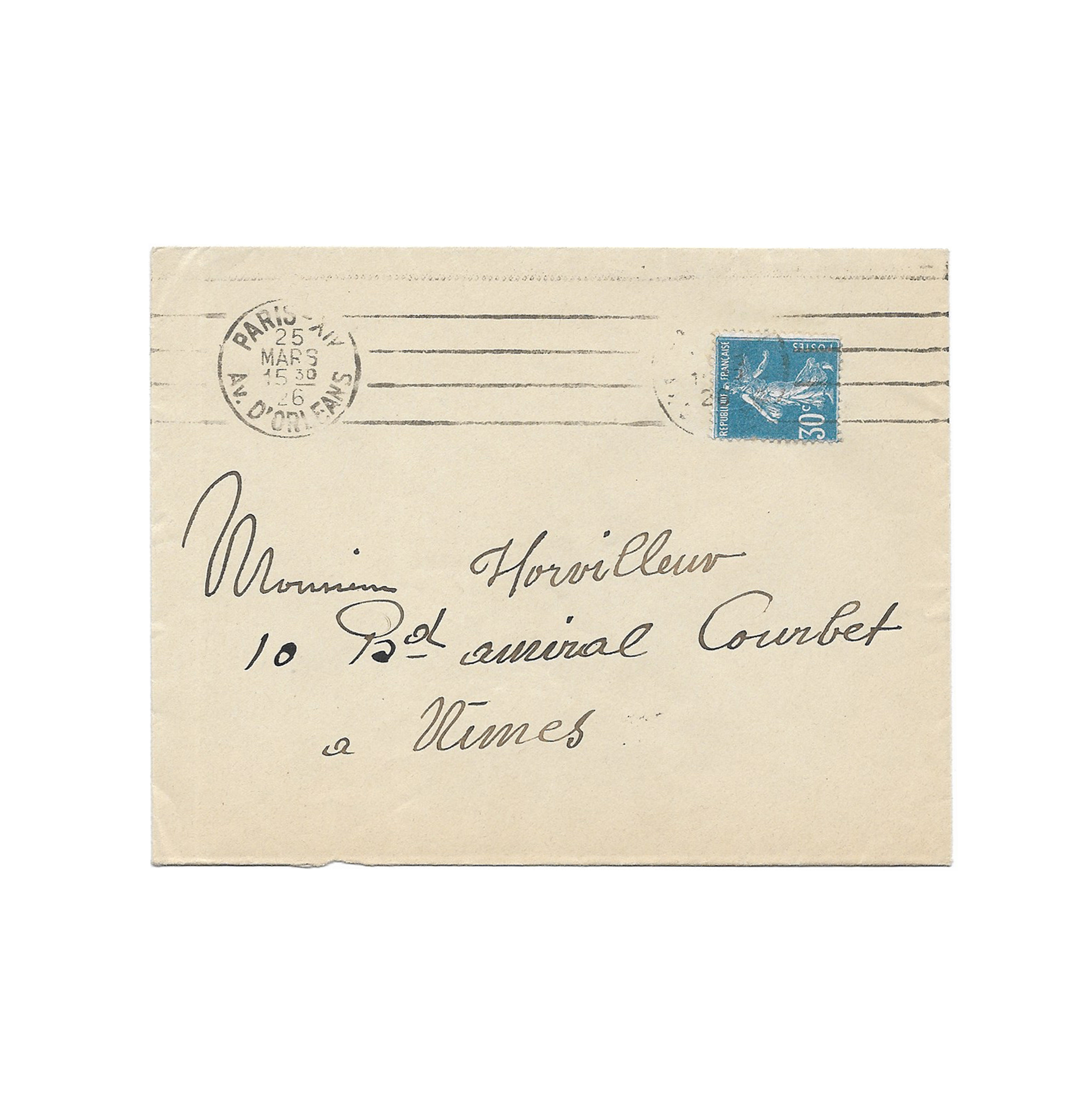
Autograph envelope enclosed, stamped and postmarked
At the height of his fame, Pompon sends a copy of his Ours and acknowledges receipt of an order for a Poule Sultane
« Cher ami,
J’ai envie de vous gronder pour ne pas avoir pris le temps de souffler aussitôt votre retour [de Paris].
J’ai donc bien reçu 5000 fr. et sur cette somme 500 fr. à valoir sur une pour sultane qui n’est pas encore fondue, j’ai réellement de l’audace de vous faire payer d’avance.
Je reste avec le bon souvenir de vous avoir revu Madame Horvilleur et vous ainsi que votre amie, et vous prie de croire chers amis à mes meilleurs sentiments.
F Pompon
une bonne carresse [sic] à vos bons enfants
Vous recevrez l’ou[r]s aujourd’hui par G[ran]de vitesse, et j’ai cru bien faire ne pas payer le transport. – »
Trained by Aimé Millet and Pierre-Louis Rouillard, Pompon joined Auguste Rodin’s studio in 1890. He worked there as a marble depot assistant on Rue de l’Université. He quickly gained the trust of the master, who entrusted him with the direction of the studio three years later. It was in this same studio that he met Camille Claudel.
From 1905 onward, Pompon resolutely embraced an aesthetic based on the simplification of forms, a practice that became his signature and whose influence would leave a lasting mark on many 20th-century artists. He achieved late recognition when he presented his White Bear at the Salon d’Automne in 1922, producing it in multiple sizes and materials. His fame then became international, and commissions poured in.
From 1924, the White Bear was issued by the Manufacture de Sèvres. The Musée d’Orsay commissioned a copy from the sculptor in 1927 for the sum of 25,000 francs, a considerable amount for the time.
An instance of the Purple Swamphen also appears in Pompon’s bird studies, preserved as paper sketches now held at the Musée d’Orsay (RF 43236, 100 / f. 50).
Provenance:
Private coll.
Join our mailing list and be the first to hear our latest news and biggest announcements.
By signing up you agree to our privacy policy. You can unsubscribe at any time.