Keep ahead of the pack
Join our mailing list and be the first to hear our latest news and biggest announcements.
By signing up you agree to our privacy policy. You can unsubscribe at any time.
Autograph letter signed « Marcel Proust » to Fernand Gregh
N.p.n.d., [26 Dec. 1904], 1 p. small in-8°, with envelope
« Your lights in this fog; a nativity scene in the darkness »
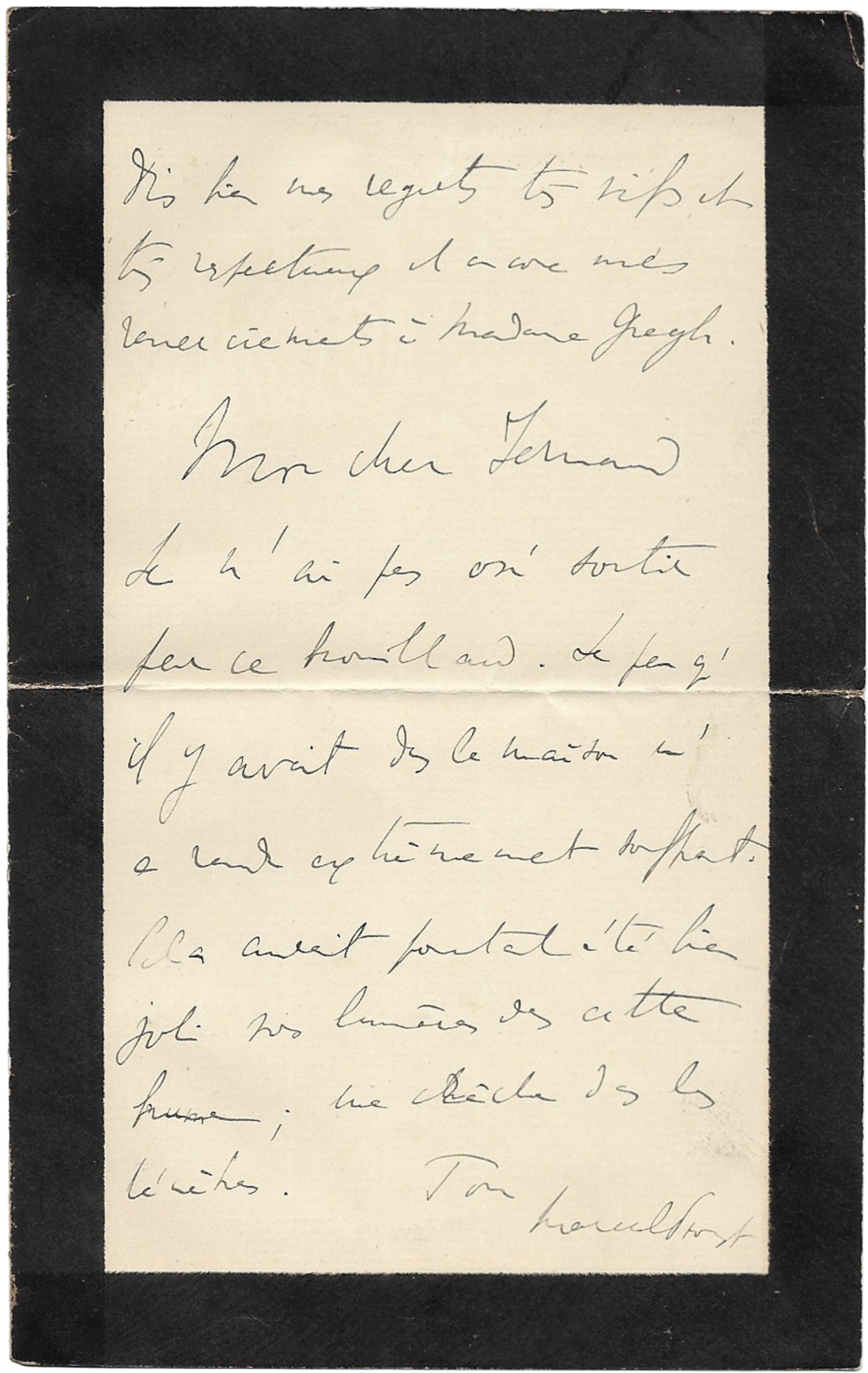
Autograph letter signed « Your Marcel Proust » to Fernand Gregh
N.p.n.d., [26 Dec. 1904], 1 p. small in-8°, on mourning stationery, in black ink
Watermark: ‘Waterword’
Central fold mark inherent to the original mailing
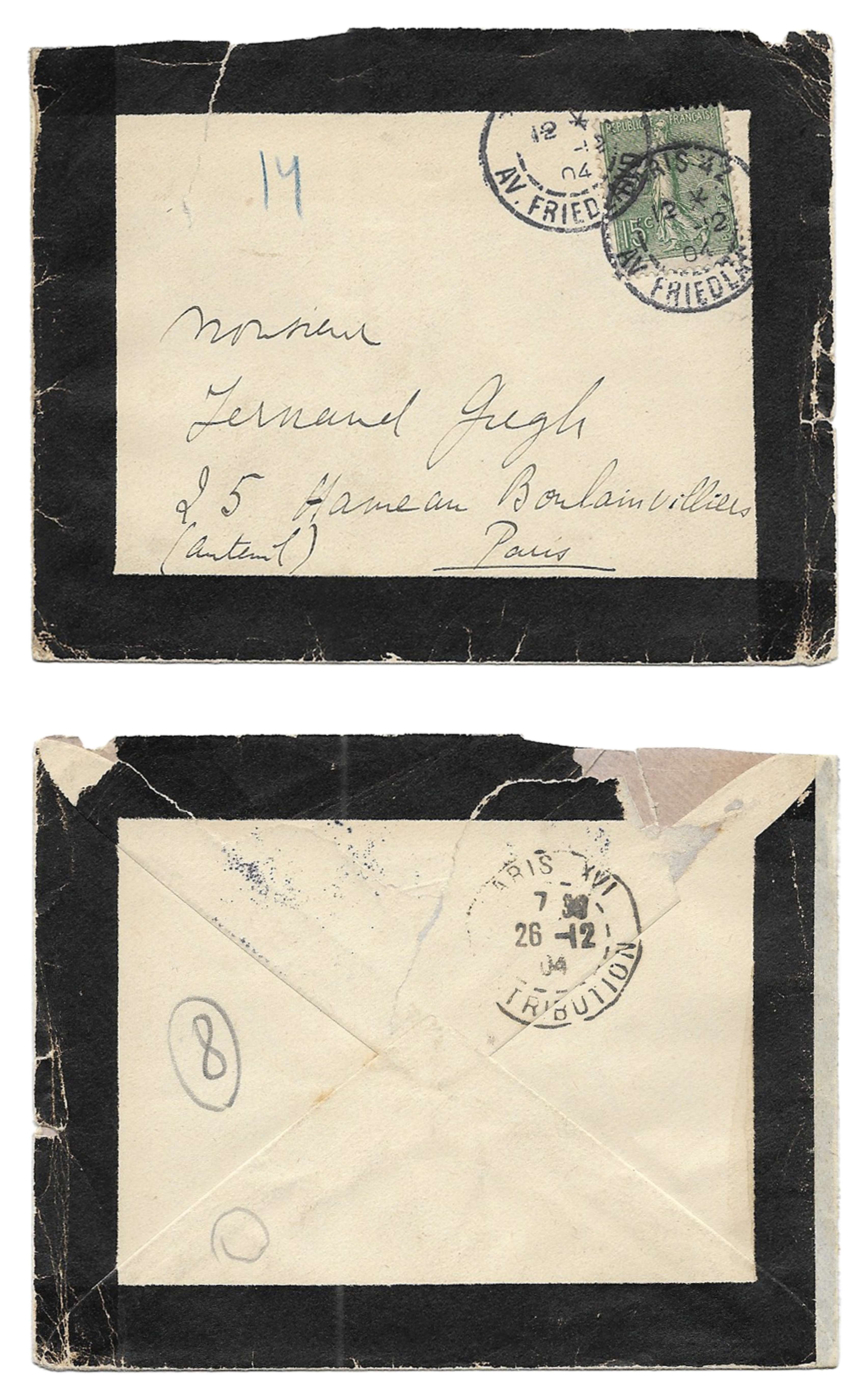
Autograph envelope attached, stamped and postmarked (minor losses, old hinge mark, typographic annotations)
Regrets at being unable to spend New Year’s Eve with his childhood friend
PROUST OR THE ART OF MAKING AMENDS
« Mon cher Fernand, je n’ai pas osé sortir par ce brouillard. Le feu qu’il y avait dans la maison m’a rendu extrêmement souffrant.
Cela aurait pourtant été bien joli vos lumières dans cette brume ; une crèche dans les ténèbres. Ton Marcel Proust.
Dis bien mes regrets très vifs et très respectueux et encore mes remerciements à madame Gregh. »
Proust had been invited to Dammarie-les-Lys to spend New Year’s Eve, where Fernand Gregh’s parents-in-law had rented a Louis XVI–style house. Too ill, he had to decline, sending a brief epistle nevertheless instantly recognizable by its style.
In his letter of 20 December to Madame Straus, Proust nonetheless wrote: “Perhaps one day I shall go to the country for Christmas.”
According to weather reports in Le Figaro at the time, Paris had been shrouded in thick fog and cold weather since Friday, 23 December 1904. On the following day, 24 December, the fog persisted in Paris. On 25 December, it was reported that the day remained foggy. (Kolb)
Fernand Gregh (1873–1960) met Marcel Proust in January 1892 among the students of the Lycée Condorcet who were involved in the literary review Le Banquet. He quickly became its director, while Proust published some of his first significant literary and theoretical texts there.
In 1893, together with two other students of the lycée and members of Le Banquet, Louis de La Salle and Daniel Halévy, Proust and Gregh began writing a novel collaboratively. This collective text, modeled on La Croix de Berny (composed by Gautier and three other writers), was never completed; however, Proust was its principal author and already introduced themes that would later reappear in In Search of Lost Time.
Fernand Gregh then devoted himself almost exclusively to poetry, winning a prize from the Académie française in 1896. He played a notable role in literary life as editor-in-chief of the Revue de Paris (1894–1897) and as editor of Les Lettres (until 1909). His friendship with Proust, however, experienced interruptions, notably due to aesthetic differences. Furthermore, like many “established” writers, Gregh initially regarded Proust with some condescension, while Proust mocked, in turn, the “charming” but occasionally ridiculous character of his friend.
Fernand Gregh was admitted to the Académie française in 1953, leaving behind important literary recollections, including a volume entitled My Friendship with Marcel Proust (1958), in which he published the letters he had received from the author of In Search of Lost Time.
Provenance:
Fernand Gregh
Then private collection
Bibliography:
R.D.M. 15 Jan. 1954, p. 300
Corr., t. IV, Kolb, Plon, n°223
Join our mailing list and be the first to hear our latest news and biggest announcements.
By signing up you agree to our privacy policy. You can unsubscribe at any time.