Keep ahead of the pack
Join our mailing list and be the first to hear our latest news and biggest announcements.
By signing up you agree to our privacy policy. You can unsubscribe at any time.
Proof sheet for Histoire des deux Indes
N.p., [c. 1784–1788], 3 p in-4°, on laid paper
« Tremble, you who feed men with falsehood, or who make them groan under oppression. You are about to be judged »
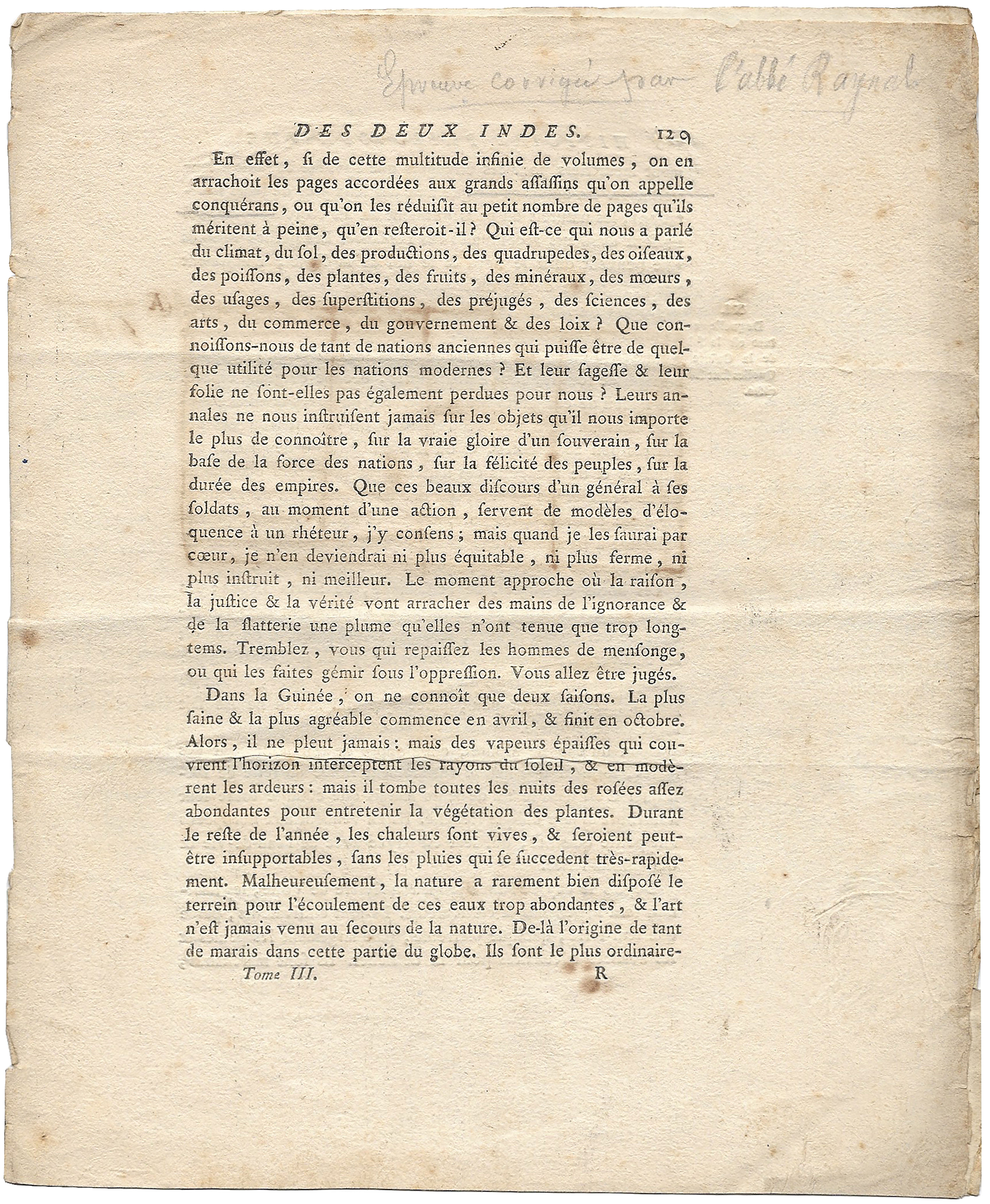
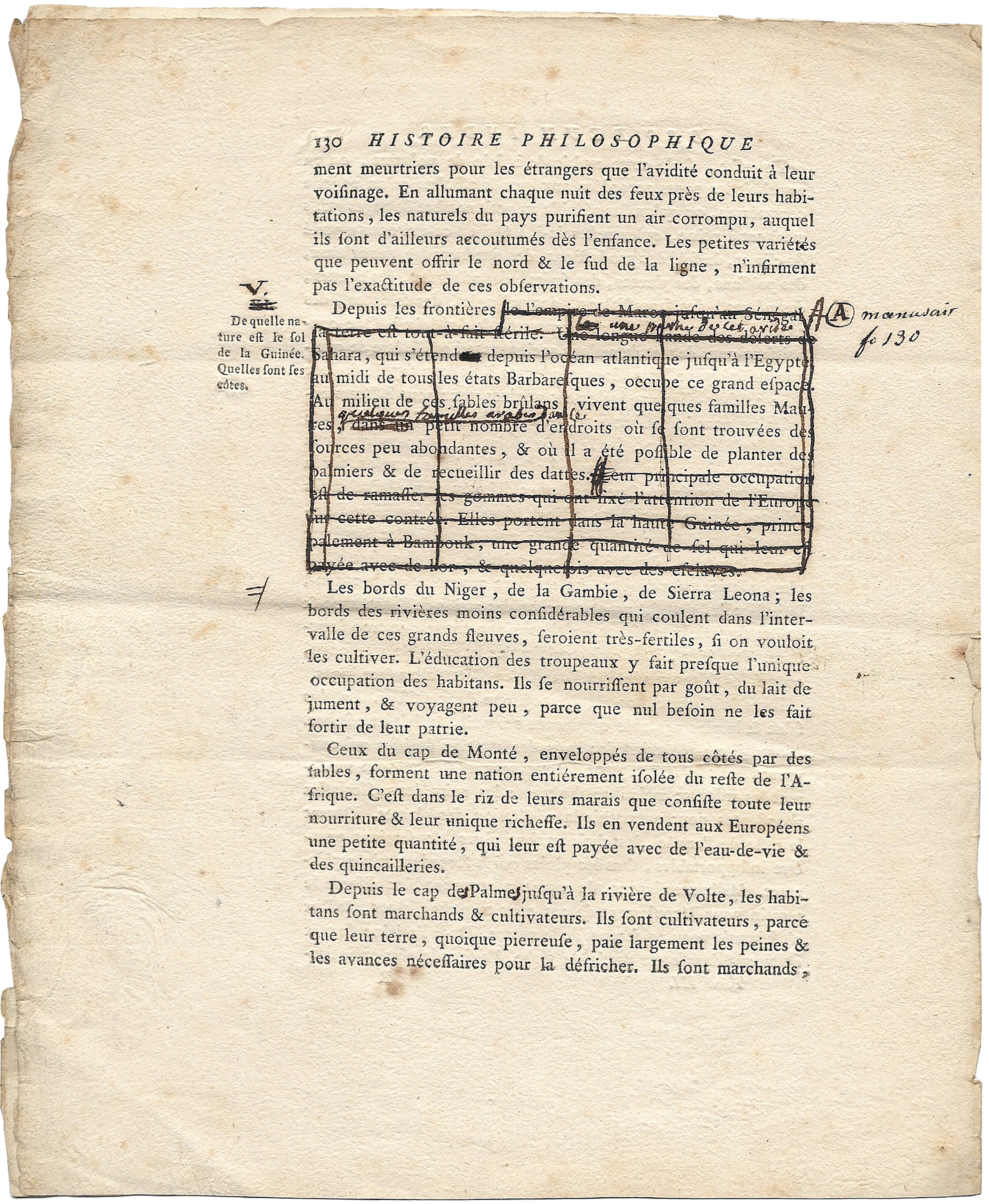
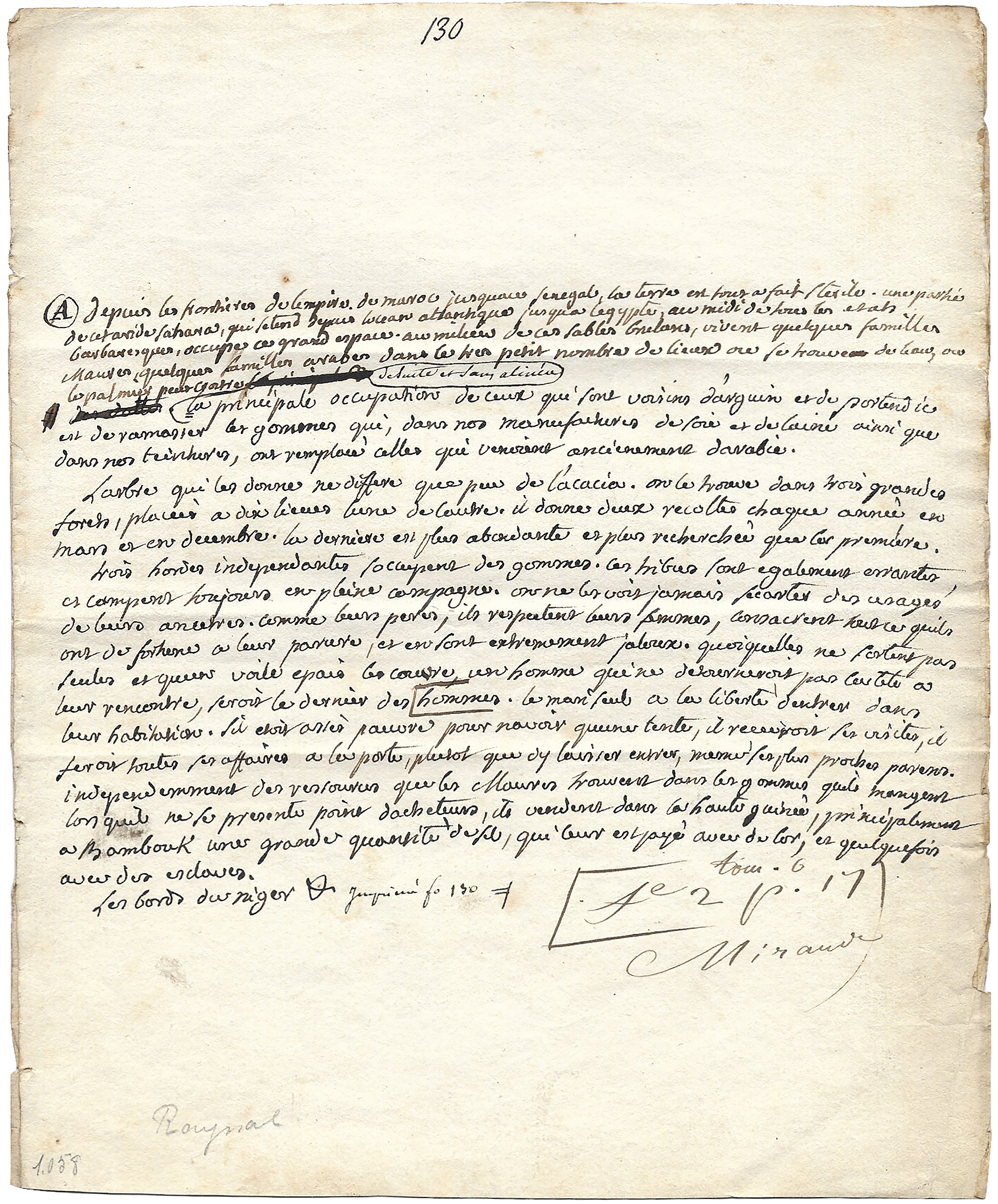
Proof sheet for Histoire des deux Indes
N.p., [c. 1784–1788], 3 p in-4°, on laid paper
Foliation: « 129-130 »
Margins slightly frayed; central fold weakened
Exceedingly rare proof with autograph corrections for his major work, Histoire des deux Indes
The great anti-colonial manifesto of the Enlightenment, with a considerable legacy
« Tremble, you who feed men with falsehood, or who make them groan under oppression. You are about to be judged »
A fundamental passage of his work: Book Eleven was devoted to the study and condemnation of the African slave trade and slavery.
The present placard corresponds to Chapters X and XI of Volume 6, Book Eleven: Europeans go to Africa to purchase cultivators for the West Indies. The manner in which this trade is conducted. Productions resulting from the labors of the enslaved. Largely devoted to West Africa and its agricultural exploitation for the benefit of the colonists, Raynal made a significant addition concerning the lands of Guinea, its inhabitants, and their customs and usages. By thus eruditely praising the purity of an ancestral territory and its traditions, the author contrasts the harmful actions of the colonists, the “grans aſſaſſins qu’on appelle conquérans.” Here, one must understand this as an accusation against the Guinea Company, a society founded in the seventeenth century that played a central role in the triangular trade. It merged in 1748 with the Groupe and Michel company, Nantes-based merchants.
Histoire philosophique et politique des établissements et du commerce des Européens dans les deux Indes: Chronology of an editorial saga long censored in France
Co-authored with collaborators including Diderot, Histoire des deux Indes is one of the most remarkable works of Enlightenment thought. The work achieved considerable success despite condemnations by the Parlement of Paris and the Faculty of Theology.
The first edition appeared anonymously in Amsterdam in 1770 but was not widely distributed until 1772. It was reprinted at least four times that year and eleven times in 1773. The second edition, still anonymous, this time included a portrait of Raynal, allowing him to claim authorship but exposing him to legal action. Printed in 1774 in The Hague, it claimed to be superior to the previous edition and was reprinted at least fourteen times between 1774 and 1778 in various formats.
Accompanied by engravings by Charles-Nicolas Cochin, tables, and an atlas by Rigobert Bonne, and signed this time by Raynal, the third edition of 1780 was the last version published during his lifetime. The work, over 3,000 pages, was issued in excerpts, abridgments, and anthologies for both adults and children, and simultaneously translated into several languages.
Raynal had planned to further expand his monumental work before his death in 1796. Between 1784 and 1788, he made numerous additions while expunging certain passages. The present placard appears to correspond to this revision of his work. It formed the basis for the 1820–1821 edition.
Raynal’s autograph manuscripts are very rare on the open market.
Join our mailing list and be the first to hear our latest news and biggest announcements.
By signing up you agree to our privacy policy. You can unsubscribe at any time.