Keep ahead of the pack
Join our mailing list and be the first to hear our latest news and biggest announcements.
By signing up you agree to our privacy policy. You can unsubscribe at any time.
Autograph letter signed « Emile Zola » to Joseph Canqueteau
Paris, 10th March 1885, 2 p. in-8°
« The seminal idea of Germinal is already very far away… »
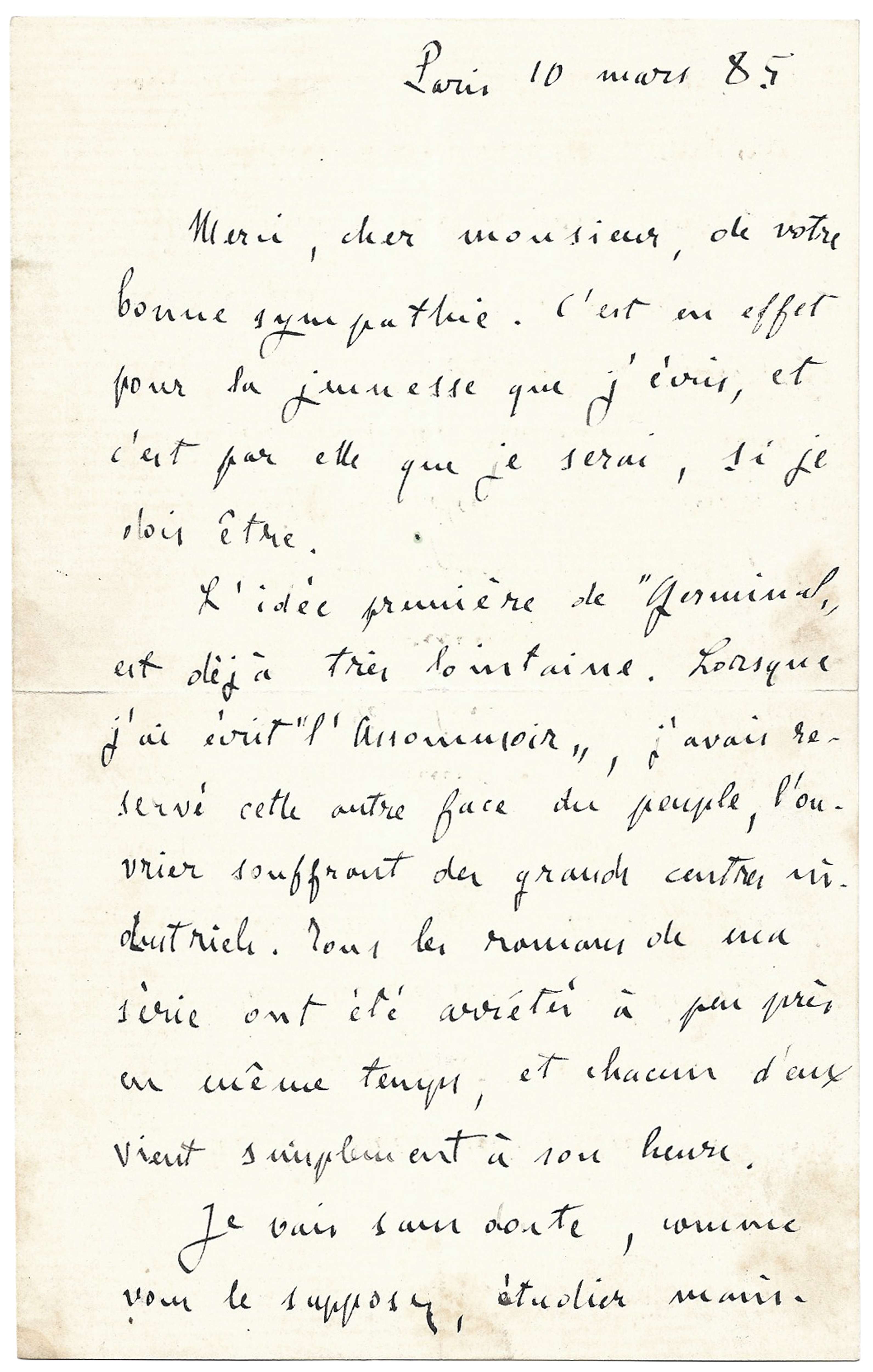
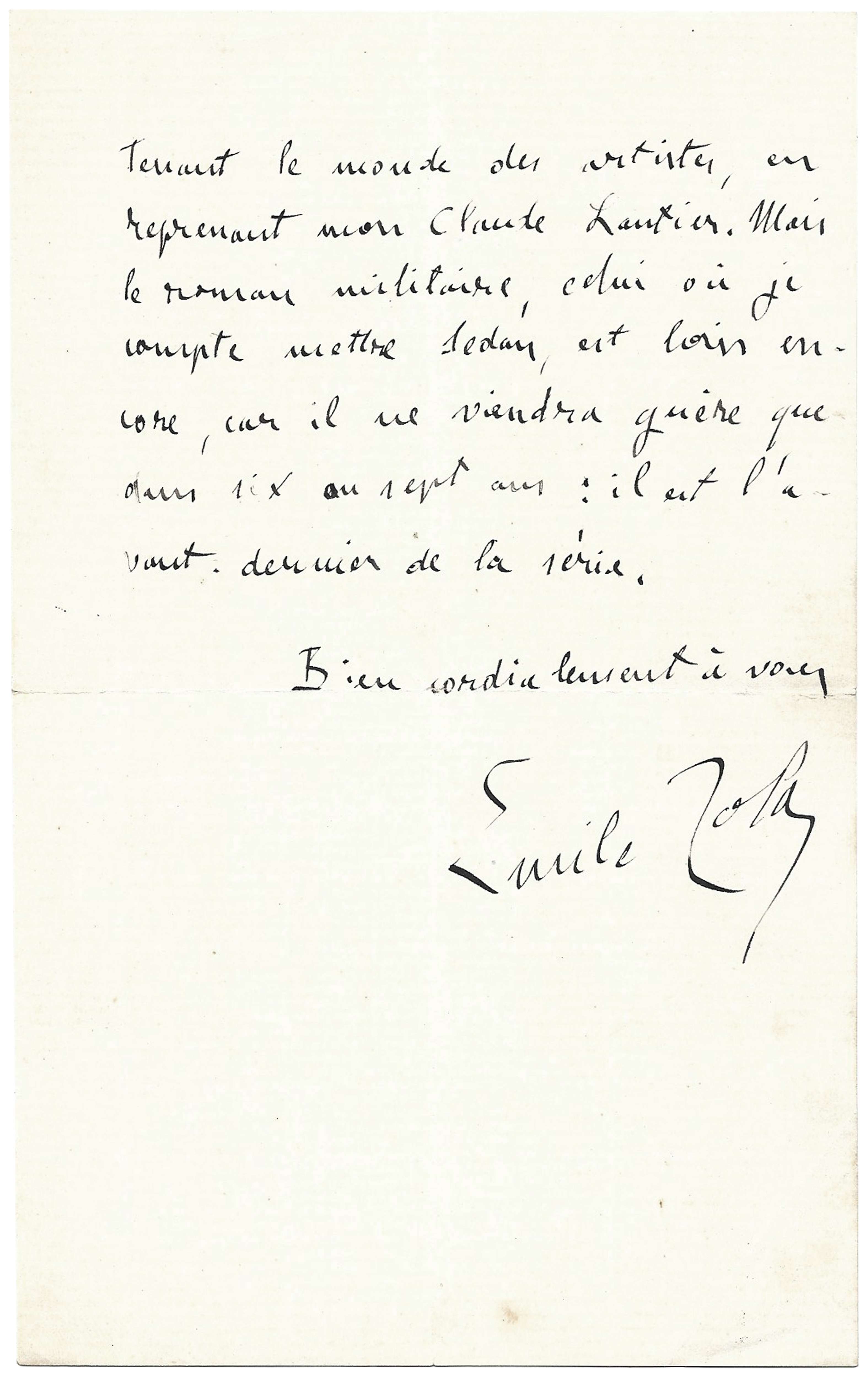
Autograph letter signed « Emile Zola » to Joseph Canqueteau
Paris, 10th March 1885, 2 p. in-8°
Small tears on folds, some browning (see scans)
An important letter, written juste a week after the release of Germinal and drawing up a panorama of some of the most emblematic works of the Rougon-Macquart saga
From the B. & R. Broca collection
« Merci, cher monsieur, de votre bonne sympathie. C’est en effet pour la jeunesse que j’écris, et c’est par elle que je serai, si je dois être.
L’idée première de “Germinal” est déjà très lointaine. Lorsque j’ai écrit “l’Assommoir”, j’avais réservé cette autre face du peuple, l’ouvrier souffrant des grands centres industriels. Tous les romans de ma série ont été arrêtés à peu près en même temps, et chacun d’eux vient simplement à son heure.
Je vais sans doute, comme vous le supposez, étudier maintenant le monde des artistes, en reprenant mon Claude Lantier [L’Œuvre]. Mais le roman militaire, celui où je compte mettre Sedan [La Débâcle], est loin encore, car il ne viendra guère que dans six ou sept ans : il est l’avant dernier de la série.
Bien cordialement à vous
Emile Zola »
Zola drew up as early as 1868 a genealogical tree of his characters and then a chronological order for the Rougon-Macquart, even before the publication of the first volume of the saga. Initially planned as a ten-volume series, the writer subsequently revised his ambitions upward. In the end, the project would comprise twenty novels written between 1870 and 1893. This letter thus makes it possible to grasp the almost millimetric organization that the author imposed upon himself, to the point of predicting with considerable precision, “in six or seven years,” the publication of La Débâcle. Indeed, the penultimate volume of the series appeared in 1892.
A bohemian artist already present in Le Ventre de Paris, though his role there is only minor, Claude Lantier (the elder brother of Étienne, the hero of Germinal) becomes the main protagonist of L’Œuvre. The fate of this accursed painter (whose features recall those of Paul Cézanne) is tragic, like that of his mother Gervaise Macquart in L’Assommoir. This fourteenth novel in the series was published by Charpentier the following year, in 1886.
One is familiar with the letter that Joseph Canqueteau, on the verge of giving a lecture on Les Rougon-Macquart, addressed to Zola in order to request some information (while having, moreover, correctly anticipated certain points): “We are here a gathering of young people who admire you greatly, I assure you, and who know how to defend you when the occasion arises. You have youth on your side, dear master; that is a formidable asset. We greatly appreciate the honor you have done us by accepting the title of honorary member of our young conference. What a powerful book Germinal is! […] I would be grateful, dear master, if you would tell me at precisely what point you conceived the idea of this vast social study. Will military life and artistic life not be the subjects of two forthcoming works?”
Provenance:
Précieux autographes [Collection particulière], Drouot, 4 déc. 1981, n°251
B. & R. Broca collection
Bibliography:
Correspondance, t. V, éd. du CNRS, p. 241-242, n°185
Join our mailing list and be the first to hear our latest news and biggest announcements.
By signing up you agree to our privacy policy. You can unsubscribe at any time.