Keep ahead of the pack
Join our mailing list and be the first to hear our latest news and biggest announcements.
By signing up you agree to our privacy policy. You can unsubscribe at any time.
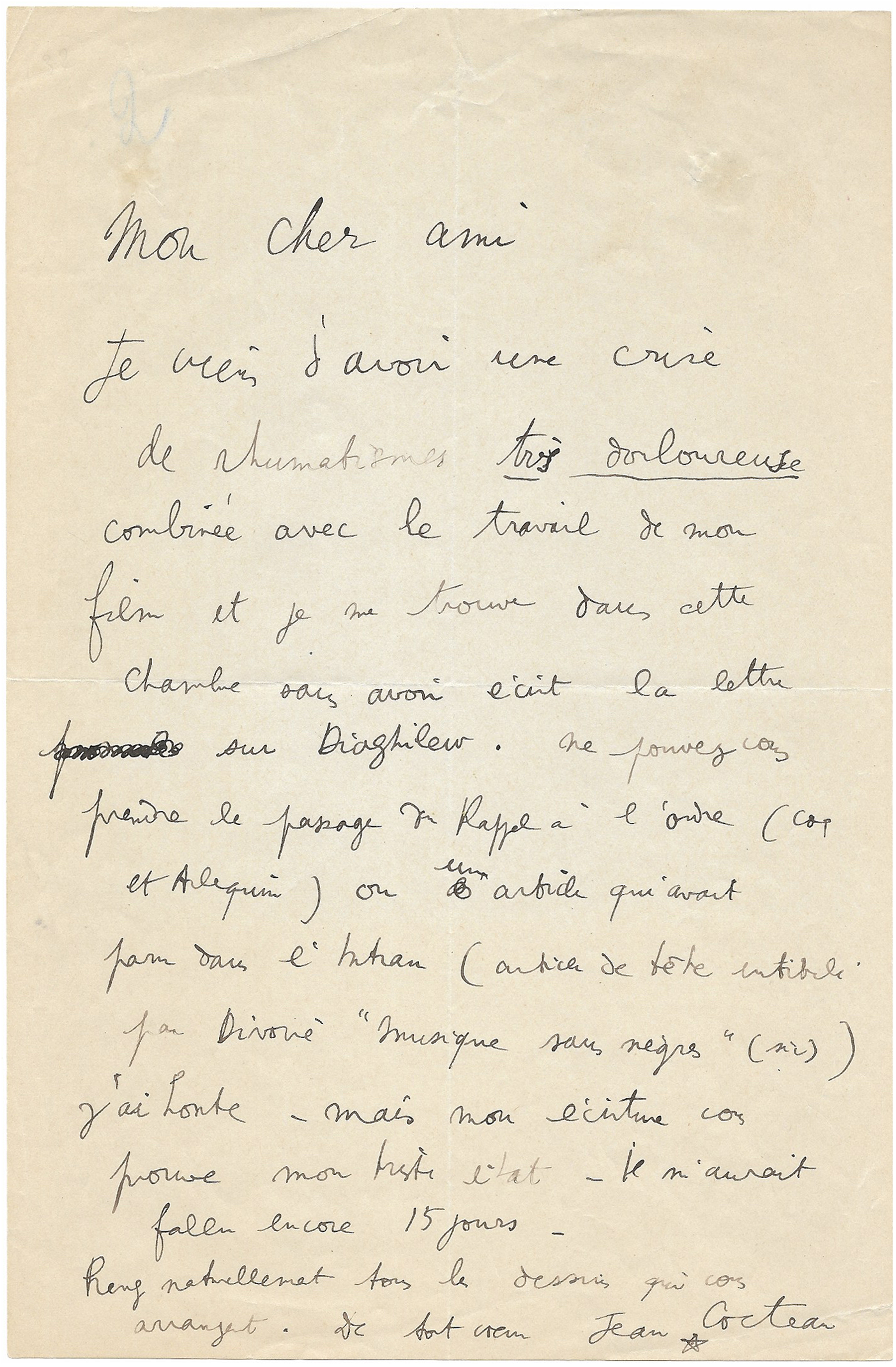
Autograph letter signed « Jean Cocteau » to a friend
N.p.n.d., [c. 1928], 1 p. in-4°
« I find myself in this room without having written the letter about Diaghilev »
Autograph letter signed « Jean Cocteau » to a friend
N.p.n.d., [c. 1928], 1 p. in-4°
Old traces of mounting on the verso
Typographic annotation in the upper left corner
Two words crossed out by Cocteau
While working on the production of his first film, Cocteau is also preparing to write his tribute to Diaghilev
« Mon Cher ami,
Je viens d’avoir une crise de rhumatismes très douloureuse combinée avec le travail de mon film et je me trouve dans cette chambre sans avoir écrit la lettre promise sur Diaghilev. Ne pouvez-vous prendre le passage du Rappel à l’ordre (Coq et Arlequin) ou un article qu’avait paru dans l’Intran[sigeant] (article de tête intitulé par [Fernand] Divoire ‘musique sans nègres’ sic).
J’ai honte – mais mon écriture vous prouve mon, triste état – il m’aurait fallu encore 15 jours.
Prenez naturellement tous les dessins qui vous arrangent. De tout cœur
Jean Cocteau »
“Cocteau’s film production is not limited to his masterpieces of the 1940s (Beauty and the Beast, Orphée, etc.). The poet was drawn to the cinematic experience shortly after Radiguet’s death, with Jean Cocteau fait du cinéma, in March 1927. The film is now lost.
The ‘letter on Diaghilev’ refers to his Hommage à Serge de Diaghilev, which is currently held at the Syracuse University Library.
The article Un animateur. Musique sans nègres by Fernand Divoire was published in L’Intransigeant, no. 15997, on May 23, 1924, p. 1.”
Bibliography:
Jean Cocteau et l’intermédialité, David Gullentops, Editions de l’université de Bruxelles, 2024, p. 135 (about the film)
Join our mailing list and be the first to hear our latest news and biggest announcements.
By signing up you agree to our privacy policy. You can unsubscribe at any time.