Keep ahead of the pack
Join our mailing list and be the first to hear our latest news and biggest announcements.
By signing up you agree to our privacy policy. You can unsubscribe at any time.
Autograph manuscript for Le Modeste
S.l.n.d. [c. 1976], 2 p. in-plano (40 x 30 cm)
« Selon lui, mettre en plein soleil / Son cœur ou son cul c’est pareil / C’est un modeste »
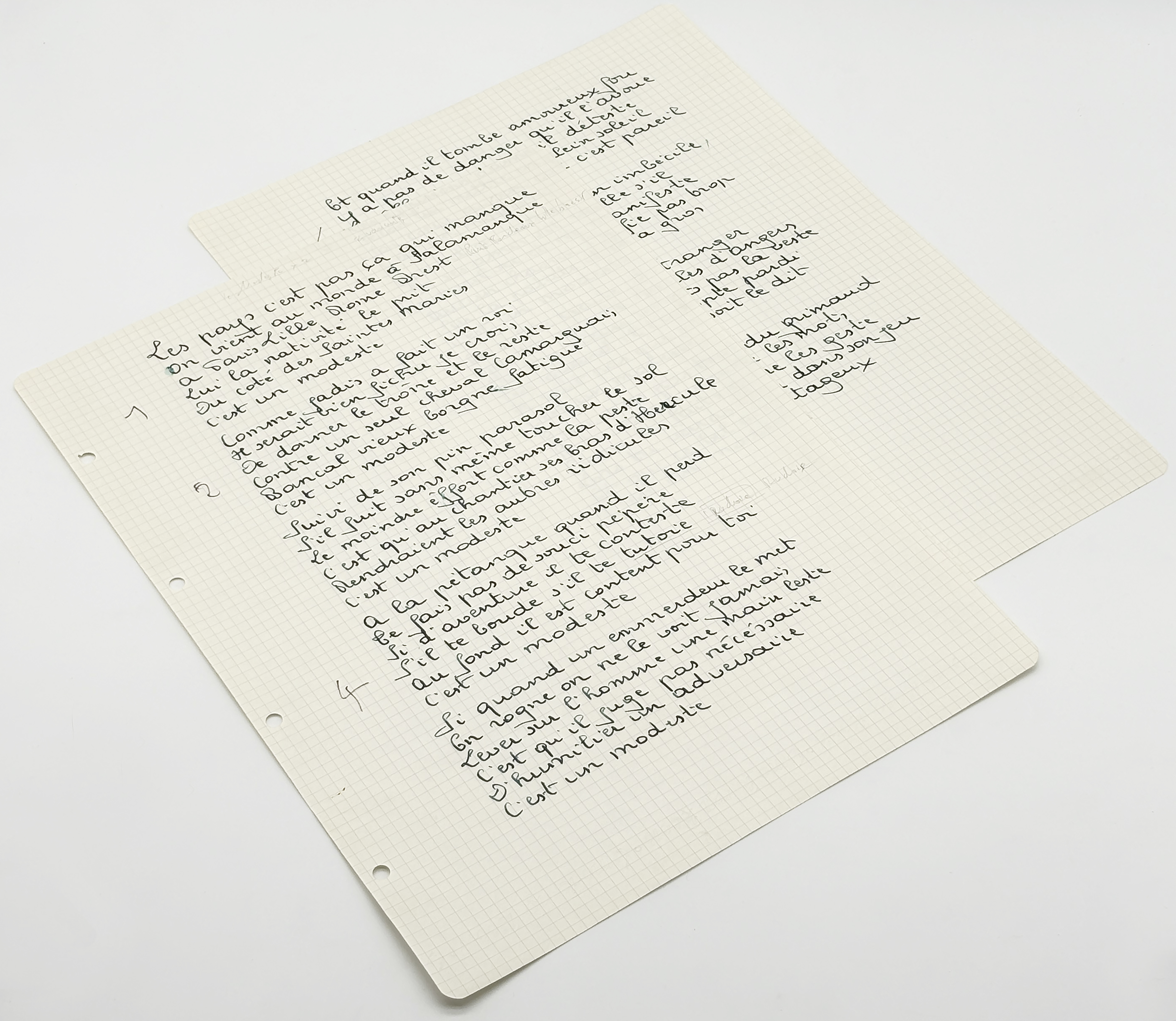
Autograph manuscript for Le Modeste
s.l.n.d. [c. 1976], 2 pp., in-plano (40 × 30 cm).
Incomplete foliation in the margins of the stanzas.
Very slight ink offset affecting three letters, not affecting readability.
The complete manuscript of this well-known song, which reads as a self-portrait, released on Trompe la mort, the last album by Brassens
“Le Modeste” is composed by Georges Brassens as a disguised self-portrait, inspired by the southern landscapes of the Camargue and Sète. Behind the repetition of the very brief refrain “C’est un modeste”, the poet constructs a paradoxical figure: that of a man proud of his own discretion, who rejects both excessive displays of emotion and any form of self-promotion. Brassens thus plays with an ironic form of false modesty: his “Herculean arms” could “make others look ridiculous”, while his refusal of effort or emotional display becomes a restrained way of asserting his singularity. The writing blends popular humour, southern expressions, and cultural references in a deliberately familiar language, characteristic of his repertoire.
The text is also built on a constant tension between appearance and inner truth. Beneath the gruff exterior, the teasing, or the apparent detachment, lies a deep sensitivity: “Sur la patate, il en a gros”. The character refuses to expose “his heart” in public, treating emotional confession as a form of indecency. This affective reserve, typical of Brassens’s world, makes the “modest man” a profoundly human figure: attached to friendship, loyalty, and an authenticity that is readable “between the words, / between the facts, between the gestures”.
This clean manuscript includes two minor variants: in the third line of the first stanza, “À Paris Bordeaux Lille Brest” is replaced here by “Paris Lille Rome Brest”. The second variant concerns the fourth line of the fourth stanza, where “rudoie” is replaced by “tutoie”.
The song remains one of the most famous and subtle pieces from his final album Trompe la mort, recorded in autumn 1976 by Philips. As always, Georges Brassens is accompanied by his faithful double bassist Pierre Nicolas, with Joël Favreau on second guitar.
Provenance: Estate of Sophie Duvernoy (1930–2025)
A discreet yet essential figure within Georges Brassens’s inner circle, Sophie Duvernoy entered his service in 1969 after having worked for the illustrator Raymond Peynet. She referred to Brassens as “the good master” (le bon maître), a nickname he himself had mischievously suggested when they first met. Born in Poland and nine years younger than the singer-songwriter, she was recruited almost by chance when Peynet moved to the South of France. At the time, Brassens was living in the Le Méridien building on Rue Émile-Dubois, alongside neighbours and friends such as Jacques Brel. Sophie subsequently accompanied Brassens when he moved to Rue Santos-Dumont, quickly becoming a stable presence within an environment shaped by the constant visits of friends and figures from the artistic world. A relationship grounded in trust and mutual understanding gradually emerged between these two reserved personalities. At the heart of this domestic space, which had become a place of artistic creation, Sophie Duvernoy assumed a central role, ensuring the conditions necessary for the work of the poet from Sète. Guardian of silence, manager of household affairs, and intermediary with the outside world, she moved in close proximity to Brassens’s creative process without ever disturbing its equilibrium. Her closeness to the artist also found expression in a limited direct participation in his work. She joined the chœur des copains alongside, among others, Claudine Caillart, Fred Mella, Joël Favreau, Pierre Nicolas, and André Tavernier, contributing backing vocals to two songs: “Tempête dans un bénitier” and “Le Roi.” Following the death of her “good master,” she lived in an apartment purchased by Brassens, who had guaranteed her lifetime use of it — a testament to the singular place she occupied both in his daily life and in the immediate orbit of his artistic creation.
Join our mailing list and be the first to hear our latest news and biggest announcements.
By signing up you agree to our privacy policy. You can unsubscribe at any time.