Keep ahead of the pack
Join our mailing list and be the first to hear our latest news and biggest announcements.
By signing up you agree to our privacy policy. You can unsubscribe at any time.
Autograph letter signed « Chamfort » to Guillaume Alexandre Tronson du Coudray
N.p., « 8 Aug., l’an 2 » [1793], 1 p. small in-4° in laid paper
« It is important both to the defendant and to me that this happen as soon as possible »
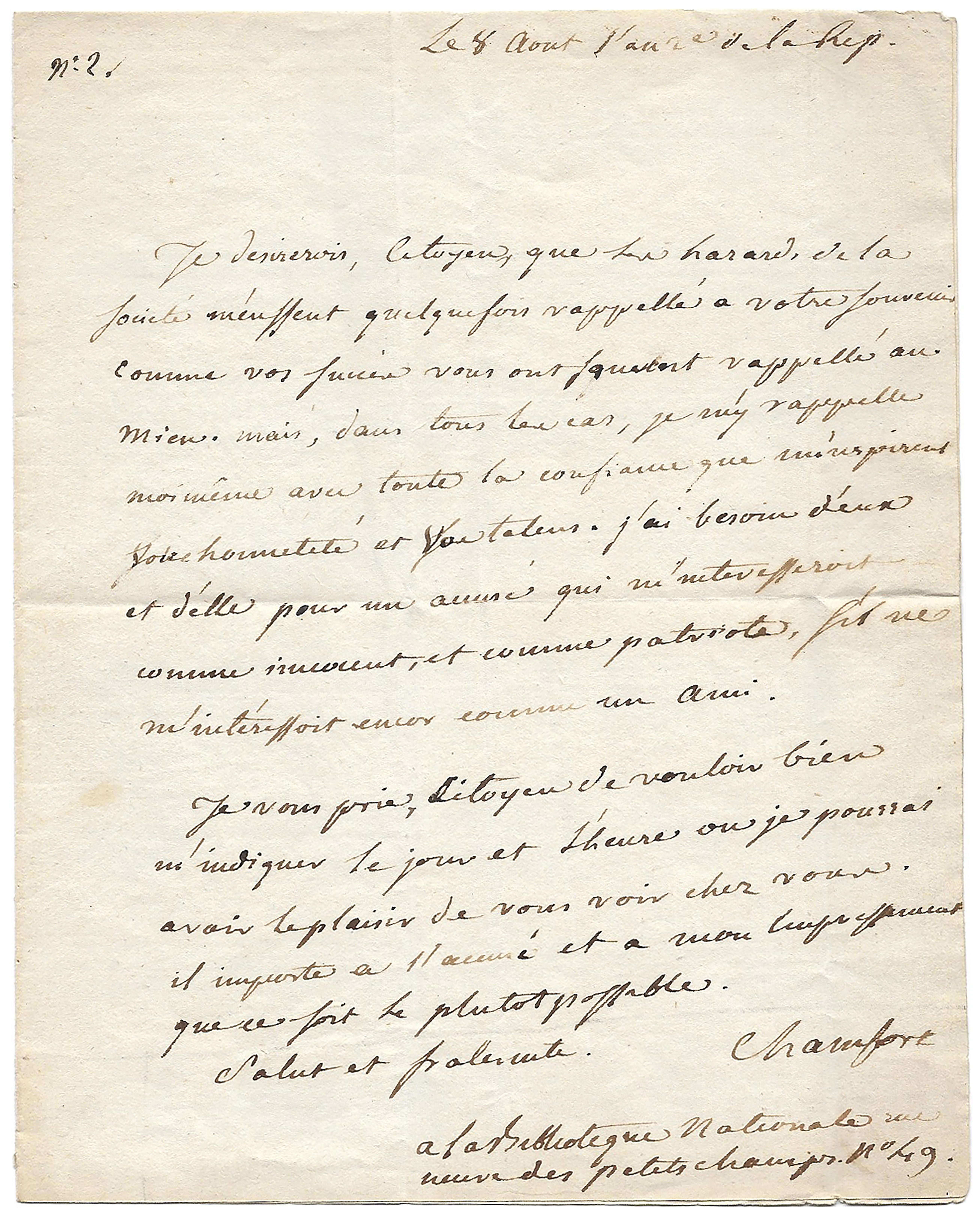
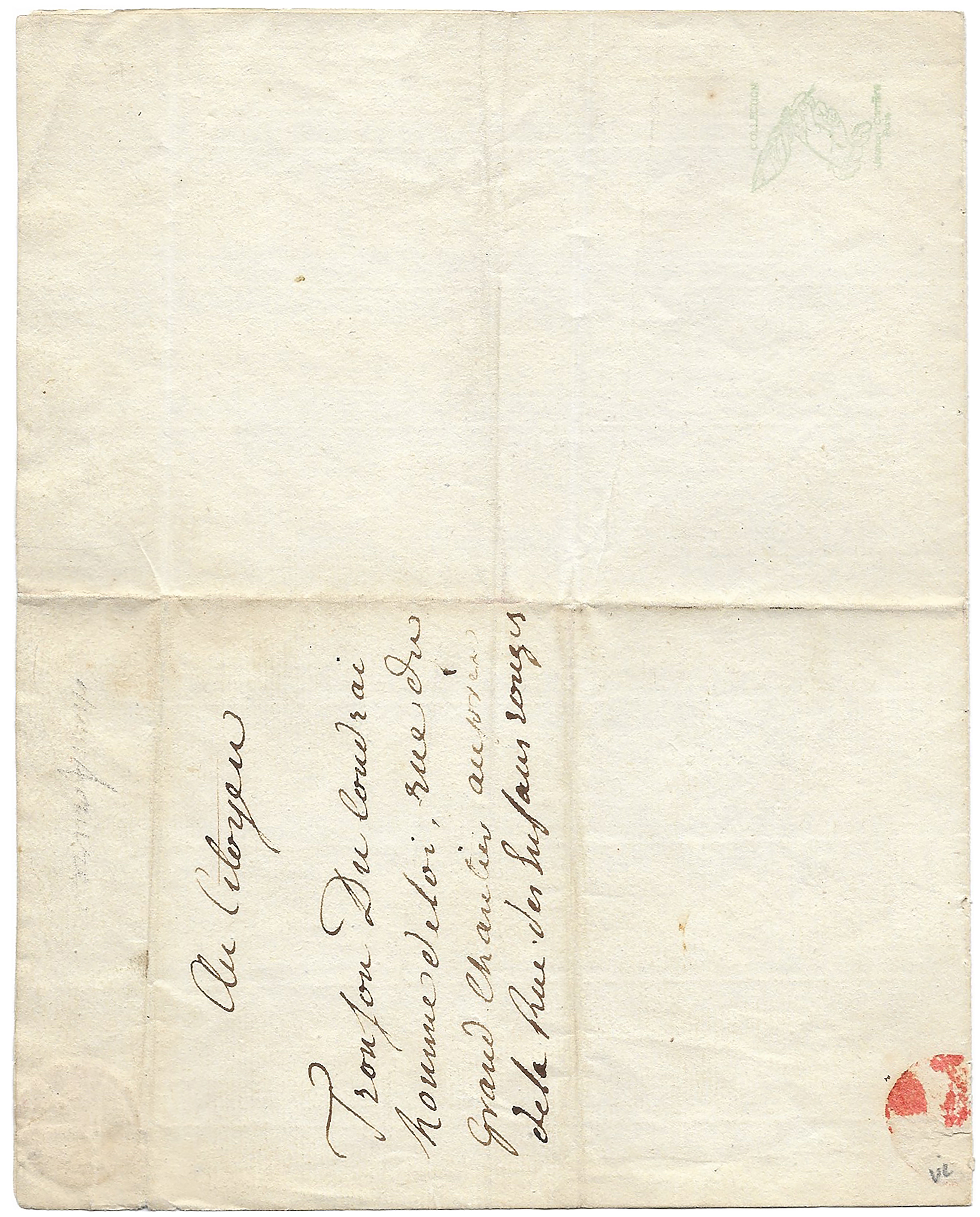
Autograph letter signed « Chamfort » to Guillaume Alexandre Tronson du Coudray
N.p., « 8 Aug., l’an 2 » [1793], 1 p. small in-4° in laid paper
Autograph address on the fourth page, with a discreet collector’s stamp.
Watermark: Coat of arms bearing a double St. Andrew’s cross, with the initials “SKW” on a shield surrounded by ornamental mantling and topped by an orange tree (Gaudriault, p. 51).
Chamfort attempts to secure unofficial support from the celebrated lawyer following the arrest of his colleague Carra, librarian of the Nation
« Je désirerois, Citoyen, que les hasards de la société m’ussent quelquefois rappellé à votre souvenir comme vos succès vous ont souvent rappelé aux miens mais, dans tous les cas, je m’y rappelle moi-même avec toute la confiance que m’inspire votre honnêteté et vos talens. J’ai besoin d’eux et d’elle pour un accusé qui m’interesseroit comme un innocent, et comme patriote, s’il ne m’interesseroit encore comme un ami.
Je vous prie, Citoyen de vouloir bien m’indiquer le jour et l’heure ou je pourrai avoir le plaisir de vous voir chez vous. Il importe à l’accusé et à mon empressement que ce soit le plus tôt possible.
Salut et fraternité
Chamfort »
The day after the fall of the monarchy, Interior Minister Roland jointly appoints Jean-Louis Carra and Chamfort “as librarians of the Bibliothèque nationale, at a salary of 4,000 livres each…”. This appointment is intended to reward the two men’s “civic virtue” and revolutionary commitment, particularly that of Carra, whose role in the overthrow of the monarchy is by then widely acknowledged. Although the pair is officially placed at the head of the institution, Carra in practice takes little part in its administration. Quickly absorbed by his political activities and his missions with the armies, he leaves Chamfort to handle most of the day-to-day management.
Carra’s situation deteriorates dramatically in 1793. Politically isolated and abandoned by a large part of his former supporters, he is arrested and brought before the Revolutionary Tribunal as part of the Girondin trial. While several of his former friends distance themselves from him, Chamfort stands out for his loyalty. Despite the threats weighing on his own person, he works to organise his colleague and friend’s defence. On 8 August 1793, he thus approaches the celebrated lawyer Tronson du Coudray, asking him to agree to defend Carra. This gesture is all the more remarkable as Chamfort himself is being attacked for his political positions and is soon to fall under suspicion from the revolutionary authorities. Although Tronson du Coudray ultimately does not become Carra’s official defence counsel, Carra is instead represented by Guigné in an unofficial capacity. Tronson du Coudray would, in turn, defend Marie-Antoinette two months later. Carra is condemned to death alongside the Girondins and executed on 1 November 1793.
Provenance:
Private collection
Literature:
Jean-Louis Carra (1742-1793), parcours d’un révolutionnaire, Stefan Lemny, L’Harmattan, 2000, p. 260 (mentioned but not transcribed)
Join our mailing list and be the first to hear our latest news and biggest announcements.
By signing up you agree to our privacy policy. You can unsubscribe at any time.