Keep ahead of the pack
Join our mailing list and be the first to hear our latest news and biggest announcements.
By signing up you agree to our privacy policy. You can unsubscribe at any time.
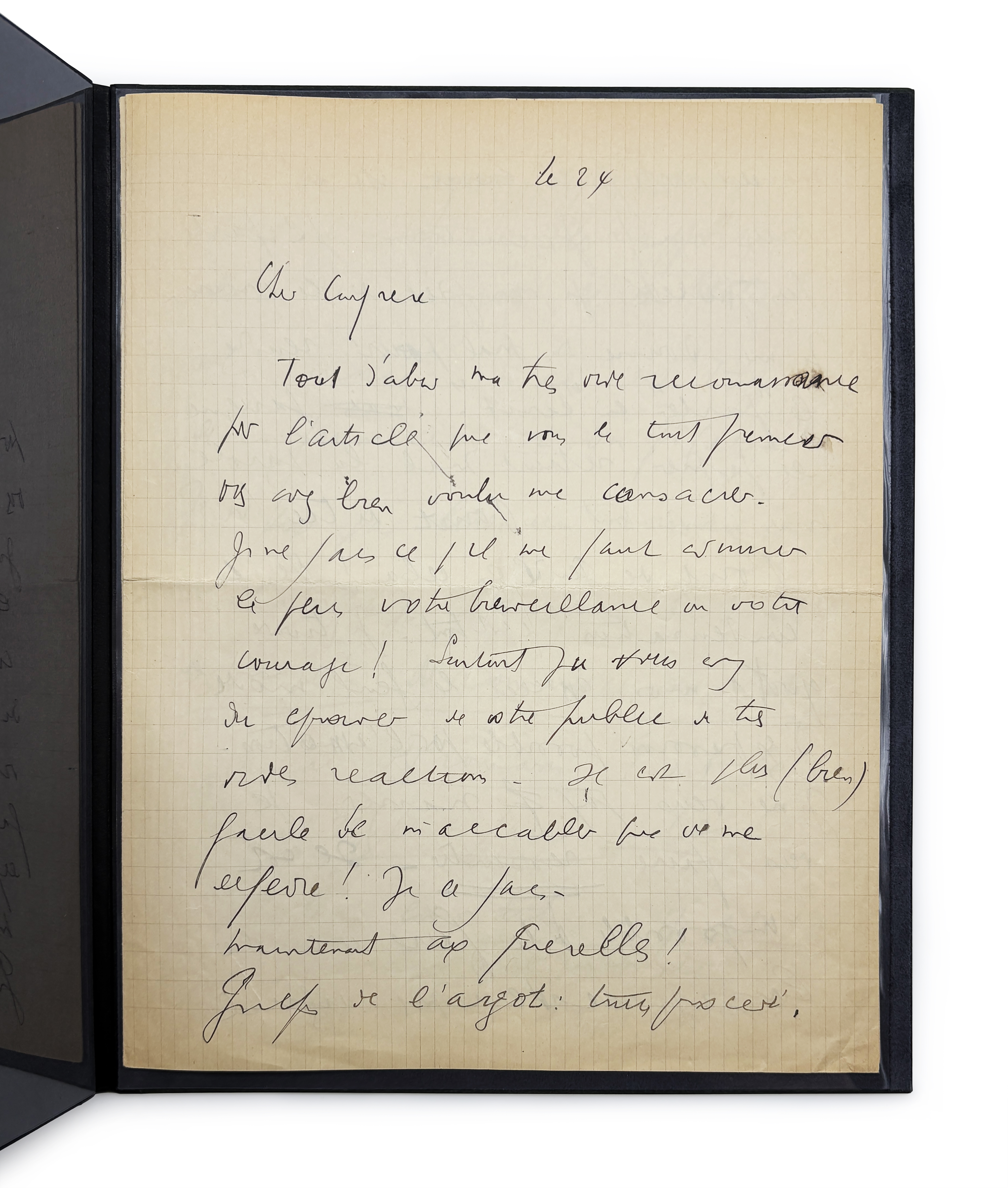
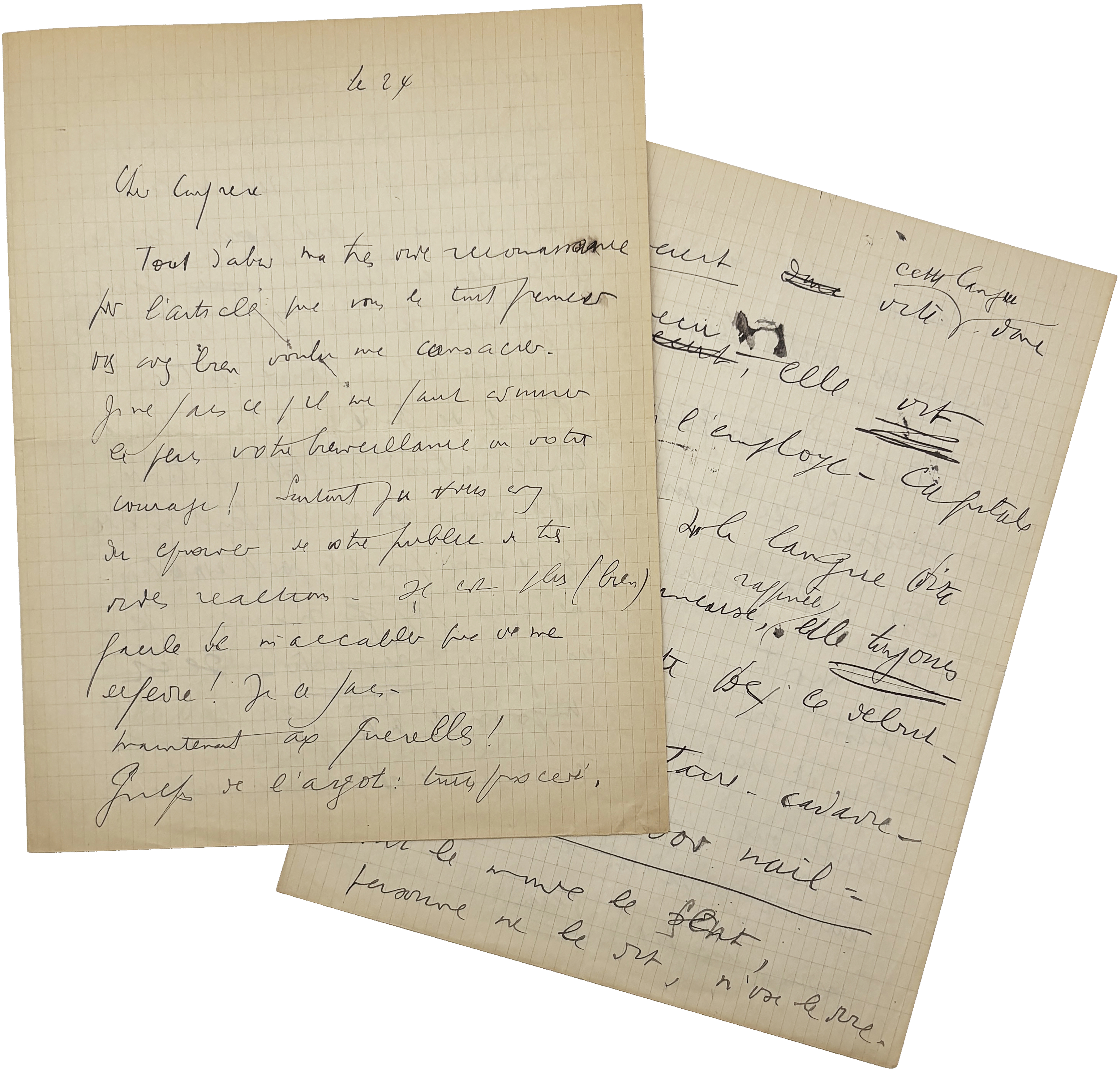
Autograph letter signed « Céline » [to André Rousseaux]
[Paris], 24 [May 1936], 8 pp. large in-4°, in black ink
« I don’t want to narrate, I want to make the reader FEEL »
Autograph letter signed « Céline » [to André Rousseaux]
[Paris], 24 [May 1936], 8 pp. large in-4°, in black ink
Numerous corrections, deletions and overwritings in Céline’s hand
A few ink offsets, period fold marks
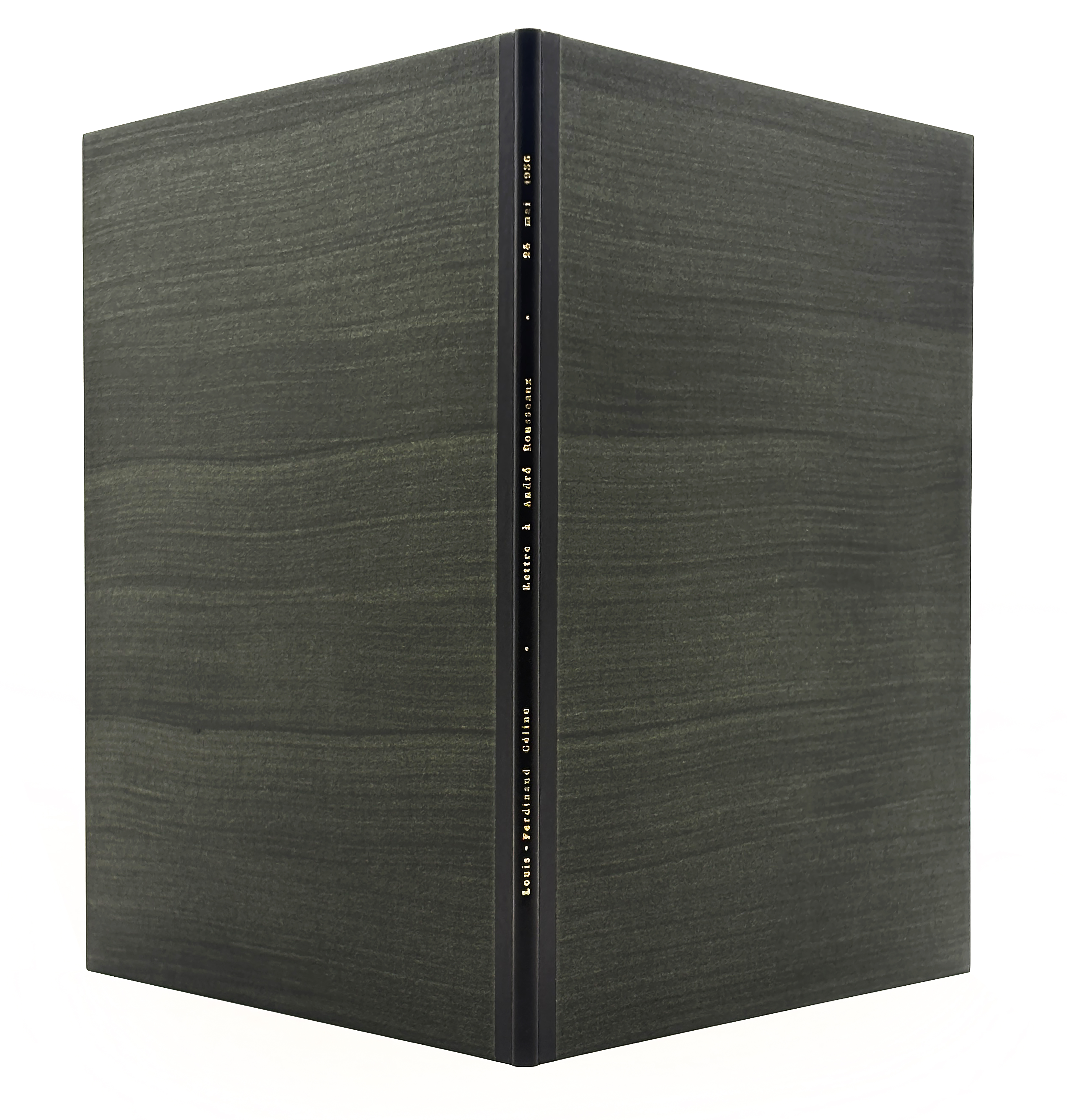
In a Bradel-style half-calf folder-case, gilt title on spine, date at foot
The French novel challenged by slang: the foundations of Céline’s aesthetic
One of the writer’s most important letters, if not the most important
« A language is like everything else, IT IS ALWAYS DYING, IT MUST DIE. One must resign oneself to it, the language of conventional novels is dead, dead syntax, everything dead. Mine will die too, probably soon, but they will have had the small advantage over so many others of having, for a year, a month, a day, LIVED. That is all that matters. »
« A letter of capital importance for understanding Céline’s poetic art » (Henri Godard, Pléiade)
« Cher confrère
Tout d’abord ma très vive reconnaissance pour l’article que vous le tout premier vous avez bien voulu me consacrer. Je ne sais ce qu’il me faut admirer le plus, votre bienveillance ou votre courage ! Surtout que vous avez dû éprouver de votre public de très vives réactions. Il est plus (bien) facile de m’accabler que de me défendre ! Je le sais.
Maintenant aux querelles !
Griefs de l’argot : truc, procédé, manière, artifice… etc. !
Mais non ! J’écris comme je parle, sans procédé, je vous prie de le croire. Je me donne du mal pour rendre le « parlé » en « écrit », parce que le papier retient mal la parole, mais c’est tout. Point de tic ! Point de genre en cela ! De la condensation c’est tout. Je trouve quant à moi en ceci le seul mode d’expression possible pour l’émotion. Je ne veux pas narrer, je veux faire RESSENTIR. Il est impossible de le faire avec le langage académique, usuel — le beau style. C’est l’instrument des rapports, de la discussion, de la lettre à la cousine, mais c’est toujours de la grimace et du figé. Je ne peux pas lire un roman en langage classique. Ce sont là des PROJETS de romans, ce ne sont jamais des romans. Tout le travail reste à faire. Le rendu émotif n’y est pas. Et c’est lui seul qui compte. D’ailleurs cela est tellement exact que sans camaraderie, forcerie, complaisance, pénurie, on ne les lirait plus depuis longtemps ! Leur langue est impossible, elle est morte, aussi illisible (en ce sens émotif) que le latin. Pourquoi je fais tant d’emprunts à la langue, au « jargon », à la syntaxe argotique, pourquoi je la forme moi-même si tel est mon besoin de l’instant ? Parce que vous l’avez dit elle meurt vite cette langue. Donc elle a vécu, elle VIT tant que je l’emploie. Capitale supériorité sur la langue dite pure, bien française, raffinée, elle TOUJOURS MORTE, morte dès le début, morte depuis Voltaire, cadavre, dead as a door nail. Tout le monde le sent, personne ne le dit, n’ose le dire. Une langue c’est comme le reste, ÇA MEURT TOUT LE TEMPS, ÇA DOIT MOURIR. Il faut s’y résigner, la langue des romans habituels est morte, syntaxe morte, tout mort. Les miens mourront aussi, bientôt sans doute, mais ils auront eu la petite supériorité sur tant d’autres, ils auront pendant un an, un mois, un jour, VÉCU. Tout est là. Le reste n’est que grossière, imbécile, gâteuse vantardise. Dans toute cette recherche d’un français absolu il existe une niaise prétention, insupportable, à l’éternité d’une forme d’écrire, une seule, en français ! le joli style ! la jolie momie ! Bandelettes ! Ne rien risquer. Vite en momie ! C’est le mot d’ordre de tous les lycées. Bandelettes ! Encore suis-je moins cruel qu’Élie Faure. « La plupart du temps les artistes sous prétexte d’art s’arrangent pour faire plus mort que la mort, ils lui ajoutent un poids spécifique que la mort n’a pas. La mort possède encore une espèce de vie… »
Votre ami
Céline »
Published on 12 May 1936 by Denoël, against the backdrop of significant political events, Mort à crédit sparked fierce controversy from the moment of its release. A large majority of reviews were unfavorable. Léon Daudet and Lucien Descaves, who had once praised Voyage and for whom Céline had had personalized copies of Mort à crédit printed, turned their backs on the writer. Obscenity, vulgarity of vocabulary, and the disjointed syntax were among the many grievances levelled against the novel: “Why […] does Céline persist in using an execrable style which, despite its appearance of revolt and liberation, is, at bottom, full of basely literary devices” (La Dépêche de Toulouse, 9 June). Scathing reviews abounded: the book was savaged. This critical hostility reveals the shock caused by a style of writing that broke with the norms of the traditional novel, a break begun four years earlier with Voyage au bout de la nuit and brought to completion with Mort à crédit.
“Céline’s prodigious verbal genius” (André Rousseaux, Le Figaro, 23 May 1936)
A journalist for Le Figaro‘s literary supplement, André Rousseaux was the very first to publish, on 23 May, an article praising the novel, going against the grain of the rest of the critical backlash. In his reply to Rousseaux, Céline sets out for the first time the foundations of his poetics: “I don’t want to narrate, I want to make the reader feel.” Céline’s reply here goes beyond simple self-defense: it constitutes a genuine aesthetic manifesto. For the writer, the central stake is emotion, conceived as the sole guarantor of a novel’s power, and achieved through a written language transposed from the “spoken” idiom.
This letter thus occupies an essential place in Célinian aesthetics. As Henri Godard points out, “Nowhere afterward, neither in the Entretiens avec le professeur Y nor in his remarks on the occasion of Trignol’s death, will Céline offer insights as profound into his use of popular language and slang as in this letter, written in the heat of his disappointment at the reception given to Mort à crédit” (Romans, vol. 1, Pléiade, p. 1413). Both disappointment and rage show through in this manifesto-letter. Although Céline begins by thanking his correspondent in relatively controlled handwriting, the break is marked in the text at the bottom of the first page: “Now for the quarrels!” Stung to the quick, the writer’s handwriting becomes progressively feverish and riddled with crossings-out, reflecting the emotional intensity of his words. Recognizing the importance of the text, Rousseaux had several extracts from the letter published in Le Figaro of 30 May. These extracts subsequently became the subject of countless commentaries and academic studies (see Bibliographie des articles de presse & des études en langue française consacrés à L.-F. Céline – 1914-1961, Jean-Pierre Dauphin, éd. Du Lérot, 2011).
Wounded in his pride by the disastrous critical reception of the novel, met with both hostility and silence, Céline was overcome with resentment and sought out those to blame. Considering Mort à crédit to be his true masterpiece, he would speak out again eighteen months later, this time publicly, from the very opening of Bagatelles pour un massacre. Thus “emotion,” conceived by the writer as the guarantor of literary power, is above all granted to the “poor,” on account of the sufferings they have endured. The “bourgeois,” by contrast, is said to be devoid of emotion, save for “schoolboy emotions, bookish emotions.”
Provenance:
André Rousseaux ; Catherine Rousseaux-Pélissier ; then private collection.
Bibliography:
Romans, t. I, éd. Henri Godard, Pléiade, 1981, p. 1119-1120 ; Lettres, éd. Henri Godard et Jean-Paul Louis, Pléiade, 2009, n°36-28
Join our mailing list and be the first to hear our latest news and biggest announcements.
By signing up you agree to our privacy policy. You can unsubscribe at any time.