Keep ahead of the pack
Join our mailing list and be the first to hear our latest news and biggest announcements.
By signing up you agree to our privacy policy. You can unsubscribe at any time.
Autograph letter signed [draft] « Emile Zola » à Albert Millaud
Paris, 9th Sept. 1876, 3 p. in-8° on three separate leaves, in black ink
« I never lie in my works. I say what I see, I simply put it into words, and I leave it to the moralists to draw the lesson »
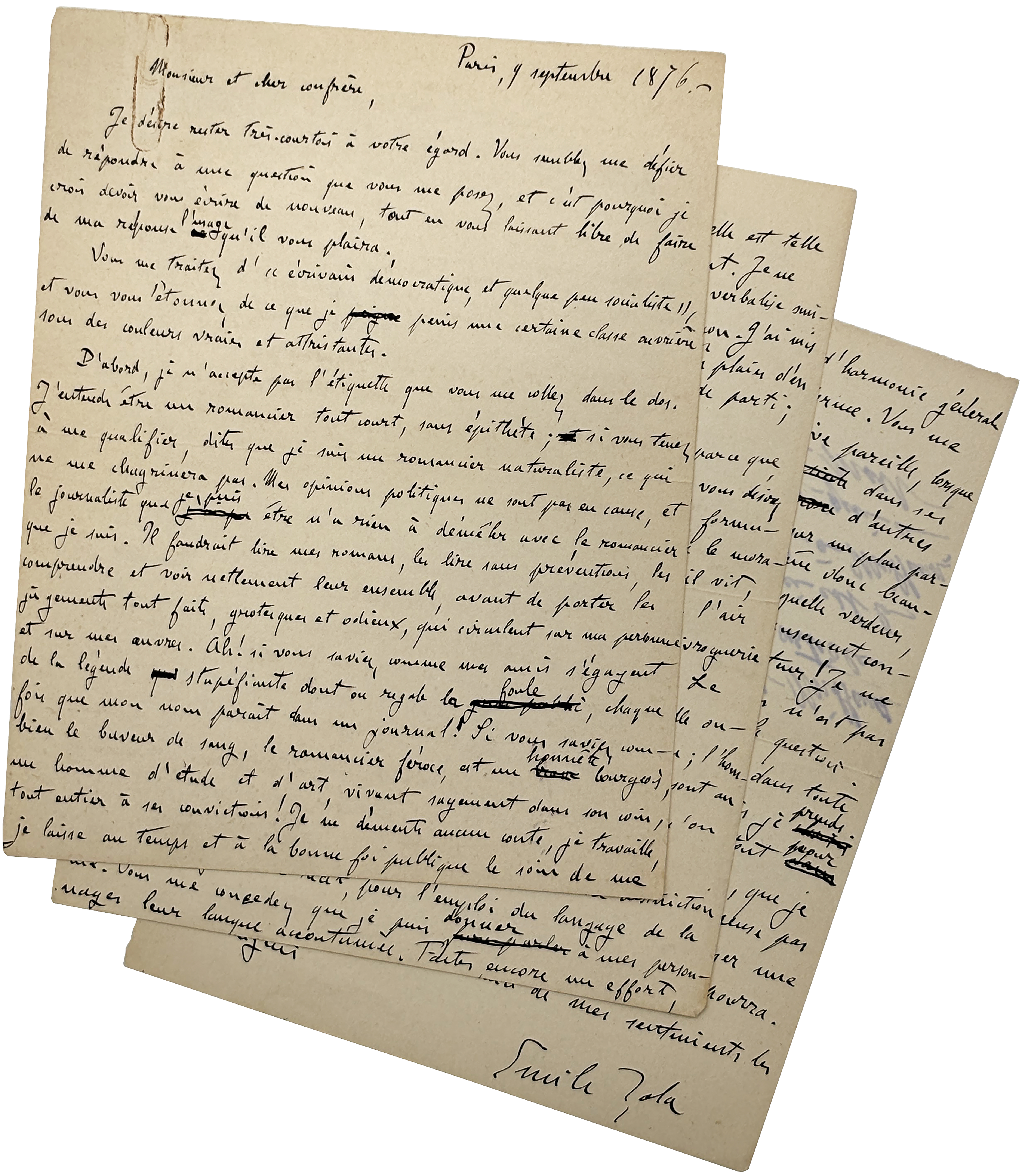
Autograph letter signed [draft] « Emile Zola » à Albert Millaud
Paris, 9th Sept. 1876, 3 p. in-8° on three separate folios, in black ink
Old paperclip mark on the first leaf
Numerous unpublished corrections in Zola’s hand
Autograph annotation by Alexandrine Zola on the verso of the third leaf, in violet ink: “2nd letter addressed to Albert Millaud regarding his second article on L’Assommoir, this is the copy [draft] of the letter sent to Millaud. It was Mr. Ludovic Halévy who purchased the latter [the original letter] upon Millaud’s death.”
Zola defends L’Assommoir and the street language from which the novel draws its substance
« Please Believe […] that from all the human filth passing through my hands, I still choose the cleanest, that for L’Assommoir in particular I have chosen the least dreadful truths »
A crucial letter, undoubtedly one of the most important in his literary correspondence, serving as a programmatic text for the preface to the novel – the only one he ever wrote for a volume of the Rougon-Macquart saga
« Monsieur et cher confrère,
Je désire rester très courtois à votre égard. Vous semblez me défier de répondre à une question que vous me posez, et c’est pourquoi je crois devoir vous écrire de nouveau, tout en vous laissant libre de faire de ma réponse l’usage qu’il vous plaira.
Vous me traitez ‘d’écrivain démocratique, et quelque peu socialiste’, et vous vous étonnez de ce que je peins une certaine classe ouvrière sous des couleurs vraies et attristantes.
D’abord, je n’accepte pas l’étiquette que vous me collez dans le dos. J’entends être un romancier tout court, sans épithète ; si vous tenez à me qualifier, dites que je suis un romancier naturaliste, ce qui ne me chagrinera pas. Mes opinions politiques ne sont pas en cause, et le journaliste que je puis être n’a rien à démêler avec le romancier que je suis. Il faudrait lire mes romans, les lire sans prévention, les comprendre et voir nettement leur ensemble, avant de porter les jugements tout faits, grotesques et odieux, qui circulent sur ma personne et sur mes œuvres. Ah ! si vous saviez comme mes amis s’égayent de la légende stupéfiante dont on régale la foule, chaque fois que mon nom paraît dans un journal ! Si vous saviez combien le buveur de sang, le romancier féroce, est un honnête bourgeois, un homme d’étude et d’art, vivant sagement dans son coin, tout entier à ses convictions ! Je ne déments aucun conte, je travaille, je laisse au temps et à la bonne foi publique le soin de me découvrir enfin sous l’amas des sottises entassées.
Quant à ma peinture d’une certaine classe ouvrière, elle est telle que je l’ai voulue, sans une ombre, sans un adoucissement. Je ne mens jamais dans mes œuvres. Je dis ce que je vois, je verbalise simplement, et je laisse aux moralistes le soin de tirer la leçon. J’ai mis à nu les plaies d’en haut, je n’irai certes pas cacher les plaies d’en bas. Mon œuvre n’est pas une œuvre de propagande et de parti ; elle est une œuvre de vérité.
Je me défends de conclure dans mes romans, parce que selon moi la conclusion échappe à l’artiste. Pourtant, si vous désirez connaître la leçon qui, d’elle-même, sortira de l’Assommoir, je la formulerai à peu près en ces termes : instruisez l’ouvrier pour le moraliser, dégagez-le le plus possible de la misère où il vit, combattez l’entassement et la promiscuité des faubourgs où l’air s’épaissit et s’empeste, surtout empêchez l’ivrognerie qui décime le peuple en tuant l’intelligence et le corps. Le roman est simple, il raconte la déchéance d’une famille ouvrière, gâtée par le milieu, tombant au ruisseau ; l’homme boit, la femme perd courage, la mort et la honte sont au bout. Je ne suis pas un faiseur d’idylles, j’estime qu’on attaque bien le mal qu’avec un fer rouge.
Et permettez-moi encore de répondre à votre distinction entre le dialogue et le récit, pour l’emploi du langage de la rue. Vous me concédez que je puis donner à mes personnages leur langue accoutumée. Faites encore un effort, comprenez que des raisons d’équilibre et d’harmonie générale m’ont seules décidé à adopter un style uniforme. Vous me citez Balzac, qui justement a fait une tentative pareille, lorsqu’il a pastiché l’ancienne langue française dans ses Contes drolatiques. Je pourrais vous indiquer d’autres précédents des livres écrits d’un bout à l’autre sur un plan particulier. D’ailleurs, ce langage de la rue vous gêne donc beaucoup ? Il est un peu gros, sans doute, mais quelle verdeur, quelle force et quel imprévu d’images, quel amusement continu pour un grammairien fureteur ! Je ne comprends pas comment l’écrivain en vous n’est pas chatouillé par le côté purement technique de la question.
Enfin, croyez, monsieur et cher confrère, que dans toute la boue humaine qui me passe par les mains je prends encore la plus propre, que j’ai surtout pour l’Assommoir choisi les vérités les moins effroyables, que je suis un brave homme de romancier qui ne pense pas à mal et dont l’unique ambition est de laisser une œuvre aussi large et aussi vivante qu’il le pourra.
Veuillez agréer l’assurance de mes sentiments les plus distingués.
Emile Zola »
Chronology of an affair that unleashed passions and propelled Zola to the rank of celebrated writers:
Seventh volume of the Rougon-Macquart saga, L’Assommoir appeared, as was customary, in serialized form. It was the radical republican newspaper Le Bien public that published the first installment, on 13 April 1876. Controversy was immediately stirred, as readers took offense at the crudeness of the language Zola employed for his characters. Yves Guyot, the newspaper’s director, had nevertheless expurgated certain passages in the boldest places, to the novelist’s astonishment. In a letter of 24 May to Ludovic Halévy, Zola protests: “They cut all my effects, they mangle my prose by removing sentences and inserting paragraph breaks.” A delay by Zola in delivering his installment (the end of the sixth chapter) served as a pretext for the newspaper to put an end to the serialization. La République des lettres, which brought together the leading lights of the Parnassian poets and also served as a launching pad for burgeoning naturalism, took over the publication. Twenty-six installments followed one another week by week, from Chapter VII onward, until the final pages, published in the issue of 7 January 1877. This second part, published in La République des lettres, did not prevent a fresh uproar, this time of an entirely different magnitude, with several journalists railing furiously against the author and his novel — foremost among them Albert Millaud. The latter opened fire in an article in Le Figaro of 1 September 1876: “[Zola] is currently publishing, in a small review, a novel entitled: L’Assommoir, which strikes us as bound to be the very ruin [assommoir] of his budding talent. This is not realism, it is filth; this is not crudeness, it is pornography…” Zola replied for the first time in an open letter, dated 3 September, published in Le Figaro of 7 September, arguing that “no one could judge the moral scope of a work still in the course of publication, and that, moreover, no novel had ever had more strictly honest intentions.” Millaud drove the point home in a second article that very same day (7 September), just as violently hostile as the first. He again raised the question: “How is it, then, that M. Zola, a democratic and somewhat socialist writer, chose precisely as the heroes of his novel people of the working class, whose customs he claims to depict — workers, proletarians? A fine lot they are! One could not draft a better indictment against the purest representatives of universal suffrage.” Millaud thus drew attention to an issue that would put Zola at odds with certain left-wing critics. Among them was Arthur Ranc, who, in La République française, reproached him for his “Neronian contempt for the people,” as well as Victor Hugo and the team at Le Rappel, who condemned the novel. According to Alfred Barbou, Hugo declared: “There are certain pictures that ought not to be painted. Let no one object to me that all this is true, that this is how things happen. I know it – I have gone down into all this misery myself – but I do not want it put on display; you have no right to do so, you have no right to bare wretchedness in public” (Victor Hugo et son siècle, Alfred Barbou, 1889, p. 183). From Paris, Zola sent Millaud a reply markedly more structured than the first. In vain – Le Figaro would not grant the writer this right of reply. In his collection “L’Assommoir et les journaux” (Lapp, 1964, p. 92), Halévy explains that “Villemessant [the newspaper’s owner] felt that two articles on L’Assommoir and one letter from Zola were enough. He did not authorize the insertion of Zola’s new letter.”
Zola’s defense: The novelist’s letter can be subdivided into two distinct movements. Zola first protests vehemently against the ad hominem attacks, while defending the very concept of the naturalist novel, of which he is the leading figure. Why should the novelist not be permitted to show the true face of the common people, after having “laid bare the wounds of those above”? That is to say, the petty bourgeoisie, mean-spirited and obsessed with profit, scheming and political. Zola is here of course alluding to the unscrupulous financiers of La Curée. For him, the base of the pyramid has its own faults and vices. He depicts reality to the point of rendering its very language. He thus makes it a point of honor to defend the language of the working-class districts: “My work is not a work of propaganda and party; it is a work of truth.” This is precisely what Millaud holds against Zola in his second article of 7 September. The journalist from Le Figaro takes offense that Zola should adopt such coarse language as his own descriptive register. This reproach was often leveled at the novelist. Flaubert, in a letter to Turgenev of 28 October 1876, wonders: “That one should make ruffians speak like ruffians, very well, but why should the author adopt their language himself? And he believes this to be powerful, without realizing that through this stylistic trick he weakens the very effect he means to produce.”
Zola counters Millaud’s argument by invoking Balzac’s Contes drolatiques, a writer for whom he never concealed his admiration. Balzac wrote his Contes in the style and spelling of the sixteenth century. Although Millaud does not explicitly draw a comparison between Zola’s attempt and Balzac’s, Zola explains, not without reason, that precedents for his novel exist and have entered into posterity.
A programmatic piece of writing for his preface to the novel, the only one Zola ever wrote for his Rougon-Macquart saga:
For the matrix of his preface, Zola draws on the present letter with only slight twists in the phrasing, when not word for word, as attested by the following extract, which has remained famous: “I wanted to depict the fatal downfall of a working-class family, in the pestilential environment of our slums. At the end of drunkenness and idleness lie the loosening of family bonds, the squalor of promiscuity, the gradual forgetting of honest feelings, and then, as the final outcome, shame and death. It is morality in action, quite simply. L’Assommoir is without doubt the most chaste of my books.”
Provenance:
Émile Zola, then Alexandrine Zola after the writer’s passin ; Le blond-Zola’s estate ; Drouot, 11 Dec. 1991, n°268 ; Drouot, 3 July 1992, n°265 ; private coll.
Bibliography:
Correspondance – [t. II], Les Lettres et les arts, éd. Fasquelle, 1908, p. 113-115 ; Correspondance, t. II, éd. C. Becker, Presses de l’Université de Montréal et CNRS, 1980, n° 291, p. 488-491 ; Les Rougon-Macquart, vol. II, éd. Armand Lanoux et Henri Mitterand, Pléiade, p. 1038-1039 ; Œuvres complètes, t. 7, Nouveau Monde éditions, p. 735-735 ; Études françaises, vol. 55, num. 1, Les Presses de l’Université de Montréal, 2019, p. 51–66
Join our mailing list and be the first to hear our latest news and biggest announcements.
By signing up you agree to our privacy policy. You can unsubscribe at any time.