Keep ahead of the pack
Join our mailing list and be the first to hear our latest news and biggest announcements.
By signing up you agree to our privacy policy. You can unsubscribe at any time.
Autograph letter signed « du Paty de Clam » [to Georges Bonnamour]
Paris, 28 March 1898, 3 p. in-12° on mourning paper
« The wretched proceedings of the Zola affair… »
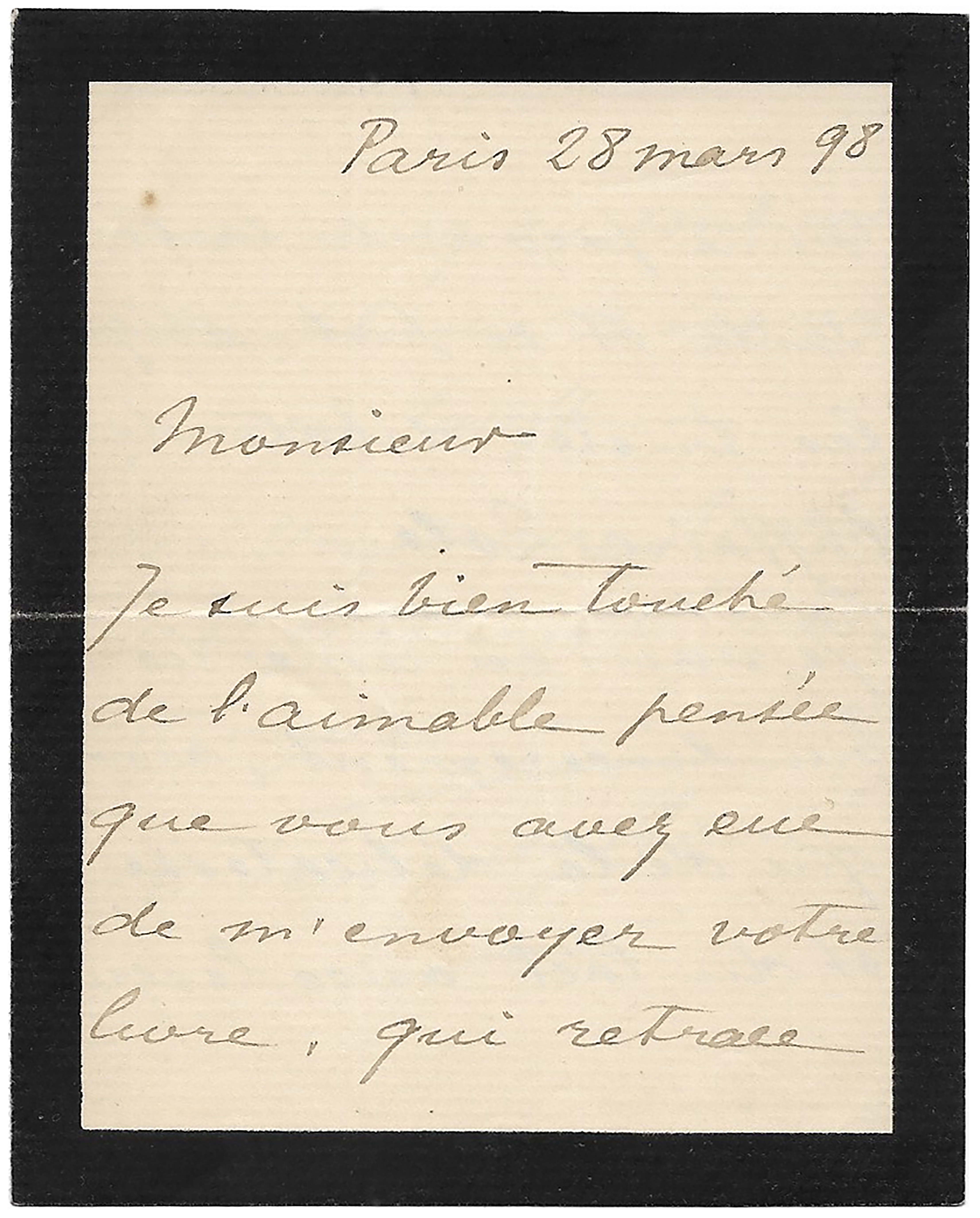
Autograph letter signed « du Paty de Clam » [to Georges Bonnamour]
Paris, 28 March 1898, 3 p. in-12° on mourning paper
Watermark: « Angoulème » topped by a crown symbol
A rare letter from du Paty de Clam, thanking Bonnamour for his book on the Zola trial of February 1898
« Monsieur
Je suis bien touché de l’aimable pensée que vous avez eue de m’envoyer votre livre, qui retrace d’une façon si saisissante et si patriotique les tristes débats de l’affaire Zola.
Je vous en remercie bien sincèrement, ainsi que de la délicatesse et du tact avec lesquels vous avez su conduire votre plume à travers ce procès touffu.
Veuillez croire, Monsieur, à mes sentiments très distingués
du Paty de Clam »
Formerly an admirer of Zola, Bonnamour swung into virulent anti-Dreyfusism from the moment of Dreyfus’s arrest, calling for him to “be shot and let that be an end of it” (“Vaines colères”). A journalist for L’Écho de Paris, he published his Impressions d’audience of the Zola trial in its pages. These were collected in volume form in March 1898 (Le Procès Zola. Impressions d’audience, Paris, Pierret). This letter from du Paty de Clam thus comes in response to the work that Georges Bonnamour had sent to the commandant. One recalls the terms in which du Paty de Clam was described by Zola’s unsparing pen, in his open letter to President Félix Faure of 13 January 1898 in L’Aurore: “the diabolical craftsman of the judicial error, unwittingly so, I am willing to believe […] for three years now, through the most preposterous and culpable machinations.” Zola was prosecuted by the army General Staff following the letter’s publication, then sentenced in February to one year’s imprisonment and a 3,000-franc fine, the maximum penalty incurred, upheld on appeal the following July.
Unpublished letter
Join our mailing list and be the first to hear our latest news and biggest announcements.
By signing up you agree to our privacy policy. You can unsubscribe at any time.