Keep ahead of the pack
Join our mailing list and be the first to hear our latest news and biggest announcements.
By signing up you agree to our privacy policy. You can unsubscribe at any time.
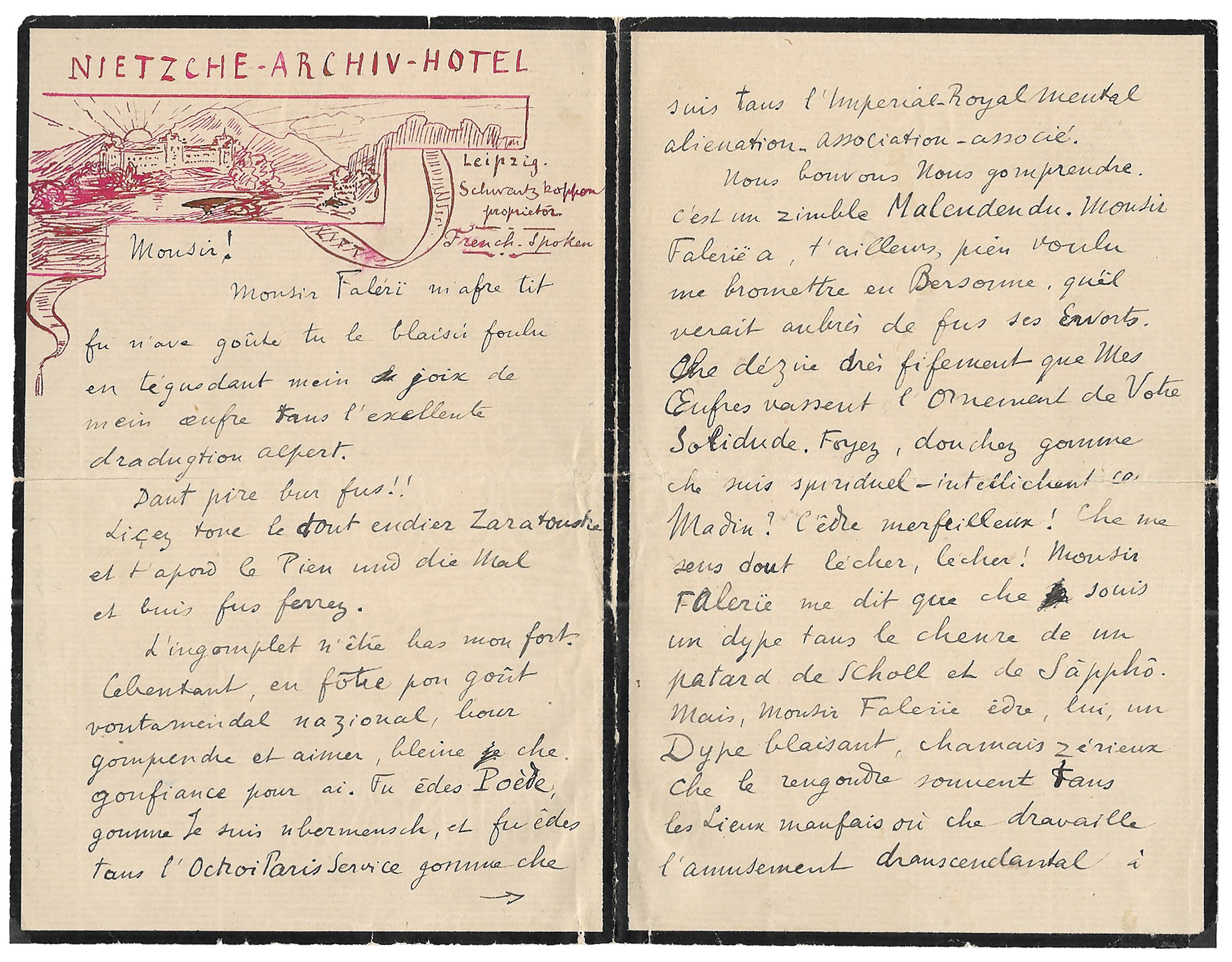
Autograph letter signed twice, « F. Nietzsche » and « Dr. F.N. » to André Fontainas
Leipzig, n.d. [May 1899], 4 p. in-8°, mourning stationary, in black and red ink
« L’ingomplet n’être bas mon fort »
Autograph letter signed twice, « F. Nietzsche » and « Dr. F.N. » to André Fontainas
Leipzig, n.d. [May 1899], 4 p. in-8°, mourning stationary, in black and red ink
Very light ink smudges, mourning border rubbed in places, central fold and small tear restored
Famous letter by Valéry, full of allusions and wit, parodying Nietzsche in phonetic French
« Monsir Falerïe êdre, lui, un Dype blaisant, chamais zérieux. Che le rengondre souvent tant les Lieux maufais où che dravaille l’amusement dranscendantal à 20 marks le folume »
Formerly in the colonel Sickles’s collection
At the head of the letter, Valéry finely executed a first drawing, spanning the full width of the page, depicting the ‘NIETZSCHE-ARCHIV-HOTEL’ at the foot of the mountains (a reference to the Nietzsche-Archiv, founded in 1894 by Elisabeth Förster-Nietzsche in Naumburg, then transferred to Weimar in 1896. In 1897 she moved into the villa ‘Silberblick’ in order to receive and care for her brother. Friedrich Nietzsche died in this house on 25 August 1900). Is the rising sun, positioned just above the mountain range, that of Nietzsche’s Morgenröte (Dawn)? Immediately to the right of the drawing appears the name Von Schwartzkoppen, the military attaché implicated in the Dreyfus Affair, then at the very center of public debate.
« Monsir !
Monsir Falérï m’a afre tit fu n’ave goûté tu le blaisir foulu en tégusdant mein de joix de mein œufre tans l’exellente dradugtion Alpert.
Dant pire bur fus !!
Liçez tonc le dout endier Zarathoustra et t’apord le Pien und die Mal et buis fus ferrez.
L’ingomplet n’être bas mon fort. Cebendant, en fotre pon goût vondamendal nazional, bour gombrendre et aimer, bleine che confiance pour ai. Fous êdes Poède gomme Je suis ubermensch, et fu êdes tans l’Octroi Paris Service gomme che suis tan l’Imperial-Royal-Mental-alienation – assiciation – associé.
Nous bouvons nous gomprende. C’est un zimble Malentendu. Monsir Falerïe a, t’ailleurs, pien voulu me bromettre en Bersonne qu’il verait aubrès de fus ses Ervorts. Che dézire drès fifement que Mes Œufres vassent l’Ornement de votre Solidude. Foyez, douchez gomme che suis spiriduel – intellichent ce Madin ? C’êdre merfeilleux ! Che me sens dont lécher, lécher ! Monsir Falérie me dit que che souis un dype tant le chenre de un patard de Scholl et de Sâpphô. Mais, Monsir Falerïe êdre, lui, un Dype blaisant, chamais zérieux. Che le rengondre souvent tant les Lieux maufais où che dravaille l’amusement dranscendantal à 20 marks le folume.
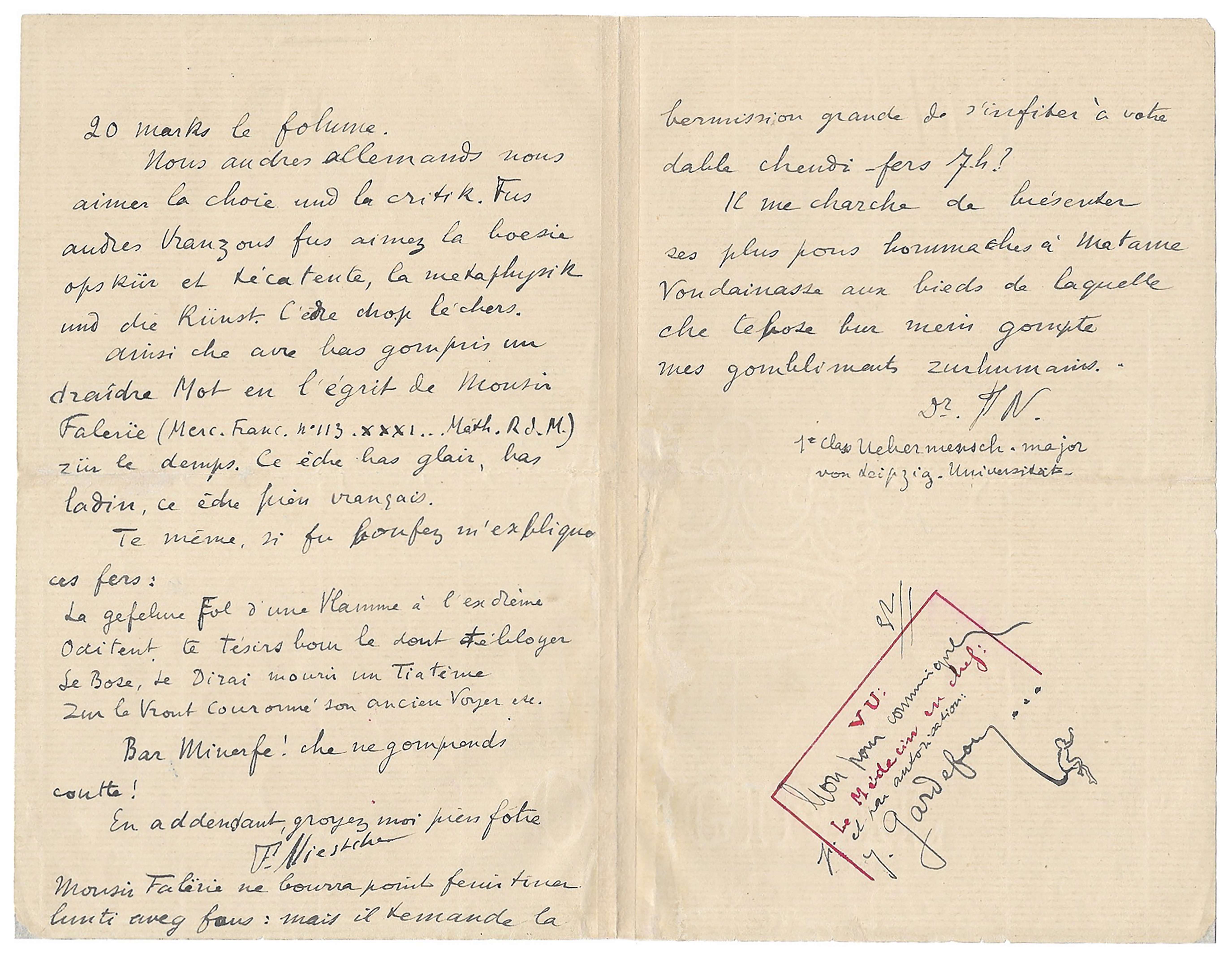
Nous audres allemands nous aimer la choie und la critik. Fus audres Vranzous fus aimez la boesie opskür et técatente, la metaphysik une die Künst. C’êdre trop léchers.
Ainsi che avre bas gompris un draidre Mot en l’égrit de Monsir Falerïe (Merc. Franc. N°113 – XXXI – Méth. R.d.M.) zür le temps. Ce êdre bas glair, bas ladin, ce êdre pien vrançais.
Te même, si fu boufez m’expliquer ces fers :
Le gefelure Fol d’une Vlamme a l’exdrême
Occitent te tésirs bour le dout téployer
Se Bose, je Dirai mourir un tiatème
Zur le Vront couronné son ancien Voyer etc.
Bar Minerfe ! Che ne gomprends coutte !
En addendant, groyer mois pien fôtre.
F. Niestche [sic]
Monsir Falërie ne bourra point fenir tiner lunti aveg fous : mais il temande la bermission grande de s’infiter à votre dable cheudi – fers 7h ?
Il me charche de brésenter ses plus pons hommaches à Matame Vondainasse aux bieds de laquelle che tepose bur mein gompte mes gombliments zurhumains.
Dr. F.N.
1er class Uebermensch – major von Leipzig-Universität »
At the end of the letter, Valéry executes a second drawing, with the same degree of precision, this time depicting a clinic stamp. The head physician’s signature ends with a small figure shown in profile:
« VU :
bon pour communiquer
p. le Médecin en chef
et par autorisation :
J. Gardefou »
This letter follows the publication of the Pages choisies of Nietzsche (printing completed on 14 April 1899), translated by Henri Albert (1869-1921). It can thus be dated with certainty to May or June 1899, shortly after the publication of the article on « Le temps » that appeared in May 1899 in the « Revue du mois » of the Mercure de France, under the rubric « Méthodes ». Beyond its schoolboyish character, the letter illustrates the enthusiasm aroused in Valéry by his discovery of Nietzsche through the translations published at the Mercure de France by his friend Henri Albert. A germanist writer and translator of Nietzsche (Ainsi parlait Zarathoustra, Par-delà le bien et le mal, Pages choisies, etc.), Henri Albert, here spelled « Alpert » by his friend Valéry, would moreover go on to play a major role in the reception of the German philosopher in France.
Valéry made the acquaintance of his correspondent André Fontainas (1865-1948), a journalist at the Mercure de France, during his very first trip to Paris, in the early 1890s. The two men were then members of Mallarmé’s circle, which held its gatherings on the rue de Rome. Fontainas’s name, here deliberately mangled by Valéry, becomes an allusion to the German « von », spelled « Vondainasse ». Without knowing the language across the Rhine, Valéry thus strives to render the Teutonic accent pushed to the point of the grotesque, mocks the fondness for German titles (signing « Dr. F.N. ») and employs a word order wholly foreign to the French language: « tégusdant » for « dégustant », « vondamendal » for « fontamental », « Vranzous » for « français », etc. This mockery inevitably recalls Balzac’s mockery of his character the baron de Nucingen in Splendeurs et misères des courtisanes.
Beyond the amusement, these lines capture, on the one hand, the threatening shadow of Germany that Valéry had lucidly depicted in « La Conquête allemande », published in 1897 in W. E. Henley’s New Review, and on the other, the literary atmosphere at the turn of the two centuries. The attacks on Mallarmé « l’obscur », along with the pride and disdain with which the young poets received them, are illustrated by the quoted stanza from the latter’s sonnet « La Chevelure folle d’une flamme à l’extrême » (Poésies, 1887): « La chevelure vol d’une flamme à l’extrême / Occident de désirs pour la tout déployer / Se pose (je dirais mourir un diadème) / Vers le front couronné son ancien foyer » here becomes « Le gefelure Fol d’une Vlamme a l’exdrême / Occitent te tésirs bour le dout téployer / Se Bose, je Dirai mourir un tiatème / Zur le Vront couronné son ancien Voyer ».
« L’ingomplet n’être bas mon fort » is an ironic reference to the celebrated opening line of Monsieur Teste (1896): « La sottise n’est pas mon fort », a line that Valéry, far from imagining he would one day become a member of the Académie, took up a second time in response to a survey by the Mercure: « L’Académie n’est pas mon fort » (Mercure de France, XXI, 1897).
This letter belongs to a period when Valéry was almost entirely detached from any literary activity. It will be recalled that the writer had taken this step back following his « Crise de Gênes », on the night of 4 to 5 October 1892. From then on Valéry was resolved to « répudier les idoles » of literature, of love, and of imprecision. As Michel Jarrety reports in Sur Nietzsche (éd. La Coopérative, 2017, p. 33), this last « donnait le sentiment d’une véritable aliénation, en même temps que, désespéré de n’atteindre à la hauteur de Rimbaud ni de Mallarmé, il décidait de suspendre le travail des vers : il lui fallait devenir un autre, un homme nouveau qui fût totalement maître de soi-même comme de ses pouvoirs ».
Provenance:
Littérature du XXe siècle [Bibliothèque du colonel Daniel Sickles], Drouot, 15 juin 1983, n° 532 ; private collection
Bibliography:
Poèmes macaroniques et autres textes inédits, À cent lieues du quai Conti et de la rue de Villejust, [1949], p. 43-45 ; Nietzsche-Valéry : A Letter, Herbert Steiner, Harvard Library Bulletin, vol. IV, 1950, p. 268-270 (with fac-similé)
Join our mailing list and be the first to hear our latest news and biggest announcements.
By signing up you agree to our privacy policy. You can unsubscribe at any time.