Thus, the stanza:
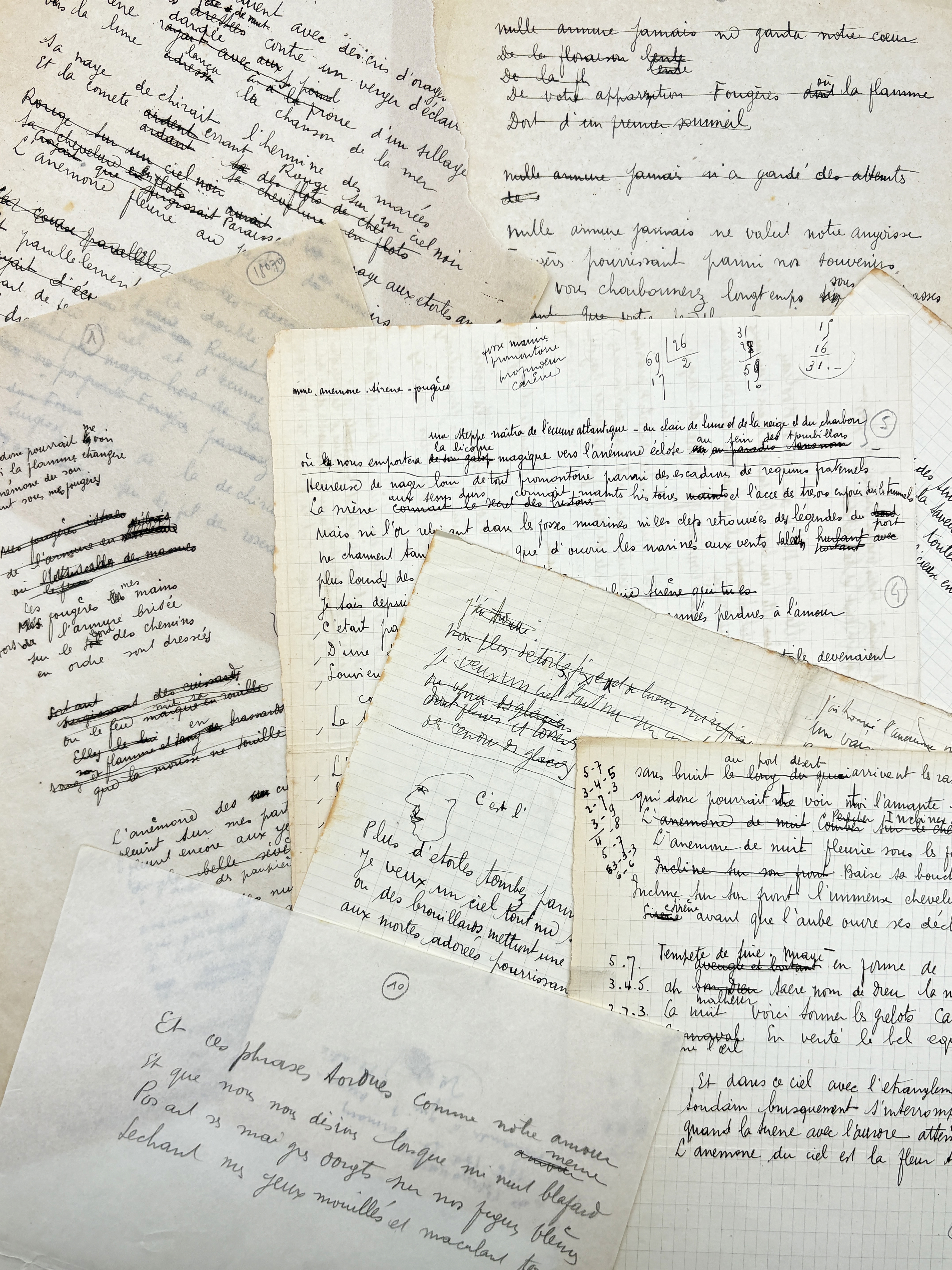
« Nulle armure jamais ne garda notre cœur
de la floraison lente
De la fl
De votre apparition fougères dont où [surcharge] la flamme
Dort d’un premier sommeil »
Becomes:
« Nulle armure jamais ne valut votre angoisse
Fougères pourrissant parmi nos souvenirs
Mais vous charbonnerez longtemps sous nos cuirasses
Avant la flamme où se cabrant pour mieux hennir »
Four leaves of graph paper follow, one of which has been filled entirely on both sides. Another leaf shows only an isolated quatrain, cancelled in places. Across these four leaves, one notices both a variable intensity of ink and a markedly inconsistent hand, reflecting the poet’s ongoing searching. It should also be noted that while the order of the stanzas remains broadly coherent across the first three leaves, the composition of the poem on the graph-paper leaves does not always follow the chronological order of the final state of the poem, once again attesting to a process of writing spread out over time.
A final leaf, this time written in pencil, gives four lines with, once again, significant variants compared with the final text:
« Et ces phrases tordues comme notre amour même
Et que je murmurais [« Et que nous nous disions » dans le manuscrit] lorsque minuit blafard
Posait ses maigres doigts sur des visages [« sur nos figures »] blêmes
Séchant les yeux mouillés et barbouillant les fards [« mes yeux mouillés et maculant ton fard »] »
Sirène-anémone appeared without prior publication in the collection Corps et biens, on 5 May 1930, from Gallimard. Bringing together the greater part of Desnos’s work from 1919 to 1929, as a « journal en marge de sa vie », this collection constitutes a first reckoning for the poet, who had never before published a volume. The present poem stands as the closing of a sequence begun with À la mystérieuse (1926) and Les Ténèbres (1927), whose pervasive marine and forest imagery contrasts with the poet’s more amorous inspirations. Behind this title with its double first name, a transition seems to take shape. In Corps et biens de Robert Desnos, Marie-Paule Berranger highlights the inexorable decline of Yvonne George, the star who died prematurely at the age of thirty-three, ravaged by tuberculosis and opium, giving way to Youki, the enduring figure of the mermaid: « À la mystérieuse, en 1926, et Les Ténèbres en 1927, puis Sirène-anémone constituent un journal de la vie amoureuse, où se devine l’amour sans espoir d’une Eurydice qui se refuse obstinément à quitter ses enfers familiers et y poursuit obstinément sa propre destruction. » (ibid., Gallimard, coll. « Foliothèque », 2010, p. 70.) Is this heartrending line not the perfect illustration of an Yvonne consumed by her own excesses: « La plus belle et la plus fatale la comète [« l’étoile » dans le présent manuscrit] le destin de larmes et / d’éternels égarements ». Sirène-anémone thus traces the amorous bridge between two women, two years before Siramour would rediscover a new equilibrium in the figure of Youki.
Written a year before the volume’s publication, Sirène-anémone is all the more significant in that it marks a renewal in Desnos’s work. Whereas most of the poems spanning the period 1919-1929 follow the aesthetic of the ode, Sirène-anémone, alongside De silex et de feu, marks a diversification, playing with hexasyllabic quatrains while blending alexandrines and free verse within a single flow, reinforcing its fluidity. Desnos here breaks with certain forms of surrealist wonder. The sensibility expressed in the poem, which can be extended to other pieces in the collection such as L’Aveugle or Mouchoir au Nadir, would be variously received by his contemporaries: as early as the first issue of Le Surréalisme au service de la révolution (1930), Aragon condemned « l’absurde délectation qui s’étale aux quinquets de l’alexandrin ». Breton, for his part, reacting to the pamphlet Un cadavre directed against him, denounced « une grande complaisance avec soi-même », before praising, in his Entretiens (1952), « le goût romantique du naufrage » embodied by Corps et biens.
Only one other manuscript of this poem is recorded, in fair-copy form, now held at the Bibliothèque littéraire Jacques Doucet (call number 7119-24).