Keep ahead of the pack
Join our mailing list and be the first to hear our latest news and biggest announcements.
By signing up you agree to our privacy policy. You can unsubscribe at any time.
Autograph manuscript signed at the head
N.p. [United Kingdom and France, c. 1802-1814], 878 pp. folio
« Since the martyrdom of Louis XVI, I have not ceased to maintain a regular correspondence with her [Marie-Antoinette]. »
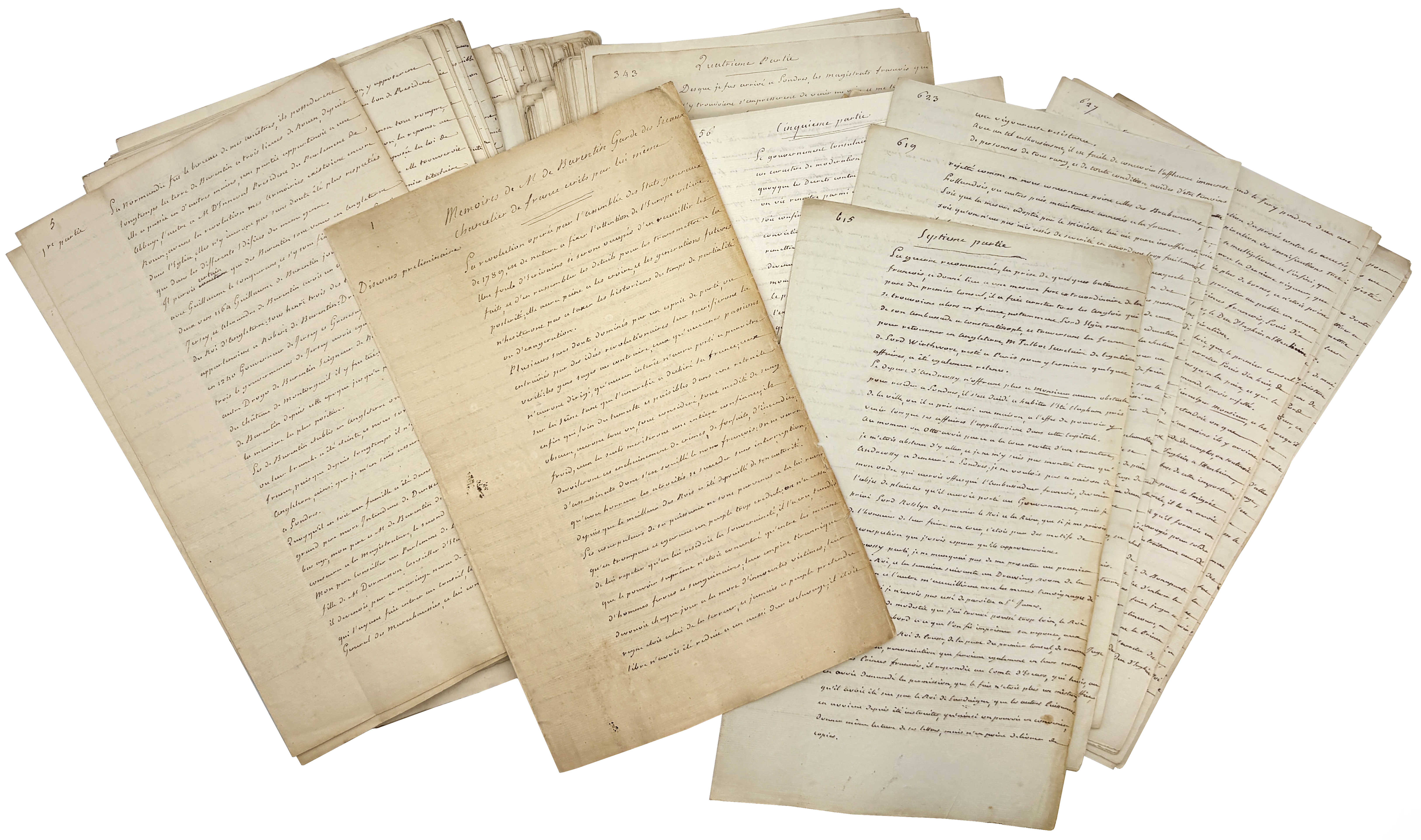
Autograph manuscript signed (at the head): “Mémoires de M. de Barentin Garde des Sceaux Chancelier de France écrits par lui-même” (“Memoirs of M. de Barentin, Keeper of the Seals, Chancellor of France, written by himself”)
N.p. [United Kingdom and France, c. 1802-1814], 878 pp. folio, on double laid leaves, in chemises with title
Foliation on each page in Barentin’s hand; a few leaves frayed or sunned in places, without serious damage or loss of text
Barentin’s Memoirs:
Monumental unpublished corpus of 878 pages by the last Keeper of the Seals under Louis XVI, from the end of the Ancien Régime to the First Restoration
Councillor at the Parlement de Paris from 1758, Barentin became advocate general there in 1764; he succeeded Malesherbes as president of the Cour des Aides in 1775, then was called to the Assembly of Notables in 1787. Succeeding Lamoignon, he became Keeper of the Seals on 14 September 1788, then was made Chancellor and Superintendent of Finances of the Orders of the King in May 1789. He co-drafted with Necker (whom he had firmly opposed) the general regulations for the convocation of the Estates General, which he opened with a speech on the King’s “intentions,” while urging the deputies to reject “dangerous innovations” that the enemies of the public good would seek to confuse with the beneficial and necessary changes that must bring about regeneration. Booed and challenged by the deputies, and wrongly judged to be chiefly responsible for the dismissal of Jacques Necker a few days earlier, he resigned from his duties on 16 July 1789. Barentin emigrated in 1790 to Piedmont and the Netherlands, then returned to France to take part in the episode of the flight to Varennes, during which he waited for Louis XVI at Montmédy. But the king got no further than Varennes.
Barentin eventually made his way to England, where he founded a law school for the sons of émigrés. In his absence, his Picardy estates at Hardivillers, where he had just rebuilt the château in the 1780s, and Maisoncelle-Tuilerie, were sold as national property in September 1794 and broken up. Louis XVIII, to whom he had been an adviser during the emigration, named him Honorary Chancellor, and made his son-in-law Dambray Keeper of the Seals in May 1814.
These Memoirs were begun around 1800 (as indicated by the watermark on the first pages) and written regularly (the Tenth Part is explicitly dated 1813) until 1814, after Dambray’s appointment as Keeper of the Seals.
Set down in a fine, regular hand filling large folio leaves, they consist of a Preliminary Discourse and eleven parts, varying in nature: the First Part is retrospective, the Second is a justificatory memoir, and the Fifth is a reflection on emigration. From the Seventh Part onward, they read as a continuous chronicle of events. We can give only a brief overview:
An immersive account of the last hours of the Ancien Régime, by one of its principal actors
The Preliminary Discourse (pp. 1-4) is a lament over the Revolution, its atrocities and its aberrations, the regicide and the enslavement of a “supposedly free people.” Barentin hopes that this cruel example will serve as a lesson to other nations. A press too free, pernicious books, Court etiquette neglected by the Princes, public finances laid bare by “the imprudent vanity of a minister” [a direct allusion to Necker], the critical spirit spread by the provincial assemblies, and the King’s weakness all led to “that fatal Revolution, which the men of letters and the Philosophers had long been preparing, and whose every thread they had imperceptibly arranged.”
The First Part (pp. 5-61) is a detailed summary of his Norman origins and his family, going back to the 12th century. […] He then recounts the accession of Louis XVI, who brought back Maurepas and, on the latter’s advice, the Parlement de Paris and the Cour des Aides. Malesherbes then wrote the remonstrances of that Court: “This immensely extensive work bore the stamp of the genius and the manly touch of its author; it contained bold things, perhaps too closely akin to the opinions whose seed later developed, and whose consequences have become so disastrous. […] I was deeply grieved by their conclusion, the demand for the Estates General.” But Barentin could not foresee that this would ultimately lead to “the suppression of the different orders of the State, the destruction of the monarchy, and the trial of the monarch, as illegal as it was iniquitous” (p. 26). […] He speaks, not without vanity, of the changes he made to the Cour des Aides, then gives an account of the Assembly of Notables (1787), which he followed without taking part: “I saw the storm form and gather over the head of M. de Calonne” (p. 43). He mentions the lit de justice of 1788, and finally tells in detail how the King chose him for the dignity of Keeper of the Seals.
The Second Part (pp. 62-251), by far the longest, deals with Barentin’s ministry and the Estates General. The author stresses the active role of Queen Marie-Antoinette, her assiduous attendance at the meetings of the Committees, and her prejudices against the Parlements, which reinforced those of the King. Barentin relates the Queen’s efforts with Louis XVI to obtain the repeal of the laws of 8 May concerning criminal procedure (the “question préparatoire,” the sellette). But the publicists and pamphleteers began their pernicious work: a constitution was demanded, and royal authority was contested. The Estates General were to open in this difficult context. Barentin discusses the ministers, the King, his own preference for a meeting place far from the capital, the appointment of the deputies, and the divisions that were inexorably worsening. He mentions the insubordination of Brittany and the calamity of the high price of grain. He himself was a victim of the libellists and noticed the disaffection of the comte d’Artois [the future Charles X], the prince de Condé, and Queen Marie-Antoinette: “soon the whole Court was imbued with my supposed nullity: the higher clergy and the nobility, greatly incensed by the double representation [of the Third Estate], and unaware of the tenacity with which I had opposed it, held it against me that I had not prevented it, and Versailles rang with the rumor that I was about to be asked for my resignation. […] The day I was called to the Seals, I foresaw that I would have to struggle against the enthusiasm that M. Necker inspires, against the ascendancy he enjoys, against the party he has formed within the ministry” (p. 124). Barentin writes that he decided to write to the King but first showed his letter to the Queen, to Monsieur and to the comte d’Artois. In a private audience, he begged the Queen to persuade the King to enlarge his Council with “well-informed and honest men, […] imbued with the ancient maxims”… He stresses that he always insisted, with Queen Marie-Antoinette and the Princes, on the need to keep Necker, but he laments the King’s slowness in enabling his Council to resist “the criminal designs, or the blind credulity, of his minister of finance” (p. 150). He then follows closely the events of June 1789, his struggle against Necker’s ideas, the stormy sessions of the assembly, Necker’s fall and finally his own resignation on 16 July: “as soon as I judged my presence harmful to the interests of the King.”
The Third Part (pp. 252-342) begins with his departure from Versailles on the very evening of his resignation. Barentin goes to the home of the Présidente de Montreuil, his relative, at the château de Verrières, where his wife joins him the next day and tells him of the departure of the comte d’Artois and all the princes of the blood except the duc d’Orléans and his sons. Rumor accuses him of having taken the Queen away with him, and his relatives are threatened. A letter from Coquebert, secretary of the Seals, convinces him to leave. There follow interesting details about the circumstances of his flight, accompanied by the chevalier de Blois: false passports, alarming news, his concern to warn the King that he was leaving the kingdom, insolent remarks overheard along the way, a nighttime incident with the National Guard in the forest of Fontainebleau, and arrest by the mob near Arcis-sur-Aube. Arriving in Liège, he pays court to the ducs d’Angoulême and de Berry, then to the Prince-Bishop. He retraces his travels through Holland, Germany and Switzerland, then Piedmont, where he meets the comte d’Artois and his family, the princes de Condé and the duc d’Enghien in Turin. In Milan, he frequents Emperor Leopold, who sends him to Montmédy to join the King, but the arrest of the royal family at Varennes intervenes. There follow echoes of events in France, of the intrigues of the Powers and the émigrés, and of the first victories of the Armies of the Republic. It is in Holland, at The Hague, in January 1793, that the news of Louis XVI’s martyrdom reaches him. He then recalls the Regency Council desired by Monsieur, and the Jansenist émigrés. He then sets out his reasons for leaving for England.
The Fourth Part (pp. 343-455) describes his reception in London by the exiled French magistrates […]. Echoes of the disastrous Quiberon expedition, the unsuccessful expedition of the comte d’Artois to the Île d’Yeu, the assassination attempt on the “King” [Louis XVIII] in July 1796 at Dillingen after his departure from Condé’s army, and the marriage of Madame Royale to her cousin the duc d’Angoulême. A nuanced psychological portrait of the duc de La Vauguyon, a diplomat, son of the governor of Louis XVIII’s father, and invested with the latter’s confidence. Barentin’s opening of a law course for the sons of émigrés.
The Fifth Part (pp. 456-537) opens with an interesting commentary on the amnesty law for émigrés (1802): some exiles were seen to hope “that Bonaparte intended to restore Louis XVIII to the throne; the frenzy to return became as strong as the eagerness to leave had been at the time of the emigration. This course was neither wise nor fitting.” […] Vigorous commentary on the successive constitutions since the Revolution, and equally sharp criticism of the clergy who accommodate themselves to them: “I like to believe that the greater number of returned émigrés has remained attached to the King.” Long details on the royalist agent Dutheil, his missions for the Princes, the suspicions that weighed on him, and his participation in the “infernal machine” plot. Reflections on the policy of Emperor Paul I of Russia and other European sovereigns. Barentin explains at length his role as adviser to Louis XVIII, whose various movements across Europe he follows and whose political conduct he sets out.
The Sixth Part (pp. 538-614) is largely devoted to Church affairs. The idea of convening a national episcopal council in Paris was set aside by Bonaparte, who saw its dangers: by reawakening the faith of the French, he would have brought to light the spoliations and usurpations arising from the Revolution. […]
The Seventh Part (pp. 615-670) is devoted to the daily chronicle of the émigrés in England. Proclamation of George III ordering foreigners who had come from countries at war with England since 1 October 1801 (Peace of Amiens) to leave before 15 September 1803, unless they obtained permission to stay, “a measure wisely adopted to guard against the spread of revolutionary principles”: Barentin and three commissioners sorted through the applications. Formation of a corps of English volunteers for the defense of the country. Monsieur decided that in case of invasion, he would place himself at the head of his troops, in the train of the English sovereign. Marriage of Mlle de Bourbon, natural daughter of the duc de Bourbon, at the prince de Condé’s residence at Wanstead (23 November 1803). Publication of a work by 38 émigré bishops, De canonicæ expostulationes, addressed to the Pope (January 1804). Signs of “Bonaparte’s inveterate rage against the Bourbons”: his attempt to have Louis XVIII arrested, the abduction and murder of the duc d’Enghien, and the propaganda after the Pichegru and Georges affair. Fears for the King’s safety in Warsaw (July 1804): attempt to poison the King and his family. Declaration of Louis XVIII to his people, banned from publication in England (January 1805).
The Eighth Part (pp. 671-747) concerns the manifesto of the King of Prussia from his headquarters at Erfurt (9 November 1806). Auerstädt, Jena, Friedland… Peace of Tilsit: “what a humiliation for the Russians and the Prussians! what a danger that the principles professed by the French may be inoculated among the foreign troops, and that they may learn to revolt against their sovereigns, to further the invasion plans of the vile Corsican.” Worries about Louis XVIII’s safety at Mittau. Considerations on English politics and diplomacy, and the invitation to Louis XVIII to confine himself to Edinburgh. […]
The Ninth Part (pp. 748-802) begins with the Austrian campaign (1809): Vienna, Aspern (Essling). In Spain: Talavera. English expedition to the Low Countries; the captivity of PIE VII; […] Marriage of the duc d’Orléans [Louis-Philippe] to the princess of Naples. Scandal of the dissolution of Napoleon and Josephine’s marriage; choice of Archduchess Marie-Louise of Austria, an “unfortunate victim,” as “concubine.” Wish of the duc d’Angoulême to join the English flag in order to fight. Barentin’s own situation: “Until the time of the Queen’s death, it had never occurred to me to ask the King to explain the nature of my rights to the chancellorship of France; I had no doubt of them, it was established that the death of Chancellor Maupeou had invested me with that dignity, by virtue of the survivorship stated in my letters patent, when the office of Keeper of the Seals was created in my favor, a survivorship that my surrender of the Seals in July 1789 could not have extinguished […] In fact His Majesty always regarded me as chancellor; it could only be in that capacity that I was honored with his confidence; since the martyrdom of Louis XVI, I have not ceased to maintain a regular correspondence with her [Marie-Antoinette]” (p. 780)… Bonaparte’s “concubine” gives birth to a son, baptized privately as King of Rome.
In the Tenth Part (pp. 803-839), Barentin is charged by Louis XVIII in 1812, in anticipation of the monarchy’s return to France, with “gathering the materials suited to the reconstruction, or regeneration, of this great edifice.” The Napoleonic Code, though the work of the Usurper, contains good and useful provisions; Barentin enlists MM. de La Bourdonnaye, du Bourblanc, d’Outremont and Malcors to carry out this work of synthesis, and examines the various proposals made to Louis XVIII. He then discusses the Peninsular War, led by Wellington, and the Russian Campaign: Bonaparte’s reverses are followed attentively. Diplomatic steps taken by Louis XVIII during Marie-Louise’s regency; publication in The Times of a proclamation by Louis XVIII on the future institutions of his kingdom (March 1813).
The Eleventh and last Part (pp. 840-878) evokes the twilight of the Empire: Bonaparte’s reverses in Germany, Wellington’s successes in Spain; the conduct of the duc d’Orléans; the arrival of Mme de Staël and Moreau in London; the attitude of Bernadotte; the campaign of France. […] Private audience granted to Barentin by the King; criticism of the Constitution proposed by the Senate (April 1814); his reasons for not accompanying Louis XVIII on his return to France. The King rewards his fidelity by naming his son-in-law Dambray Chancellor: “Having attained the first dignity of the State, how sweet it is for me to see my authority honored with the esteem and friendship of honest people; these feelings, precious to a sensitive soul, will be the consolation of my old age in the bosom of my family and my friends, whose tenderness and memory will always be dear to my heart.”
Provenance:
Piasa, 7 mars 2007, n°360
Join our mailing list and be the first to hear our latest news and biggest announcements.
By signing up you agree to our privacy policy. You can unsubscribe at any time.