Keep ahead of the pack
Join our mailing list and be the first to hear our latest news and biggest announcements.
By signing up you agree to our privacy policy. You can unsubscribe at any time.
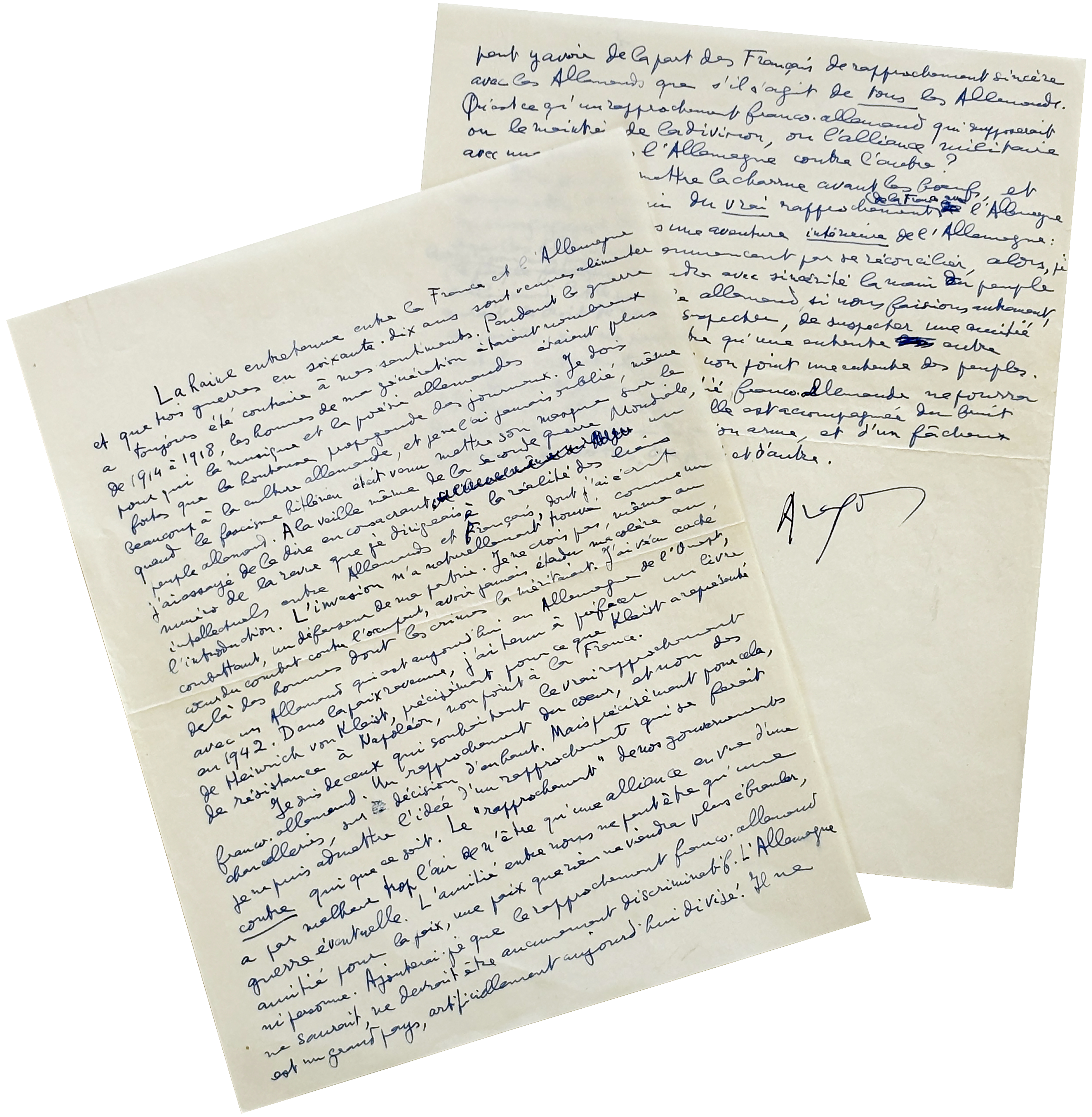
Autograph manuscript signed « Aragon »
N.p.n.d. [c. 1960 ?], 1 p. ½ 4°
« I owe a great deal to German culture… even when Hitlerian fascism had come to place its mask over the German people »
Autograph manuscript signed « Aragon »
N.p.n.d. [c. 1960 ?], 1 p. ½ 4° in blue ink
Several redactions and additions in Aragon’s hand
Important, apparently unpublished manuscript on Franco-German relations
In the aftermath of the wounds inflicted by the Second World War, Aragon pleads for a sincere reconciliation with a Germany he refuses to conflate with its tormentors
« La haine entretenue entre la France et l’Allemagne et que trois guerres en soixante-dix ans sont venues alimenter a toujours été contraire à mes sentiments. Pendant la guerre de 1914 à 1918, les hommes de ma générations étaient nombreux pour qui la musique et la poésie allemandes étaient plus fortes que la honteuse propagande des journaux. Je dois beaucoup à la culture allemande, et je ne l’ai jamais oublié, même quand le fascisme hitlérien était venu mettre son masque sur le peuple allemand. […] L’invasion m’a naturellement trouvé comme un combattant, un défenseur de ma patrie. Je ne crois pas, même au cœur du combat contre l’occupant, avoir jamais étendu ma colère au-delà des hommes dont les crimes la méritait. J’ai vécu caché avec un allemand qui est aujourd’hui en Allemagne de l’Ouest, en 1942. Dans la paix revenue, j’ai tenu à préfacer un livre de Heinrich von Kleist [Michael Kohlhaas, paru en 1810], précisément pour ce que Kleist a représenté de résistance à Napoléon, non point à la France.
Je suis de ceux qui souhaitent le vrai rapprochement franco-allemand. Un rapprochement du cœur, et non des chancelleries, sur décision d’en haut. […] L’Allemagne est un grand pays, artificiellement aujourd’hui divisé. Il ne peut y avoir de la part des Français de rapprochement sincère avec les Allemands que s’il s’agit de tous les Allemands. […]
De toute façon, l’amitié franco-allemande ne pourra être franche, et durable, si elle est accompagnée du bruit de gâchette des fusils qu’on arme, et d’un fâcheux orchestre de bottes, de part et d’autre.
Aragon »
If Aragon’s relationship to Germany was essentially shaped by History, as Annick Jauer shows in the Cahiers d’Études Germaniques (Univ. Aix-Marseille I, 2001, pp. 231-242), the poet was neither a germanophile nor a germanophobe: his stances toward Germany always responded to a precise set of circumstances, from the pro-German bias of the 1920s — a protest against the nationalism of the day — to the anti-germanism of his Resistance collections. The present manuscript falls within the continuation of this trajectory: a plea for a Franco-German rapprochement rooted in personal conviction rather than in the chancelleries alone, it reveals an Aragon intent on distinguishing the German people — artificially divided, as he puts it — from the regimes that had exploited them, and on founding friendship between the two nations on a shared culture rather than on ceremonial agreements.
This same conviction comes through in this manuscript, where Aragon recalls his experience of the First World War as well as his preface to Heinrich von Kleist’s Michael Kohlhaas, a symbolic gesture by which he intended to pay tribute to German resistance against Napoleon, “not to France.”
Provenance :
Louis Aragon ; Christie’s, 21 Nov. 2022, n°156
Join our mailing list and be the first to hear our latest news and biggest announcements.
By signing up you agree to our privacy policy. You can unsubscribe at any time.