Keep ahead of the pack
Join our mailing list and be the first to hear our latest news and biggest announcements.
By signing up you agree to our privacy policy. You can unsubscribe at any time.
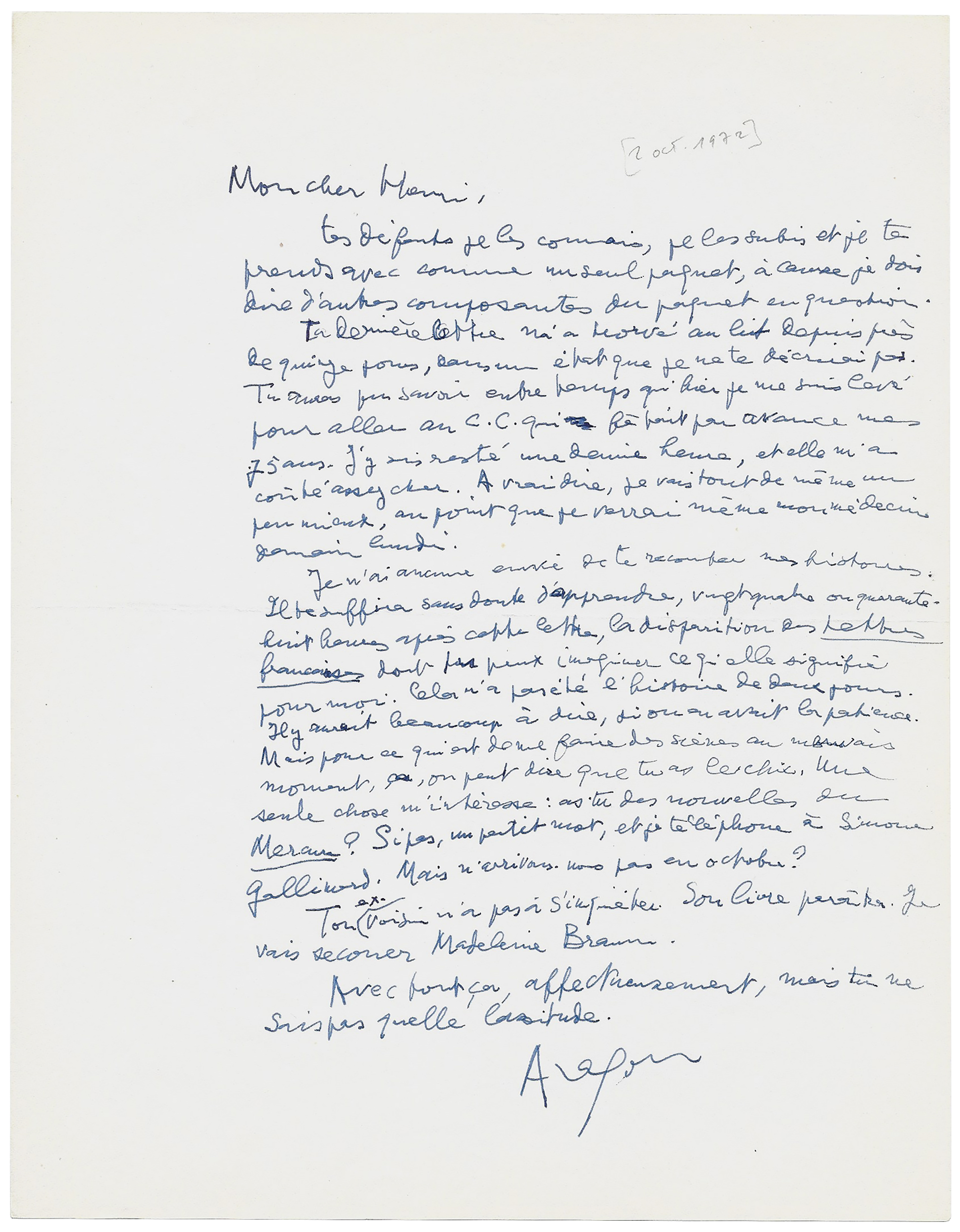
Autograph letter signed « Aragon » to Henri Droguet
N.p. [2 Oct. 1972], 1 p. 4°
« It will no doubt be enough for you to learn… of the disappearance of Les Lettres françaises, and you cannot imagine what that means to me »
Autograph letter signed « Aragon » to Henri Droguet
N.p. [2 Oct. 1972], 1 p. 4° in blue ink
Two words crossed off by Aragon
Shaken by the disappearance of Les Lettres françaises, Aragon draws on his literary network to support one of his young poets in the world of Parisian publishing
« Mon cher Henri,
Tes défauts je les connais, je les subis et je te prends avec comme un seul paquet […] Tu auras pu savoir entre temps qu’hier je me suis levé pour aller au C[omité] C[entral] qui fêtait par avance mes 75 ans. J’y suis resté une demie heure, et elle m’a coûté assez cher. […]
Je n’ai aucune envie de te raconter mes histoires. Il te suffira sans doute d’apprendre, vingt-quatre ou quarante-huit heures après cette lettre, la disparition des Lettres françaises dont tu peux imaginer ce qu’elle signifie pour moi. Cela n’a pas été l’histoire de deux jours. Il y aurait beaucoup à dire, si on en avait la patience. Mais pour ce qui est de me faire des scènes au mauvais moment, ça on peut dire que tu as le chic, une seule chose m’intéresse : as-tu des nouvelles du Mercure ? Si pas, un petit mot, et je téléphone à Simone Gallimard […]
Ton ex-voisin [Michel Cahour] n’a pas à s’inquiéter. Son livre paraîtra. Je vais secouer Madeleine Braun.
Avec tout ça, affectueusement, mais tu ne sais pas quelle lassitude.
Aragon »
As he himself confided in Aragon parle (Seghers), the poet was only able to live from his writing « from 1959, that is to say at the age of sixty-one. Until then, never. » Director of Les Lettres françaises since 1953, Aragon from then on put his immense literary renown to use to promote numerous young poets and writers in the newspaper. Among them, Henri Droguet appeared alongside established authors such as Pablo Neruda, Eugène Guillevic and Nicolas Guillén. Such was Aragon’s wish to bring a diversity of voices into the review, among other literary and artistic columns.
The End of Les Lettres françaises
The stance taken by Les Lettres françaises against the invasion of Czechoslovakia by the Warsaw Pact in August 1968 had led the USSR to cancel its numerous subscriptions on behalf of its universities, schools and libraries in the Eastern Bloc countries. This was a fatal decision for the financial balance of the review, which the support of the PCF could not make up for. The publication disappeared in 1972, not without leaving a deep mark on Aragon, for whom it had been the guiding spirit for almost twenty years. The review would subsequently go through a few convulsions, reappearing briefly between 1990 and 1993, then as an insert in L’Humanité from 2004, before ceasing all print publication definitively in 2014.
After Gaston Gallimard bought Mercure de France in May 1958 (a publishing house founded in late 1893 by Rachilde and Alfred Vallette as an extension of the eponymous review), Simone Gallimard, separated from her husband Claude Gallimard, took over its management in 1962, before becoming its president in 1969.
Madeleine Braun ran the Éditeurs français réunis (EFR) alongside Aragon from 1961, giving the house a new impetus by creating, notably in 1966, the Petite Sirène series.
Provenance:
Henri Droguet ; private coll.
Bibliography:
Recherches croisées Aragon / Elsa Triolet n°13, Presses Universitaires de Strasbourg, 2011, n°XII
Join our mailing list and be the first to hear our latest news and biggest announcements.
By signing up you agree to our privacy policy. You can unsubscribe at any time.