Keep ahead of the pack
Join our mailing list and be the first to hear our latest news and biggest announcements.
By signing up you agree to our privacy policy. You can unsubscribe at any time.
Autograph card signed « Weygand » to commandant Lanrezac ?]
N.p. [between 1954 and 1959 ?], 2 p. in-12°
« The young de Gaulle has brought so many errors into his memoirs… »
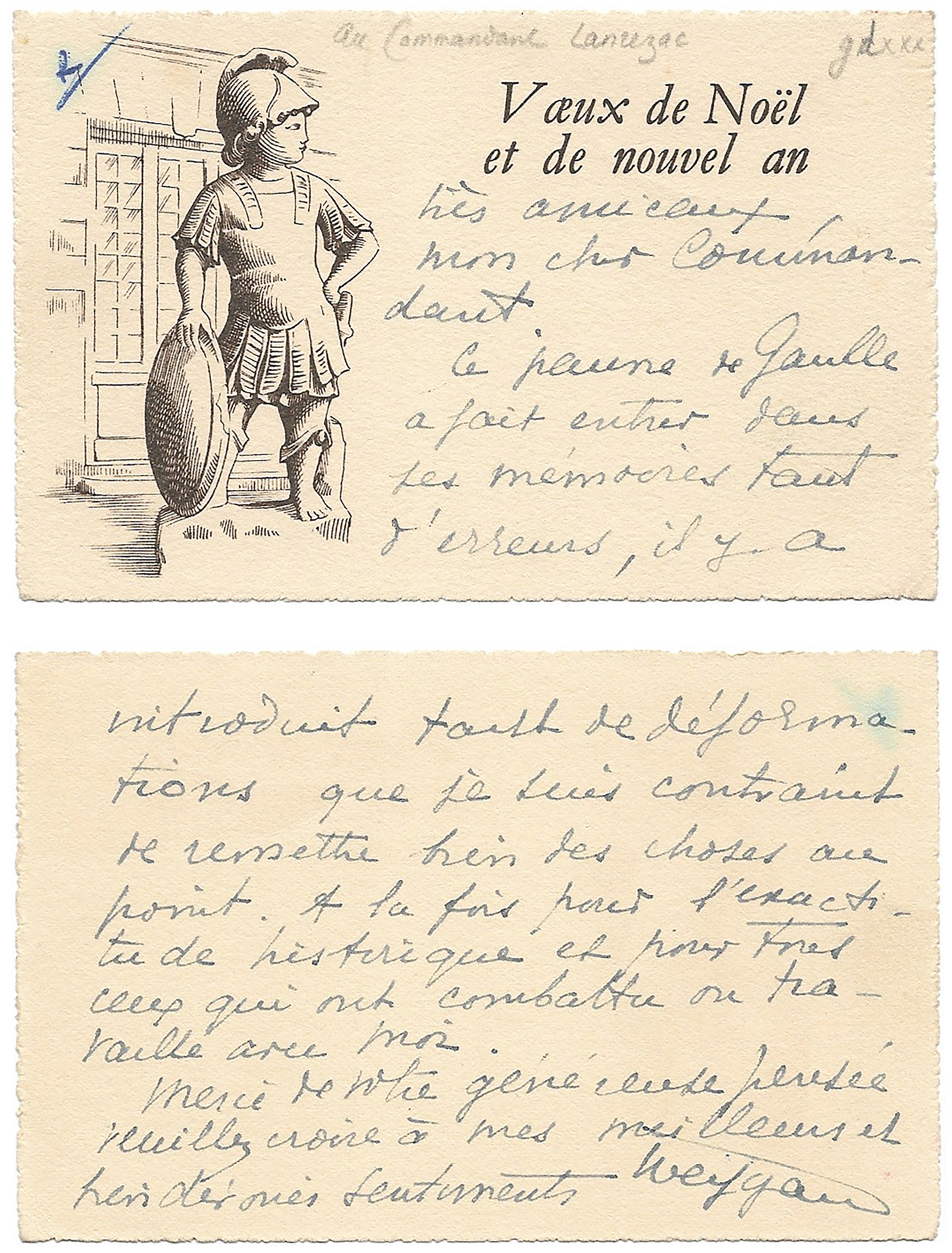
Autograph card signed « Weygand » to commandant Lanrezac ?]
N.p. [between 1954 and 1959 ?], 2 p. in-12° recto and verso, in blue ink
Printed card, illustrated with a cherub dressed up as a Roman soldier
Annotation “R” by the recipient in the upper left corner
Severe judgment by Maxime Weygand on the Mémoires de guerre of Charles de Gaulle
« [Vœux de Noël et de nouvel an] très amicaux mon cher commandant.
Le jeune de Gaulle a fait entrer dans ses mémoires tant d’erreurs, il y a introduit tant de déformations que je suis contraint de remettre bien des choses au point. À la fois pour l’exactitude historique et pour tous ceux qui ont combattu ou travaillé avec moi.
Merci de votre généreuse pensée, veuillez croire à mes meilleurs et bien dévoués sentiments,
Weygand »
The rivalry between Weygand and de Gaulle took shape when the former, then aged 73, replaced Gamelin on 19 May 1940 as generalissimo. Twenty-three years his junior, de Gaulle does not fail to heap criticism on Weygand in his Mémoires de guerre. There he calls into question both his age and the rise to the highest echelons of the military hierarchy of an officer who had never commanded troops. He presents him as a « brilliant second-in-command » who « had never held any command during his career », « struck with stupor » by the Blitzkrieg, and attached to outdated military principles since « he had never envisaged the real possibilities of mechanical force ». De Gaulle also criticizes a strategy limited to the « narrow framework of metropolitan France », as well as an evasion of responsibility that supposedly led him to support Marshal Pétain’s request for an armistice. Finally, he reproaches him for his part in setting up the Vichy regime which, « without faith and without vigor, opted for the worst abandonment ».
Beyond personal differences, the rivalry between Weygand and de Gaulle reflects the clash of two readings of the defeat of 1940 and of two conceptions of national salvation. While the former favored preserving French forces within the framework of the armistice, the latter chose to continue the fight immediately from abroad. The harsh judgments passed by de Gaulle long helped shape Weygand’s image in historiography.
Provenance:
H.D. collection
Literature:
Mémoires de guerre – L’Appel : 1940-1942, t. I, Paris, éd. Plon, 1954, p.53-56
Join our mailing list and be the first to hear our latest news and biggest announcements.
By signing up you agree to our privacy policy. You can unsubscribe at any time.