Keep ahead of the pack
Join our mailing list and be the first to hear our latest news and biggest announcements.
By signing up you agree to our privacy policy. You can unsubscribe at any time.
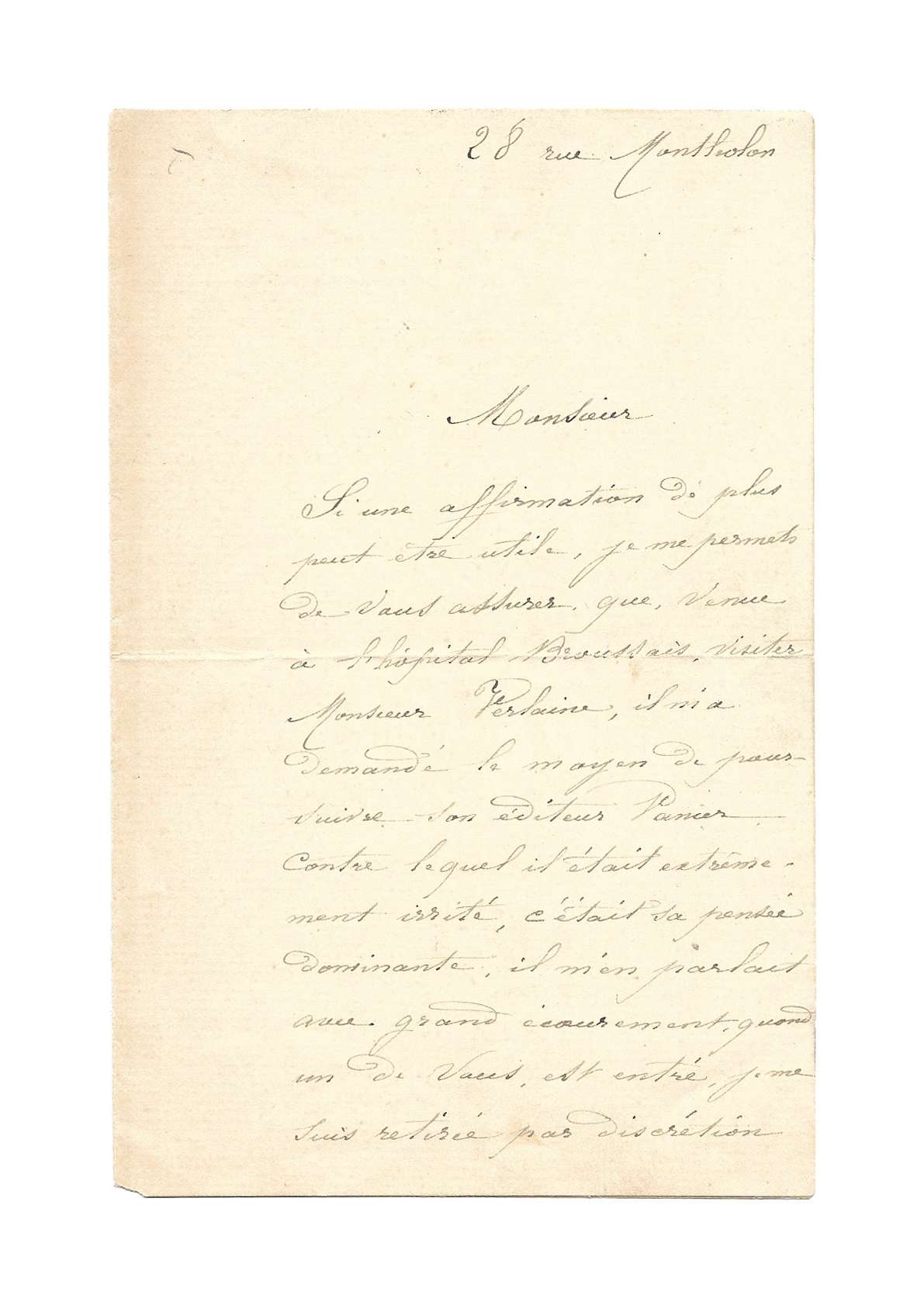
Autograph letter signed “J. Verlaine” to a gentleman (probably Edmond Lepelletier)
Rue Montholon [Paris], circa 1889, 2 pp. in-8
“I would assure you that, when he came to the Broussais hospital to visit Mr. Verlaine, he asked me for a way to sue his publisher Vanier against whom he was extremely irritated.”
Autograph letter signed “J. Verlaine” to a gentleman (probably Edmond Lepelletier)
Rue Montholon [Paris], circa 1889, 2 pp. in-8
Tiny missing bit on lower left margin without affecting the text
Letter from the enigmatic Jeanne who claimed to be related to Verlaine, about the famous conflict between verlaine and Vanier
« Monsieur
Si une affirmation de plus peut être utile, je me permets de vous assurer que, venue à l’hôpital Broussais visiter Monsieur Verlaine, il m’a demandé le moyen de poursuivre son éditeur Vanier contre lequel il était extrêmement irrité, c’était sa pensée dominante, il m’en parlait avec grand écœurement, quand un de vous est entré, je me suis retirée par discrétion me réservant de vous en expliquer plus amplement à sa sortie, qui devait être prochaine.
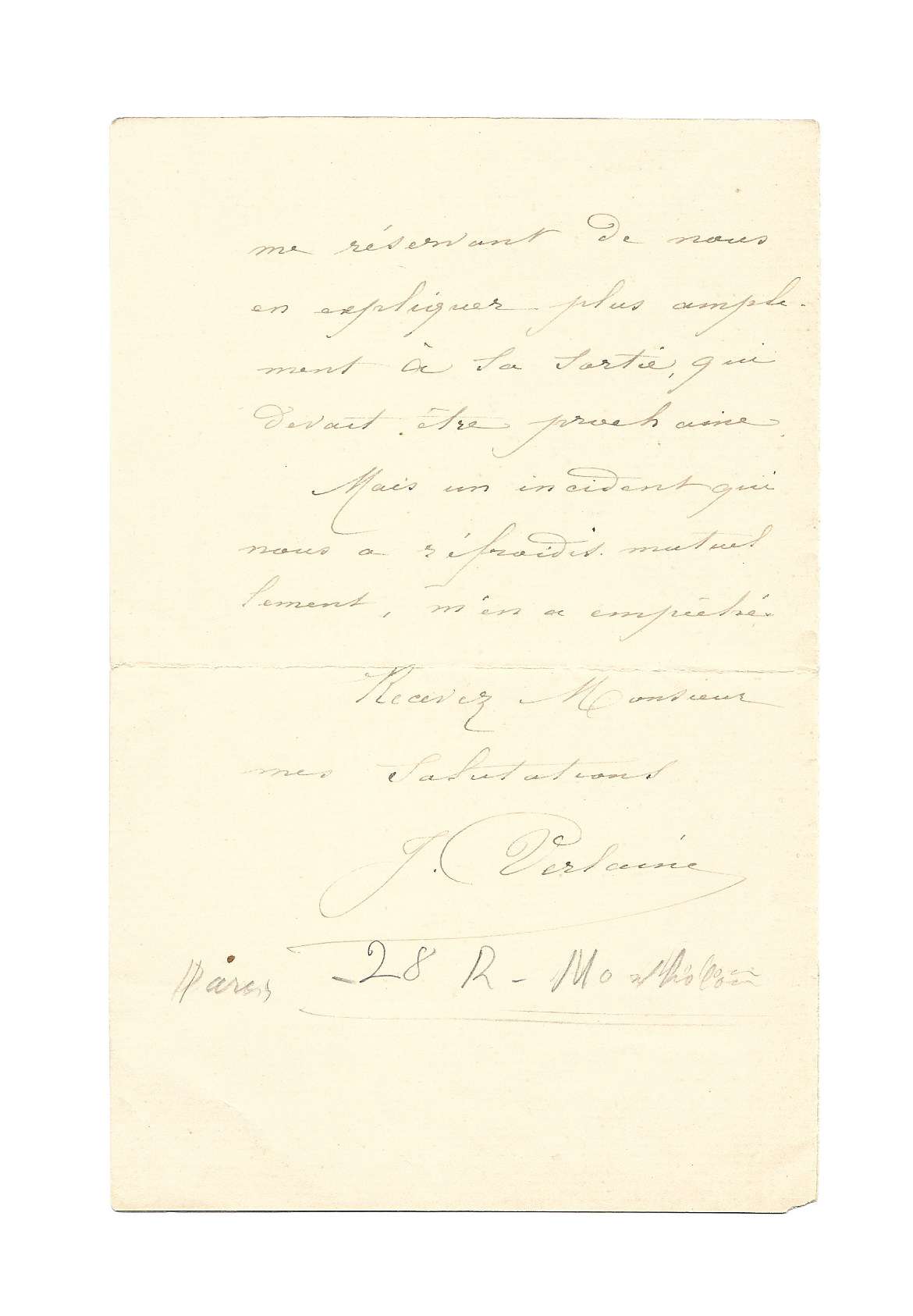
Mais un incident qui nous a refroidis mutuellement m’en a empêché.
Recevrez Monsieur mes salutations.
J. Verlaine »
This enigmatic figure is a lady who claims to be a relative of the poet. She met Verlaine at Broussais in 1889, at a time when she was herself hospitalized (the episode mentioned in the letter refers to Verlaine’s falling out with Vanier, following a notice published in Parallèlement without the poet’s knowledge). Verlaine was at Broussais from July 8 to August 18, 1889, so the letter should be dated accordingly. Verlaine mentions this person on several occasions in his correspondence from August–September 1889, referring to her alternately as “Mme J. V.” and “Mme mon homonyme” (letter to Cazals, August 26, 1889). According to Georges Zayed, she may have been the dedicatee of a poem in Dédicaces (2nd ed., 1894), “À Mme J…,” a second version of which is entitled “À Mme Jeanne,” thus providing the key to the “J.”
We would like to thank Olivier Bivort for his help in completing this description
Join our mailing list and be the first to hear our latest news and biggest announcements.
By signing up you agree to our privacy policy. You can unsubscribe at any time.