Keep ahead of the pack
Join our mailing list and be the first to hear our latest news and biggest announcements.
By signing up you agree to our privacy policy. You can unsubscribe at any time.
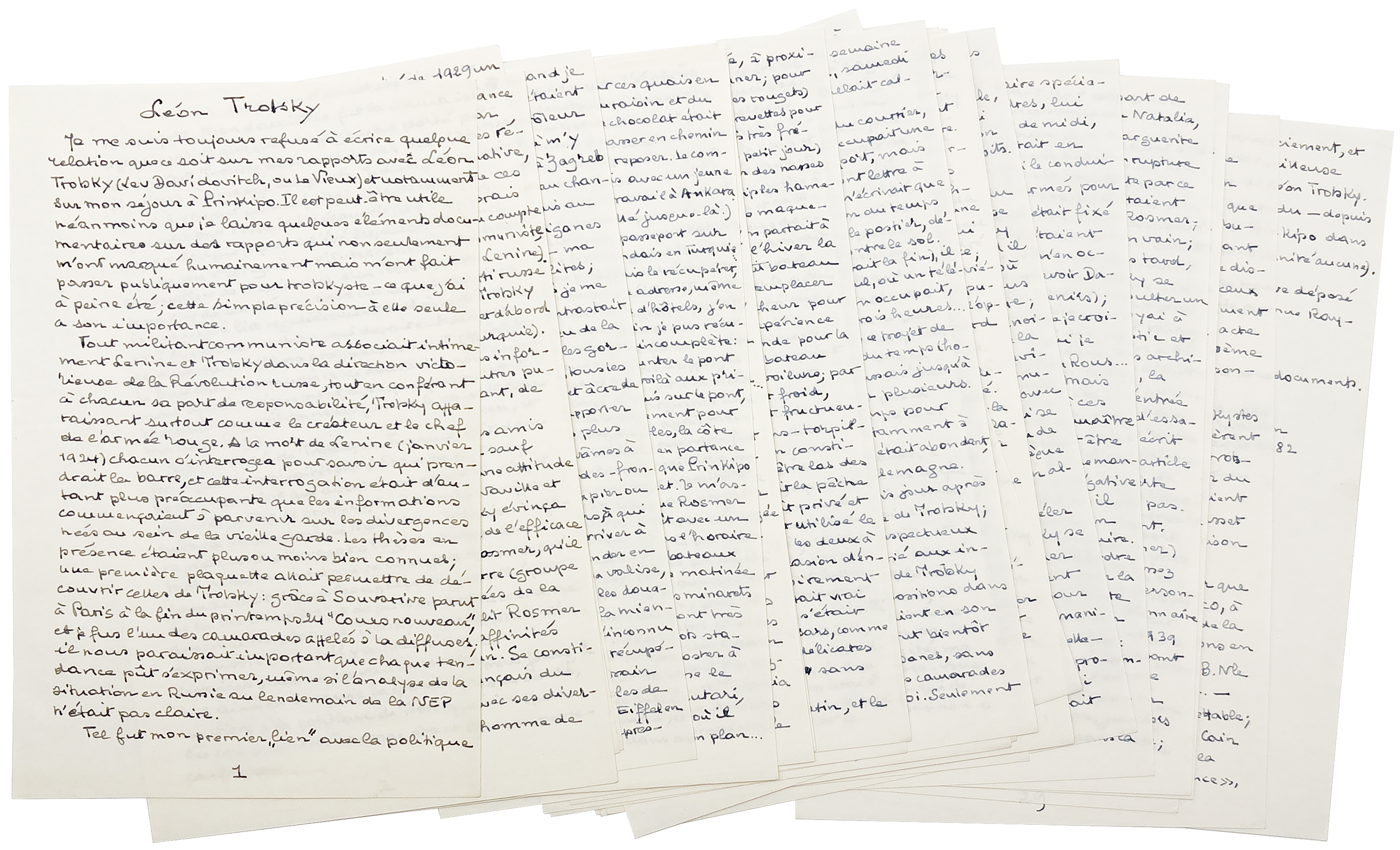
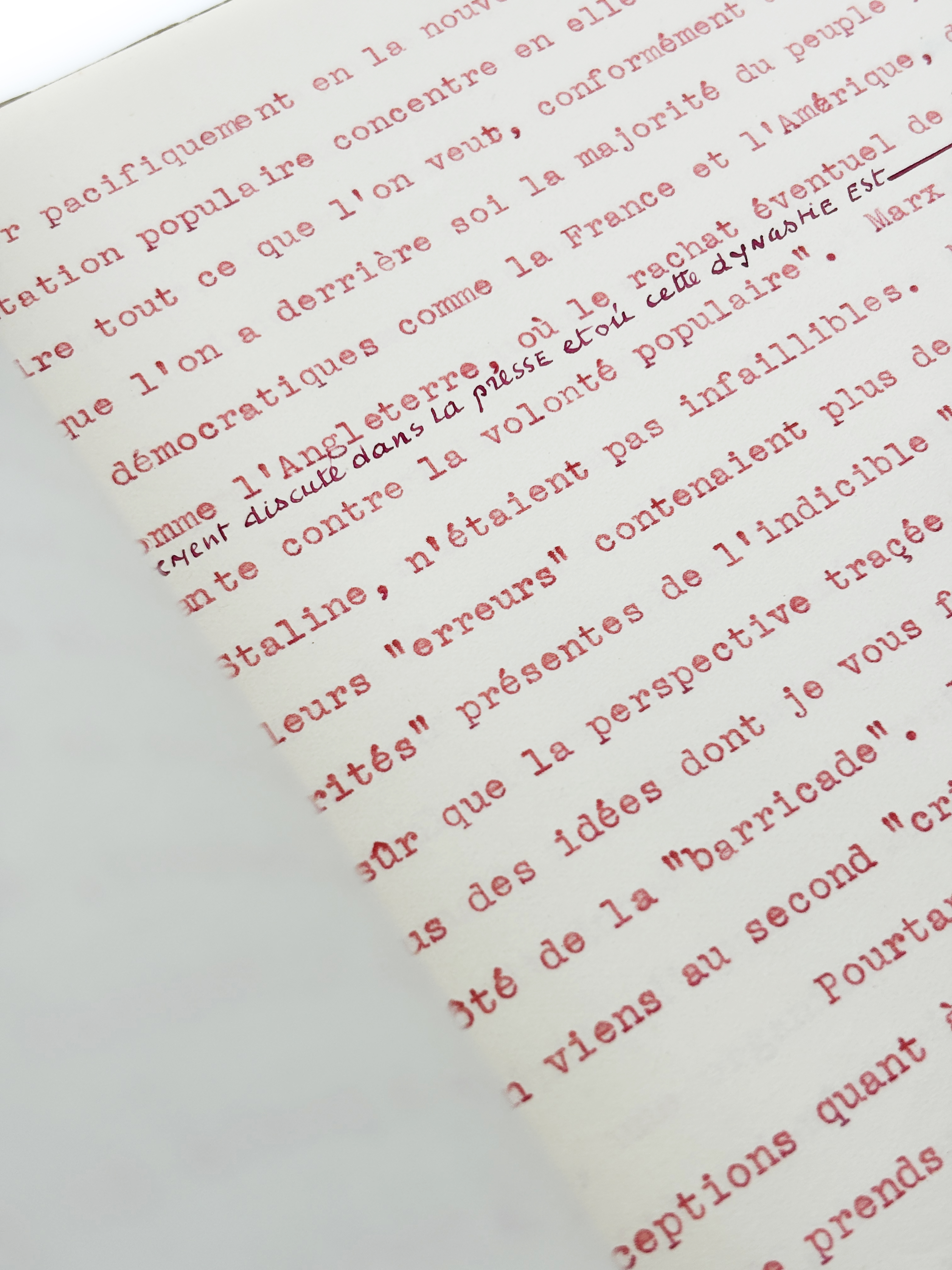
Autograph manuscript signed « P. » : Léon Trotsky
Les Monties [Gers], « early Aug.1982 », 30 p. in-8° in blue ink
« So for the first time I was seeing this historic figure, true to his image, clean-shaven, with the legendary goatee… »
Autograph manuscript signed « P. » : Léon Trotsky
Les Monties [Gers], « early Aug.1982 », 30 p. in-8° (each page on recto only), in blue ink
In a white folder, a few redactions and overwritten passages, each page foliated
A gripping first-hand account, entirely unpublished, from one of Trotsky’s secretaries during the fateful exile in Prinkipo, at the turn of the 1930s
« So for the first time I was seeing this historic figure, true to his image, clean-shaven, with the legendary goatee […] eyes of a steely blue that concentrated all his authority, beneath a full head of wavy hair that left a fine forehead exposed »
An immersion into the daily life of the Bolshevik revolutionary, founder of the Red Army
Here we can transcribe only a few fragments of this long manuscript by Pierre Frank, “written in one sitting and without documents,” thirty pages long, every one of them densely filled:
The account opens with a preliminary note in which Frank, at the twilight of his life (he was to die two years later), states that he had always refused to write about his relations with the great figure of the Bolshevik Revolution: «I have always refused to write any account whatsoever of my relations with Leon Trotsky (Lev Davidovich, or The Old Man), and in particular of my stay at Prinkipo. It may nevertheless be useful for me to leave some documentary material […]». Frank then goes on to Lenin’s death and the fragmented legacy the latter left behind: «Every Communist militant closely associated Lenin and Trotsky in the victorious leadership of the Russian Revolution, while assigning each his share of responsibility, Trotsky appearing above all as the creator and leader of the Red Army. At Lenin’s death (January 1924), everyone wondered who would take the helm, and this question was all the more troubling as reports began to arrive of the divergences that had emerged within the old guard. […]». Frank then discusses the disagreements within the Russian party and Trotsky’s theses, and the actions that «were to lead first to his deportation (Alma-Ata), then to his exile (Turkey). Souvarine’s Bulletin communiste kept us systematically informed, along with a few other oppositionist publications […]».
Next comes the matter of Trotsky’s arrival in Turkey and the sorting-out he carried out within his young French guard: «his French friends rushed to Istanbul – except Boris Souvarine, who held a reserved attitude toward him. – [Maurice] Paz first, the [Alfred and Marguerite] Rosmers, [Pierre] Naville and Gérard Rosenthal, the [Raymond and Jeanne] Moliniers… Trotsky quickly cast aside “the lawyer” Paz, grew fond of the efficient Molinier, but was delighted to be reunited with Rosmer […] There were real affinities there for working together. Thus was formed in Turkey the French group supporting Trotsky’s politics, with its various components, Rosmer being the man of trust.» What follows are details about Trotsky settling into his villa at Prinkipo and his need to find a secretary. Rosmer then comes to meet Pierre Frank, a proofreader at the Petit Parisien, to go and join the revolutionary for a few months at Prinkipo «while awaiting another secretary to be found; the decision had to be made very quickly». […] «I was twenty-four, and politically engaged as I was, the proposal was tempting: secretary to Trotsky, aid to a political exile… I did not hesitate». Pierre Frank then recounts the very long journey that was to bring him to Prinkipo, mentioning his difficult train journeys, his stopovers in various capitals, and the confiscation of his passport by the Turkish authorities for his refusal to give information about his place of residence. Having finally arrived at Prinkipo: «the welcome was cordial. It was Liova (the son) [Lev Sedov] who greeted me, with the enthusiasm of youth, and who took me straight to Trotsky, who was in his office on the first floor; he was sitting behind his table, piled high with books and newspapers, and he stood up; once the first moment of surprise at my arrival had passed, he came closer to me, near the window open onto the Marmara, and questioned me: about the journey, my papers [provided by Rosmer] (which I immediately took out of the folder to hand over as proof), and my accommodation in the villa: a room awaited me on the ground floor, where I would be lodging alone […]».
Frank quickly had to familiarize himself with Russian and Turkish idioms, while Liova, Trotsky’s son, had to leave for Berlin: «I was then left alone to face all the daily tasks». A precise description follows of the villa and its surrounding gardens, the guard dogs, and the Turkish bodyguards permanently present in an annex adjoining the villa. Frank was obliged to learn how to handle firearms, «the part he felt least comfortable with, but in the end Liova taught him how to take them apart and put them back together, as well as how to oil them».
Then comes a striking description of Trotsky, a few days after Frank’s arrival at the villa: «I saw Trotsky again: he was tall, broad-shouldered, strong and upright, in what might be called military dress (trousers and a tunic, white in fine weather, or grey); turtleneck sweaters were reserved for fishing and the moments that followed it, worn with half-boots. He was always impeccably dressed, and Natalia was dressed in a bourgeois manner. So for the first time I was seeing this historic figure, true to his image, clean-shaven, with the legendary goatee (which gave way to the demands of various travels); eyes of a steely blue that concentrated all his authority, beneath a full head of wavy hair that left a fine forehead exposed. His speech was crisp, rather clipped, issuing from firmly set lips.» Frank then describes the daily schedule to which Trotsky subjected him, devoted chiefly to going through the French press and drafting correspondence with Trotskyist supporters. «He had marvellous handwriting, tall and flowing, perfectly legible. At the time he was writing “My Life” and “The History of the Russian Revolution”, in Russian, and his secretary was fully occupied with it; he was also finishing his series of articles on the situation in the U.S.S.R. for the New York Times, which allowed him to “keep the pot boiling”. […] He got through a great deal of work, with ease – interrupted only by meals and fishing trips.» A long description follows of Trotsky’s daily life, then of his favourite pastime: «he regarded fishing as the physical exercise he was otherwise deprived of, and threw himself into it vigorously», followed by conversations in his company: «this was then the occasion to strike up conversation – almost inevitably political. Once, I asked him whether it was true that Lenin, upon entering the Kremlin, had first gone to the tsars’ Masonic lodge, as I had been assured in 1927 under delicate circumstances: a question that remained unanswered…»
Frank then discusses the political differences that set him at odds with Trotsky, while remaining loyal to him and in his service, notably through the prism of two anecdotes: «The correspondence was abundant, particularly with France and Germany. It was through this correspondence that I discovered, day after day, Trotsky’s character and political line; naturally I was a secretary respectful of texts, but little by little I was initiated into Trotsky’s injunctions and his systematic struggle against deviations from his own positions within all those little groups that were forming in his name; I had to come to terms with what soon appeared to me to be sectarian, partisan interventions, without nuance and without kindness, directed at comrades motivated purely by good faith. This only reminded me of the brutal, merciless reply Trotsky had given to a long letter of political discussion sent to him by Souvarine; once, unable to hold back any longer, I told Trotsky, as we were coming back from fishing, that I would like to talk with him about Boris’s letter: he replied to me, ‘there is nothing in that letter’ […] This reminded me of unfortunate practices from the Bolshevization period […] and I withdrew into my shell. Another incident was to worsen this unpleasant impression […]». Frank then returns to the spontaneous arrival of a man in rags in front of the villa, who had «managed to escape the grip of Stalinist repression» and whom Trotsky refused to see. This person turned out to be the Bolshevik and leader of the Workers’ Opposition, Gabriel Miasnikov. Frank then explains the ideological distance he was taking from his employer.
There follows a long, very detailed digression on a secret mission that Trotsky entrusted to Frank, aimed at a meeting in the Hagia Sophia with a spy who would turn out to be none other than Yakov Blumkin: «Blumkin, who had assassinated Count Mirbach, the first German ambassador to Moscow after the Peace of Brest-Litovsk, had been executed in the cellars of the Lubyanka. Trotsky then revealed to me the whole story of Blumkin […] An unsigned letter was a little later to inform Trotsky of all the circumstances of Blumkin’s return, arrest, and execution […]».
Frank goes on to discuss this period of exile marked by Trotsky’s isolation, then the visit of Marguerite Rosmer, who brought news of the movement in France. She tries to persuade Frank to come and help her husband on the editorial staff of the Trotskyist paper La Vérité once he is back in Paris, which Frank declines.
The end of the mission is approaching; it is February 1930, and Erwin Wolf has just arrived at the villa to take over from Frank. The latter agrees to continue serving Trotsky once back in France, and then come the farewells: «he kissed me in the Russian manner, on the lips – and we were both deeply moved… after these months of working together.»
Over several pages, Frank recounts the difficult return to his home country, his strained relations with the revolutionary, and then his fraternal ties with the latter’s son, Lev, settled in Paris, where he was to die prematurely in 1938 under obscure circumstances, «a pure and simple liquidation» in his own words. He also recalls the assassination of Trotsky in the summer of 1940: «I was a prisoner in the barracks at Vannes when the radio broadcast news of Trotsky’s assassination; the shock was brutal, but I had no doubt as to the murderer’s origin.»
[Enclosed:]
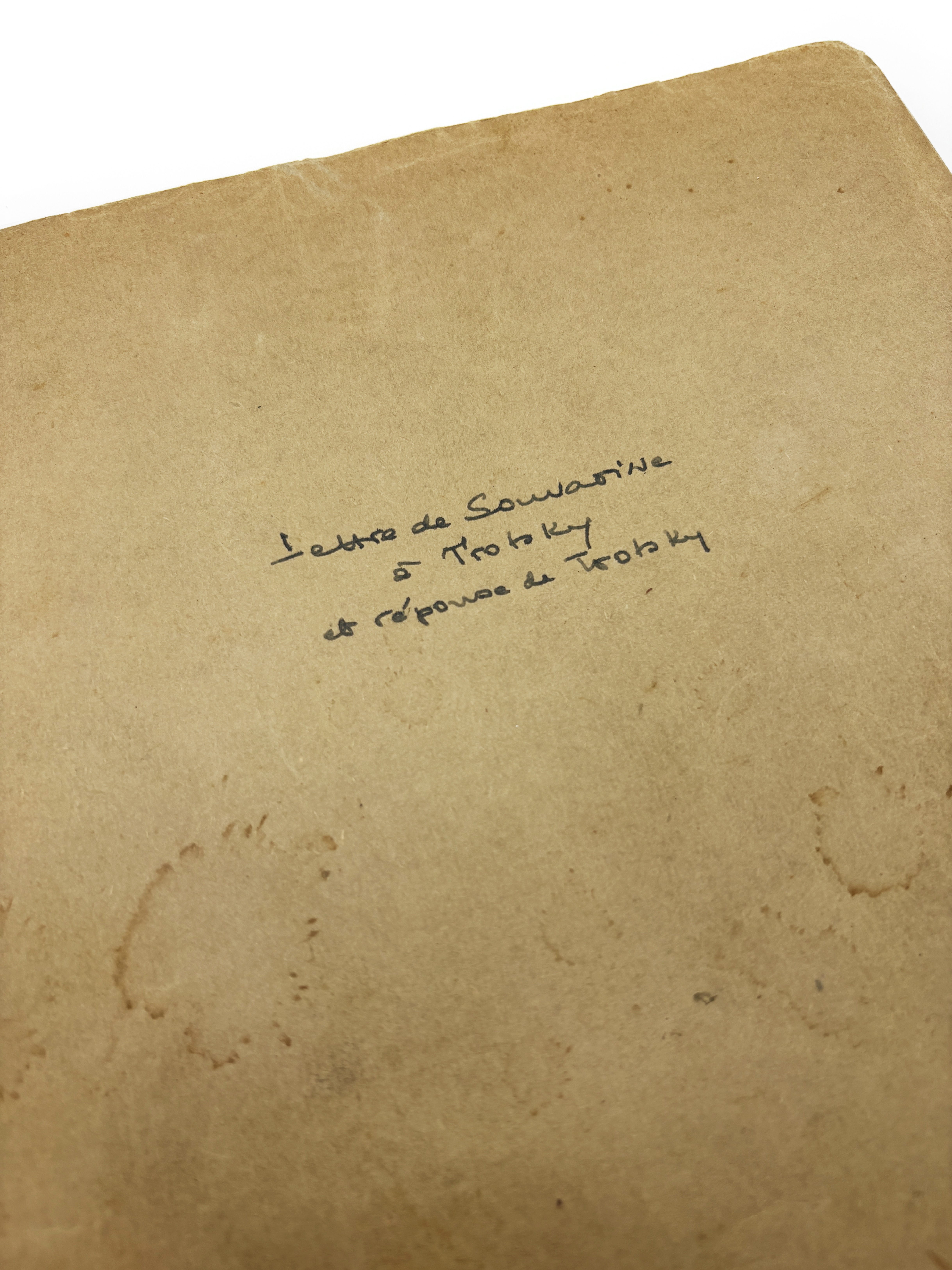
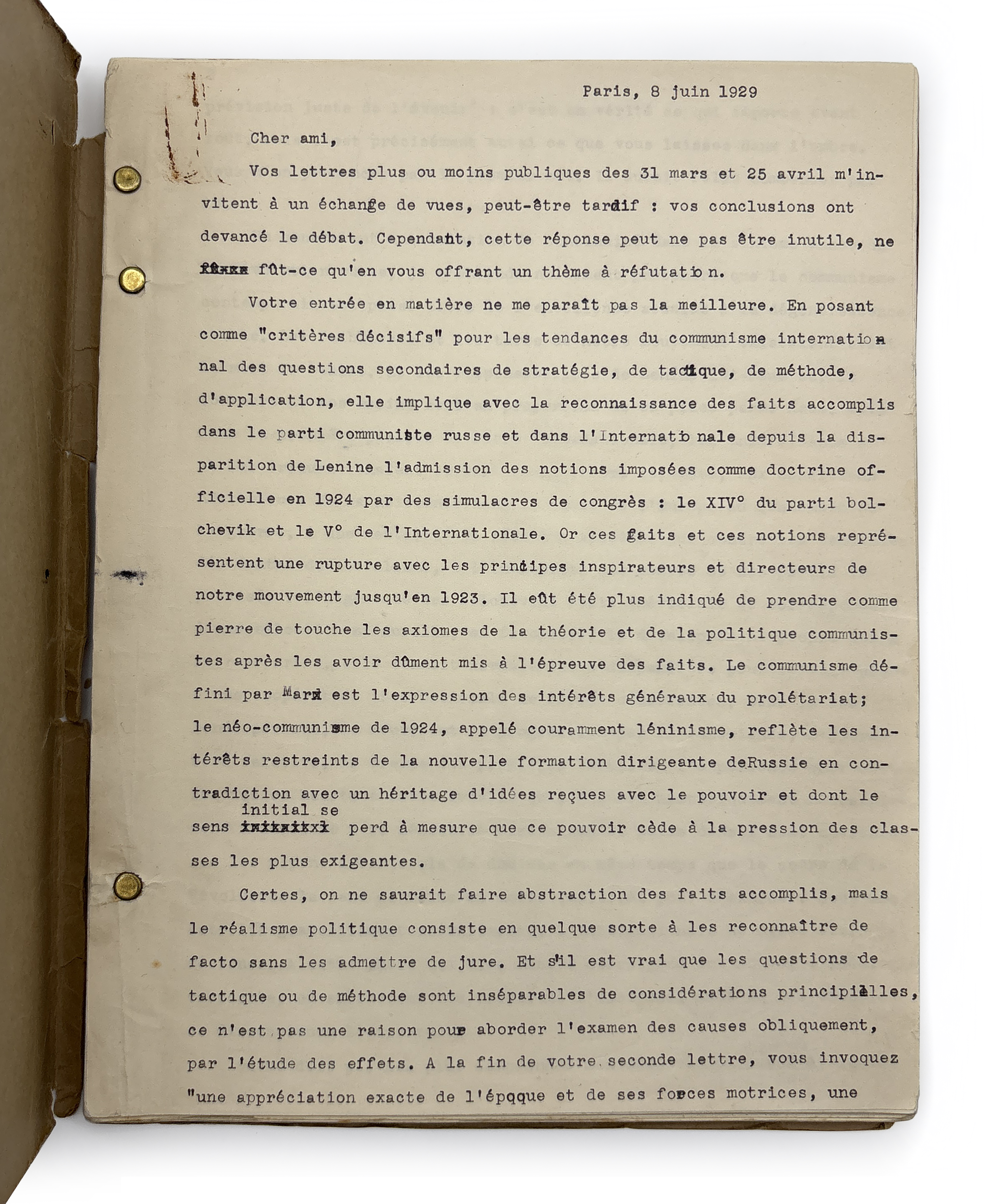
1/ The famous letter from Souvarine to Trotsky of 8 June 1929, 96 pp. in-4° (to which Pierre Frank expressly refers in the manuscript, see above.)
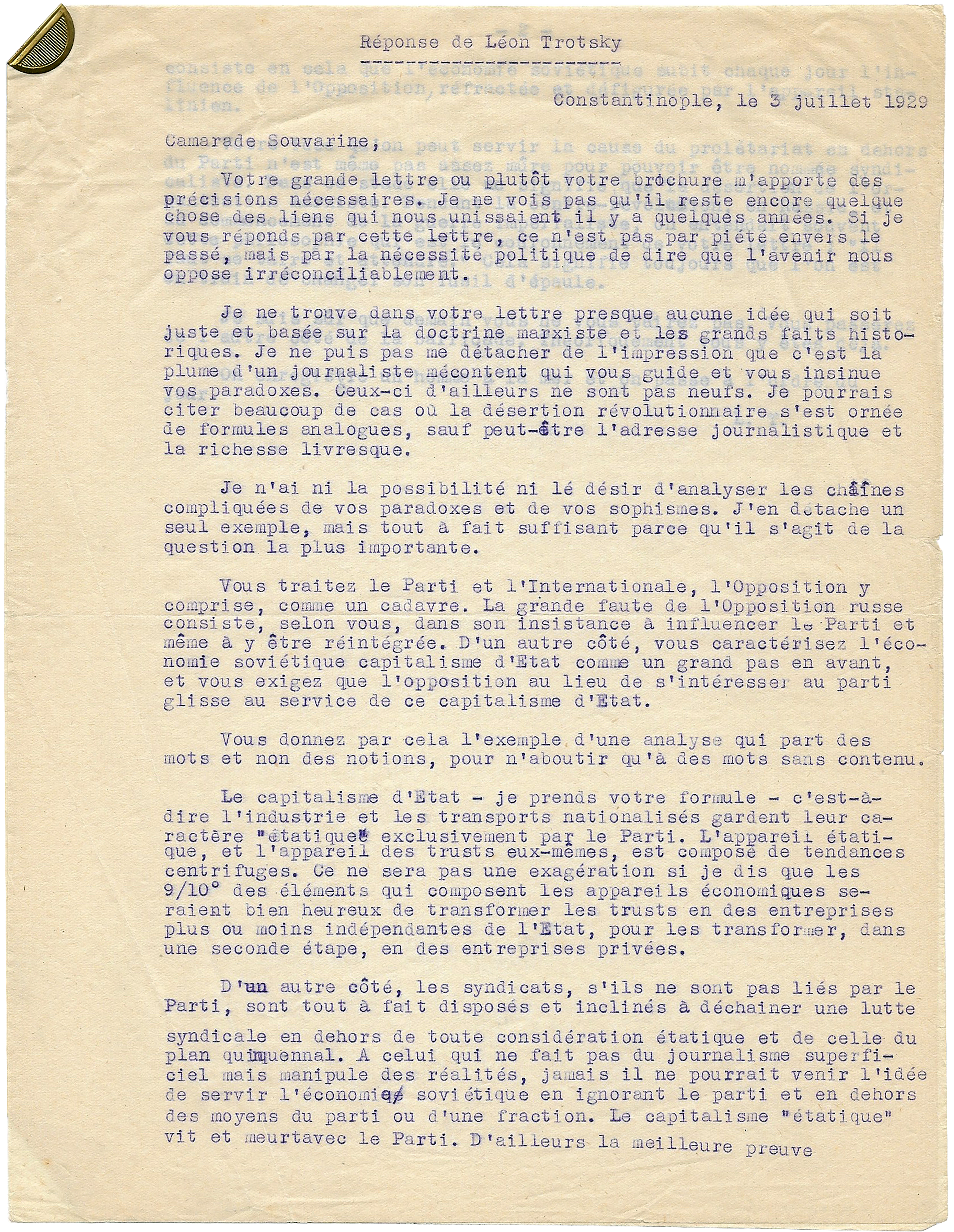
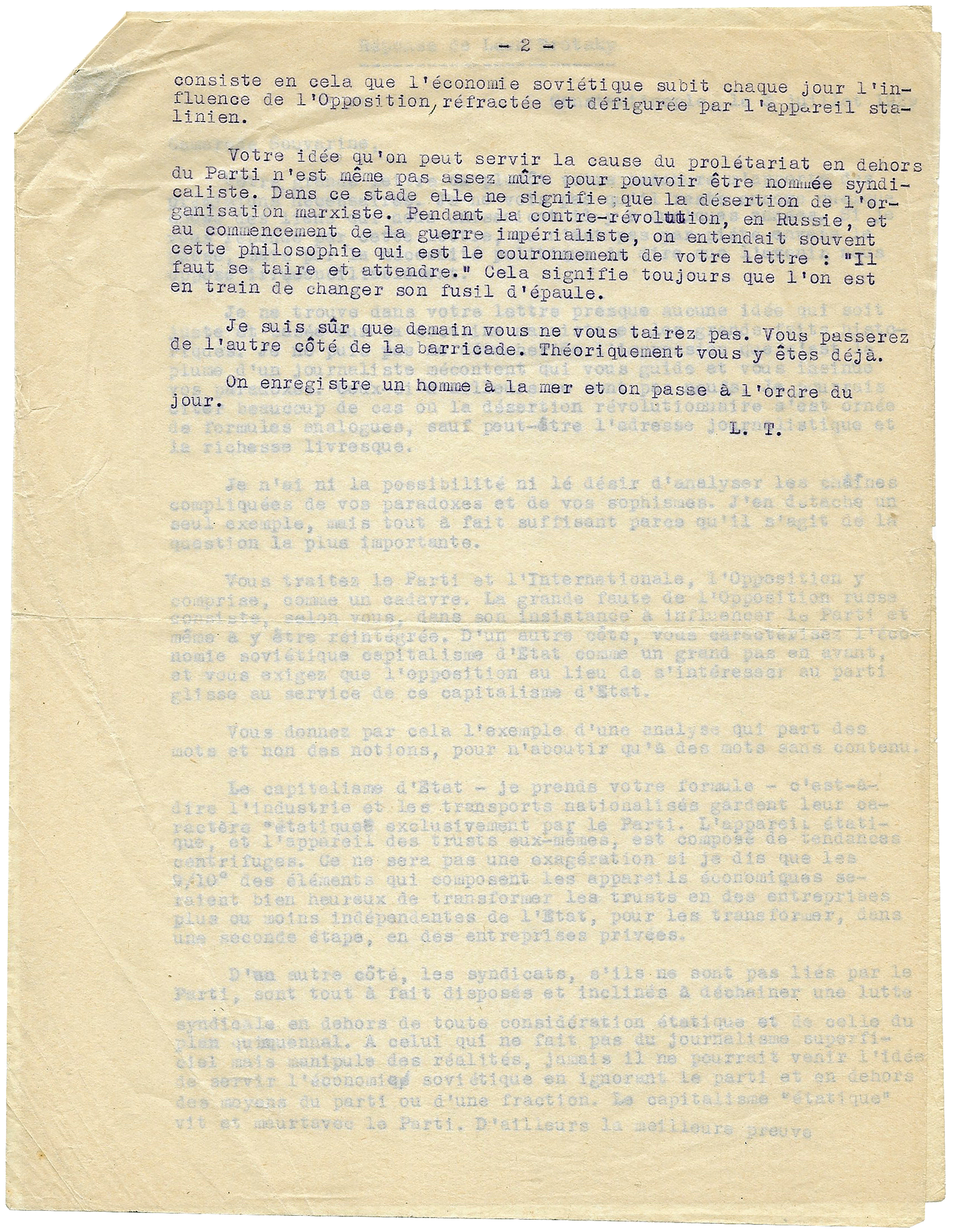
2/ Trotsky’s terse and equally famous reply to Souvarine of 3 July 1929, running to only 1½ pp.
Both documents in period typescript copy, in a folder captioned by Pierre Frank
In the spring of 1929, just as Trotsky had been expelled from the USSR and was seeking to organize the Left Opposition from his exile at Prinkipo, Boris Souvarine sent him, on 8 June, a very long letter marking the culmination of an intellectual evolution that had been under way for several years. A former ally of Trotsky’s against Stalinist bureaucratization, Souvarine now held that Stalinism did not constitute a mere “deviation” from Bolshevism, but that it had its roots in certain practices and conceptions developed under Lenin himself. His letter thus offered a fundamental critique of Leninism, analyzed the USSR as a new form of state capitalism, and criticized Trotsky for wanting to restore a form of Bolshevism whose historical premises he refused to sufficiently interrogate. This divergence was all the more significant given that Souvarine had been expelled from the official Communist movement as early as 1924 for having defended Trotsky against the leadership of the Comintern.
Trotsky’s reply sealed the break. Refusing to engage in a detailed discussion, he wrote: «Je ne vois pas qu’il reste encore quelque chose des liens qui nous unissaient il y a quelques années» — “I do not see that anything still remains of the bonds that united us a few years ago” — and stated that «nos avenirs s’opposent irréconciliablement» — “our futures are irreconcilably opposed” — before dismissing Souvarine’s analyses as the theses of a «journaliste mécontent» — “disgruntled journalist” — who had abandoned the ground of Marxism.
This exchange is generally regarded by historians as the definitive act of separation between two forms of anti-Stalinism: one, embodied by Trotsky, which sought to preserve and carry forward the legacy of October; the other, represented by Souvarine, which held it necessary to subject the entire Bolshevik experience to a radical historical critique.
Trotsky’s fateful four years at Prinkipo:
Expelled from the Soviet Union in February 1929, following an earlier deportation to Alma-Ata, Leon Trotsky found refuge on the island of Prinkipo, in the Princes’ Islands archipelago, not far from Istanbul. This exile, which was to last nearly four and a half years, until his departure for France in July 1933, is regarded as one of the most fertile periods of his intellectual and political career. It was at Prinkipo that he wrote two of his major works, My Life and The History of the Russian Revolution, and that he waged a systematic struggle to mobilize the German and international working class against Hitler’s rise to power. On the organizational front, Trotsky directed the International Left Opposition there, laying its foundations as early as 1930 within the Comintern itself; it became, in 1933, the International Communist League following the expulsion of its members from the Comintern, and then, in 1938, the Fourth International. It was moreover from Prinkipo that Trotsky issued, on 15 July 1933, his first call for the formation of the latter, a call he would give concrete form to five years later. This period was also marked by intense international correspondence, the publication of the Bulletin of the Opposition, and the constant threat of the Soviet services, of which the 1929 execution of his former secretary Yakov Blumkin, who had secretly come to visit him at Prinkipo, remains a central episode.
Provenance:
Private collection
Bibliography (non-exhaustive):
Contributions à l’histoire du Comintern, dir. Jacques Freymond, Genève, Librairie Droz, 1965, pp. 158-211 ; À Contre-courant. Écrits 1925-1939, Jeannine Verdès-Leroux, Éditions Denoël, 1985 (pour la lettre de Souvarine à Trotski)
Join our mailing list and be the first to hear our latest news and biggest announcements.
By signing up you agree to our privacy policy. You can unsubscribe at any time.