Keep ahead of the pack
Join our mailing list and be the first to hear our latest news and biggest announcements.
By signing up you agree to our privacy policy. You can unsubscribe at any time.
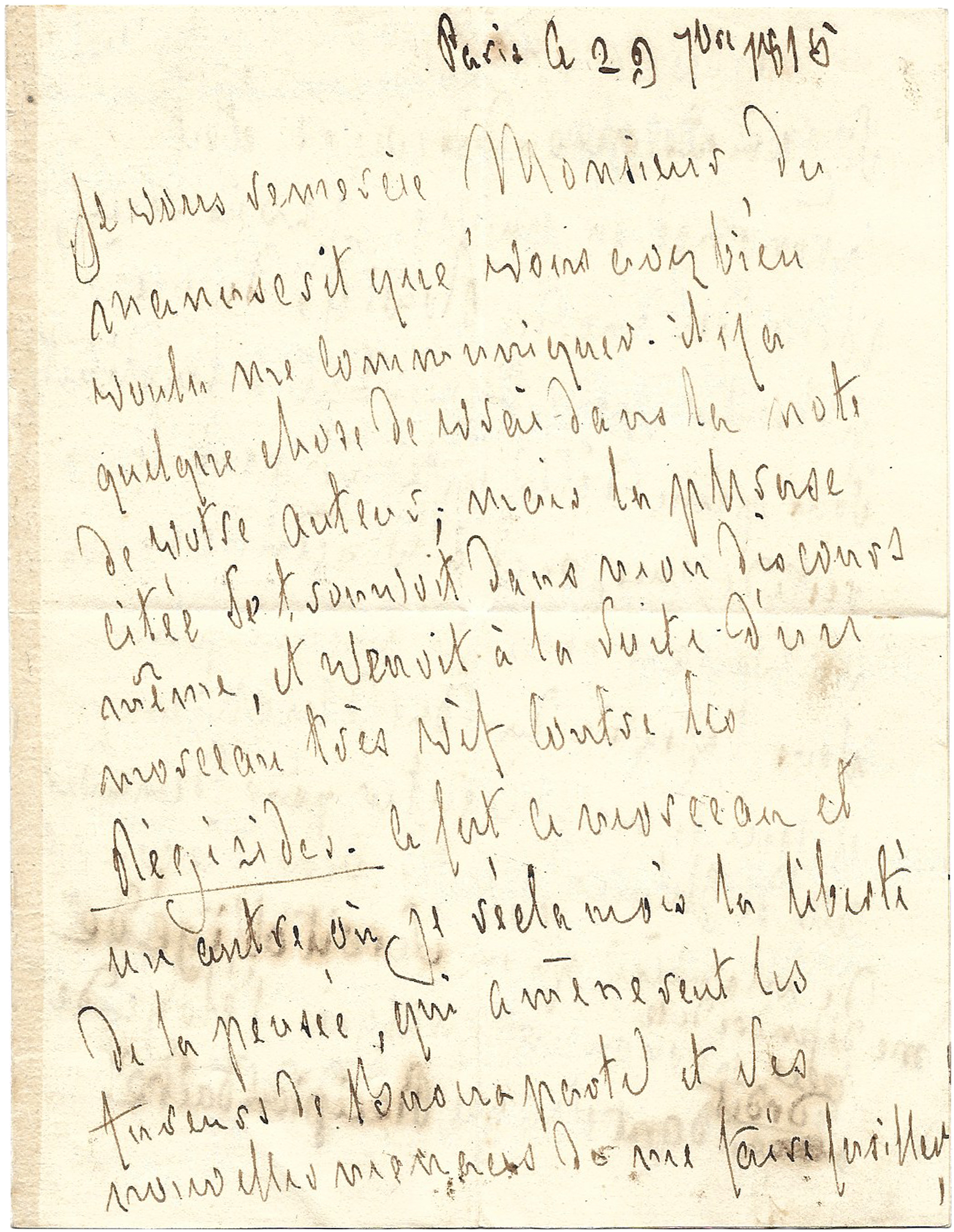
Autograph letter signed « Le Vte de Chateaubriand » to Abel
Paris, 29th Sept. 1815, 4 pp. in-8°
« I was advocating for freedom of speech, which provoked Buonaparte’s fury and his renewed threats to have me executed »
Autograph letter signed « Le Vte de Chateaubriand » to Abel
Paris, 29th Sept. 1815, 4 pp. in-8°
Numerous unpublished corrections by Chateaubriand on page 2 and 3
Collection stamp on fourth page, previous mounting on left margin
Endowed with an unyielding moral conscience, Chateaubriand recounts the fury provoked in Napoleon by his reception speech at the Academy
« Je vous remercie, Monsieur, du manuscrit que vous avez bien voulu me communiquer. Il y a quelque chose de vrai dans la note de votre auteur [J.E. Chetwode] ; mais la phrase citée se trouvait dans mon discours même, et venait à la suite d’un morceau très vif contre les Régicides. Ce fut un morceau et un autre, où je réclamais la liberté de la pensée, qui amenèrent les fureurs de Buonaparte et ses nouvelles menaces de me faire fusiller, si jamais mon discours était prononcé en public. J’avais reçu l’ordre du duc de Rovigo de me présenter pour candidat à l’institut, sous peine d’être enfermé pour le restant de mes jours à Vincennes.
Ne voulant occuper aucune place sous l’assassin du duc d’Enghien, et forcé de me présenter pour occuper celle de [Marie-Joseph] Chénier, je fis mon discours de manière qu’on serait obligé de me défendre de le prononcer malgré l’éloge de droit don chaque récipiendaire était obligé de couronner son discours. Je réussi dans ce dessein, mais je pensais y perdre la vie ; et l’on se rappelle tout le bruit que cette affaire de l’institut fit dans le temps à Paris.
Je pense donc Monsieur, que l’anecdote racontée par M. Chetwode étant presque entièrement controuvée, elle peut être supprimée sans inconvénients.
Pour mon compte, je désire que l’on parle de moi le moins possible. C’est à vous Monsieur, de suivre là-dessus votre sentiment ; et je vous renouvelle encore mes remerciements pour votre politesse et la délicatesse de votre procédé envers moi.
J’ai l’honneur d’être, Monsieur, votre très humble et très obéissant serviteur.
Le Vte de Chateaubriand »
When Marie-Joseph Chénier (brother of the poet guillotined during the Revolution) died on 10 January 1811, his death left vacant a seat in the second class of the Institut, devoted to the French language and literature. Reluctant to take over Chénier’s seat, Chateaubriand was also keenly aware that he would, moreover, be compelled to deliver the customary eulogy of a man who had mocked Atala, voted for the death of Louis XVI, and dragged Catholicism through the mud. Nevertheless, the writer resolved to do so.
The address was read in April 1811 before the Academy, not by its author himself, as some had urged, but in his absence, by one of the members of the Commission. Combining praise of liberty, attacks on political authority, and a claim to the writer’s right to express himself without constraint, the discourse assumed the contours of an anti-imperial pamphlet.
Following a brief debate conducted in secrecy, a vote was held which decided, by a majority, that the discourse could not be accepted. Chateaubriand, who was waiting in an adjoining room, was immediately informed of this decision. Regnaud de Saint-Jean-d’Angély, one of the Emperor’s close associates, hastened to report the incident, which he regarded as more political than literary. Carrying the discourse with him, he ensured that Napoleon became immediately acquainted with its contents. Great was the Emperor’s irritation: for he took the entire argument as directed at himself, and therefore all its attacks. Chateaubriand was forbidden to take his seat; he would gain access to it only at the time of the Restoration.
An enmity dating back to the assassination of the Duc d’Enghien
The personal relationship between the great writer and Napoleon Bonaparte deteriorated under the Empire. Chateaubriand’s admiration for Bonaparte had nevertheless been complete from 1800 onward; he was even appointed First Secretary of the Embassy in Rome. However, he shifted to open distrust following the execution of the Duc d’Enghien in 1804. He immediately tendered his resignation and entered into opposition to the Empire.
The writer would later return at length to these episodes in volumes III and IV of his Memoirs from Beyond the Grave.
Provenance:
Coll. Benjamin Fillon, Charavay, 15 juillet 1878 – série VII – n°1173
L.B. collection
Bibliography:
Correspondance générale, éd. P. Riberette, Nrf, t. III, p. 60-61, n°729
Correspondance, éd. Thomas, t. I, p. 392-395 (n° 246aa)
Marquis de Granges de Surgères, Une gerbe de lettres inédites de Chateaubriand, Nantes et Pars, Leclerc, 1911, p. 28
Join our mailing list and be the first to hear our latest news and biggest announcements.
By signing up you agree to our privacy policy. You can unsubscribe at any time.