Keep ahead of the pack
Join our mailing list and be the first to hear our latest news and biggest announcements.
By signing up you agree to our privacy policy. You can unsubscribe at any time.
Autograph manuscript signed, first draft
N.p., [c. 1952-1954], 296 p. in-4° et 56 p. in-8°
Exceptional preparatory corpus for the collection Clair-obscur, enriched with five original drawings
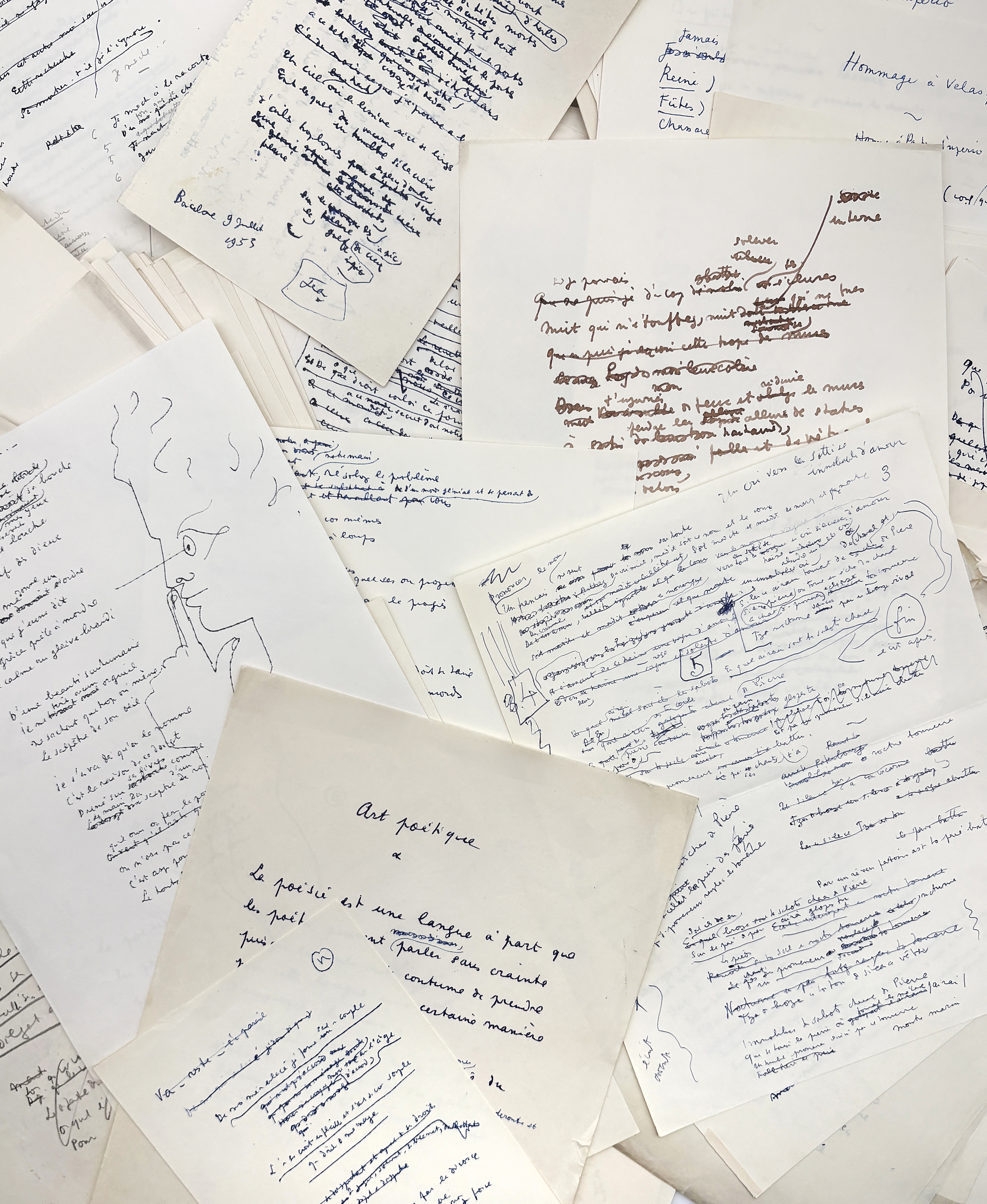
Autograph manuscript, signed in various places, first draft, for his collection Clair-obscur.
N.p., [c. 1952-1954], 296 p. in-4° et 56 p. in-8°, mainly on vellum paper from Lalo writing pads; three cardboard backings and an envelope were also used as supports for drafts; in addition, 5 leaves in folio of drawing paper from a spiral-bound pad. About thirty poems are accompanied by their carbon copies. Most pages are written in blue ballpoint pen, about thirty in pencil, four in pale green ballpoint pen on lined paper. The whole is gathered in an ochre folder, titled by Cocteau “Esquisses pour Clair-obscur”. This corpus, comprising more than 350 pages of sketches, notes, drafts and intermediate fair copies, bears innumerable obliterations, deletions and overwritings, allowing the full extent of the collection’s genesis to be measured. A few leaves are frayed at the upper margin (without affecting the text); some light sunning is also noted, not serious.
Exceptional preparatory corpus for Clair-obscur, enriched with five original drawings
« POETRY IS A LANGUAGE APART »
One of the most important collections of poems of Cocteau’s maturity, in part a tribute to the Spanish masters
This manuscript is the very first elaboration of the collection Clair-obscur, bearing witness to a laborious and complex poetic undertaking. The variants, later discarded from the final collection, are innumerable. Although the composition falls mainly between August 1952 and July 1954, Cocteau probably expressed the wish to go « to the end of Clair-obscur » while working on his « Hommage à Picasso », around mid-June 1953. In August of the same year, he conceived « Hommages et poèmes espagnols » as the central section (« Obscur » in the collection), but wished to frame it with an opening and a closing « in light » (Le Passé défini, vol. II, Gallimard, 1985, pp. 157, 165). The division of the book into three distinct parts was thus present very early on. This is borne out by the plan of this very first draft: « 1. The little preface – with asterisk and note at the end of the book. / 2. Severe selection of non-Spanish poems. / 3. Spanish suite (dated) / 4. One should end on a masterpiece – but there you are! »
If this corpus bears witness to the poet’s effervescence and enthusiasm while writing his collection, it also shows that this ambitious poetic undertaking was carefully worked out by Cocteau. The famous little preface to the collection is already fixed in this first draft, in a fuller version than the one published, with a second paragraph that was discarded in the following preparatory corpus: « Poetry is a language apart which poets can speak without fear, since crowds are in the habit of mistaking for this language a certain way of speaking their own / Poetry requires one to tie and untie the thread of the word in such a way that its ball bewilders and never unwinds as far as the street ».
Five original drawings accompany this preparatory file: besides a very fine profile partly superimposed on a poem, Cocteau drew a handsome Spanish scene in which bulls, toreadors and flamenco dancers are intertwined. On other leaves, small drawings, shapeless sketches and undulating lines accompany and extend the tormented writing of the drafts, in contrast with the hand of the finished manuscripts. The lines of verse sometimes run across the page diagonally or in every direction, producing a set of astonishing graphic richness created by the writing itself, like genuine works of art.
This set gives a very complete panorama of the avant-texte and reveals the various stages of the poet’s work, offering an immersion into the heart of his creative process. While some leaves show hastily jotted notes added to drafts already overloaded with strike-throughs, other pages present near-final forms of fair-copied poems, some of them signed and dated.
Besides the dates, one finds important details; thus on a draft of the first three stanzas of the Hommage à Goya: « L’Hommage à Goya was written the same day, but L’Hommage à Gréco had been made in my head since Toledo ». In addition to chronological or contextual indications, Cocteau sometimes added to the margins notes taken as reminders, with no direct relation to the text.
The poems of the last part, where the formal research is most advanced, bear the traces of successive hesitations and rewritings. Thus the drafts for Hommage à Pouchkine occupy ten leaves, nine of them dated. The stages in the making of the poem run from 25 June to 5 July 1954. The last leaf gives another version of the final stanza, still heavily crossed out. A series of notes written during its composition, together with a proof and two typescripts, are now preserved at the BHVP. There is also another preparatory manuscript, now in a private collection, which lacks seventeen pages. The collection was published by Éditions du Rocher in the autumn of 1954.
Provenance:
Francine Weisweiller, one of his most faithful friends, who often stayed at the poet’s villa in Saint-Jean-Cap-Ferrat; Carole Weisweiller (by descent); private collection
Bibliography:
Œuvres poétiques complètes, éd. Michel Décaudin, Pléiade, 1999, p. 835-967
Join our mailing list and be the first to hear our latest news and biggest announcements.
By signing up you agree to our privacy policy. You can unsubscribe at any time.