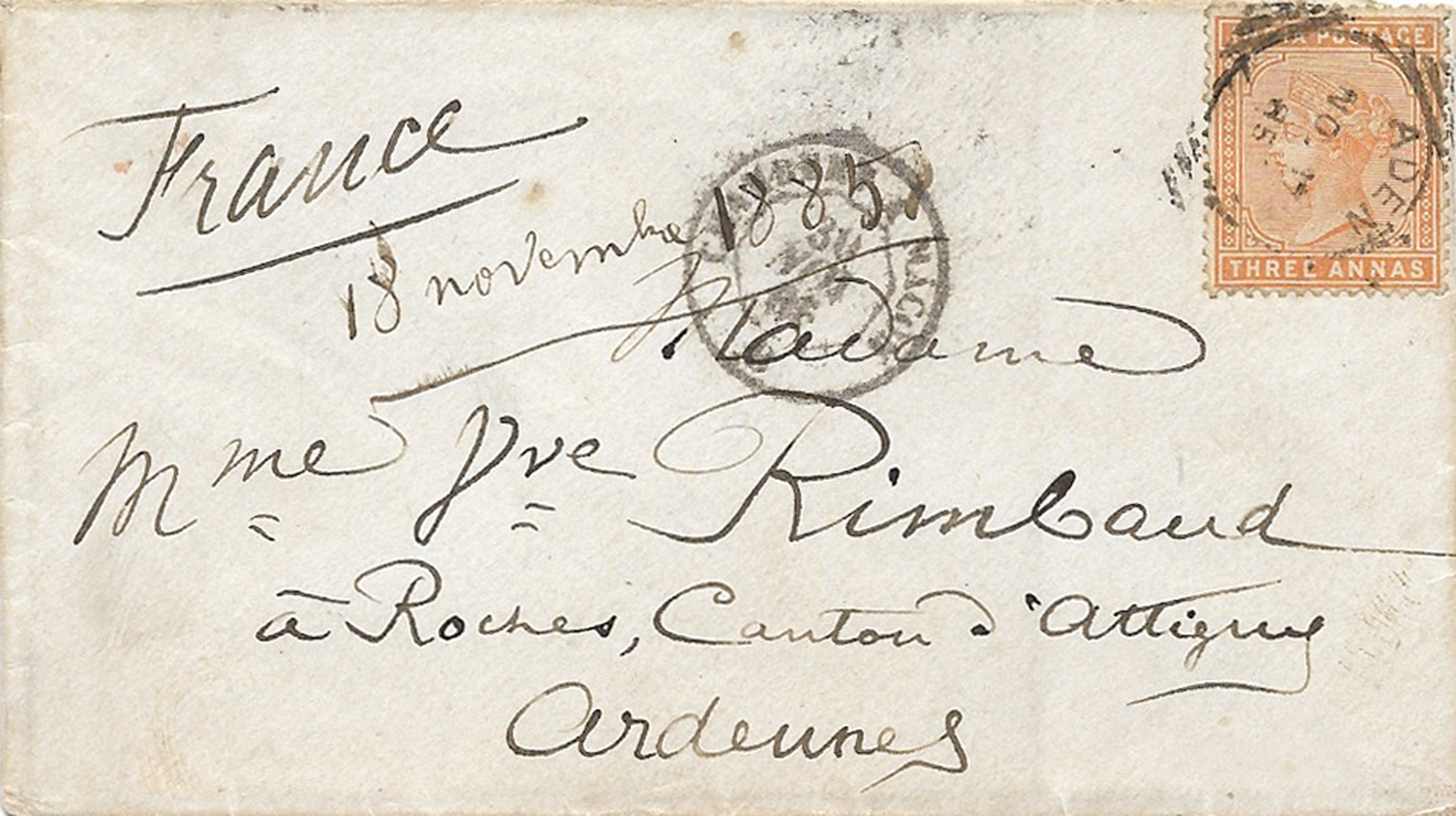
COURBET, Gustave (1819-1877)

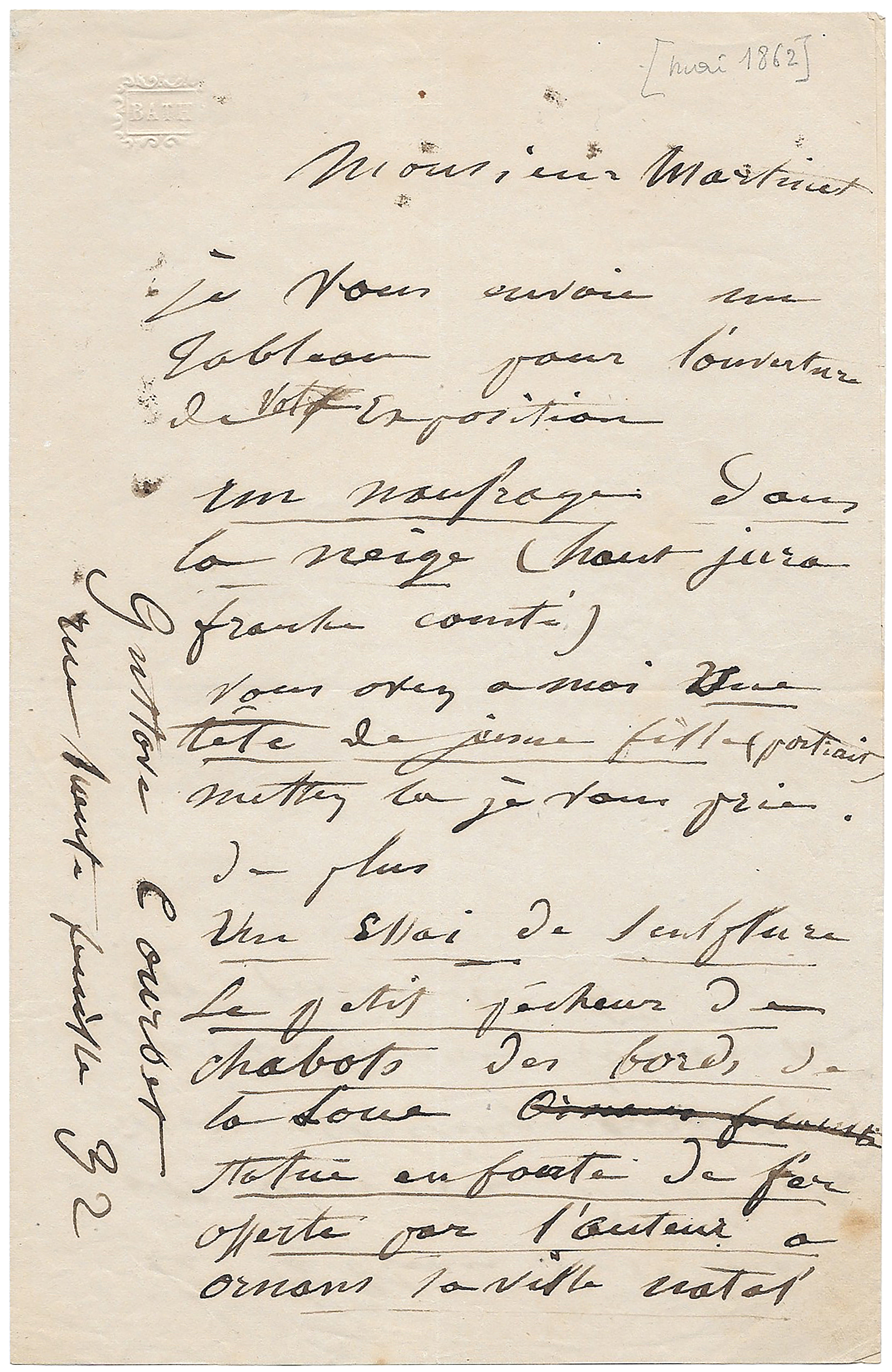
Autograph letter signed « Gustave Courbet » à Louis Martinet
[Paris] « rue Hautefeuille 32 », n.d. [May 1862 ?] 1 p. ¼ in-8°, on brown ink

« I’m sending you a painting for the opening of your exhibition »
SOLD
Fact sheet

COURBET, Gustave (1819-1877)

Autograph letter signed « Gustave Courbet » à Louis Martinet
[Paris] « rue Hautefeuille 32 », n.d. [May 1862 ?] 1 p. ¼ in-8°, on brown ink
Slight ink offset on the upper part of the first page, evidence of a fold made by Courbet while the ink was still wet, three words struck through by the author
Blind embossed stamp “BATH” in the upper left corner

Courbet gives his instructions for the exhibition of his works, paintings and sculpture, at the Société nationale des Beaux-Arts

Unpublished letter, the only one known today from Courbet addressed to Martinet


« Je vous envoie un tableau pour l’ouverture de votre exposition.
Un naufrage dans la neige (haut jura franche comté)
Vous avez à moi une tête de jeune fille (portrait) mettez la je vous prie.
de plus
Un essai de sculpture Le petit pêcheur de chabots des bords de la Loue Ornans fr.
[anche] comté
Statue en fonte de fer offerte par l’auteur a Ornans sa ville natal
[e]
[en marge :]
Gustave Courbet
rue haute feuille 32

[…] »


Initially an inspector in the Beaux-Arts administration, Louis Martinet left his position to open, in 1859, his first permanent painting exhibition gallery at 26, boulevard des Italiens, in Paris. In order to increase his standing with the great collectors of the time, he partnered with Théophile Gautier in 1862 to found, that same year and at the same address, the Société nationale des Beaux-Arts, whose “principle […] is copyright in painting, – the legitimate and fair profit that the artist should be able to draw from the exhibition of his work” (Louis Martinet, in his opening remarks in the Courrier artistique, 15 March 1862).
Courbet joined Delacroix and Corot in answering the gallery owner’s call for the Society’s very first exhibition, which opened its doors on 15 June. To his inevitable sculpture, the Pêcheur de Chabots, were added three oil paintings on canvas: Le Naufrage dans la neige (1860), Les Demoiselles de village (1852), which is not mentioned in the letter, and, it seems, a third canvas, the “Tête de jeune fille” mentioned here by Courbet, which we have not been able to identify.
Made in March 1862 in front of his students, the Pêcheur de chabots was at the time a great source of pride for Courbet. The statue depicts a child of about ten years old, entirely nude, fishing with a trident. As he specifies in his letter, the word “essai” (trial) appears on the cast bronze copy given by the artist to Ornans, his native town. Courbet had at the same time sent a copy, presumably in plaster, to the International Exhibition in London as well as to Paris, where, as he says in a letter to his father from April 1862, “it caused an extraordinary stir” (Corr., ed. Petra Ten-Doesschate Chu, no. 62-2). Another copy, in addition to the one exhibited by Martinet at the Société nationale des Beaux-Arts, was sent to the exhibition in Besançon.
Writing from Saintes and concerned about the critical reception of his works, the artist asked after the progress of the exhibition in a letter to Jules Troubat from June 1862: “Give me news of my statue and of the Martinet exhibition.” (Ibid., no. 62-4).
Le Naufrage dans la neige is today held at the National Gallery in London (inv. NG3242).
The address 32, rue Hautefeuille was Courbet’s Parisian studio, where he made, among other works, his famous painting L’Atelier du peintre, Allégorie Réelle déterminant une phase de sept années de ma vie artistique (et morale), executed in 1855 and now held at the Musée d’Orsay (inv. RF2257).

Provenance:
Private collection

Literature:
Gustave Courbet en Saintonge, Roger Bonniot, éd. C. Klincksieck, Paris, 1973, p. 286 ; Courbet [Catalogue raisonné], t. I et t. II, Robert Fernier, Bibliothèque des arts, 1978, p. 267 [pour Le Naufrage dans la neige] et p. 315 [pour le Pêcheur de Chabots, orthographié « chavots »] ; Correspondance de Courbet, éd. Petra Ten-Doesschate Chu, Flammarion, 1995, p. 186-189

Keep ahead of the pack

Join our mailing list and be the first to hear our latest news and biggest announcements.

By signing up you agree to our privacy policy. You can unsubscribe at any time.