Keep ahead of the pack
Join our mailing list and be the first to hear our latest news and biggest announcements.
By signing up you agree to our privacy policy. You can unsubscribe at any time.
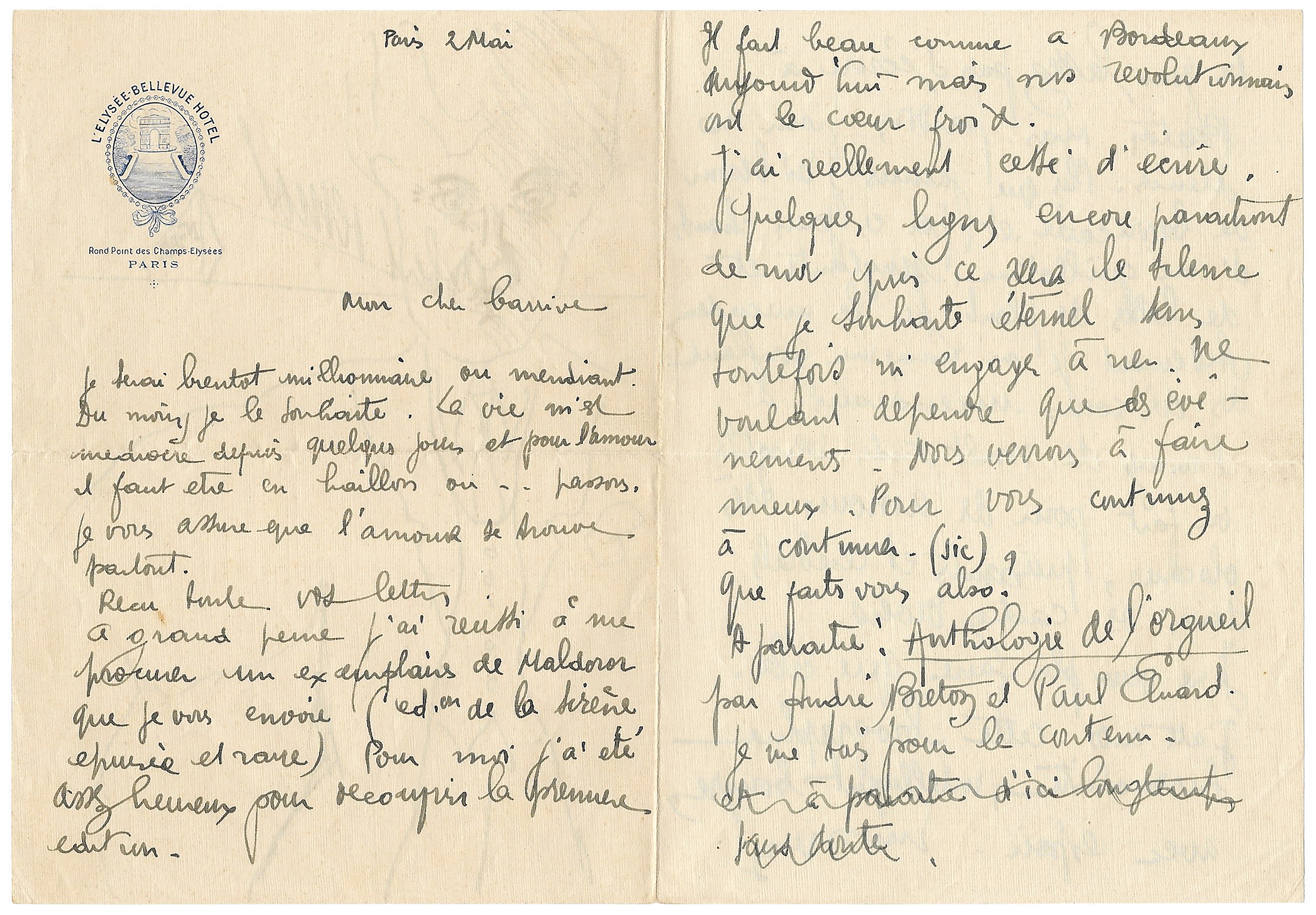
Autograph letter signed « Robert Desnos » to Jean Carrive
Paris, 2 May [1923], 4 p. in-12° à in dark blue ink
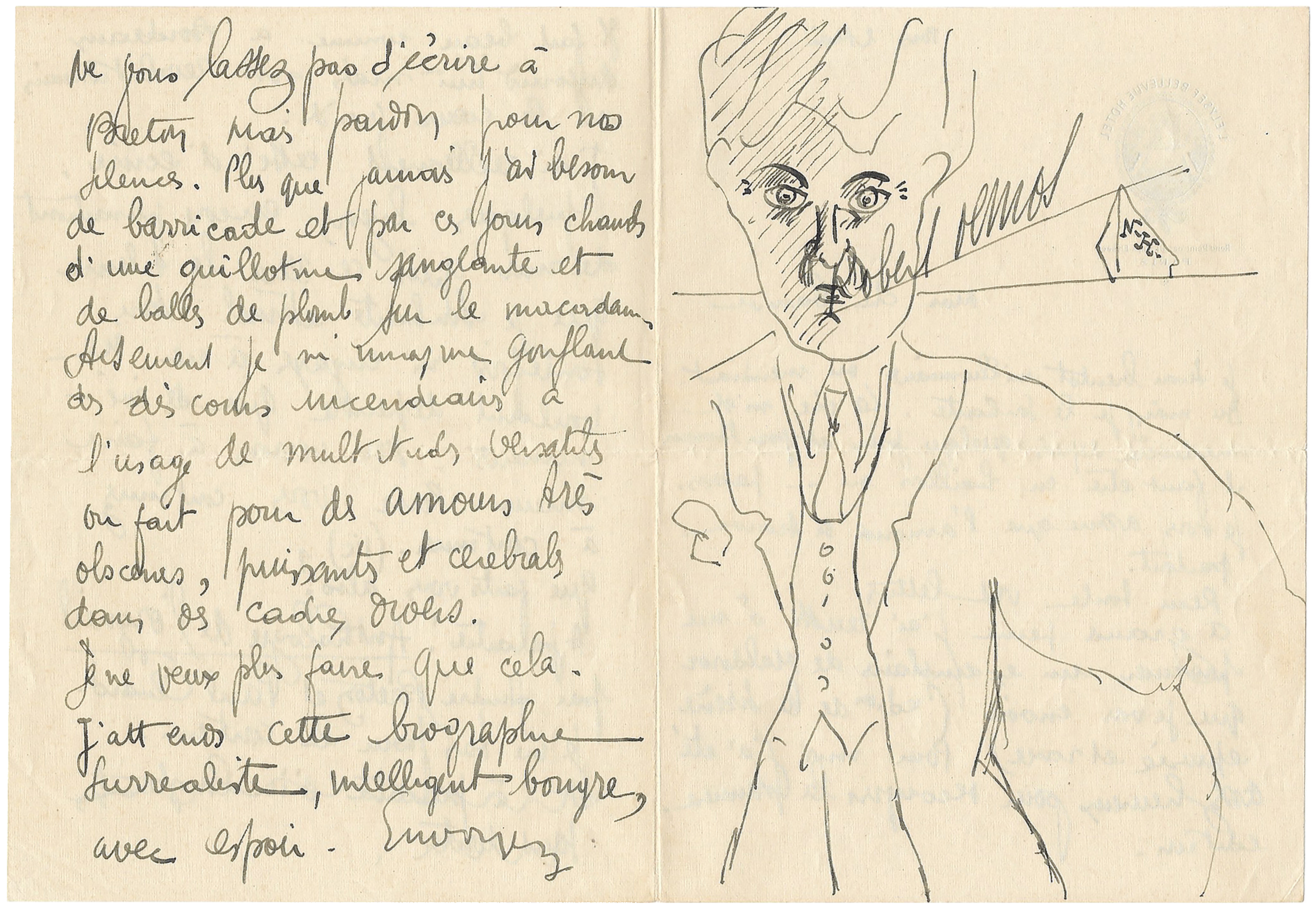
« More than ever, I feel the need for a barricade and, in these sweltering days, for a blood-stained guillotine and lead bullets on the pavement »
Autograph letter signed « Robert Desnos » to Jean Carrive
Paris, 2 May [1923], 4 p. in-12° à in dark blue ink
On stationery bearing the letterhead of the Hôtel de l’Élysée-Bellevue.
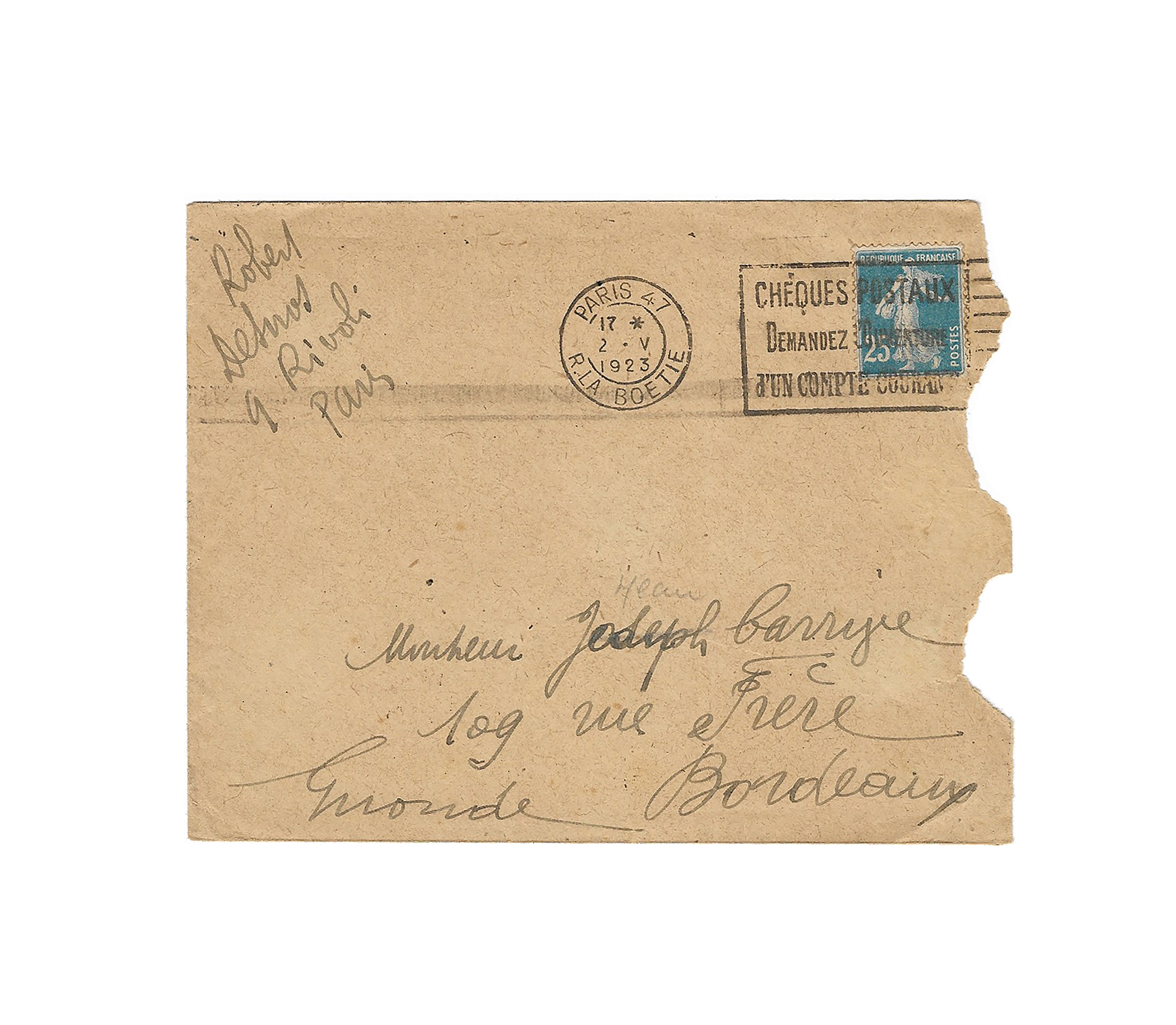
Autograph envelope enclosed, stamped and postmarked (with minor marginal loss).
Fine letter by the poet, containing a reference to one of his hypnotic trances and enhanced by a full-page self-portrait
« Mon cher Carrive,
Je serai bientôt millionnaire ou mendiant. Du moins je le souhaite. La vie m’est médiocre depuis quelques jours et pour l’amour il faut être en haillons ou… passons.
Je vous assure que l’amour se trouve partout. […]
À grand’peine j’ai réussi à me procurer un exemplaire de Maldoror que je vous envoie (édition de la Sirène épuisée et rare)[édition de 1920. La première date de 1869]. Pour moi j’ai été assez heureux pour découvrir la première édition.
Il fait beau comme à Bordeaux aujourd’hui mais nos révolutionnaires ont le cœur froid.
J’ai réellement cessé d’écrire. Quelques lignes encore paraîtront de moi puis ce sera le silence que je souhaite éternel sans toutefois m’engager à rien, ne voulant dépendre que des événements. Nous verrons à faire mieux. […]
À paraître, Anthologie de l’orgueil par André Breton et Paul Éluard.
Je me tais pour le contenu. Et à paraître d’ici longtemps sans doute.
Ne vous lassez pas d’écrire à Breton mais pardon pour nos silences. Plus que jamais j’ai besoin de barricade et par ces jours chauds d’une guillotine sanglante et de balles de plomb sur le macadam.
Aisément je m’imagine gonflant des discours incendiaires à l’usage de multitudes versatiles ou fait pour des amours très obscènes, puissantes et cérébrales dans des cadres divers.
Je ne veux plus faire que cela.
J’attends cette biographie surréaliste, intelligent bougre, avec espoir. Envoyez.
[ici Desnos dessine son autoportrait, faisant sortir la signature de son prénom par sa bouche]
Robert Desnos »
Soon to become part of the Surrealist group forming around Éluard and Breton, Desnos distinguished himself above all through his experiments with hypnotic trance states, initiated notably at Breton’s home in 1922. While asleep, he answered questions, improvised poems and drawings, embodying an exceptionally free form of automatic speech. These sessions revealed his attraction to involuntary expression, dreams, and the marvellous, in which visions and figures spontaneously emerged. His need for a “barricade and, in these hot days, a blood-soaked guillotine” is a recurring motif in Desnos’s work, appearing in his hypnotic trance of 30 September 1922 (Littérature, n.s., no. 6, November 1922, p. 11).
Facing the final page, Robert Desnos drew his self-portrait, in which his signature, written out in full, appears to emerge from his mouth. On the horizon, a ship bearing the initials “N.H.” on its prow seems to refer to the New Hebrides.
A solitary Bordeaux schoolboy in revolt against family conventions, Carrive discovered the journal Littérature at the age of eighteen and sought, through André Breton, to join the Parisian avant-garde circle. Wary of this prolific correspondent, Breton frequently delegated to Desnos the task of replying to him. An exchange of singular freedom and intensity then developed between the two young men, in which provocation and a taste for literary subversion served as an implicit manifesto.
Carrive was among the nineteen names mentioned in the Manifeste du surréalisme (1924) as having “made an act of absolute Surrealism.” He contributed to the twelfth and final issue of La Révolution surréaliste in 1929, before gradually distancing himself from the movement at the end of the 1920s. André Breton ultimately settled his account with him, among others, in the Second Manifesto of Surrealism (1930): “M. Carrive, incapable of considering the political or sexual problem otherwise than from the standpoint of Gascon terrorism, ultimately a poor apologist for M. Malraux’s Garine.”
Provenance:
Jean Carrive, puis Charlotte Behrendt, épouse Carrive (1909-2002) ; Bibliothèque surréaliste de Jean Carrive, Tajan, 17 nov. 2016, n°416, (Charlotte Carrive’s estate)
Bibliography:
Cahiers Robert Desnos – 1923, ns n°9, 2020, p.71-73
Join our mailing list and be the first to hear our latest news and biggest announcements.
By signing up you agree to our privacy policy. You can unsubscribe at any time.