Keep ahead of the pack
Join our mailing list and be the first to hear our latest news and biggest announcements.
By signing up you agree to our privacy policy. You can unsubscribe at any time.
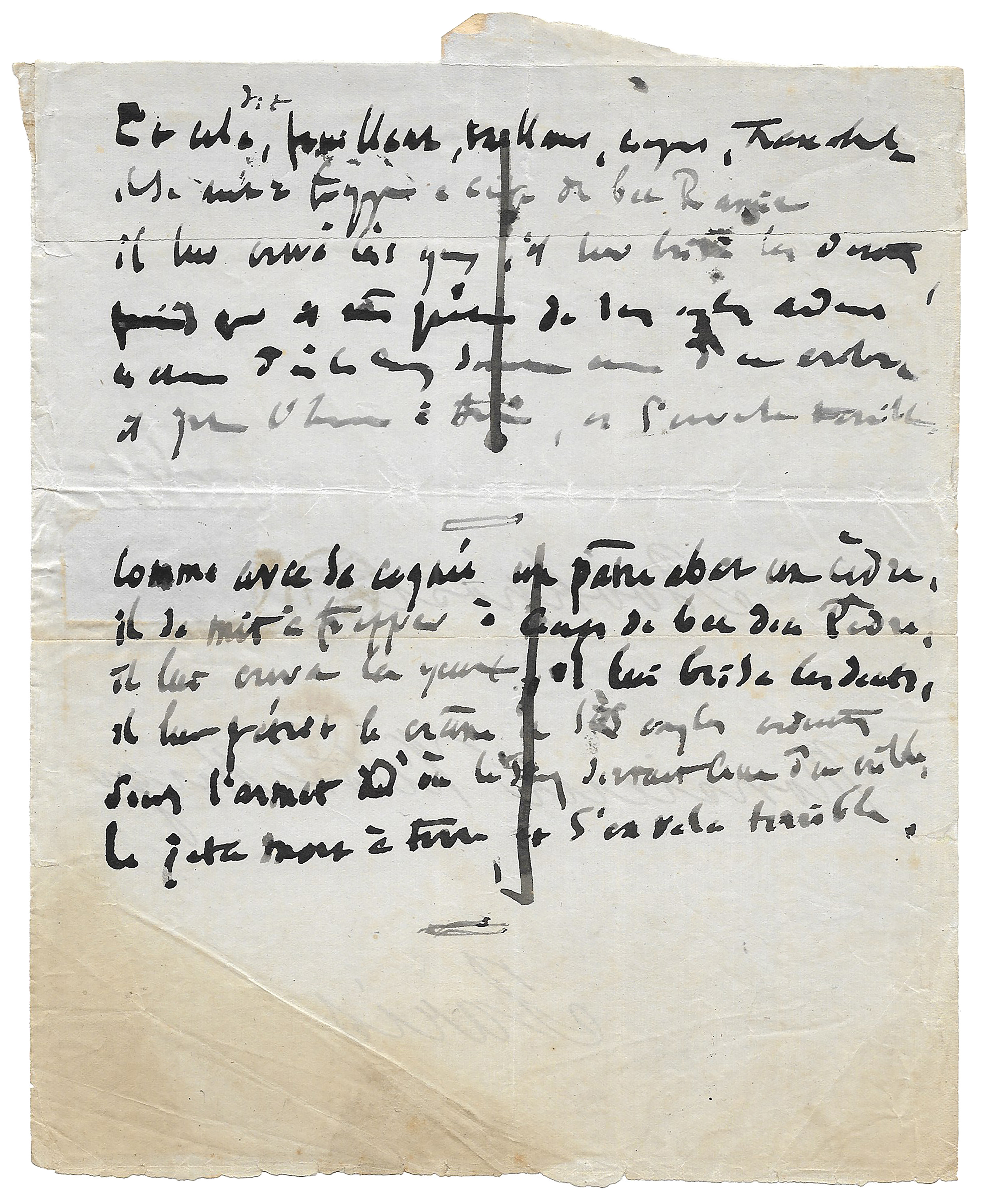
Autograph manuscript
[Paris, c. 1874-1876], 1 p. small in-4° (approx. 23 x 19 cm), in black ink
« Il se mit à frapper à coups de bec Tiphaine / Il lui creva les yeux ; il lui broya les dents »
Autograph manuscript
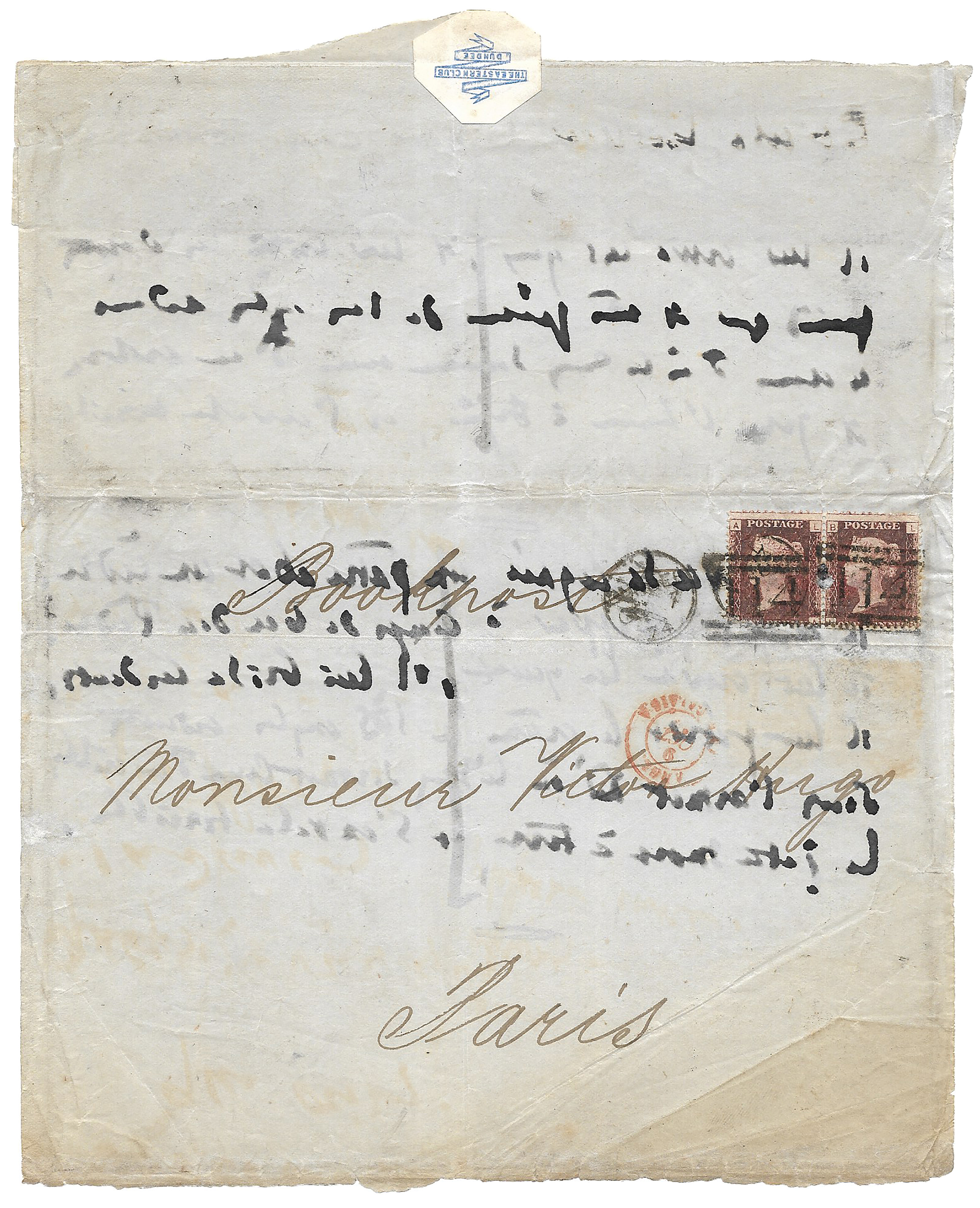
[Paris, c. 1874-1876], 1 p. small in-4° (approx. 23 x 19 cm), in black ink
On the verso of an unfolded envelope, addressed from the United Kingdom by an unidentified sender to « Monsieur Victor Hugo / Paris » (stamps and postal marks) ; seal reading « The Eastern Club / Dundee »
Minor creasing and soiling, of no consequence
Two unpublished variants of the last seven verses of L’Aigle du casque, Hugo’s monumental poem published in La Légende des siècles
Two groups of verses can be found on the verso of an envelope that served the poet as scrap paper. These two stanzas correspond to the ending of his monumental poem L’Aigle du casque. Hugo here portrays Tiphaine, a solitary Saxon knight, feared and without known ties, embodying the cruel and merciless warrior: he challenges to a duel the young count Angus, a sixteen-year-old boy, then, after an unequal combat, relentlessly pursues him through the woods despite the pleas of a hermit, of nuns, and of a mother, before savagely killing him. Hugo here provides the earliest drafts, hitherto unpublished, of the punishment inflicted upon Tiphaine.
« Et cela dit, ainsi qu’un piocheur fouille un champ,
Comme avec sa cognée un pâtre brise un chêne,
Il se mit à frapper à coups de bec Tiphaine ;
Il lui creva les yeux ; il lui broya les dents ;
Il lui pétrit le crâne en ses ongles ardents
Sous l’armet d’où le sang sortait comme d’un crible,
Le jeta mort à terre, et s’envola terrible. » (published version)
L’Aigle du casque appears in volume I of the Nouvelle Série of La Légende des siècles (Calmann-Lévy, 1877), within section IX, « Avertissements et châtiments » (p. 255-276). As with Le Mariage de Roland and Aymerillot (La Légende des siècles, 1859 ed.), the poem has its origin in an article by the medievalist historian Achille Jubinal: Quelques romans chez nos aïeux, published in the Journal du dimanche of 1 November 1846, and more specifically in the latter’s free translation of the chanson de geste Raoul de Cambrai. As Jacques Seebacher and Guy Rosa report in their critical apparatus to the Œuvres complètes (see reference below), « the avenging eagle replaces the stork with the ‘steel beak’ originally planned ». Behind the punishment of the « dark » lord Tiphaine, devoured by the metal eagle adorning his helmet, one can discern a fierce warning from the poet, then in the midst of his fight for the amnesty of the Communards.
The Œuvres complètes place the composition of the Nouvelle série of La Légende des siècles at 5 August 1876, which must necessarily correspond to the fair copy. The present fragment was written on the verso of an envelope addressed to the poet, dated 7 October 1874. It may therefore be supposed that Hugo drafted these variants upon receiving the letter, or shortly thereafter. As was his habit, he struck through each of the stanzas with a single vertical stroke, with a view to a further fair copy.
Provenance:
Coll. particulière
Bibliography:
Poésies complètes III, éd. Jacques Seebacher et Guy Rosa, Bouquins, 1985, p. 339 ; Hugo, La Légende des siècles de 1859, Claude Rétat, Sedes, p. 223
Join our mailing list and be the first to hear our latest news and biggest announcements.
By signing up you agree to our privacy policy. You can unsubscribe at any time.