Keep ahead of the pack
Join our mailing list and be the first to hear our latest news and biggest announcements.
By signing up you agree to our privacy policy. You can unsubscribe at any time.
Autograph letter signed « Eugénie » to Marie-Thérèse Bartholoni
[Farnborough Hill] s.d. [after 1873], 4 p. in-8°
« I don’t feel I have the courage to go back to a past so full of pain, disillusionment and disgust »
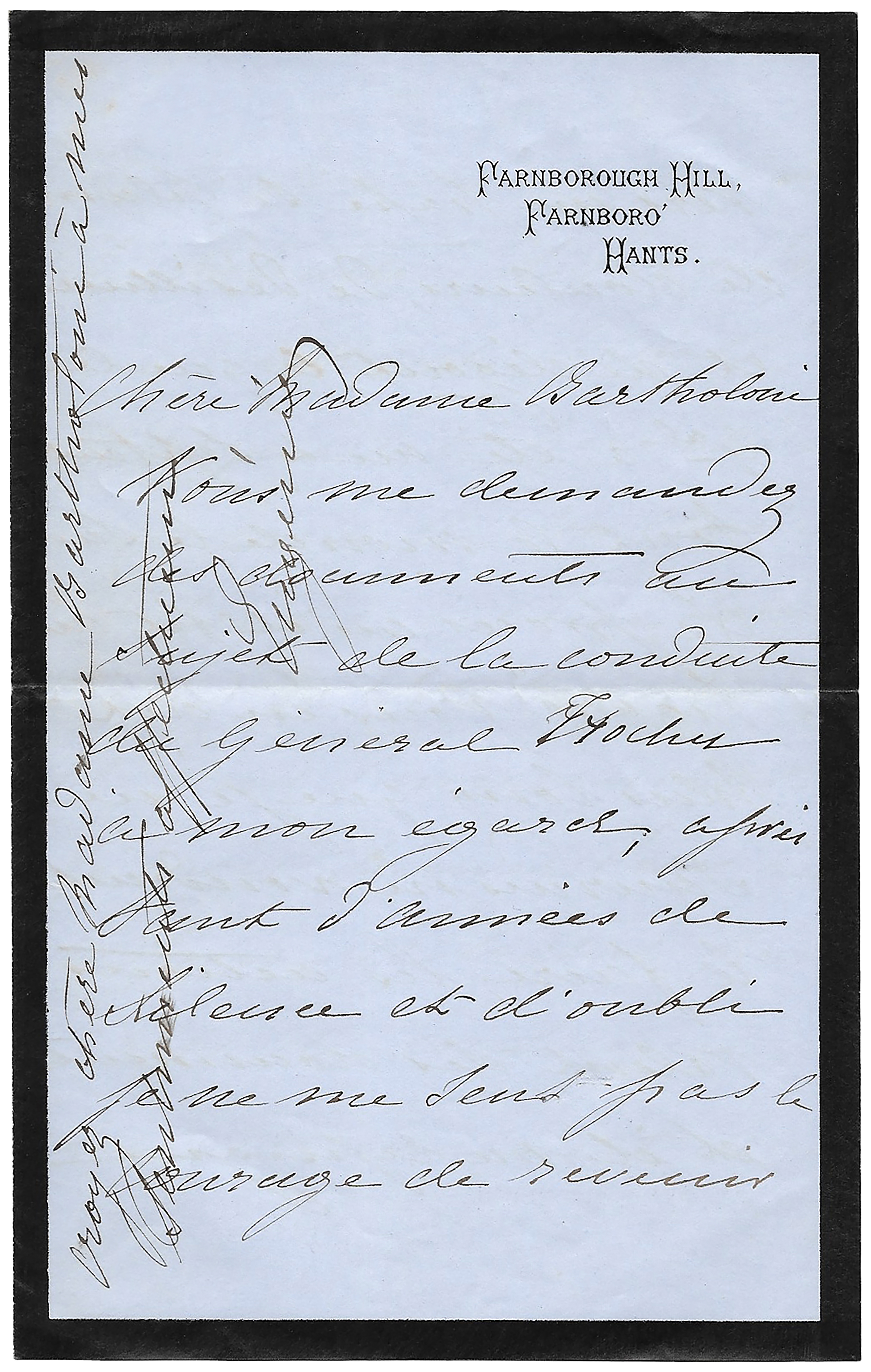
Autograph letter signed « Eugénie » to Marie-Thérèse Bartholoni
[Farnborough Hill] s.d. [after 1873], 4 p. in-8°, in black ink
Mourning stationery, light foxing of no consequence
Honor above all: Empress Eugénie’s harsh judgment of General Trochu’s conduct in the aftermath of the fall of the Empire
« Chère Madame Bartholoni,
Vous me demandez des documents au sujet de la conduite du général Trochu à mon égard ; après tant d’années de silence et d’oubli, je ne me sens pas le courage de revenir vers un passé si plein de douleurs, de désillusion et de dégoût.
Ce que le général a été au 4 septembre, tout le monde le sait.
Le procès qu’il fit au « Figaro » vous en dit plus long que je ne saurais ni voudrais le faire ; les actions valent des documents et il me répugne de le poursuivre dans sa retraite.
Il fut autrefois un vaillant soldat. L’orgueil le perdit dans un jour de malheur et lui fit oublier son devoir et son honneur.
Il crut sincèrement, je crois, sauver Paris. A ce prix, il trahit par excès de confiance en lui-même. C’est son excuse. Il s’est trompé et s’est fait justice lui-même.
C’est tout ce que je puis vous dire à ce sujet pénible pour moi, au-delà de ce que vous pouvez penser. Aujourd’hui, je tache d’oublier une époque qui, après le premier insuccès de nos armes, a été surtout la déroute des caractères.
Croyez, chère Madame Bartholoni, à mes sentiments affectueux.
Eugénie »
Louis Jules Trochu (1815-1896), an Orleanist, was never a supporter of the Second Empire. However, the notoriety he gained through his criticism of the French military organization led Napoleon III to appoint him Governor of Paris on 17 August 1870, in the midst of the Franco-Prussian War. The Empress’s main grievance here concerns the general’s conduct on the fateful day of 4 September 1870. She believed he made no active effort to defend the Regency or the imperial institutions against the movement that was about to bring down the regime. Parisian demonstrators, who had learned the previous day of the army’s capitulation at Sedan and of Napoleon III’s captivity, invaded the National Assembly and prevented the Corps législatif from deliberating. The Republic was then proclaimed at the Hôtel de Ville. In this power vacuum, General Trochu became president of the Government of National Defense. That was all the deposed Empress needed to repudiate him. Victor Hugo’s famous remark about this episode is remembered: “Trochu, past participle of the verb trop choir” (L’Année terrible, Michel Lévy frères, 1872, p. 270).
Goddaughter of Chateaubriand and lady-in-waiting at the Tuileries to Princess Julie Bonaparte, Marie-Thérèse Bartholoni (1833-1910) was, through her beauty, one of the ornaments of the Court of the Second Empire. Born Marie-Thérèse Frisell (1833-1910), she was the wife of Anatole Bartholoni (1822-1902), who served as a deputy in the Corps législatif from 1860 to 1869.
She kept a brilliant salon, which inspired Marcel Proust. The writer frequented it assiduously in the years 1897-1899, and was also a guest at the Château de Coudrée, which the Bartholonis owned on the shores of Lake Geneva, between Thonon and Geneva. The witty conversation of the former “belle of the Empire” seems to have strongly inspired him.
For a time, Marcel Proust courted one of Madame Bartholoni’s three daughters, Louise, known as “Kiki”, herself a goddaughter of Empress Eugénie.
Provenance:
Bartholoni estate
Join our mailing list and be the first to hear our latest news and biggest announcements.
By signing up you agree to our privacy policy. You can unsubscribe at any time.