Keep ahead of the pack
Join our mailing list and be the first to hear our latest news and biggest announcements.
By signing up you agree to our privacy policy. You can unsubscribe at any time.
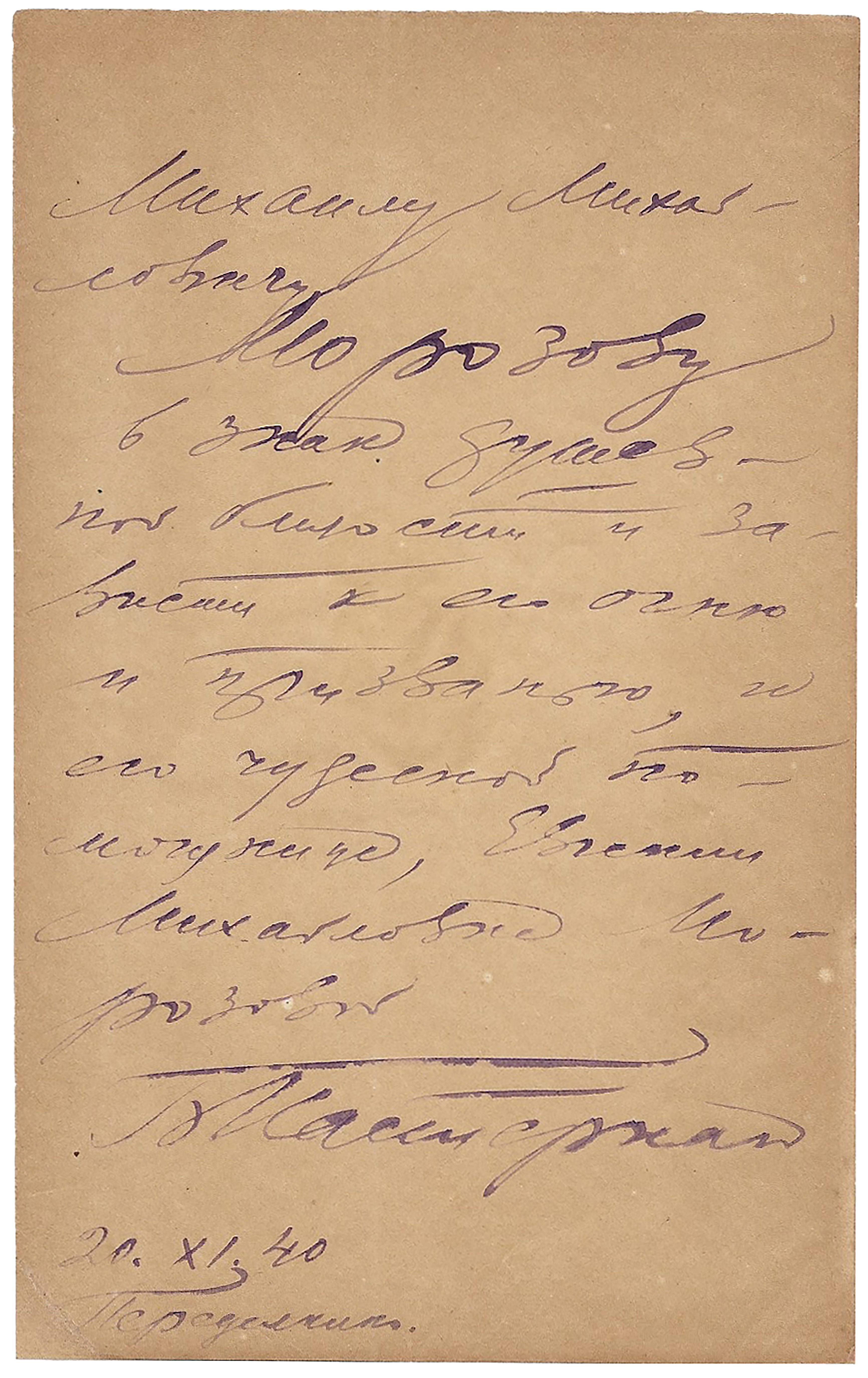
Autograph letter signed « B. Pasternak » to Mikhaïl Mikhaïlovitch Morozov
Peredelkino [Moscou Oblast], 20 Sept. 1940, 1 p. in-12° (in russian)
« In token of spiritual kinship »
Autograph letter signed « B. Pasternak » to Mikhaïl Mikhaïlovitch Morozov
Peredelkino [Moscou Oblast], 20 Sept. 1940, 1 p. in-12° (in russian), in purple ink
Paper uniformly browned, small loss at the lower left corner, skilfully restored (with no loss of text)
« Fire and Vocation » : Pasternak’s admiring tribute to his friend Morozov
A rare letter from the author of Doctor Zhivago
Translated from Russian:
« To Mikhail Mikhailovich Morozov, in token of spiritual kinship and envy for his fire and his vocation, and to his admirable assistant, Evgenia Mikhailovna Morozova.
B. Pasternak »
Original text:
« Михаилу Михайловичу Морозову,
В знак душевной близости и зависти к его огню и призванию,и его чудесной помощнице, Евгение Михайловне Морозовой.
Б Пастернак
Boris Pasternak and Mikhail Mikhailovich Morozov both moved within Moscow’s intellectual circles of the 1930s, where their paths crossed around a shared passion for Shakespeare. The son of the celebrated patron and art collector, Morozov established himself as a scholar and translator, becoming one of the foremost Soviet specialists in Shakespearean studies, notably directing the seminar devoted to the English playwright at the Faculty of Philology of Moscow University. Pasternak, for his part, harboured an equally passionate interest in Shakespeare, one that would lead him to translate several of his plays, including Hamlet.
A dacha village located some 25 km southwest of Moscow, Peredelkino was established in 1934 at the initiative of Maxim Gorky, with Stalin’s approval, to house the Soviet writers deemed most deserving by the regime. The place combined material privilege with the ideological oversight of intellectuals. It was at Peredelkino that Pasternak wrote much of Doctor Zhivago, whose 1957 publication and the Nobel Prize awarded in October 1958 brought down the wrath of the Soviet authorities upon him. The writer was compelled to decline the award in order to spare himself, and his family, severe reprisals.
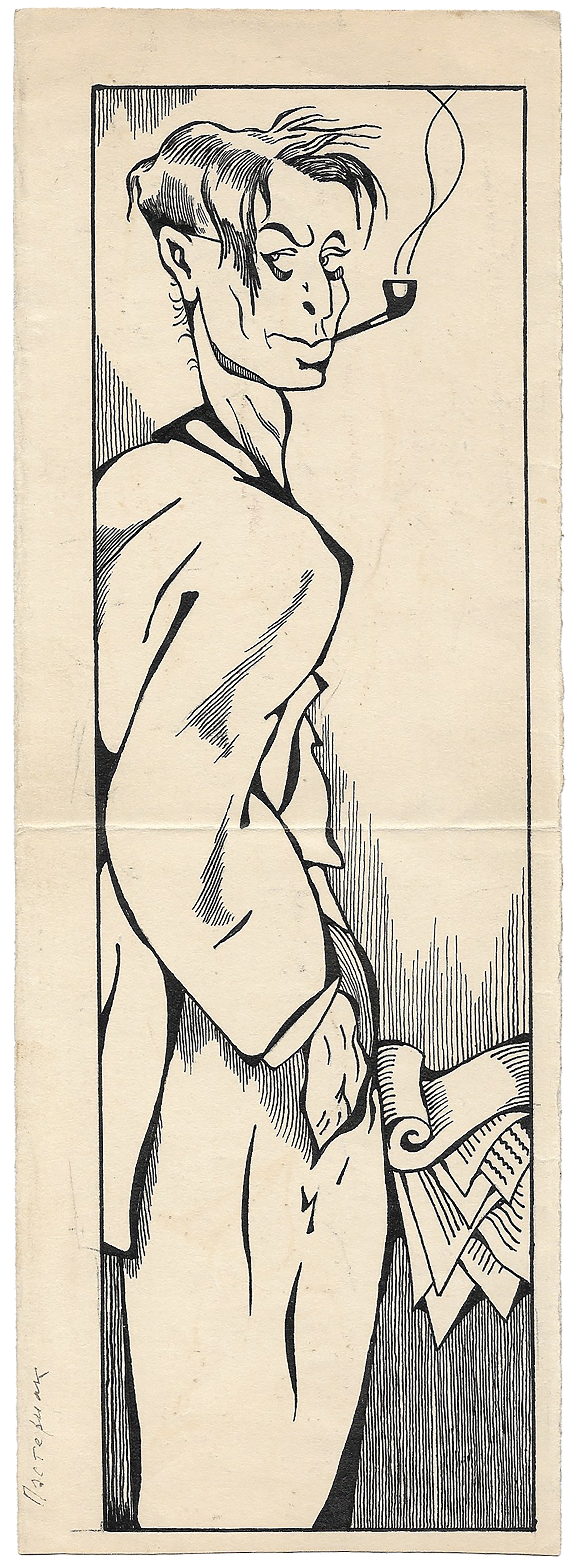
[Enclosed:] A striking India ink portrait of Pasternak, in profile, one hand in his pocket, the other holding a manuscript.
[Pasternak] Anonymous
N.p., n.d. [1940s?], approx. 28.1 x 10 cm, India ink on heavy paper
Titled «Pasternak» in Cyrillic script at the lower left corner
Annotation and portrait [of the artist?] in pencil on the verso, centre fold
Provenance:
Private collection
Join our mailing list and be the first to hear our latest news and biggest announcements.
By signing up you agree to our privacy policy. You can unsubscribe at any time.