Keep ahead of the pack
Join our mailing list and be the first to hear our latest news and biggest announcements.
By signing up you agree to our privacy policy. You can unsubscribe at any time.
Autograph letter signed « Joseph Caillaux » to Philippe Pétain
Mamers, Sarthe, 30 Apr. 1944, 1 p. in-8° on grey paper, in black ink
« I know President Roosevelt means to claim he backed you from the start »
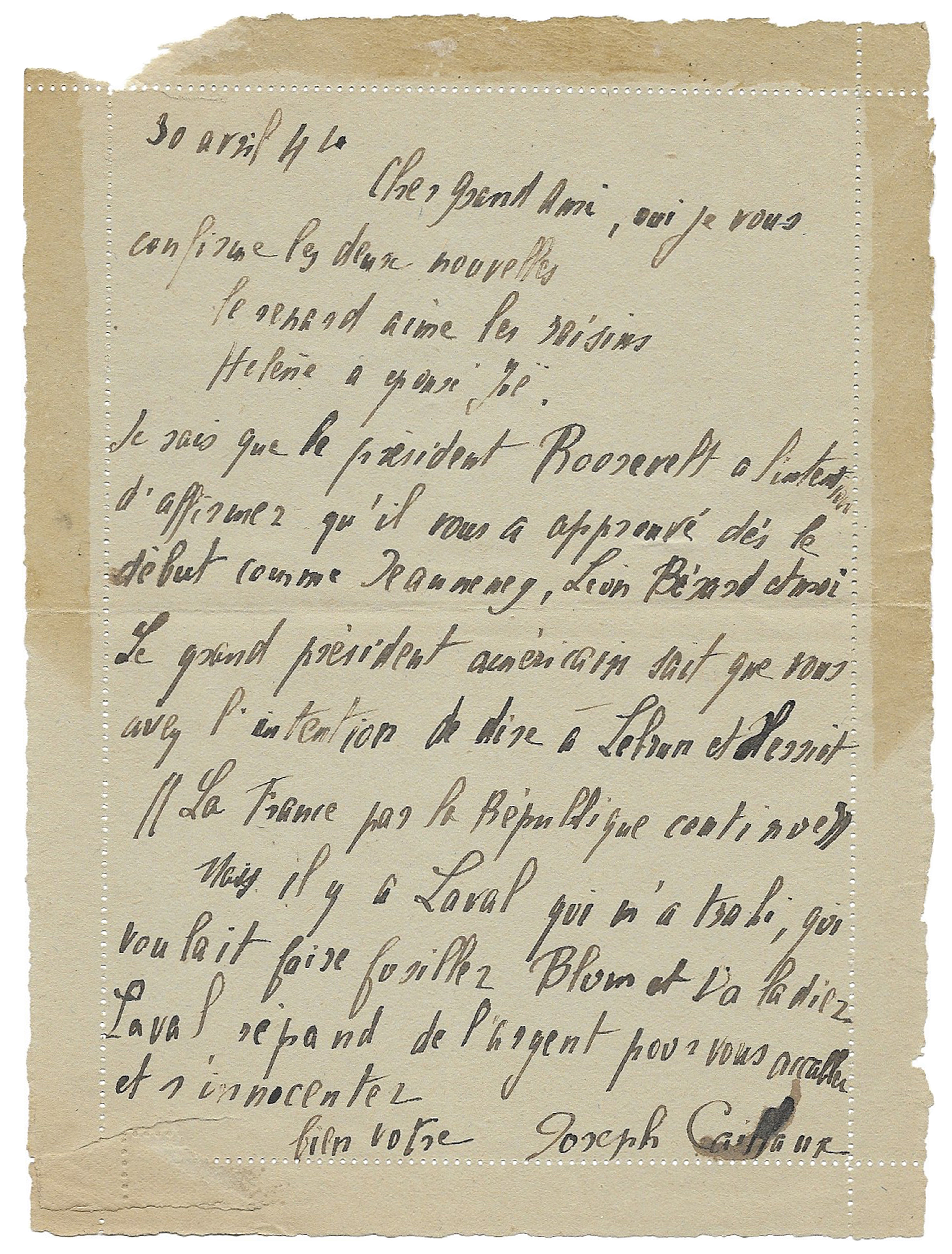
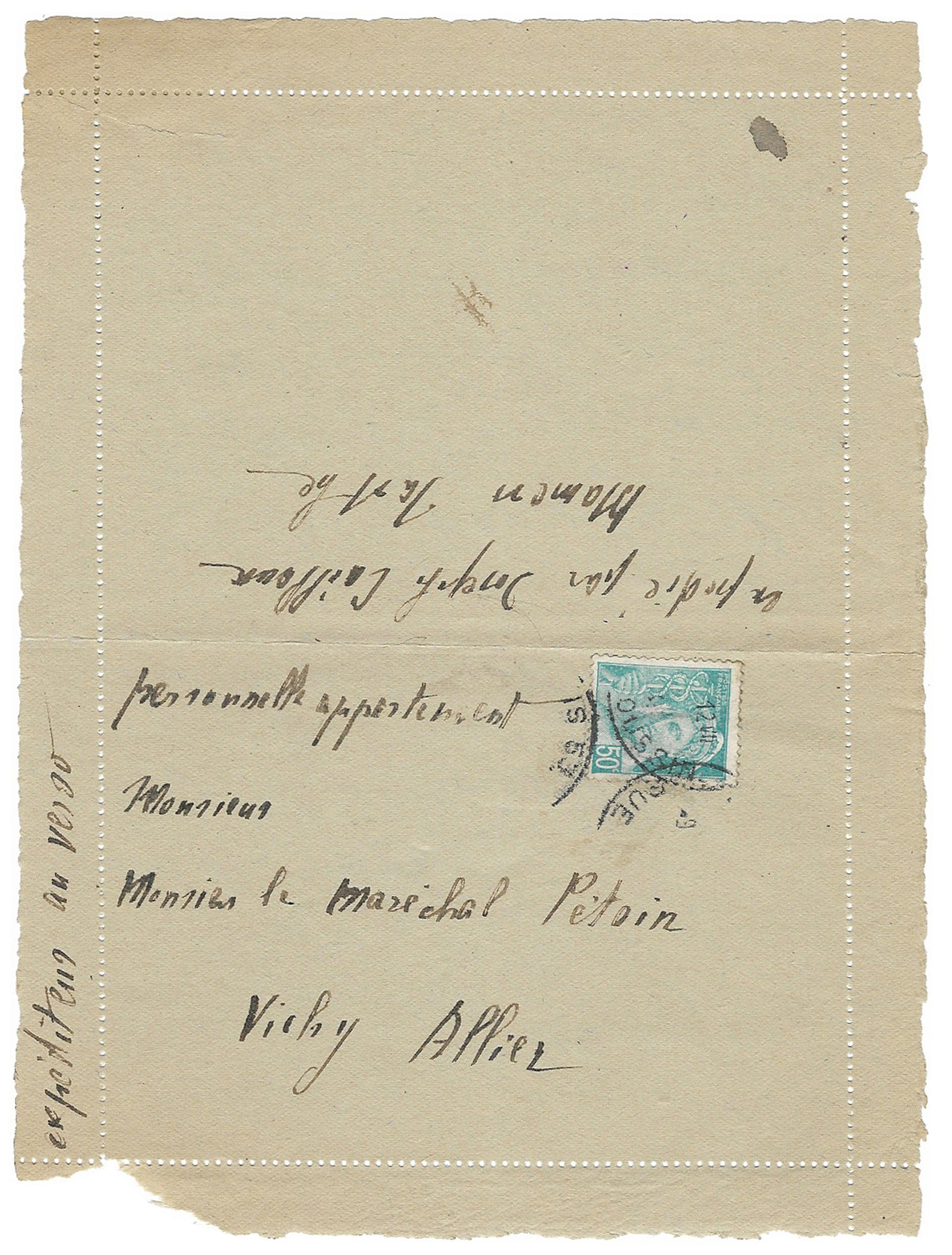
Autograph letter signed « Joseph Caillaux » to Philippe Pétain
Mamers, Sarthe, 30 Apr. 1944, 1 p. in-8° on grey paper, in black ink
Marginal tears at the opening, no loss of text; ink smudge at the signature
Curious letter from Caillaux to Pétain, at the twilight of the Vichy regime
« Cher grand ami, oui je vous confirme les deux nouvelles
Le renard aime les raisins
Hélène a épousé Joë
Je sais que le président Roosevelt a l’intention d’affirmer qu’il vous a approuvé dès le début comme [Jules] Jeanneney, Léon Bérard et moi.
Le grand président américain sait que vous avez l’intention de dire à [Albert] Lebrun et [Édouard] Herriot ‘La France par la République continue’.
Mais il y a Laval qui m’a trahi, qui voulait faire fusiller Blum et Daladier. Laval répand de l’argent pour vous accabler et s’innocenter.
Bien vôtre
Joseph Caillaux »
If Caillaux spends his final years in a kind of brooding introspection, his political career—begun as early as 1898—had in fact continued without interruption until 1940: he chairs the Senate Finance Committee up to that date and still holds, on several occasions during the interwar period, the post of Minister of Finance. He votes to grant full powers to Pétain on 10 July 1940. Contrary to what might be suggested at first glance, Roosevelt’s attitude toward Pétain stems less from ideological sympathy than from pragmatic calculation: maintaining a diplomatic channel with Vichy (through Ambassador William D. Leahy) is meant, it is hoped, to encourage those elements within the Vichy government opposed to military collaboration with Germany, and to limit French concessions to German demands in North Africa and the Levant. This policy is accompanied by a persistent distrust of de Gaulle, whom Washington regards as troublesome and unrepresentative.
The political situation in 1944 bodes ill for Pétain. The head of state is on the verge of being brought to trial for collusion with the enemy. In December 1940, Pétain dismisses Pierre Laval from his post as Vice-President of the Council, owing in particular to his excessive independence and his secret dealings with the Reich. What Pétain holds against him is less the principle of collaboration itself, which he shares, than the overly independent manner in which Laval conducts it.
Although Pierre Laval attempts to « s’innocenter » [clear himself], as Caillaux notes, he is ultimately executed as a traitor for his collaboration with the Nazis, on 15 October 1945. His grip on France weakens under the combined effect of the growing resistance movement and the rise of ultra-collaborationist currents embodied by Marcel Déat, head of the Rassemblement National Populaire (RNP), whose appointment to government in 1944 reflects the Reich’s tightening grip over the Vichy regime.
Provenance:
Private collection
Join our mailing list and be the first to hear our latest news and biggest announcements.
By signing up you agree to our privacy policy. You can unsubscribe at any time.