Keep ahead of the pack
Join our mailing list and be the first to hear our latest news and biggest announcements.
By signing up you agree to our privacy policy. You can unsubscribe at any time.
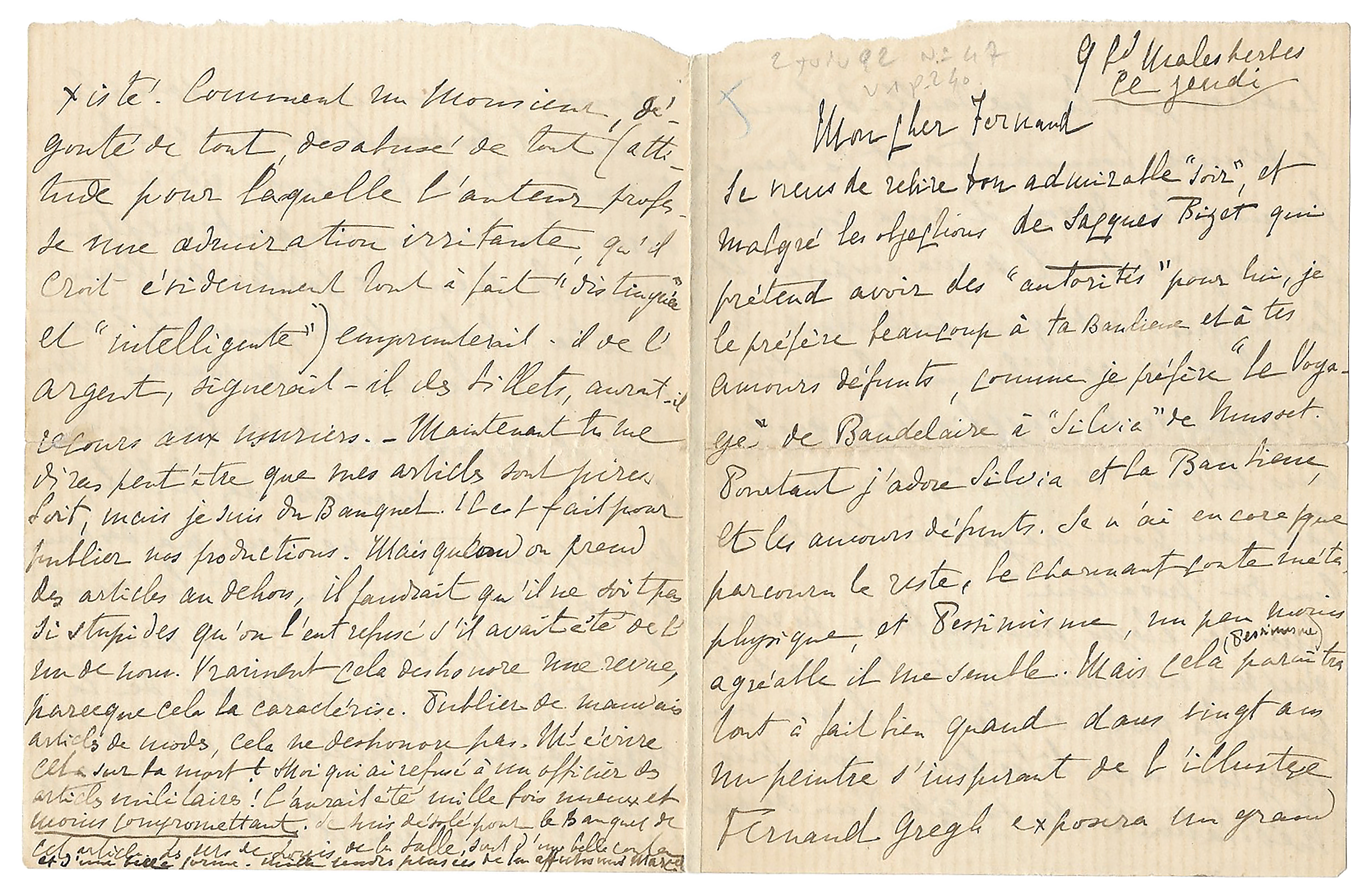
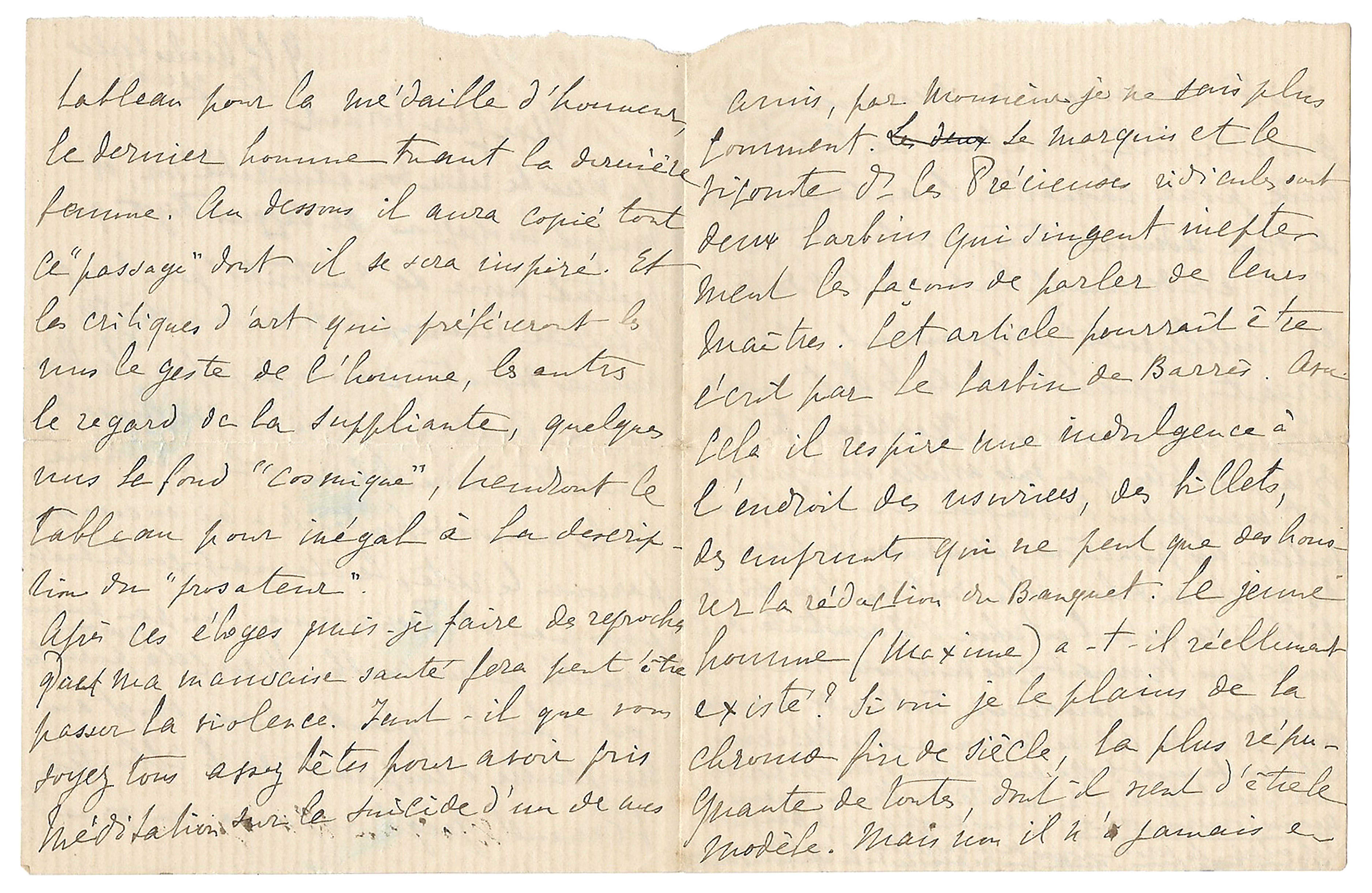
Autograph letter signed « Marcel » to Fernand Gregh
[Paris], « 9 bd Malesherbes », « ce jeudi » [2 June ? 1892], 4 p. in-12°
« This article could have been written by Barrès’s lackey »
Autograph letter signed « Marcel » to Fernand Gregh
[Paris], « 9 bd Malesherbes », « ce jeudi » [2 June ? 1892], 4 p. in-12° heavily filled with fine handwriting, in black ink on watermarked laid paper
Irregular upper margin, discreet trace of a mounting stub in the left margin, two words cancelled by Proust
The Literary Adventure of the Review Le Banquet, or Proust’s Masterly Beginnings in Criticism
When the author of Jean Santeuil cruelly savages Léon Blum in a letter both erudite and of extraordinary freedom of tone: « How can you all have been foolish enough to have taken “Méditation sur le suicide d’un de mes amis”, by Monsieur whatever-his-name-was »
« Mon cher Fernand, je viens de relire ton admirable « Soir » et malgré les objections de Jacques Bizet qui prétend avoir des « autorités » pour lui, je le préfère de beaucoup à ta « Banlieue » et à tes « Amours défuntes », comme je préfère « Le Voyage » de Baudelaire à « Silvia » de Musset. Pourtant j’adore « Silvia » et « La banlieue », et « Les amours défuntes ». Je n’ai encore que parcouru le reste, le charmant « Conte métaphysique », et « Pessimisme », un peu moins agréable il me semble. Mais cela (« Pessimisme ») paraîtra tout à fait bien quand dans vingt ans un peintre s’inspirant de l’illustre Fernand Gregh exposera un grand tableau pour la médaille d’honneur, le dernier homme tuant la dernière femme [dans le récit intitulé « Petit conte métaphysique », l’humanité est sauvée d’une extermination complète par la dernière femme, « misérable folle » qui seule conserve encore un désir aveugle de la vie]. Au-dessous, il aura copié tout ce « passage » dont il se sera inspiré. Et les critiques d’art qui préfèrent, les uns le geste de l’homme, les autres le regard de la suppliante, quelques-uns le fond « cosmique », tiendront le tableau pour inégal à la description du « prosateur ». Après ces éloges, puis-je faire des reproches dont ma mauvaise santé fera peut-être passer la violence. Faut-il que vous soyez tous assez bêtes pour avoir pris « Méditation sur le suicide d’un de mes amis », par Monsieur je ne sais plus comment [Léon Blum]. Le marquis et le vicomte dans Les Précieuses ridicules sont deux larbins qui singent ineptement les façons de parler de leur maîtres. Cet article pourrait être écrit par le larbin de Barrès. Avec cela il respire une indulgence à l’endroit des usuriers, des billets, des emprunts qui ne peut que déshonorer la rédaction du Banquet. Le jeune homme, Maxime, a-t-il réellement existé ? Si oui, je le plains de la chromo fin de siècle, la plus répugnante de toutes, dont il vient d’être le modèle. Mais non, il n’a jamais existé ! Comment un monsieur, dégoûté de tout, désabusé de tout (attitude pour laquelle l’auteur professe une admiration irritante, qu’il croit évidemment tout à fait « distinguée » et « intelligente ») emprunterait-il de l’argent, signerait-il des billets, aurait-il recours aux usuriers. Maintenant tu me diras peut-être que mes articles sont pires, mais je suis du Banquet. Il est fait pour publier mes productions. Mais quand on prend des articles au dehors, il faudrait qu’il ne soit pas si stupide qu’on l’eût refusé s’il avait été de l’un de nous. Vraiment, cela déshonore une revue, parce que cela la caractérise. Publier de mauvais articles de mode, cela ne déshonore pas. Mais écrire cela sur la mort ! Moi qui ai refusé à un officier des articles militaires ! ç’aurait été mille fois mieux et moins compromettant. Je suis désolé pour Le Banquet de cet article. Les vers de Louis de La Salle sont d’une belle couleur et d’une belle forme. Mille tendres pensées de ton affectionné Marcel »
Le Banquet contains Proust’s first important texts: at the beginning of 1892, Marcel Proust took part in founding this literary review with several former classmates from the Lycée Condorcet drawn to writing, including Fernand Gregh, Robert Dreyfus, Louis de La Salle, Daniel Halévy, Horace Finaly and Jacques Bizet. While the title borrows from Plato’s eponymous text (consisting chiefly of a series of speeches on the nature and qualities of Eros, the god of Desire), the editorial line was chosen in opposition to Symbolism and Decadentism, with a particular curiosity for foreign literature. Although Proust was named to the reading committee (according to a record kept by Bizet), the editorship soon passed to Fernand Gregh. The editorial venture of Le Banquet ran from March 1892 to March 1893, before being absorbed by the Natanson brothers’ Revue blanche. Proust published eight contributions there (including his first short story), all but two of which would later be included in his collections Les Plaisirs et les jours (1896), Pastiches et mélanges (1919) and Chroniques (1927). In these pages, the young writer sketched out a personal doctrine that would find concrete application in the writing of his major works, particularly regarding the distance separating dream from reality, and his conception of time, beauty and travel. Proust already offered sublime pages there on the Baudelairean theme of the sea, and described the Comtesse de Chevigné, who would later lend some of her traits to the Duchesse de Guermantes.
Fernand Gregh (1873-1960) met Marcel Proust in January 1892, among the pupils of the Lycée Condorcet who ran the literary review Le Banquet. He soon became the editor of this periodical, while Proust published there some of his first important literary and theoretical texts. With two other pupils from the lycée and members of Le Banquet, Louis de La Salle and Daniel Halévy, Proust and Gregh undertook in 1893 to write a novel in collaboration. This collective text, conceived on the model of La Croix de Berny (written by Gautier and three other writers), was never completed, but Proust was its principal author and already placed within it themes that would recur in La Recherche. Fernand Gregh subsequently devoted himself almost exclusively to poetry, winning a prize from the Académie française in 1896. He played a certain role in literary life through his position as editorial secretary at the Revue de Paris (1894-1897) and as an editor at Les Lettres (until 1909). His friendship with Proust nonetheless had its intermittent periods, owing in particular to aesthetic differences. While Gregh at first tended to regard Proust with a certain condescension, Proust for his part mocked the ridiculousness of his friend’s “charming” character. Fernand Gregh was elected to the Académie française in 1953 and left behind significant literary reminiscences, including a volume entitled Mon Amitié avec Marcel Proust (1958), in which he published the letters he had received from the author of La Recherche.
Provenance:
Fernand Gregh, the private collection
Bibliography:
Corr., t. I, Kolb, Plon, n°47 ; Biographie I [Nouvelle éd.], Jean-Yves Tadié, Folio, p. p. 240-241
Join our mailing list and be the first to hear our latest news and biggest announcements.
By signing up you agree to our privacy policy. You can unsubscribe at any time.