Keep ahead of the pack
Join our mailing list and be the first to hear our latest news and biggest announcements.
By signing up you agree to our privacy policy. You can unsubscribe at any time.
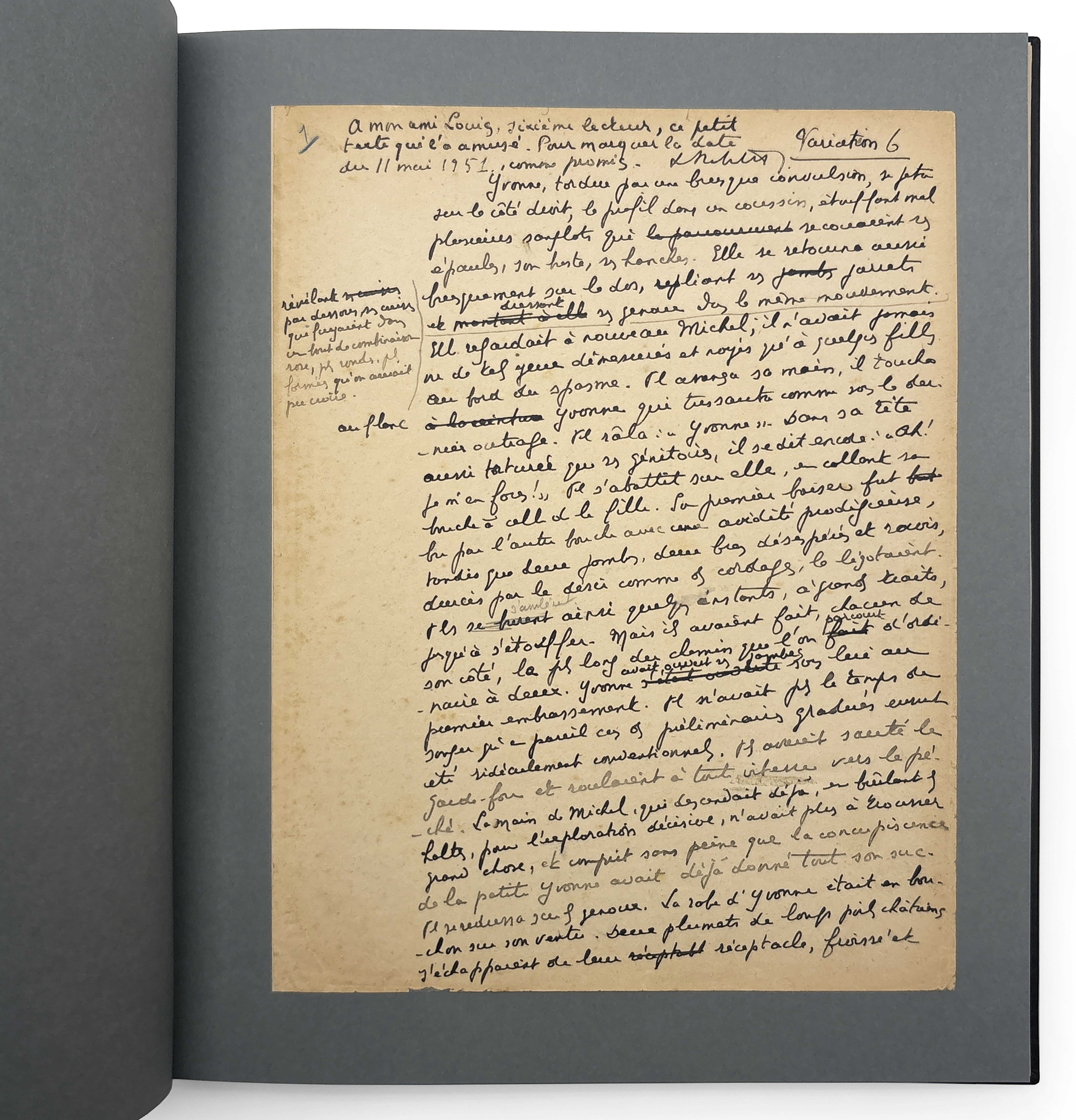
Autograph manuscript signed « LRebatet »
[Clairvaux prison], May 1951, 30 p. in-4° in black ink
« I fucked Yvonne this afternoon, I took her virginity, I screwed her… I meant no harm; I’d been very aroused the day before. »
Autograph manuscript signed « LRebatet »
[Clairvaux prison], May 1951, 30 p. in-4° in black ink
Written on rectos only; each page appears on the verso of accounting slips or financial statements from the prison administration, all bearing the letterhead of the Ministry of Justice.
Minor fraying and very slight marginal losses, without impact on the text.
A first draft, featuring numerous deletions, revisions, overwriting, and marginal additions in Rebatet’s hand.
Each leaf numbered in blue typographic pencil in the upper left corner.
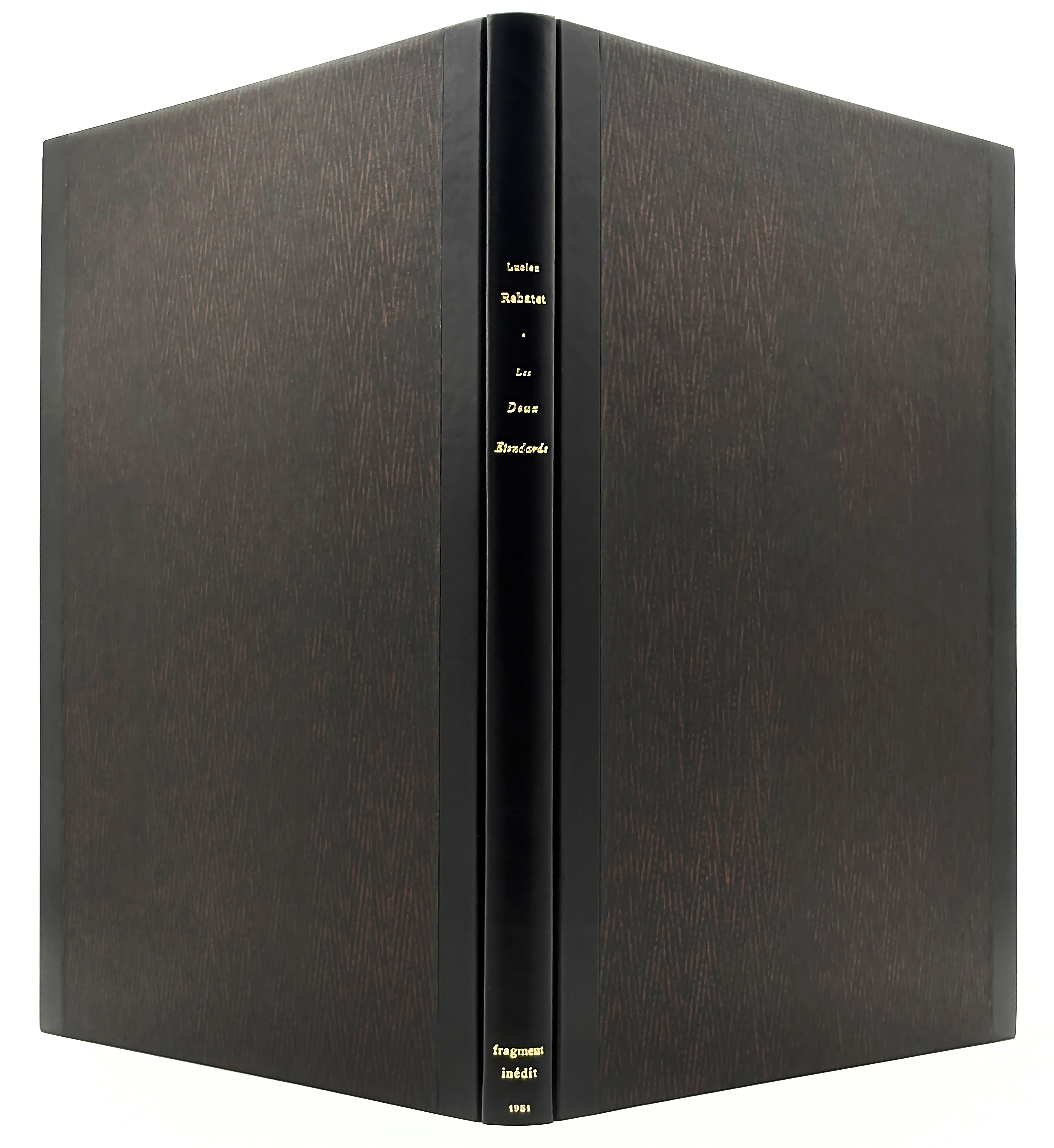
Each leaf mounted on a guard, bradel binding in half-calf, gilt title on the spine
Mystical Equation and Carnal Pleasures: a licentious and entirely unpublished epilogue to Les Deux Étendards, one of the major novels of the postwar period
« There are two kinds of men: those who have read Les Deux Étendards, and those who have not. » (François Mitterrand)
The only known fragment of the novel currently in private hands
Les Deux Étendards was published by Gallimard in 1952. Despite the support of Paulhan, it achieved limited circulation due to the author’s collaborationist commitment and virulently antisemitic positions during the Occupation. Begun in Sigmaringen, the work was completed in prison at Clairvaux in 1951.
Largely autobiographical in inspiration, the novel portrays the Lyonnais bourgeoisie of the 1920s. It centres on a love rivalry between two friends: Régis Lanthelme, who intends to enter the Society of Jesus and is modelled on François Varillon, and Michel Croz, a militant agnostic inspired by Rebatet himself. Both are in love with the same young woman, Anne-Marie Villard, based on Simone Chevallier.
In his narrative, Rebatet magnifies and idealises a past that was, in reality, less flattering. In his article “Les Deux Étendards: libération, masturbation, profération” (Les Deux Étendards – Le Chef-d’œuvre inconnu de Lucien Rebatet, ed. Y. Reboul, Roman 20-50, 2017), Jean-François Louette notes: “at the end of his relationship with Simone, Rebatet was still a virgin […] the aim [in the novel] is to correct or compensate for lived experience […] to relive, intensify, and reshape memory: in Paris, Michel has already known more than one woman; Rebatet regrets not having had Simone (as Stendhal would put it): Michel not only possesses her (as Anne-Marie), and brings her to pleasure, but is depicted as having the luxury of turning down several ready conquests (his cousin Marie-Louise, Yvonne Ageron, a voluptuous redhead at the Carlton Hotel).”
The present manuscript is a highly erotic variation, in the form of an epilogue, on an episode from Chapter XV of the novel, entitled “L’Équation mystique.” In the published version, Régis and Anne-Marie, who share a mystical relationship, introduce Michel to Anne-Marie’s friend Yvonne, hoping that the two might form a similar bond.
The equation is presented as follows: “R + A.M. = infinity / Y + M = R + A.M. / therefore Y + M = infinity.”
Although Michel struggles to take his friends’ project seriously and feels no attraction to Yvonne, he gradually realises—almost despite himself—that she desires him sexually. This excites him, though he ultimately manages to restrain himself.
In this alternative ending, however, Rebatet accelerates the narrative dramatically. In the published text, Michel and Yvonne control their impulses and do not enter into a physical relationship. Moreover, several hundred pages elapse before Régis and Anne-Marie separate, Michel sleeps with Anne-Marie, and eventually becomes a writer. In this unpublished epilogue, Michel yields to Yvonne’s unmistakable desire, and the equation becomes: “A.M. + R = infinity, but Y = M = M/Y!” Rebatet gives free rein to a form of sexual frenzy between the two characters, who, unable to resist temptation, repeat their encounters five times in the same afternoon.
Michel even mocks his friend Régis, who is both disgusted and jealous: “I fucked Yvonne this afternoon, I took her virginity, I had her… I meant no harm; I’d been very aroused the day before.”
At the head of the manuscript, Rebatet inscribes a dedication to Louis Barellon (1915–1993): “To my friend Louis, sixth reader, this little text which amused him. To mark the date of 11 May 1951, as promised. L. Rebatet.” This dedication is surprising, as Barellon does not appear in the author’s biography or in any study devoted to him. However, a letter from Rebatet to Barellon dated 1954 survives, in which he describes him as “a big fellow from Saint-Étienne.” In any case, the two men were clearly close enough for Barellon to become the dedicatee of this erotic fantasy. They likely met in Fresnes prison or at Clairvaux.
An officer in the French Milice, Barellon enlisted on orders in 1943 in the 1st Régiment de France, where Darnand placed his informants. He took part in numerous anti-resistance operations in Haute-Savoie before being appointed deputy departmental head of the Milice in the Jura in February 1944. Retreating to Germany as Allied forces advanced, he joined the Waffen-SS in November 1944. Captured in Bolzano, northern Italy, in May 1945, he was severely sentenced by the Besançon court of justice the following year. He was among the last to be pardoned and was released in 1955.
The manuscript and the typescript of Les Deux Étendards, along with Rebatet’s complete manuscript archives, were bequeathed to IMEC by Nicolas d’Estienne d’Orves, the author’s rights holder. In addition to the novel manuscript, around one hundred pages survive, constituting the original epilogue later discarded by Rebatet. This first alternative ending has also been discussed in an article by Pascal Ifri (“L’épilogue sartrien des Deux Étendards: a presentation of the novel’s original ending”). The present corpus of thirty pages therefore remains, to this day, the only known fragment of the novel still in private hands.
Join our mailing list and be the first to hear our latest news and biggest announcements.
By signing up you agree to our privacy policy. You can unsubscribe at any time.