Keep ahead of the pack
Join our mailing list and be the first to hear our latest news and biggest announcements.
By signing up you agree to our privacy policy. You can unsubscribe at any time.
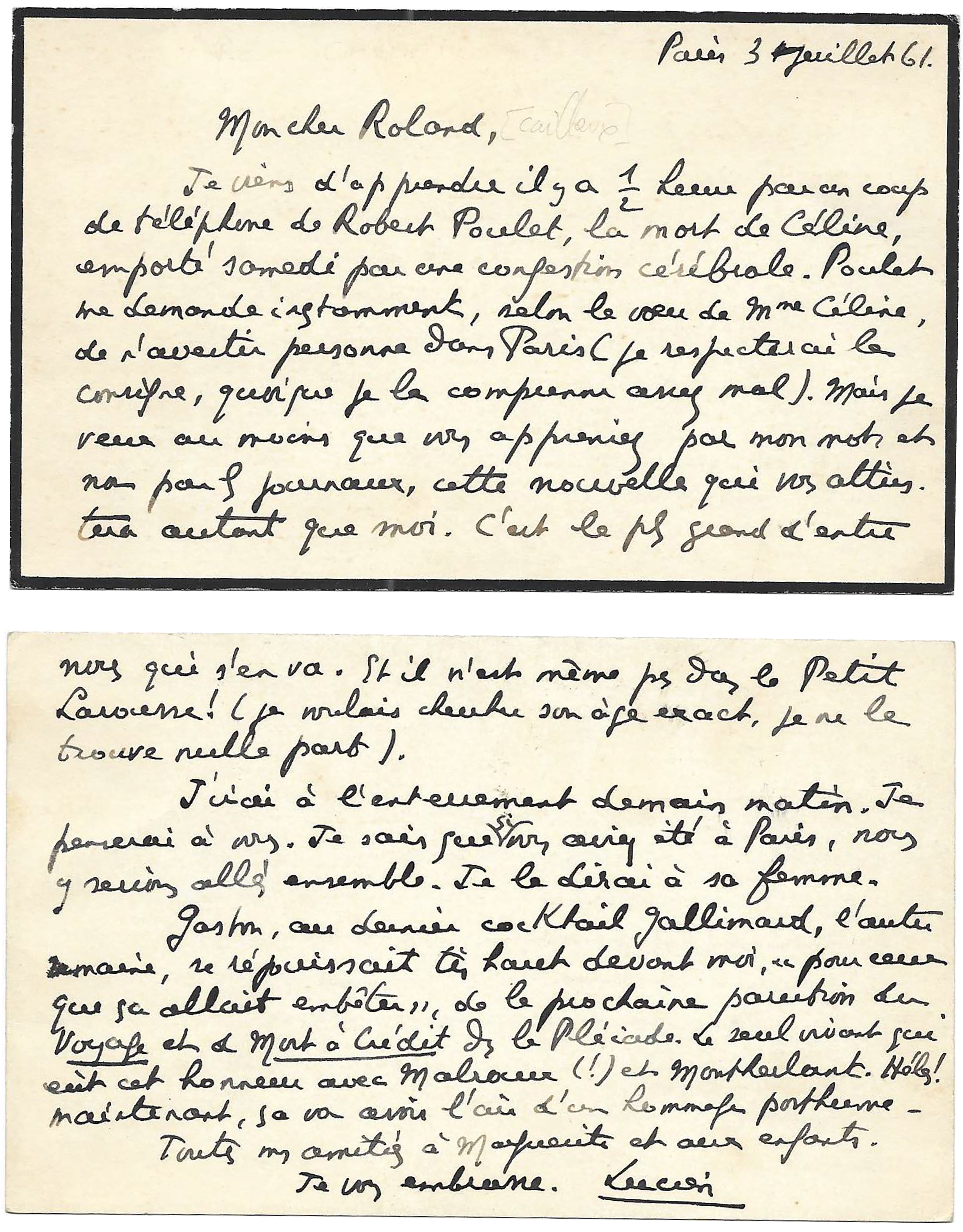
Autograph card signed « Lucien » to Roland [Cailleux]
Paris, 3rd July 1961, 2 p. small in-12° written on both sides
« The greatest among us is gone…»
Autograph card signed « Lucien » to Roland [Cailleux]
Paris, 3rd July 1961, 2 p. small in-12° written on both sides
On thick paper, small mourning border
Exceptional testimony by Rebatet reacting to the death of his friend Céline
« Mon cher Roland,
Je viens d’apprendre il y a 1/2 heure par un coup de téléphone de Robert Poulet, la mort de Céline, emporté samedi d’une congestion cérébrale. Poulet me demande instamment, selon le vœu de Mme Céline [Lucette Destouches], de n’avertir personne dans Paris (je respecterai la consigne, quoique je la comprenne assez mal). Mais je veux au moins que vous appreniez par mon mot et non par les journaux, cette nouvelle qui vous attristera autant que moi. C’est le plus grand d’entre nous qui s’en va. Et il n’est même pas dans le Petit Larousse ! (Je voulais chercher son âge exact, je ne le trouve nulle part).
J’irai à l’enterrement demain matin. Je penserai à vous. Je sais que si vous aviez été à Paris, nous y serions allés ensemble. Je le dirai à sa femme.
Gaston, au dernier cocktail Gallimard, l’autre semaine, se réjouissait très haut devant moi, « pour ceux que ça allait embêter », de la prochaine parution du Voyage et de Mort à Crédit dans la Pléiade. Le seul vivant qui eût cet honneur avec Malraux (!) et Montherlant. Hélas ! Maintenant, ça va avoir l’air d’un hommage posthume.
Toutes mes amitiés à Marguerite et aux enfants.
Je vous embrasse
Lucien »
The death of Céline:
Louis-Ferdinand Céline died at his home in Meudon on 1 July 1961, most likely from cerebral atherosclerosis, leaving his wife Lucette Destouches a widow. He was buried in great secrecy at the cemetery of Longs Réages on 4 July, in the presence of his daughter Colette Destouches, Roger Nimier, Marcel Aymé, Claude Gallimard, Max Revol, Jean-Roger Caussimon, Renée Cosima, Lucien Rebatet, as well as journalists André Halphen and Roger Grenier.
The Pléiade editions:
The Pléiade series was one of Céline’s principal obsessions in the final years of his life. This “famous idea,” first expressed as early as 1956, recurs repeatedly in his correspondence with Gaston Gallimard: “Old men, as you know, have their quirks. Mine are to be published in the ‘Pléiade’ and in your paperback series… I shall not cease, I have asked you twenty times already.” (letter to Gaston Gallimard, 24 October 1956). This wish would be fulfilled a year after his death.
Intersecting trajectories:
Lucien Rebatet’s admiration for Journey to the End of the Night and Death on the Installment Plan also extended to Céline’s antisemitic pamphlets, which he received with enthusiasm. The ideological proximity of the two men during the Occupation brought them together beyond their respective literary talents. When Céline published Les Beaux Draps in 1941, his fourth and final pamphlet, Rebatet reinforced this line the following year with Les Décombres, published by Denoël (the same publisher as Céline’s works).
The two writers later met in Sigmaringen, in the collapsing atmosphere of the Reich after the Allied advance. Céline resumed his medical practice, while Rebatet, a devoted music lover, worked as a music teacher. Whereas Céline eventually managed to flee to Denmark, the author of Les Décombres was arrested in Feldkirch, Austria, on 8 May 1945.
A Belgian far-right journalist and activist, Robert Poulet was the publisher of Le Pont de Londres, the second part of Guignol’s Band, published in 1964. Céline would later write of him in the opening of Rigodon: “I can see Poulet is giving me the cold shoulder… Poulet Robert, condemned to death… he doesn’t talk about me in his columns anymore… once I was the great this… the incomparable that… now just an occasional little word, rather dismissive. I know where it comes from, that we had a falling-out… in the end he was pissing me off, always beating around the bush!… are you sure your convictions don’t lead you back to God!”
In his diary, Rebatet takes up again the following day (4 July) part of the material from his letter to Roland Cailleux and provides further details about the circumstances of Céline’s burial:
“We have just returned from Céline’s funeral. He died on Saturday around 6 p.m., of a cerebral congestion. Since the morning, he had been feeling even more unwell than usual; his nerves were on edge. He lay down for a moment and said to Lucette:
– I’m going to die.
To which Lucette replied, with her usual serene expression:
– You say that every day.
– No, this time I feel I’m going to die.
Shortly afterwards, he lost consciousness, and within twenty minutes, it was all over.
I only learned of his death last night by telephone from Robert Poulet. Lucette was absolutely determined that the news remain as secret as possible, so that the packs of journalists would not be alerted. She was right. This morning there were only about thirty of us friends (for literature: Roger Nimier, Marcel Aymé, Robert Poulet, Claude Gallimard and myself). And this almost clandestine funeral was an extraordinary Célinian scene. The coffin was placed in his bedroom, next to the open door of the bathroom. One could see the sink, the towels, and, turning one’s head the other way, Louis-Ferdinand’s clothes—his five or six worn-out Canadian jackets—hanging in a heap on a coat rack. Lucette would have wanted a mass (Céline did not care; he would have preferred a pauper’s grave), but the priest of Bas-Meudon refused. He also refused to send a nun to perform his last washing.
We therefore went straight to the cemetery of Vieux-Meudon. At that very moment, a light drizzle began to fall, as if illustrating Death on Credit. It was truly striking, because barely had we left the cemetery when the sun reappeared over this heterogeneous suburb. We all felt that it was entirely in keeping with the spirit of the times that the greatest French writer of today should be buried in this way, on the quiet, by a handful of friends, far more modestly than a concierge.” (Journal of L. Rebatet, notebook XX, pp. 334–335; cited in L.-F. Céline et Karl Epting by F. R. Hausmann, Éditions du Bulletin célinien, 2008.)
Provenance:
Private collection
Join our mailing list and be the first to hear our latest news and biggest announcements.
By signing up you agree to our privacy policy. You can unsubscribe at any time.