Keep ahead of the pack
Join our mailing list and be the first to hear our latest news and biggest announcements.
By signing up you agree to our privacy policy. You can unsubscribe at any time.
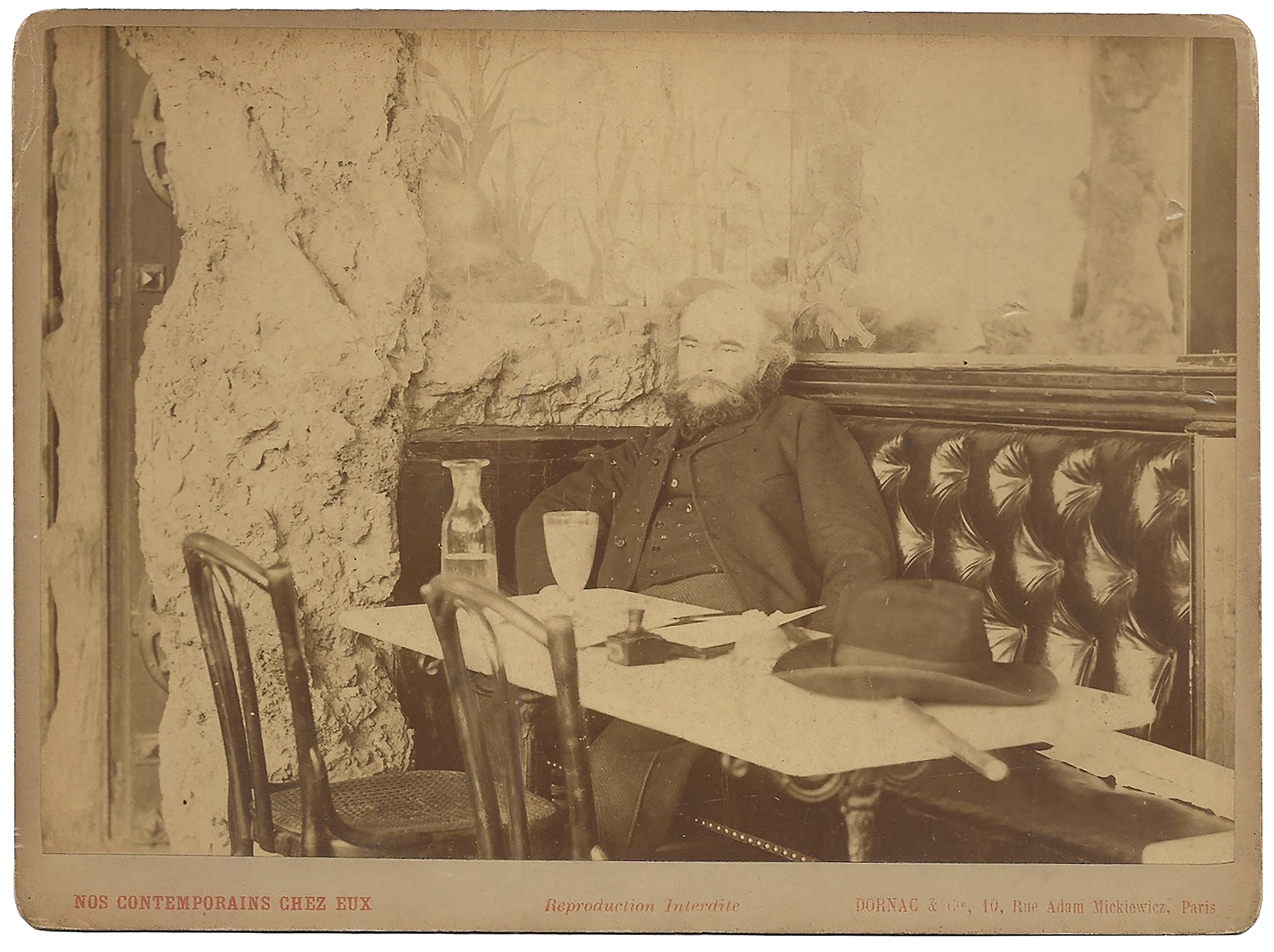
Original photograph of Paul Verlaine by Paul Cardon, known as Dornac
[Paris, 28 May 1892], approx. 13.5 x 18 cm
Iconic portrait of Verlaine, slumped on a bench at the Café François Ier, in front of a large glass of absinthe
Original photograph of Paul Verlaine by Paul Cardon, known as Dornac
Period albumen print, mounted on heavy card (approx. 14 x 19 cm), captioned “Nos Contemporains chez eux” with the imprint “Dornac & Cie, 10 rue Adam Mickiewicz”
[Café François 1er, boulevard St Michel, Paris, 28 May 1892], 135 x 180 mm
Some flaws to the print (see scan), faded contrast, browning to the mount, creasing and imperfections to the margins
Iconic portrait of Verlaine, slumped on a bench at the Café François Ier, in front of a large glass of absinthe
Verlaine’s gaze appears slightly clouded; on the table, beside a large glass of absinthe, lie a few sheets of paper, an inkwell, his cane and his hat.
This photograph immortalises Verlaine in one of the cafés of the boulevard Saint-Michel, where he was a regular and received writers, friends and curious onlookers.
“The Café François Ier on the boulevard Saint-Michel is the meeting place of poets. When one does not find Verlaine there, absorbed over his absinthe or his rum and water, one at least has the chance of seeing Jean Moréas, proud as the swordsman he describes in his verse” (W.G.C. Bijvanck, Un Hollandais à Paris en 1891, cited by B. Noël, “Profils méconnus de Paul Verlaine,” Histoires littéraires n° 59-60).
In the late 1880s, Dornac undertook a series of portraits of the celebrities of his day entitled Nos contemporains chez eux.
Verlaine’s sitting at the Café François Ier took place on 28 May 1892. The photographer took three photographs of the poet seated at his table in the establishment. This image is closely related to another showing the poet at a different spot on the bench, with a glass of wine in front of him instead of a glass of absinthe. Such staging inevitably calls to mind Verlaine’s fellow so-called “poètes maudits,” among them Baudelaire and Rimbaud. Alcohol and spleen are recurring motifs in their respective works. It is thus hardly surprising that Verlaine should play on this, as if echoing his own creative output.
Iconography:
Ruchon, LXXXVI ; Noël, « Profils méconnus de Paul Verlaine », in Histoires littéraires, juillet-décembre 2014, vol. XV, n° 59-60, p. 203-211 ; Verlaine, Rimbaud, Mallarmé, Galantaris, catalogue raisonné d’une collection, 2000, p. 360-361
Join our mailing list and be the first to hear our latest news and biggest announcements.
By signing up you agree to our privacy policy. You can unsubscribe at any time.