Keep ahead of the pack
Join our mailing list and be the first to hear our latest news and biggest announcements.
By signing up you agree to our privacy policy. You can unsubscribe at any time.
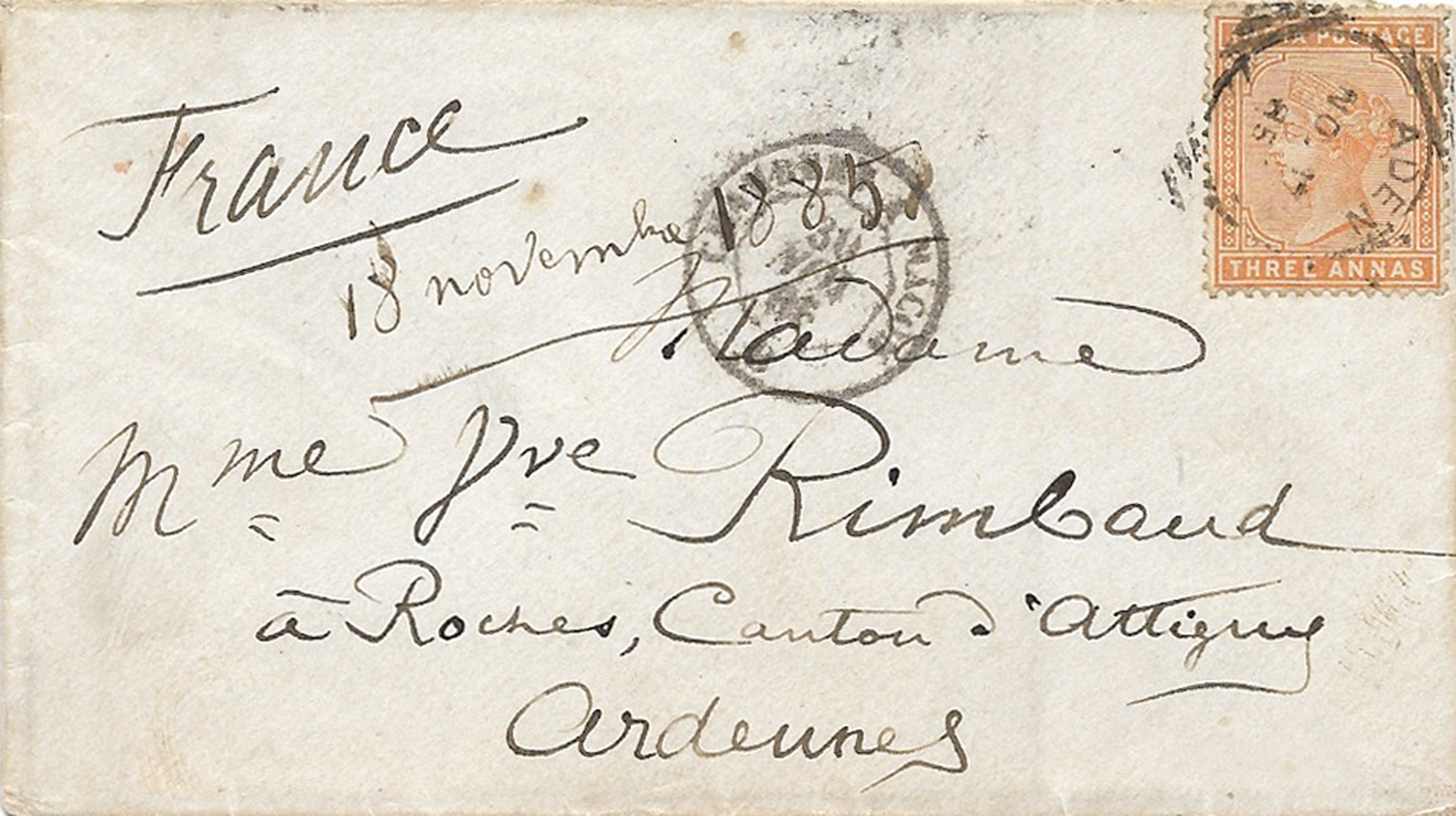
Autograph letter signed « Rimbaud » to his family
Aden, 10th September 1884, 4 pp. in-8° on laid paper
« Every man is a slave to this miserable fate »
Autograph letter signed « Rimbaud » to his family
Aden, 10th September 1884, 4 pp. in-8° on laid paper
Supplied with bespoke leather maroquin sleeve
From the Bernard Loliée collection
Steeped in fatalism, Arthur Rimbaud bears witness to his difficult life in Aden
One of his most significant travel letters still in private hands
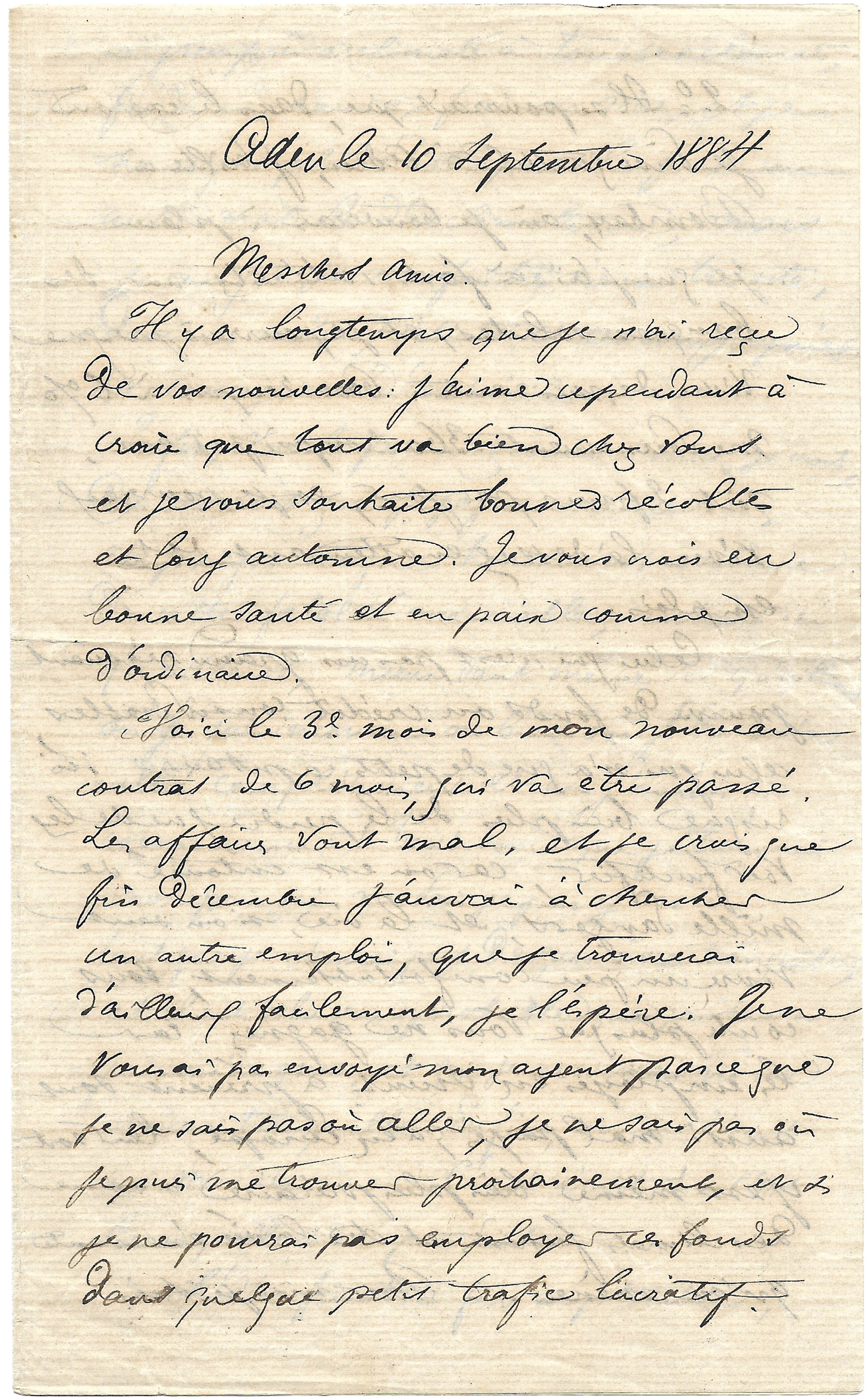
« Mes chers amis,
Il y a longtemps que je n’ai reçu de vos nouvelles : j’aime cependant à croire que tout va bien chez vous et je vous souhaite bonnes récoltes et long automne. Je vous crois en bonne santé et en paix comme d’ordinaire.
Voici le troisième mois de mon nouveau contrat de six mois, qui va être passé. Les affaires vont mal, et je crois que fin décembre j’aurai à chercher un autre emploi, que je trouverai d’ailleurs facilement, je l’espère. Je ne vous ai pas envoyé mon argent parce que je ne sais pas où aller, je ne sais pas où je puis me trouver prochainement, et si je ne pourrai pas employer ces fonds dans quelque petit trafic lucratif.
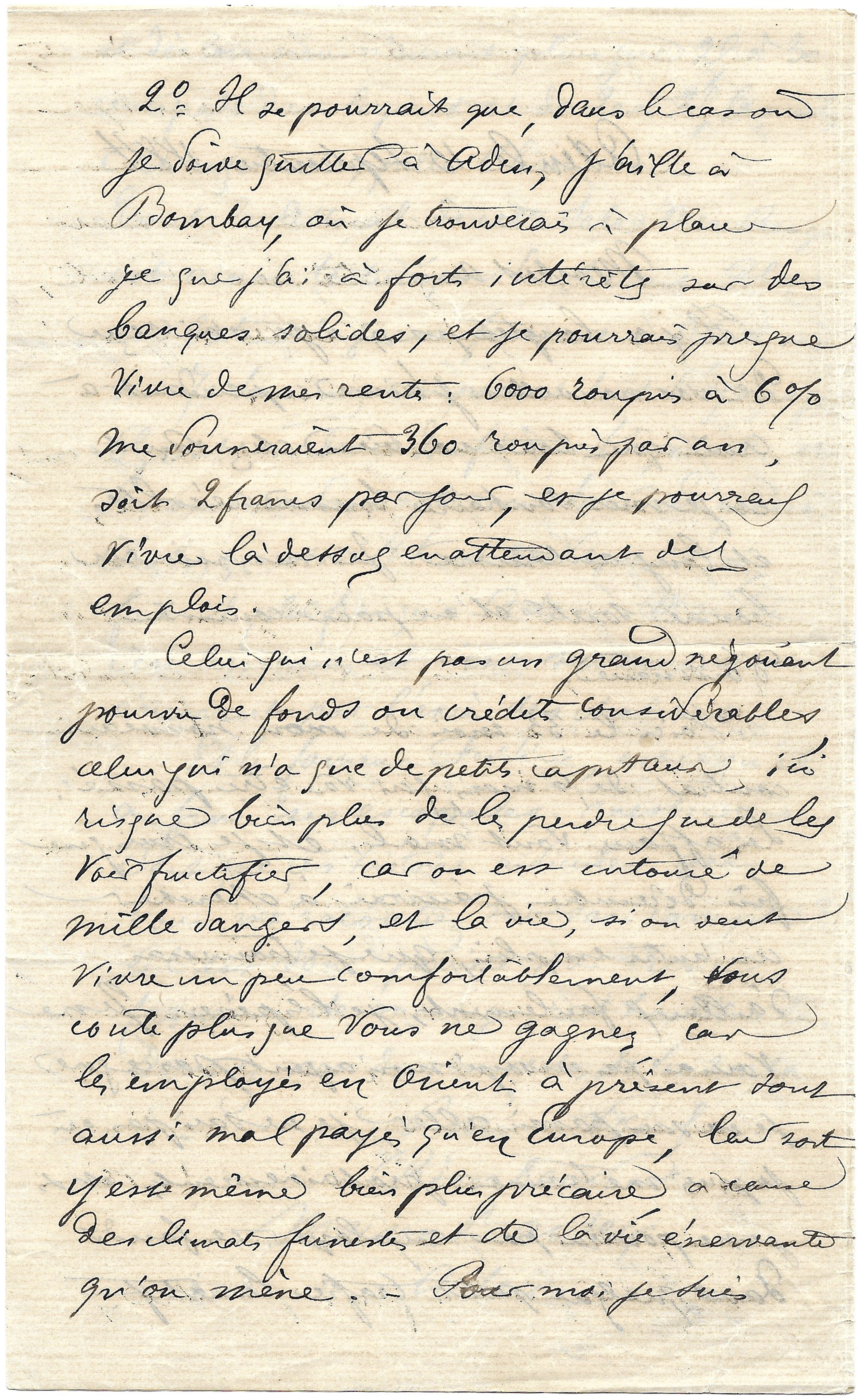
2° Il se pourrait que, dans le cas où je doive quitter à Aden, j’aille à Bombay, où je trouverai à placer ce que j’ai à fort intérêt sur des banques solides, et je pourrai presque vivre de mes rentes : 6.000 roupies à 6% me donnerait 360 roupies par an, soit 2 francs par jour, et je pourrais vivre là-dessus en attendant des emplois.
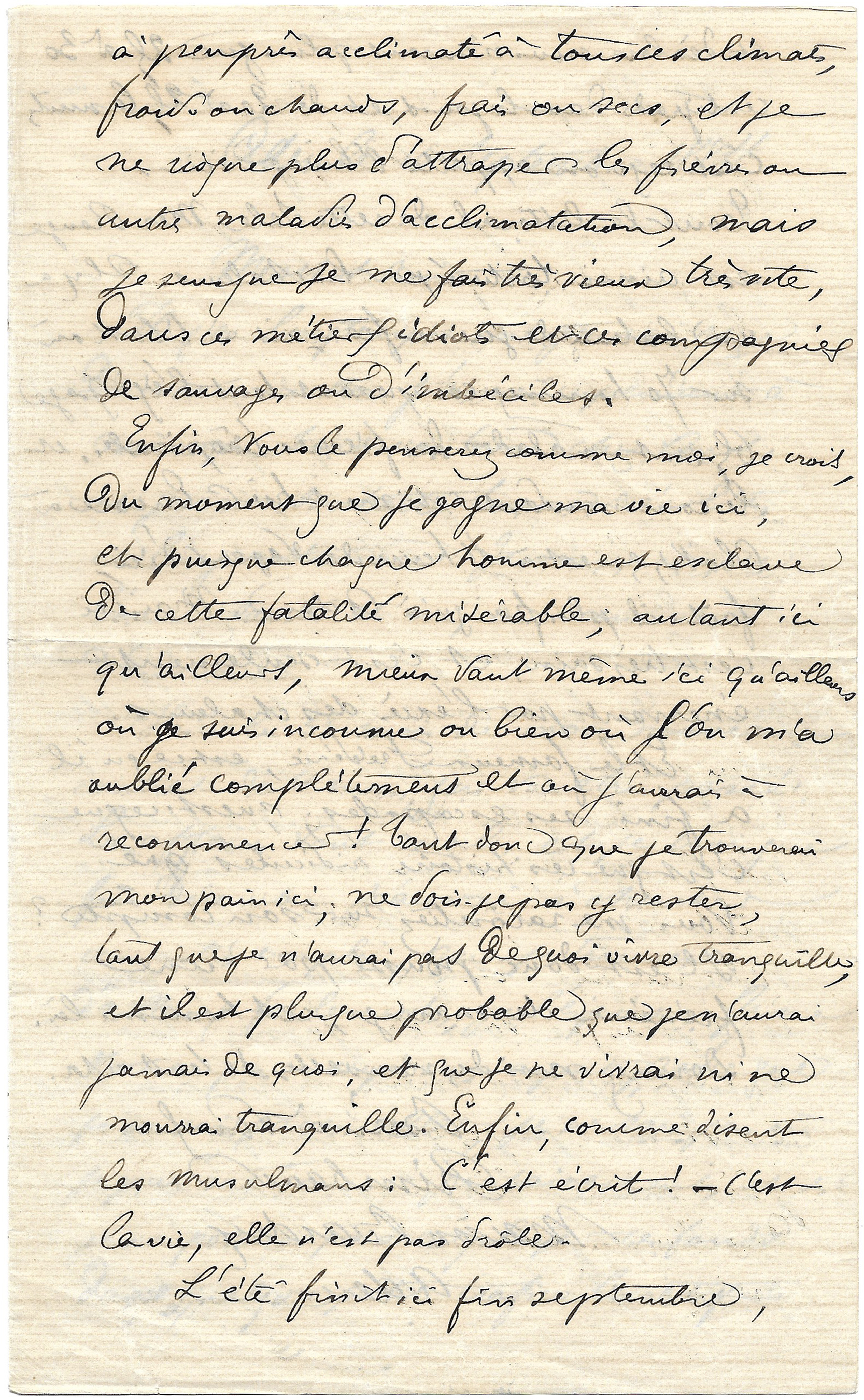
Celui qui n’est pas un grand négociant pourvu de fonds ou crédits considérables, celui qui n’a que de petits capitaux, ici risque bien plus de les perdre que de les voir fructifier, car on est entouré de mille dangers, et la vie, si on veut vivre un peu confortablement, vous coûte plus que si vous ne gagnez, car les employés en Orient à présent son aussi mal payés qu’en Europe, leur sort u est même bien plus précaire, à cause des climats funestes et la vie énervante qu’on mène. – Pour moi je suis à peu près acclimaté à tous ces climats, froids ou chauds, frais ou secs, et je ne risque plus d’attraper les fièvres ou autres maladies d’acclimatation, mais je sens que je me fais très vieux très vite, dans ces métiers idiots et ces compagnies de sauvages ou d’imbéciles.
Enfin, vous le penserez comme moi, je crois, du moment que je gagne ma vie ici, et puisque chaque homme est esclave en cette fatalité misérable, autant ici qu’ailleurs où je suis inconnu ou bien où l’on m’a oublié complètement et où j’aurai à recommencer ! Tant donc que je trouverai mon pain ici, ne dois-je pas y rester, tant que je n’aurai pas de quoi vivre tranquille et il est plus que probable que je n’aurai jamais de quoi, et que je ne vivrai ni ne mourrai tranquille. Enfin, comme disent les musulmans : C’est écrit ! – C’est la vie, elle n’est pas drôle.
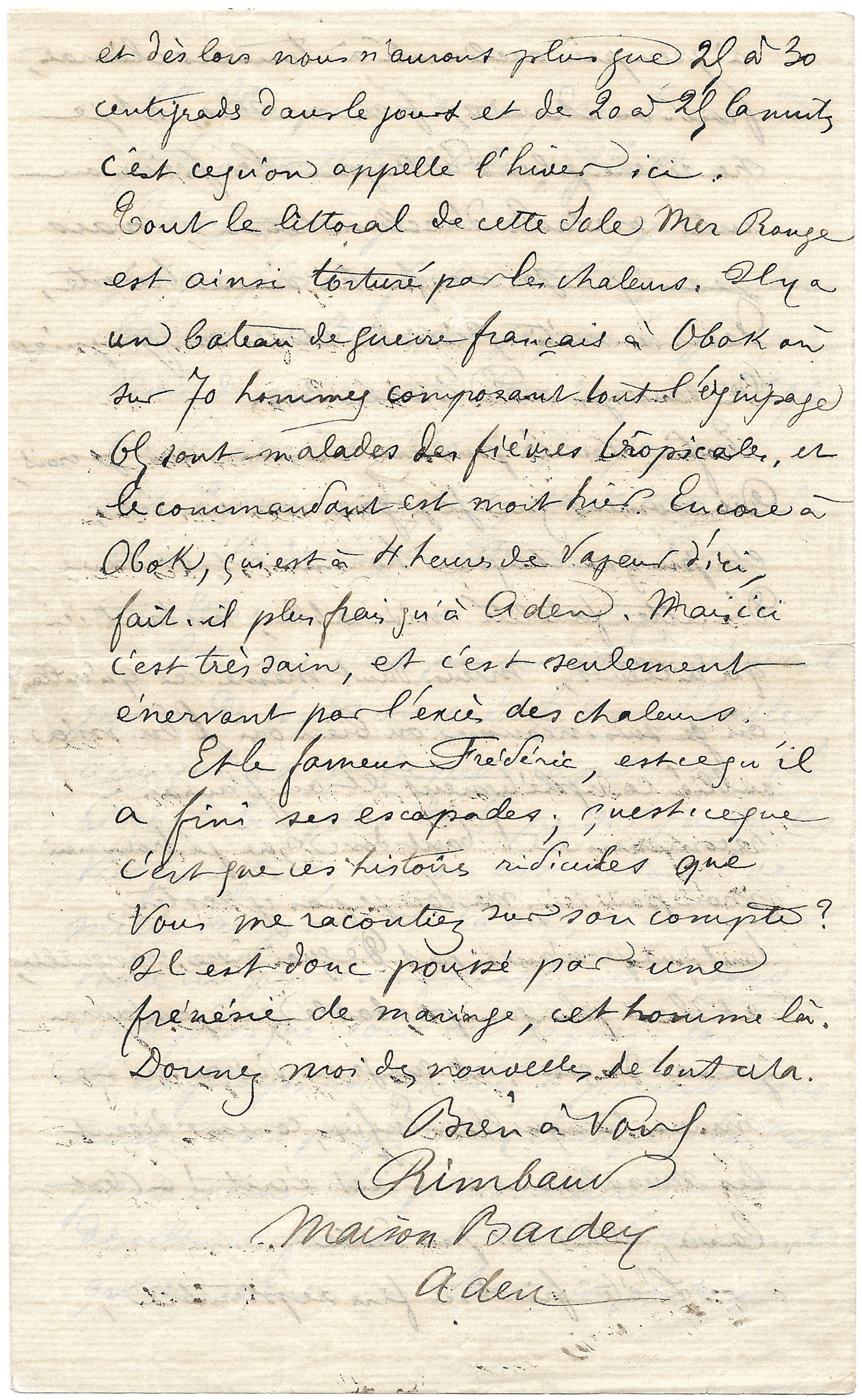
L’été finit ici fin septembre, et dès lors nous n’aurons plus que 25 à 30 centigrades dans le jour et de 20 à 25 la nuit, c’est ce qu’on appelle l’hivers ici. Tout le littoral de cette sale mer Rouge est ainsi torturé par les chaleurs. Il y a un bateau de guerre français à Obok où sur 70 hommes composant tout l’équipage 65 sont malades des fièvres tropicales, et le commandant est mort hier. Encore à Obok, qui est à quatre heures de vapeurs d’ici, fait-il plus frais qu’à Aden. Mais ici c’est très sain, et c’est seulement énervant par l’excès des chaleurs.
Et le fameux Frédéric, est-ce qu’il a fini ses escapades ; qu’est-ce que c’est que ces histoires ridicules que vous me racontiez sur son compte ? Il est donc poussé par une frénésie de mariage, cet homme-là. Donnez-moi des nouvelles de tout cela.
Bien à vous,
Rimbaud.
Maison Bardey, Aden. »
Rimbaud leaves Harar at the beginning of March: the city where he had been working had become “uninhabitable because of the troubles of the war” (letter to his family, April 24, 1884). After six weeks of “travels through the deserts” (same letter), he arrives in Aden, Yemen, around April 20. The Bardey house, which employed him, had experienced severe financial difficulties and closed both its trading posts, in Harar and Aden. For several months, he lives off his savings: according to a letter to his family on May 5, he had set aside “twelve or thirteen thousand francs.” The situation improves in the second half of May. His employer, Alfred Bardey, had gone to Marseille to secure funds, and business was set to resume. By mid-June, Rimbaud and Bardey sign a new contract binding them for six months, from July 1 to December 31, 1884.
The heat in Aden during the summer months is unbearable. Europeans unaccustomed to it fall ill. Rimbaud resists. The hardy Ardennais has retained his resilience, and the expatriate his capacity for acclimatization. Yet homesickness catches up with him. He eagerly awaits letters from France, and correspondence seems painfully slow across the continents. In the present letter addressed to his family, he inquires about the “end-of-summer harvests”: as every year, his mother, Vitalie, and his sister, Isabelle, had undertaken the seasonal transhumance to work in the fields, traveling from their residence in Charleville to their estate in Roche, some forty kilometers away. It is there, in September 1884, that they inform Rimbaud of their activities.
Above all, this letter is striking for the sense of complete fatalism it conveys. As if compelled to draw conclusions from everything he recounts to his family, from all that he endures in the regions where he came hoping to earn a living, Rimbaud, somewhat detached from the practical, commercial, and climatic issues he describes, expresses what he understands about life, about the meaning of life: “every man is a slave to this miserable fate,” from which, here or elsewhere, one cannot escape. This sense of fatalism, and of the “miserable fate,” articulated here far from Europe, had already been expressed in the major programmatic text Une saison en enfer. And however radical the rupture and however real the distance for someone seeking to flee all feeling and philosophical inheritance, the idea of man as “slave” to fate returns to him like Cain’s eye, whose presence he had observed “as much here as elsewhere.”
“I abhor misery,” Rimbaud wrote in the “Farewell” of Une saison en enfer. At that time, he imagined he could free himself from Christian law, from the curse of his baptism. Life, misery, and fate had caught up with him, so that all he could do was cite the credo of another religion, that “of the Muslims”: “It is written.” He remained the godless man he had been since adolescence, except when it came to understanding what religions say about universal misery and the tragic destiny of every human creature.
Since there is nothing but “life,” and since it is “not pleasant,” one might as well live “here as elsewhere,” Rimbaud writes, adding: “even better here than elsewhere.” But does he truly believe this? The attention he pays to his family, to all that he has left behind and from which, according to a well-known existential paradox, distance brings him closer, suggests another sentiment. One knows this terrible logic of nostalgia, celebrated by the Romantics, which is merely a way of experiencing dissatisfaction: the fir tree, in the snow, dreams of the Oriental sun, the Egyptian palm of northern frost. This is Rimbaud’s sense of life, which this letter, and its seemingly casual treatment of human misery, reveals.
Hence the attention he gives to his family, to the activities of his mother and sister, whom he has taken to addressing in the masculine as “dear friends,” as if the circle to which his letters are addressed were naturally to be enlarged. His attention extends to fieldwork, to the harvests, and to the erratic behavior of his brother, Frédéric, his elder by just under a year: Frédéric was born on November 3, 1853, Arthur on October 20, 1854.
At the end of the letter—in cauda venenum—Rimbaud speaks unflatteringly of his brother, “the famous Frédéric,” as he calls him with scornful irony: “famous” in the sense that the younger brother knows what to expect from the elder, and also in the sense that Frédéric’s reputation burdens him: “it would bother me quite a lot, for example, if people knew I had such a bird for a brother,” he wrote in another letter to his family on October 7 of the same year.
Frédéric seeks to marry at all costs. Rimbaud himself, when imagining a happy future, contemplates marriage. But Frédéric makes a fool of himself. He strives to the point of appearing “possessed by a marriage frenzy.” One must especially imagine that he exercises this frenzy in the lower echelons of Ardennes society, which triggers maternal fury: Vitalie will oppose her eldest son’s marriage with all her strength, even appealing to the courts. Rimbaud may not share such social prejudices, at least in their provincial and bourgeois sense, but he has other reasons to despise his brother, whom he considers ontologically inferior. He takes his mother and sister as witnesses to this atavism: “he is a complete idiot, we have always known it, and we always admired the hardness of his head” (letter of October 7, 1884). One must weigh the significance of this “we” and “always” to grasp the power of a contempt rooted in childhood, and contrast this repudiation of an elder brother, unworthy to replace the absent father, with the image shown in the 1866 photograph taken in Charleville, where the two brothers appear as first communicants, in the deceptive resemblance of their youth, gazing wide-eyed at life’s horizon, a life that would place an insurmountable gulf of incommunicability between them. David Le Guillou has fully captured this incommunicability in a finely narrated essay on “the other Rimbaud,” as he calls Arthur’s brother (L’Autre Rimbaud, Paris, L’Iconoclaste, 2020).
It is understandable that Isabelle, in 1896, when communicating Rimbaud’s letters to her future husband, Paterne Berrichon, omitted the final paragraph of the letter of September 10, 1884, whose published text therefore remained incomplete for a long time. The disagreement with Frédéric was likely settled, but she was reluctant to reveal such family secrets at a time when, after Arthur’s death, Frédéric and his descendants were destined to bear the Rimbaud name.
At the same time, in Paris, a book by Verlaine was published: Les Poètes maudits, by Vanier…
Provenance:
Famille Rimbaud
Bernard Loliée collection
Then private collection
Bibliography:
Œuvres complètes, éd. A. Guyaux, Pléiade, p. 551-552
Correspondance, éd. J-J. Lefrère, Fayard, 2007, p. 400-401
Join our mailing list and be the first to hear our latest news and biggest announcements.
By signing up you agree to our privacy policy. You can unsubscribe at any time.