Keep ahead of the pack
Join our mailing list and be the first to hear our latest news and biggest announcements.
By signing up you agree to our privacy policy. You can unsubscribe at any time.
Autograph manuscript signed « GB » for Tempête dans un bénitier
N.p.n.d. [c. 1976], 1 p. grand in-4°
« O most holy Mary, shit / God, tell those fucking monks / that they’re pissing us off… »
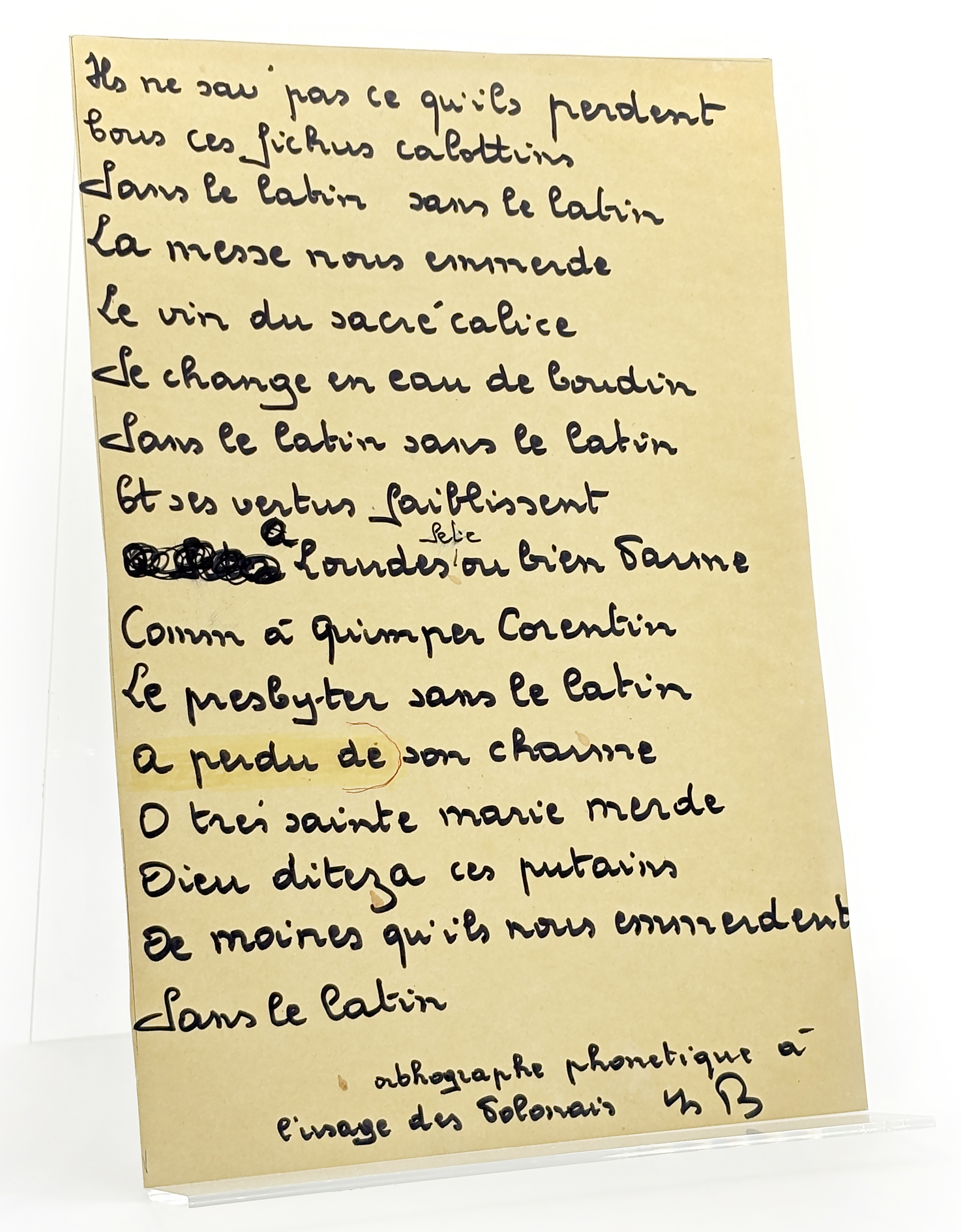
Autograph manuscript signed « GB » for Tempête dans un bénitier
N.p.n.d. [c. 1976], 1 p. grand in-4°
Two words redacted by Georges Brassens in “À Sète,” with one word inserted between the lines in his hand using a fine felt-tip pen.
Three words highlighted with a Stabilo Boss marker, and one typographic annotation in red ink.
Tempête dans un bénitier: the famous refrain from one of his best-known songs, which caused a scandal upon its release
From the Sophie Duvernoy Collection.
« Ils ne sav’ pas ce qu’ils perdent
Tous ces fichus calottins
Sans le latin sans le latin
La messe nous emmerde
Le vin du sacré calice
Se change en eau de boudin
Sans le latin sans le latin
Et ses vertus faiblissent
À Lourdes Sète ou bien Parme
Comm à Quimper Corentin
Le presbyter sans le latin
A perdu de son charme
O très sainte marie merde
Dieu dites à ces putains
De moines qu’ils nous emmerdent
Sans le latin
Orthographe phonétique à l’usage des Polonais
GB »
The third track on his album Trompe-la-mort, recorded in 1976, “Tempête dans un bénitier” (“Tempest in a Holy Water Font”) belongs within the context of the Second Vatican Council, convened at the initiative of Pope John XXIII, of which the song constitutes a biting satire. Through an apparent defence of liturgical Latin, the author adopts an ironic stance intended to mock both the ecclesiastical reforms and their conservative opponents alike. The title itself parodies the French expression tempête dans un verre d’eau (“storm in a teacup”), thereby suggesting the exaggerated nature of the controversies provoked by the reforms.
It should be recalled that Sophie Duvernoy was one of the backing vocalists on this song. The amusing dedication at the bottom of the page to her housekeeper leaves little doubt as to the practical use of this manuscript, which most likely served her during the studio recording sessions, singing from the text in hand.
Georges Brassens also abbreviated the phrase “savent pas” in the opening line to “sav’ pas”, perhaps in order to emphasize the brevity and clipped delivery of the sung passage. In a final provocation, Brassens plays on sound patterns in the lines “O très sainte marie merde / Dieu dites à ces putains…”, transforming the “mère de” (“mother of”) found in the original text into “merde” (“shit”).
A manuscript of the song is preserved at the Espace Georges Brassens (inv. M025).
Provenance: Estate of Sophie Duvernoy (1930–2025)
A discreet yet essential figure within Georges Brassens’s inner circle, Sophie Duvernoy entered his service in 1969 after having worked for the illustrator Raymond Peynet. She referred to Brassens as “the good master” (le bon maître), a nickname he himself had mischievously suggested when they first met. Born in Poland and nine years younger than the singer-songwriter, she was recruited almost by chance when Peynet moved to the South of France. At the time, Brassens was living in the Le Méridien building on Rue Émile-Dubois, alongside neighbours and friends such as Jacques Brel. Sophie subsequently accompanied Brassens when he moved to Rue Santos-Dumont, quickly becoming a stable presence within an environment shaped by the constant visits of friends and figures from the artistic world. A relationship grounded in trust and mutual understanding gradually emerged between these two reserved personalities. At the heart of this domestic space, which had become a place of artistic creation, Sophie Duvernoy assumed a central role, ensuring the conditions necessary for the work of the poet from Sète. Guardian of silence, manager of household affairs, and intermediary with the outside world, she moved in close proximity to Brassens’s creative process without ever disturbing its equilibrium. Her closeness to the artist also found expression in a limited direct participation in his work. She joined the chœur des copains alongside, among others, Claudine Caillart, Fred Mella, Joël Favreau, Pierre Nicolas, and André Tavernier, contributing backing vocals to two songs: “Tempête dans un bénitier” and “Le Roi.” Following the death of her “good master,” she lived in an apartment purchased by Brassens, who had guaranteed her lifetime use of it — a testament to the singular place she occupied both in his daily life and in the immediate orbit of his artistic creation.
Join our mailing list and be the first to hear our latest news and biggest announcements.
By signing up you agree to our privacy policy. You can unsubscribe at any time.