Keep ahead of the pack
Join our mailing list and be the first to hear our latest news and biggest announcements.
By signing up you agree to our privacy policy. You can unsubscribe at any time.
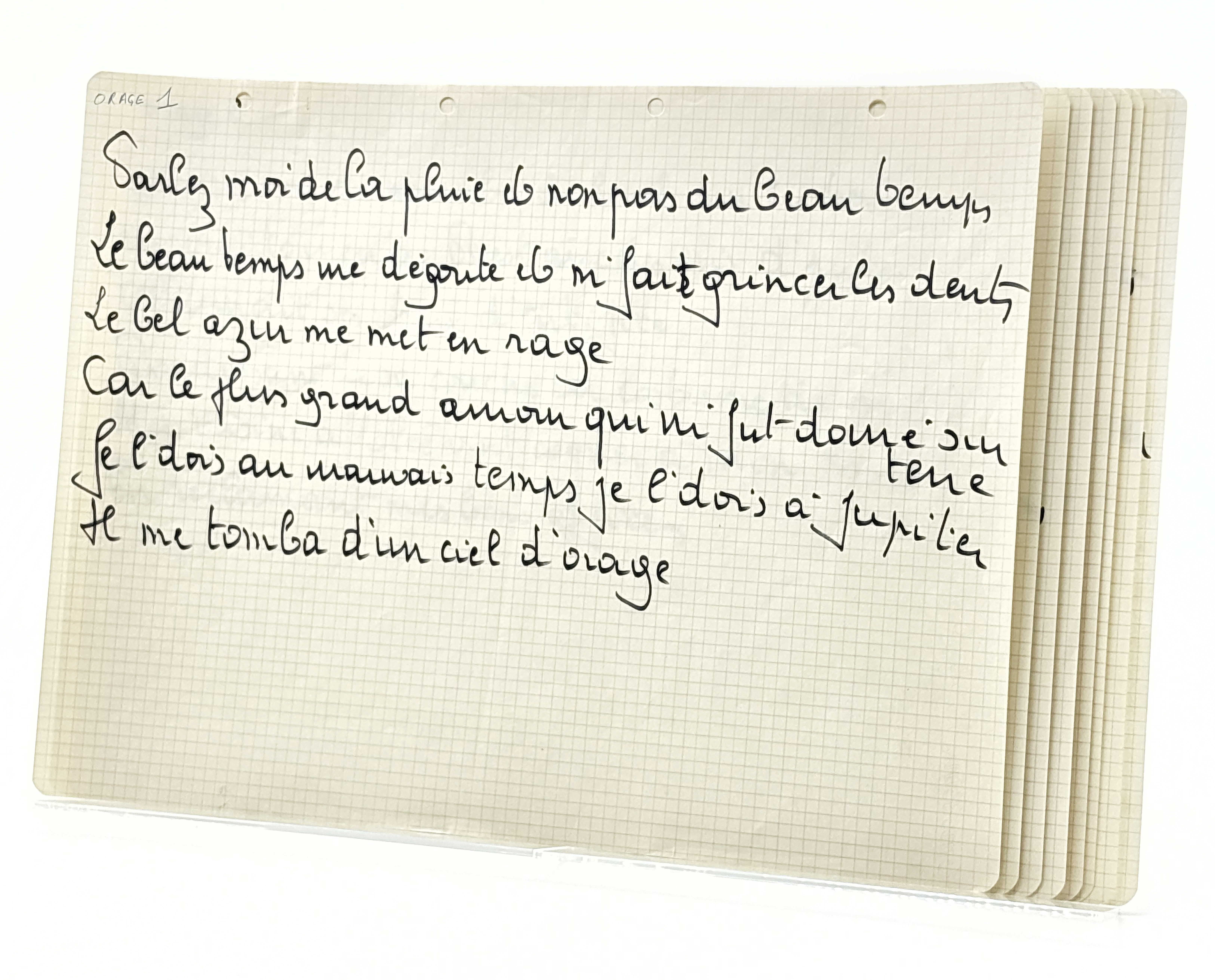
Autograph manuscript for L’Orage
s.l.n.d. [c. 1975], 8 oblong folio leaves (30 × 40 cm)
« Parlez-moi de la pluie et non pas du beau temps / Le beau temps me dégoûte et m’ fait grincer les dents… »
Autograph manuscript for L’Orage
s.l.n.d. [c. 1975], 8 oblong folio leaves (30 × 40 cm) on small-ruled paper, black felt-tip pen.
Binder holes, typographic annotations in another hand on the first and sixth leaves.
Fine condition.
L’Orage, or adultery revisited by Georges Brassens with humour and poetry
Very valuable complete autograph manuscript of one of his most iconic songs
Any admirer of Georges Brassens will immediately recognise the words of the opening stanza of this iconic song:
« Parlez-moi de la pluie et non pas du beau temps / Le beau temps me dégoûte et m’ fait grincer les dents / Le bel azur me met en rage / Car le plus grand amour qui m’ fut donné sur terre / Je l’ dois au mauvais temps, je l’ dois à Jupiter, / Il me tomba d’un ciel d’orage… »
The recording session took place in February 1960 at Studio Blanqui in Paris. The song was then released shortly afterwards on the album Les Funérailles d’antan. For the orchestration, Brassens was accompanied by his faithful double bassist Pierre Nicolas and, on second guitar, Victor Apicella.
Brassens recopied the entire song in full on very large sheets (single-sided). This manuscript may have served as a teleprompter during the television programme Numéro Un, hosted by his friend Marcel Amont on 10 January 1976. Brassens is accompanied there by guitarist Joël Favreau. Filmed in close-up, the Sète-born poet fixes a motionless point, suggesting the presence of a prompter removing the sheets as the performance progresses.
This clean copy contains no errors by the author, except for a slight correction visible on the first sheet, on the second line, where “fais” is changed to “fait”. Brassens also added by hand, in pencil, several circumflex accents on certain words.
Composed without a refrain, the song unfolds solely through narrative verses. This linear construction, based on successive verses and finely paced, reinforces the impression of a “sung tale”, where each element contributes to the progression of the story. Brassens evokes “his love of bad weather and his sudden passion for his neighbour, the wife of a representative for a lightning rod company, who, panicked one stormy evening, came to ask for his assistance…” (1976: le coup de foudre de Georges Brassens, INA).
The work stands out for its playful yet almost didactic character, multiplying cultural references and allusions while maintaining a brisk rhythm and strong formal coherence. The whole gives this accidental adultery scene a more universal dimension, reflecting the fragility of commitments and the contingency of human situations.
The transgenerational success of the song is such that many younger performers have included it in their repertoire, alongside established French and international artists, bringing the total number of recorded interpretations of L’Orage to over one hundred.
Provenance: Estate of Sophie Duvernoy (1930–2025)
A discreet yet essential figure within Georges Brassens’s inner circle, Sophie Duvernoy entered his service in 1969 after having worked for the illustrator Raymond Peynet. She referred to Brassens as “the good master” (le bon maître), a nickname he himself had mischievously suggested when they first met. Born in Poland and nine years younger than the singer-songwriter, she was recruited almost by chance when Peynet moved to the South of France. At the time, Brassens was living in the Le Méridien building on Rue Émile-Dubois, alongside neighbours and friends such as Jacques Brel. Sophie subsequently accompanied Brassens when he moved to Rue Santos-Dumont, quickly becoming a stable presence within an environment shaped by the constant visits of friends and figures from the artistic world. A relationship grounded in trust and mutual understanding gradually emerged between these two reserved personalities. At the heart of this domestic space, which had become a place of artistic creation, Sophie Duvernoy assumed a central role, ensuring the conditions necessary for the work of the poet from Sète. Guardian of silence, manager of household affairs, and intermediary with the outside world, she moved in close proximity to Brassens’s creative process without ever disturbing its equilibrium. Her closeness to the artist also found expression in a limited direct participation in his work. She joined the chœur des copains alongside, among others, Claudine Caillart, Fred Mella, Joël Favreau, Pierre Nicolas, and André Tavernier, contributing backing vocals to two songs: “Tempête dans un bénitier” and “Le Roi.” Following the death of her “good master,” she lived in an apartment purchased by Brassens, who had guaranteed her lifetime use of it — a testament to the singular place she occupied both in his daily life and in the immediate orbit of his artistic creation.
A discreet yet essential figure within Georges Brassens’s inner circle, Sophie Duvernoy entered his service in 1969 after having worked for the illustrator Raymond Peynet. She referred to Brassens as “the good master” (le bon maître), a nickname he himself had mischievously suggested when they first met. Born in Poland and nine years younger than the singer-songwriter, she was recruited almost by chance when Peynet moved to the South of France. At the time, Brassens was living in the Le Méridien building on Rue Émile-Dubois, alongside neighbours and friends such as Jacques Brel. Sophie subsequently accompanied Brassens when he moved to Rue Santos-Dumont, quickly becoming a stable presence within an environment shaped by the constant visits of friends and figures from the artistic world. A relationship grounded in trust and mutual understanding gradually emerged between these two reserved personalities. At the heart of this domestic space, which had become a place of artistic creation, Sophie Duvernoy assumed a central role, ensuring the conditions necessary for the work of the poet from Sète. Guardian of silence, manager of household affairs, and intermediary with the outside world, she moved in close proximity to Brassens’s creative process without ever disturbing its equilibrium. Her closeness to the artist also found expression in a limited direct participation in his work. She joined the chœur des copains alongside, among others, Claudine Caillart, Fred Mella, Joël Favreau, Pierre Nicolas, and André Tavernier, contributing backing vocals to two songs: “Tempête dans un bénitier” and “Le Roi.” Following the death of her “good master,” she lived in an apartment purchased by Brassens, who had guaranteed her lifetime use of it — a testament to the singular place she occupied both in his daily life and in the immediate orbit of his artistic creation.
Join our mailing list and be the first to hear our latest news and biggest announcements.
By signing up you agree to our privacy policy. You can unsubscribe at any time.